When is the clubshaft on plane during the downswing?
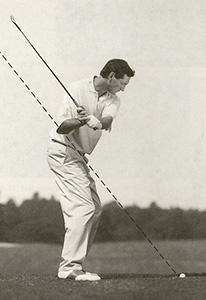
There are many TGMers who would state that the clubshaft is "on plane" when the end of the clubshaft that is nearest to the ground points at the ball-target line (or its extension) at all time-points during the downswing, when it is not parallel to the ground. That means that the clubshaft end should always point at the ball-target line even when it is shifting planes during the downswing. So, for example, many golfers shift planes from the turned shoulder shoulder plane (at the start of the downswing) to the elbow plane (at impact) and HK's "on plane" idea is that the clubshaft end should always point at the ball-target line even while it is shifting planes. However, I presume that this is not an ironclad rule, but a generally useful guideline.
Hank Haney has his own idea of being "on plane". He states that when the clubshaft is on a plane that is above the clubshaft-at-address plane, that the clubshaft should always be parallel to the clubshaft-at-address plane. Therefore, according to Hank Haney's model, when the clubshaft is shifting from the turned shoulder plane to the elbow plane in the downswing, it should always be parallel to the clubshaft-at-address plane. Haney calls these parallel planes "congruent planes".
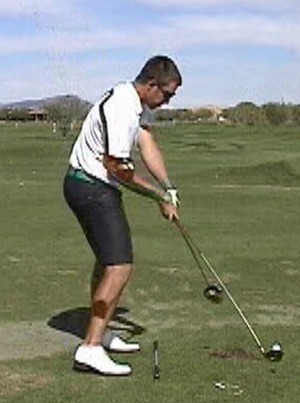
Here is a photo showing Hank Haney demonstrating his parallel clubshaft plane idea.
Note that the butt end of the club doesn't point at the ball-target line, so Hank Haney's idea of being "on plane" is incompatible with HK's idea of being "on plane". It would seem to me that neither Hank Haney or Homer Kelley has an ironclad theoretical justification for their "on plane" theory, and that it is only a rough guideline. It would seem to me that the clubshaft's behaviour will fit in more with Hank Haney's model during the early/mid downswing if the hands (and therefore) clubshaft drops down (groundwards) more per unit time than the left arm rotates counterclockwise per unit time, and that it is individual golfer-dependent. Consider three golfers.
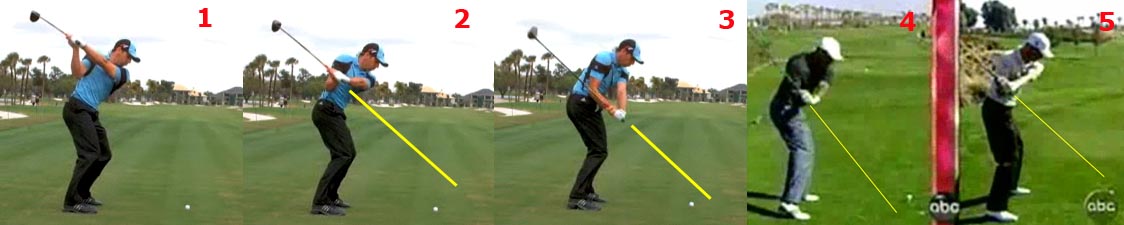
Images 1-3 show Sergio Garcia at varying time-points in the early/mid downswing, and you can see that his clubshaft is nearly parallel to the clubshaft-at-address plane. In other words, he better fits Hank Haney's model simply because his hands drop more per unit time (relative to the degree of left arm counterclockwise rotation per unit time) than the "average" professional golfer. Image 4 shows Tiger Woods and image 5 shows Adam Scott, and neither of their clubshaft-ends precisely points at the ball-target line, but they are closer to the HK model. From my perspective, it only means that their clubshaft is dropping groundwards less per unit time (relative to the degree of left arm counterclockwise rotation per unit time) than Sergio Garcia's clubshaft, and that it is only an individual golfer characteristic.
In other words, there is seemingly no "fixed" rule that specifies how much the hands should drop per unit time (relative to the degree of left arm counterclockwise rotation per unit time) during the downswing. The only critical time point is when the hands reach a below-waist-level position, and at that time point the clubshaft should point at the ball-target line so that the final clubshaft release can be "on plane" (as can be seen in this photo of Aaron Baddeley).
Jeff one problem with pics is unless the camera angle is perfectly square to the player the plane angles will not be precise. Additionally many pros manipulate the hands near impact to get the club on plane. If you look at some of the youtube slo mo videos of Mickelson you can see this just before contact. Hogan really got that right forearm on plane pointing at the ball.
There is "magic" in the right forearm.
Jeff, Until you can forsake the shaft and its visuals you will never get to the exciting essence of TGM.
The sweetspot and PP3 should be on plane...there are times during a swing when they can follow the same plane as the shaft but there are times when there are seperate.
But the key is to FEEL the force and FEEL what on plane is...If you can't feel it with a golf club then use a heavier weighted implement and swing...FEEL the sweetspot in your hands and then draw the lines in your head.
Sorry if that sounds cryptic but there is a level of understanding and appreciation that comes only through feeling. You can do the Math afterwards!
Start to swing heavy things around your body...build a plane board like Homer did...LOOL, LOOK, LOOK....and FEEL , FEEL, FEEL...
Then do it again and again...1 month minimum...
Then wonder why you ever worried about drawing lines on videos which will always be plagued by parallax problems...
I think that this is what VJ was getting at when he replied to you....
I did not have the guts to mention the part about disregarding the shaft. Tough to substitue an imaginary line (sweetspot plane) with an actual line (the clubshaft) I built one of those thingmy-jigs with a length of yarn connecting the pressure point spots on the aft side of the grip with the sweetspot. I went a step further and spray painted the club head, the face and the shaft different colors! Without seperate identities there is nothing but chaos! Moooohahahahah! Diabolically evil laughter for the puzzled!
I gotta throw in that focusing on the shaft is playpen stuff. I do not know other teachers that identified the sweetspot plane, so perhaps Haney should be mentioned in the same breath as someelse who does not know! Clue: not Homer Kelley! A little caustic...I know!
I am aware that the key points are the PP#3 (and not the hands) and the sweetspot plane (and not the clubshaft plane). However, the angular difference and point location difference is so small that using the hands/clubshaft as a surrogate visual marker is not far off. I, therefore, find your theoretical objections somewhat invalid. You are free to draw the sweetspot plane on my images, and then demonstrate the relevant differences. I will be very surprised to find that it makes any difference to my contention that "being on plane" needs to factor-in the amount of hand dropping per unit time relative to the amount of left arm rotation per unit time, and that the entire concept of "being on plane" is an arbitrary construct.
Regarding your idea of practicing "feelings" as a replacement for accurate visual examination of "real life" swings (despite the small problem of parallax error) is an even greater mistake from my perspective - in terms of understanding the concept of "being on plane" instead of the concept of "feeling on plane".
The swing, including the club, is shifting toward or on a shoulder plane when powered by the shoulders.
The swing, including the club, is shifting toward or on an arm plane when powered by the arms, including the forearm and upperarm.
The swing, including the club, is shifting toward or on a hand plane when powered by the hands.
The swing, including the club, is shifting toward or on a shoulder-arm-combined plane when powered by the shoulders and arms.
The swing, including the club, is shifting toward or on a shoulder-arm-hand-combined plane when powered by the shoulders, arms and hands.
.
.
.
.
The swing, including the club, is shifting toward or on whatever plane when powered by whatever.
__________________ Yani Tseng, Go! Go! Go! Yani Tseng Did It Again! YOU load and sustain the "LAG", during which the "LAW" releases it, ideally beyond impact.
"Sustain (Yang/陽) the lag (Yin/陰)" is "the unification of Ying and Yang" (陰陽合一).
The "LAW" creates the "effect", which is the "motion" or "feel", with the "cause", which is the "intent" or "command".
"Lag" is the secret of golf, passion is the secret of life.
Think as a golfer, execute like a robot.
Rotate, twist, spin, turn. Bend the shaft.
I cannot fulfill your request to post my golf swing, because I don't really have a golf swing. I only pretend to have a golf swing by mimicking a certain number of golf swing motions. Now, if that fact that makes me unqualified to comment on the golf swing in your mind, then please ignore my unqualified/uninformed posts and please refrain from repeatedly commenting negatively on my unqualified/uniformed posts, because they are obviously not worthy of your time and effort.




 Hybrid Mode

