In Five Lesson, Hogan stressed the importance of starting the
downswing with the truning of the hips. In fact, he mentions it
OVER 40 TIMES, so it was obviously important to him. However,
most amatures cannot master this critical move, and it's one of the
main reasons they struggle with Hogan's teaching.
Most amatures cannot get their weight over to their left side soon
enough in the downswing. If the average golfer starts to turn his hips
with his weight centered, he completely opens up the left side of the
golf course because his center of gravity is behind the ball and his
left shoulder may or many not get ahead of the ball. The tendency
for the average player is to come over the top and pull the ball left: a
better player will likely hit a hook. To counter this tendency and
to get the weight over the left foot earlier in the swing, better players
will slide the hips forward at the beginning of the downswing before
rotating them.
However, it is difficult to slide and trun the hips repeatedly
and accurately at the beninning of your downswing unless you have
the cooridination of a tourning pro, and even then this will occasionally
fail. It requires tremendous coordination in order to consistently
move the center of mass forward when the hips are turning, so
players stop turning their hips, and they tend to hold the clubface
open to prevent the pull-hook. They begin to lay the face back and
play a pull-slice.
By incorporating the missing piece into his swing, Hogan got his
hips forward during his backswing. One there, Hogan could start
by the downswing by turning his hips and move his body in perfect
sequence for maximum power.
With his hip action, Hogan figured out a way for his body to
produce repeatable alignments, a flat or slightly bowed left wrist and
a straight left arm at impact, every time. This body motion allowed
his hands to play a much lesser role. His body put him in a perfect
position to hit the ball with power and precision.
In the thred prior to his one, showing Yodas swing, note that Yoda
appeared to keep a lot of weight on the left side in the backswing.
The pictures appear to show that Yoda was on his left side prior
to starting the downswing. From this position Yoda could set the
accumulator with a slight hip turn to start the downsing.
Hey V.J., Hope that I did not infringe on your book. It is such
a masterpiece.
I realise that VJ believes that Hogan got most of his body weight onto his left foot at the end-backswing and that he therefore didn't have to shift-rotate his pelvis left-laterally during the downswing. I, however, am not convinced by the evidence provided in his book.
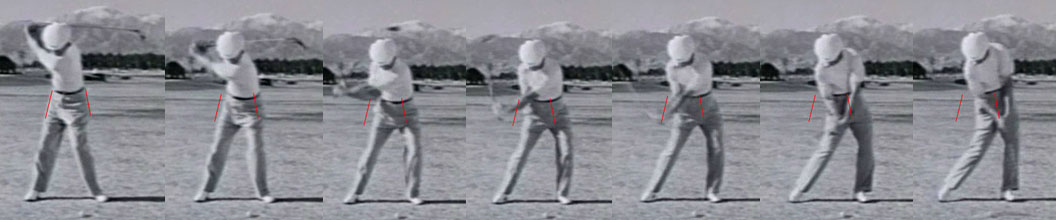
Here is a photo sequence of Hogan's downswing.
I placed red lines on the outer border of Hogan's pelvis at the end-backswing (after he shifted his pelvis to the left during the late backswing).
The series of images demonstrates that Hogan still had a large left-lateral shift of his pelvis during the downswing.
Jeff, the digrams that you drew were very good. Thank you for
the pictures of Hogan. I think that the shift, that V.J. presents,
is for the center of mass/center of gravity of the body rather
than the pelvis. The center of mass is right between the feet
at address but moves to just inside the left foot with the shift
before the downswing. V.J. mentions that the center of mass
is through the body in line with the seams of the pants
and aprox at the forward inter heals. I think that the appearance
of a big shift, after the downswing is due to the pivot way to
the left where the center of mass has moved. For the pelvis.
I think that the Hula Hula accounts for the appearance of the
hip slide. V.J. is the expert and could clear up missconceptions
that I may have made. What I have said is my impression, not
necessarly his.
I realise that VJ believes that Hogan got most of his body weight onto his left foot at the end-backswing and that he therefore didn't have to shift-rotate his pelvis left-laterally during the downswing. I, however, am not convinced by the evidence provided in his book.
Here is a photo sequence of Hogan's downswing.
I placed red lines on the outer border of Hogan's pelvis at the end-backswing (after he shifted his pelvis to the left during the late backswing).
The series of images demonstrates that Hogan still had a large left-lateral shift of his pelvis during the downswing.
Jeff.
Jeff . . . Not a knock on you but I think we have to be careful about picking sequences and saying . . "Yo! This is what Hogan did!" You can find sequences to support exactly what VJ says about Hogan's pivot . .. and obviously from the sequence you reference above we can see he DIDN'T do the VJ deal too. There are people who say . . . "Hogan's shoulders were X degrees open at impact." If you look at the footage in the Ben Hogan Collection you can find footage where his shoulders are square to closed . ..
The point of all this . . . Hogan did whatever he needed to do to create the desired ball flight . . . but one thing you can see pretty consistently in Hogan is lots of #3 angle and a club that swings IN and ON PLANE quickly after low point . . . I think that is a BIG piece of the "Secret."
I agree with your perspective that one can interpret Hogan's swing in different ways depending on "how" one views his swing. I simply try and reconcile the different expressed viewpoints as best I can - within the limits of my personal set of biases. I also think that we cannot definitely answer the question as to whose personal perspective is most accurate, because Hogan is not available for formal testing in a research laboaratory. I wish he was - I would love to acquire a better understanding of his swing, that would be more readily measurable with today's golf laboratory research equipment.
I cannot quite understand your viewpoint - particularly the following statement.
"I think that the appearance of a big shift, after the downswing is due to the pivot way to the left where the center of mass has moved."
If the center of mass is already located well left of center at the end-backswing, then I cannot understand how one can still pivot far over to the left during the downswing. What part of Hogan's body is located well to the left of center at the end-backswing position, and how can one determine its mass relative to the total body mass?
How come the sequence you made approaching the top of backswing and the transition for the down swing got only one picture to show your point of view?
In my try with the capture, there are 188 frames of the same clip you did. From a few I made, I can see, before the club approaching the very top of the swing, the lower body already moved forward…or as VJ’s comment: “get the weight over to their left side soon enough in the downswing”
In the second row, the club was going even back and down while the lateral hip motion was already there.
The lateral move not only _________ but also ___________.
__________________
If you cannot take the shoulder down the clubshaft plane, you must take along some other path and add compensations - now, instead of one motion to remember, you wind up with at least two!
Jeff . . . Not a knock on you but I think we have to be careful about picking sequences and saying . . "Yo! This is what Hogan did!" You can find sequences to support exactly what VJ says about Hogan's pivot . .. and obviously from the sequence you reference above we can see he DIDN'T do the VJ deal too. There are people who say . . . "Hogan's shoulders were X degrees open at impact." If you look at the footage in the Ben Hogan Collection you can find footage where his shoulders are square to closed . ..
The point of all this . . . Hogan did whatever he needed to do to create the desired ball flight . . . but one thing you can see pretty consistently in Hogan is lots of #3 angle and a club that swings IN and ON PLANE quickly after low point . . . I think that is a BIG piece of the "Secret."
Well in my opinion he is making a lateral shift in his backswing ala the VJ book and it may certainly have felt to Hogan that he just "cleared" his hips but it doesn't take a genius to figure out that some right side participation will indeed shift the hips forward somewhat whilst rotating
Your question is why do I represent the end-backswing position with a single photographic image, and you seem to imply that it might not demonstrate the "true" amount of left-lateral pelvic/weight shift seen in the final moments of the backswing.
First of all, I produce only a single end-backswing image for simplicity sake. Secondly, let me define what represents my definition of the end-backswing - it is the time-point when the clubshaft starts to move in the opposite direction. So, using a swing analyser program, I advance the video frame-by-frame until the clubhead starts to change direction. I then back off one-frame, and that represents the end-backswing position - and it incorporates Hogan's final left-lateral pelvic shift in the final moments of the backswing. As your series of images demonstrates, if I was off by a single frame, it would have very little effect one one's overall impression.
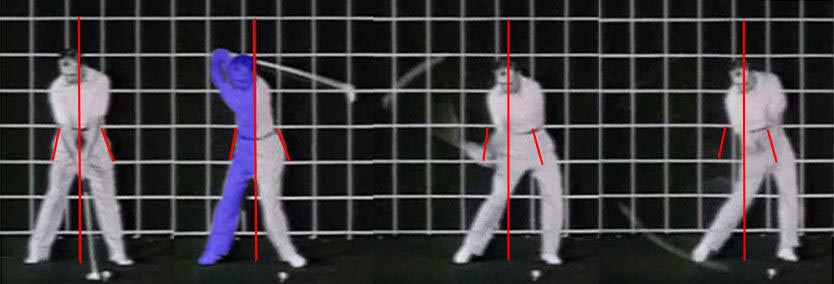
I did the same process with another swing video of Hogan. I waited until the clubshaft changed directions to determine the end-backswing position.
The blue-colored area represents that part of Hogan's body that 'appears" to be right of the center of his stance at the end-backswing position.
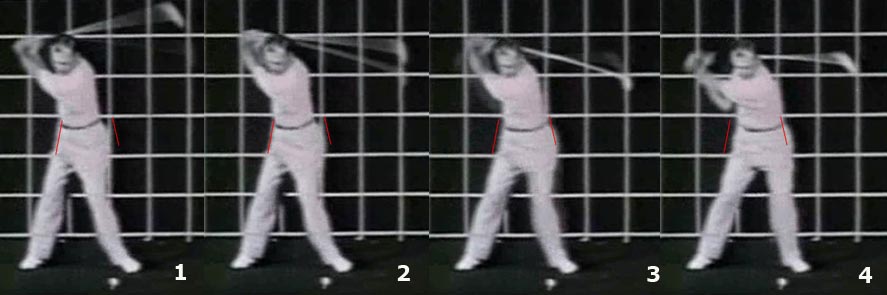
Anticipating that you may claim that my single-frame representation of the end-backswing doesn't accurately represent the end-backswing position, I have produced the following series of images.
I advanced the video one frame at a time. Image 4 shows the clubhead changing direction. Therefore. image 3 accurately represents the end-backswing position (and includes the left-lateral pelvic slide that occurs in the final moments of his backswing). Look at his clubhead position in image 3, and note that it is in the same position as my single-image representation of the end-backswing in the previous series of images. I do not believe that there is any foundation for any "belief" that I am deliberately misrepresenting reality.






 Linear Mode


