
|
Clubshaft "on plane"
When is the clubshaft on plane during the downswing?
There are many TGMers who would state that the clubshaft is "on plane" when the end of the clubshaft that is nearest to the ground points at the ball-target line (or its extension) at all time-points during the downswing, when it is not parallel to the ground. That means that the clubshaft end should always point at the ball-target line even when it is shifting planes during the downswing. So, for example, many golfers shift planes from the turned shoulder shoulder plane (at the start of the downswing) to the elbow plane (at impact) and HK's "on plane" idea is that the clubshaft end should always point at the ball-target line even while it is shifting planes. However, I presume that this is not an ironclad rule, but a generally useful guideline. Hank Haney has his own idea of being "on plane". He states that when the clubshaft is on a plane that is above the clubshaft-at-address plane, that the clubshaft should always be parallel to the clubshaft-at-address plane. Therefore, according to Hank Haney's model, when the clubshaft is shifting from the turned shoulder plane to the elbow plane in the downswing, it should always be parallel to the clubshaft-at-address plane. Haney calls these parallel planes "congruent planes". Here is a photo showing Hank Haney demonstrating his parallel clubshaft plane idea. 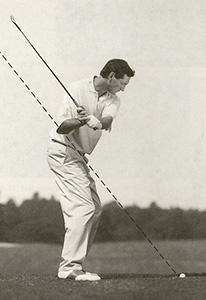 Note that the butt end of the club doesn't point at the ball-target line, so Hank Haney's idea of being "on plane" is incompatible with HK's idea of being "on plane". It would seem to me that neither Hank Haney or Homer Kelley has an ironclad theoretical justification for their "on plane" theory, and that it is only a rough guideline. It would seem to me that the clubshaft's behaviour will fit in more with Hank Haney's model during the early/mid downswing if the hands (and therefore) clubshaft drops down (groundwards) more per unit time than the left arm rotates counterclockwise per unit time, and that it is individual golfer-dependent. Consider three golfers. 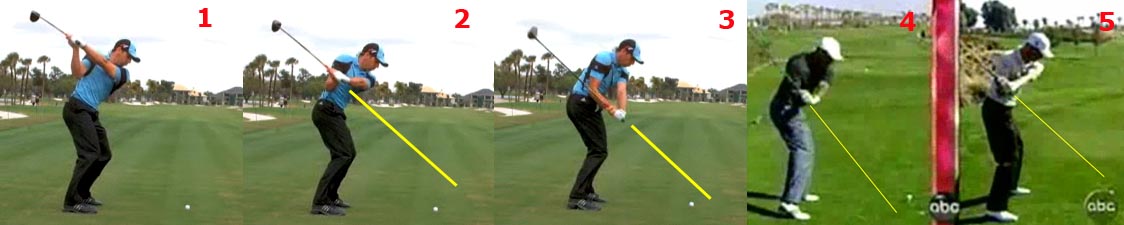 Images 1-3 show Sergio Garcia at varying time-points in the early/mid downswing, and you can see that his clubshaft is nearly parallel to the clubshaft-at-address plane. In other words, he better fits Hank Haney's model simply because his hands drop more per unit time (relative to the degree of left arm counterclockwise rotation per unit time) than the "average" professional golfer. Image 4 shows Tiger Woods and image 5 shows Adam Scott, and neither of their clubshaft-ends precisely points at the ball-target line, but they are closer to the HK model. From my perspective, it only means that their clubshaft is dropping groundwards less per unit time (relative to the degree of left arm counterclockwise rotation per unit time) than Sergio Garcia's clubshaft, and that it is only an individual golfer characteristic. In other words, there is seemingly no "fixed" rule that specifies how much the hands should drop per unit time (relative to the degree of left arm counterclockwise rotation per unit time) during the downswing. The only critical time point is when the hands reach a below-waist-level position, and at that time point the clubshaft should point at the ball-target line so that the final clubshaft release can be "on plane" (as can be seen in this photo of Aaron Baddeley). 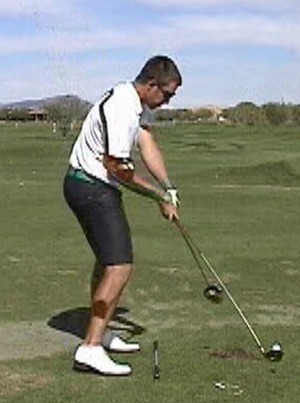 What do you think? Jeff. |
Jeff one problem with pics is unless the camera angle is perfectly square to the player the plane angles will not be precise. Additionally many pros manipulate the hands near impact to get the club on plane. If you look at some of the youtube slo mo videos of Mickelson you can see this just before contact. Hogan really got that right forearm on plane pointing at the ball.
There is "magic" in the right forearm. |
Geometrically Oriented Linear FORCE
Jeff, Until you can forsake the shaft and its visuals you will never get to the exciting essence of TGM.
The sweetspot and PP3 should be on plane...there are times during a swing when they can follow the same plane as the shaft but there are times when there are seperate. But the key is to FEEL the force and FEEL what on plane is...If you can't feel it with a golf club then use a heavier weighted implement and swing...FEEL the sweetspot in your hands and then draw the lines in your head. Sorry if that sounds cryptic but there is a level of understanding and appreciation that comes only through feeling. You can do the Math afterwards! Start to swing heavy things around your body...build a plane board like Homer did...LOOL, LOOK, LOOK....and FEEL , FEEL, FEEL... Then do it again and again...1 month minimum... Then wonder why you ever worried about drawing lines on videos which will always be plagued by parallax problems... I think that this is what VJ was getting at when he replied to you.... |
Invisisweetspotplanemagic
I did not have the guts to mention the part about disregarding the shaft. Tough to substitue an imaginary line (sweetspot plane) with an actual line (the clubshaft) I built one of those thingmy-jigs with a length of yarn connecting the pressure point spots on the aft side of the grip with the sweetspot. I went a step further and spray painted the club head, the face and the shaft different colors! Without seperate identities there is nothing but chaos! Moooohahahahah! Diabolically evil laughter for the puzzled!
|
Haney is plane wrong!
I gotta throw in that focusing on the shaft is playpen stuff. I do not know other teachers that identified the sweetspot plane, so perhaps Haney should be mentioned in the same breath as someelse who does not know! Clue: not Homer Kelley! A little caustic...I know! :laughing1
|
Golfbulldog
I am aware that the key points are the PP#3 (and not the hands) and the sweetspot plane (and not the clubshaft plane). However, the angular difference and point location difference is so small that using the hands/clubshaft as a surrogate visual marker is not far off. I, therefore, find your theoretical objections somewhat invalid. You are free to draw the sweetspot plane on my images, and then demonstrate the relevant differences. I will be very surprised to find that it makes any difference to my contention that "being on plane" needs to factor-in the amount of hand dropping per unit time relative to the amount of left arm rotation per unit time, and that the entire concept of "being on plane" is an arbitrary construct. Regarding your idea of practicing "feelings" as a replacement for accurate visual examination of "real life" swings (despite the small problem of parallax error) is an even greater mistake from my perspective - in terms of understanding the concept of "being on plane" instead of the concept of "feeling on plane". Jeff. |
Pay attention to Homer’s words: the base plane line of the inclined plane is usually BUT not always the line of flight.
Also pay attention to this photo also:  You are not the camera man and even you are, you might not take the right angle to let you study what is on plane or to disprove Homer study….as Tiger will not allow you to stand right behind him. BTW, can you analysis what is the degree of the camera shooting Tiger and Adam and their intended line of flight? Homer spent 28 years and went on research, and with today technology, we can find out what the ^$%#% is “on plane” or not...and, how about the sweet spot plane line? The below real 3d motion captured picture showed one or two things Homer stated…  And finally, question to TGM expert, is there any difference when Homer put with quotation mark or not with the words ON PLANE? |
Regardless of your plane theory, the longitundinal center of gravity (which is a line) must stay be aligned to that plane. The clubshaft is at an angle to this line so as the LCOG is the axis on which the turn and roll takes plane, the shaft will make a conical shape and will be aligned with the inclined plane only at 2 points around 360 degrees of rotation.
Now to the Hank Haney parallel plane theory. To those not acquanted with the golfing machine would think it contradictory to the TGM however they are mistaken. Homer Kelley clearly states in 7-7 - I don't have my book with me so I will have to paraphrase "other controlled procedures may be more difficult but not be deemed incorrect such as positioning the club to the plane angle intended for release". This is exactly the same as the parallel plane theory. However going into this in detail is another post however I concur with Homer Kelley on this that it is unnessesarily difficult. |
KOC
I have no problem appreciating the fact that camera angle variations can distort our perception of whether the clubshaft is on plane - using HK's definition (peripheral end of the club pointing at the baseline of the inclined plane). However, I can tell from looking at Sergio Garcia's clubshaft-hand movements in images 1,2, 3 that he is definitely not "on plane" per HK's definition (even when accepting the potential presence of camera angle perceptual problems), and the reason relates to the fact that Sergio has the individual idiosyncrasy of dropping his hands groundwards a large amount per unit time, with only a small degree of left arm rotation per unit time, during that time period of his downswing. I also cannot label Sergio's downswing action imperfect if he successfully gets his clubshaft-on-plane at the critical time point - at impact. Jeff. |
Quote:
Mathew put up a nice 3D animation at one point. Pretty sure its still in the gallery. |
Bagger - is it correct to infer that the right forearm need only trace the plane line in the later downswing to reach a perfect impact alignment, and that the right forearm's movement in the early downswing can be very variable in different individual golfers?
Jeff. |
Help Wanted
Mathew should correct me and say its when the sweetspot and right forearm as guided by the #3 pressure point are tracing the base of the plane.
Or something like that. |
Bottom line is that you have to get to the correct release plane.
Through impact the club will need to move on the release plane because of the design of the club (and if anyone is unsure of why this is let me know...)- however technically pp3 will actually be moving fractionally offplane as the club is released. As the club is rotated around the LCOG by moving the left hand towards vertical, the clubshaft will rotate in a conical fashion and because pp3 is on the line of the shaft not the LCOG it must move offplane. The right forearm and arm of course needs to maintain alignments inorder to move the pressure point correctly and in that sence guides pp3. |
Quote:
Study Flip release in the book….one of Paul Hart’s favorite subject. :happy3: |
Quote:
I agree that even with parallax some of those guys are starting down on no specific plane...not TGM plane nor Haney....they usually are on plane during release though impact. But it really is about sweetspot feel. Homer wrote in a generation before Video cameras were readily available for golf teaching...you just don't need them to make his stuff work. When you do you swinging with your weighted keyboard...aiming to release on a straight plane line....try and make an intentional off plane release AND then still be on plane for impact region....really hard to do...you will feel the biomechanical inefficiency...then you don't need to draw lines.:golf: |
Quote:
YES SIR! Sergio and Furyk are considered two of the best ball strikers on tour. They shift the club all over the place . . . I would say the plane matters most from impact to separation. That is why the #3 accumulator angle is sooooooooo important. You can shift the plane all over but as Homer said "Plane shifts are hazardous" . . . I would add "the closer you get to the ball." The right forearm location and alignment to the shaft is going to change based on several factors 3 critical ones would be the delivery path, selected delivery line or arc, and plane angle. The right forearm is going to have a different look based on right shoulder location and the amount of waist bend as well. This is why a centered stroke is so important. If your head Bobs . . . then you disrupt the #3 accumulator angle and your clubface alignments will be fleeting as a result. |
Golfbulldog
I don't have to attach the keyboard to a club to understand your concept of an "on-plane feeling". I have tried it with a standard golf club, and the "on-plane feeling" works very well. That's why I am so enamored by HK"s TGM-teaching. It offers a conceptual model that can help a beginner golfer stay "on plane" from an arbitrary (but extremely useful) HK perspective. My arguments about different golfers merely reflects the fact that different golfers use different definitions/concepts of "being on plane" and that a Sergio Garcia-style golfer (who drops the hands more per unit time relative to the amount of left arm rotation per unit time) may not be helped by trying to develop a "feeling" at PP#3 (that can be used to trace a straight plane line) while the hands are moving through the early-mid downswing. Jeff. |
Quote:
Homers intention, his gift to golfdom, was to provide the information and mechanical understanding necessary for golfers to be able to make an uncompensated golf stroke - a model of mechanical efficiency based on Physics and Geometry. Homer was a bright lad and readily understood that the making of such a golf stroke was not an easy matter, even for the very best. So, he continued to work for around another 28 years in order to catalogue the differences (individual compensations, if you like) that we golfing inadequates need to know in order for us to make as efficient a golf swing as we are capable of. Your efforts to complete your understanding of golfing mechanics are to be marveled at. The time you spend in this endeavour and your devotion to duty is almost beyond belief. (Do you get the time to eat, sleep, play golf even?) Nevertheless, I have to say that I, for one, find it more than slightly offensive that you persist in the introduction all sorts of variations of "golfer examples in action" into your arguments as grounds for your presumption that, somehow, Homer may just have got it all wrong and you will set us all to rights. A wise man listens Jeff and hears what is being said. Others just talk a lot and hear nothing. Sorry if this offends you (not my intention as you may come to realise) but it makes me feel a little better to get it off my chest rather than keep these feelings bottled up. Embrace the information Homer bequeathed to us and ask how ever many questions you must in order to gain an understanding of his work. Don't just chuck up bits and pieces willy nilly in order to prove that you are right in cases where you have clearly not grasped the concept at issue. That is doing yourself a disservice. |
Burner
You wrote-: "Nevertheless, I have to say that I, for one, find it more than slightly offensive that you persist in the introduction all sorts of variations of "golfer examples in action" into your arguments as grounds for your presumption that, somehow, Homer may just have got it all wrong and you will set us all to rights." I am puzzled by your use of the word "offensive". It is never offensive to analyse/dissect/criticize a scientific theory, because a "true" scientist invites rigorous analysis/counterarguments/criticism of his theory, because he knows that his theory's ability to withstand any attempt at falsification (in a Popperian sense) strengthens his theory. In the absence of criticism, a scientific theory is essentialy untested, and therefore not knowingly "true". A scientific theory is optimally tested when it is attacked from every possible angle, because it becomes the "best' theory when it withstands all attempts at falsification (better than alternative theories in the same field). I have read virtually all of Yoda's archived posts and he has repeatedly demonstrated that HK's golf swing theories are extremely sound and not easy to falsify. That's why I hold HK's work in such high regard - it has a very low falsifiability factor. Regarding my modus operandi of attacking any golf swing theory, it merely reflects my scientific approach established over many decades. I find that the best way to understand a scientific theory and assess its "falsifiability factor" is to attack and analyse it from every possible angle. If it withstands rigorous analysis, then my admiration for its "low falsifiability" factor increases, and I respect it much more. So, don't be offended. Instead, you should realize that my inability to find flaws in Hk's theory actually strenghtens his theory in a way that you would not realise if his theory was not repeatedly dissected and analysed and criticized by me, and many other critics. Jeff. |
Based evidence golf
Jeff
It is obvious that your have a very scientific approach, and I do know the based evidence medecine concept.But there is a long way from BEM to Based Evidence Golf, and without offending , I share Burner advice that this forum is not really the place. You have your own site (http://perfectgolfswingreview.net/index.html), a very good one, where you kindly share your works. Why don't you open a forum on this site to "dissect" with people who appreciate this kind of approach. Keeping on asking on this forum, wich is the best place, and elaborate on yours, seems to be a very scientific approach, and a good contribution to golf comprehension. |
Dr Jeff
I am wondering what your credentials are in the field of Physics and Engineering are??? Homer may not have got it all correct after all Mac Ogrady stated only 70% was correct but he has not even published anything BUT at least he can swing a golfclub extremely well. Can you put YOUR GOLFSWING UP on the forum so I can get some perspective on the PERFECT swing and then i can model my swing after yours Please im begging you PUT YOUR SWING UP |
On plane?
The swing, including the club, is shifting toward or on a shoulder plane when powered by the shoulders.
The swing, including the club, is shifting toward or on an arm plane when powered by the arms, including the forearm and upperarm. The swing, including the club, is shifting toward or on a hand plane when powered by the hands. The swing, including the club, is shifting toward or on a shoulder-arm-combined plane when powered by the shoulders and arms. The swing, including the club, is shifting toward or on a shoulder-arm-hand-combined plane when powered by the shoulders, arms and hands. . . . . The swing, including the club, is shifting toward or on whatever plane when powered by whatever. |
Pistol
I cannot fulfill your request to post my golf swing, because I don't really have a golf swing. I only pretend to have a golf swing by mimicking a certain number of golf swing motions. Now, if that fact that makes me unqualified to comment on the golf swing in your mind, then please ignore my unqualified/uninformed posts and please refrain from repeatedly commenting negatively on my unqualified/uniformed posts, because they are obviously not worthy of your time and effort. Jeff. |
Quote:
|
Quote:
Don't just pigeon hole Homer into a little box. Don't forget about Chapter 10. I think Jeff is a credit to this forum for the light he shines under the mushroom. I think Homer would ENJOY the discourse . . . so should we. Jeff is a seeker and is welcome in my world. I love the pictures. Keep in mind golf isn't played in the "uncompensated world" . . . we play in the real world. And bottom line for a long time in his stroke Sergio AIN'T on plane . . . . but he's as uncompensated as anybody where the bidness gets done. |
Quote:
|
Quote:
|
Quote:
KOC- he was talking about the BASE LINE of the incline plane- not the incline plane's angle. Where it is attached to the ground which is usually but not always the line of flight. You can have the base line open or closed to the line of flight. The incline plane is always FLAT and extends in every direction. go to the quote and add three words to the beginning. |
Quote:
|
Quote:
|
Quote:
|
Quote:
I have no problem with arguments and counters thereto, it is the life blood of any forum. My "offense", maybe not the most well chosen word, arises out of your modus operandi where certain examples you put forward in support of your stance appear to be based on no other scientific principle than "look, this bloke (choice of bloke varies as to which one best suits your purpose) doesn't do it so it cannot be so". Simple as that. I have no other issues with you and, indeed, welcome your input in the various forums we both enjoy. You have much to offer and raise questions that cause not only me, I suspect, to have a little rethink on various aspects from time to time. Bucket, Quote:
Furthermore, I appreciate the fact that Homer would likely "enjoy the discourse". But, he would have preferred any discourse to be based on sounder scientific principles than those occasionally put forward by Jeff - this bloke doesn't do it, see, so it cannot be right. Know what I'm saying? |
Burner
I didn't just introduce an isolated bloke's swing (Sergio Garcia's swing) out of context. I used Sergio Garcia as an example of another plane theory - Hank Haney's theory of conguent plane angles. Whether you regard Hank Haney's plane theory as being as "scientific" as HK's plane theory is a personal choice, but I don't think that I am being "destructive" or "unnecessarily disrespectful of HK" by comparing HK's plane theory to other plane theories (Hank Haney's). I think that we all can learn by dissecting/comparing golf swing theories. Jeff. |
Quote:
Quote:
|
Quote:
B . . . We're tight so I understand where you come from. I just don't want to see things turn into let's pile on Jeff session. Homer said there were millions of workable patterns. AND you can have the club pointing at the plane line and STILL hit a stinker shot. |
Quote:
Individual sections, on to themselves, of HK's TGM will always confuse those that don't see the bigger picture- the elephant as Yoda says. If some understood the back stroke and the difference between END and TOP, the concept of being on Plane would suddenly look different. |
Where is the boss?
Yoda! Yoda! Yoda?
|
Zookeepers Privilege
Quote:
8) |
Founder's Perogative...booo!
Oh ye of little faith! :laughing9 Maybe if we throw some more fried chicken in there...Bucket will jump in!
|
Quote:
Don't tell me about stinker shots as I am still inventing ways to hit them.:iamwithst Feel free though to tell me how to isolate the gene that causes my predisposition to do this by all means.:laughing1 |
| All times are GMT -4. The time now is 04:10 AM. |