LynnBlakeGolf Forums

LynnBlakeGolf Forums (http://www.lynnblakegolf.com/forum/index.php)
-   The Golfing Machine - Basic (http://www.lynnblakegolf.com/forum/forumdisplay.php?f=16)
-   -   Bending the Plane (http://www.lynnblakegolf.com/forum/showthread.php?t=7022)

Daryl 11-15-2009 09:28 AM

Bending the Plane
 
Quote:

4-D-0 RELEASE MOTIONS This term refers to the Release of Accumulators #2 and #3. So it is not a Pattern Component in itself. Normally, it can only be either Simultaneous (Hitting) or Sequenced (Swinging) per 10-11-0-2 and 10-11-0-3. “Uncocking” (4-B-3) and “Roll” (4-C-3) are two separate motions: 1) Wrist Motion and 2) Hand Motion – coordinate but very independent (4-0). Their execution is not a haphazard amalgamation (10-10-C and D). Normally, Uncocking is a function of the Wrists actuating the Clubhead (4-B). See 5-0 and 7-11. It has nothing to do with Clubface alignment at Impact – that is the function of the Hands, executing a Clubface Motion (4-C) – Accumulator #3 (2-G). Whenever the Wrist Motion (instead of Hand Motion) throws the Clubface at the ball, there will be Steering and Clubhead Throwaway. See 2-P. The Hitter concentrates on Hand Motion, while the Swinger concentrates on Wrist Motion. Both halves of each Release Action can be either Automatic (normally) or Non-Automatic (per Pattern). Study 6-E. So each must be consciously differentiated during execution.

Normally, only Swingers with their Standard Wrist Action (10-18-A) “Swivel” – that is, actually rotate the Left Wrist – through the Release into its Vertical Position for Impact. That must be pre-programmed not later than The Top per 8-6. Have a clear picture of the intended Impact Hand Position all the way down – NOT the process of achieving it. But all players must “Swivel” – actually rotate their Wrists – into the “parallel to the Plane” position for the Finish (8-12) after the Follow-through.

It is mandatory that there is no break or bend in the Delivery Line direction during either half of the Release Motion. Both halves, as well as, the Release and Finish Roll (2-G), must be executed on the same Delivery Line (2-J-3) – On Line or Cross Line, but not both. Construct an Inclined Plane such as shown in 10-5, or find a low bench, fence rail – or anything providing the Clubshaft with a straight edge or flat surface – and swing the Clubshaft back and forth along that edge or surface while executing the above Wrist and Hand Motions until you thoroughly understand their relation to 10-5. Study 2-N very carefully. That is why item 12-3-22 is capitalized. Study 3-F-6.

Remember a flat plane has a straight baseline. A circle is two dimensional and can lie on a flat plane. If the Plane Line loses it straightness the Clubhead Orbit becomes three dimensional and precision vanishes.
Just some illustrations to review. I'm sure there are many ways to bend the Plane Line.

These are not illustrations of the Left Arm and Clubshaft at Impact. The Top two Illustrations assume that the Delivery and Plane lines are the same.


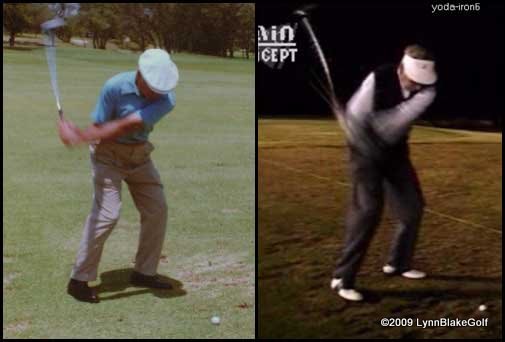
The Above picture intends to illustrate what happens when Swinging on the Elbow Plane with a Flat Left Wrist, Uncocks on the Plane of the Left Arm Wedge, but then needs to Roll to another Delivery Line for Impact.

KevCarter 11-15-2009 09:44 AM

WOW, it's too early in the morning, the incubator needs some coffee...

I have a feeling when I wake up this post is going to be VERY enlightening!

Thanks Daryl.

Kevin

jerry1967 11-15-2009 09:56 AM

This is very big for me- thank you for posting the drawings!

KevCarter 11-15-2009 11:02 AM

I'm waking up, finally, just in time to leave for work. :-(

Daryl, why do you say these alignments are NOT at impact? How and why would they change?

You are on a roll this morning, lovin your plane posts. I'll look forward to studying this stuff more tonight.

Thanks again,
Kevin

KevCarter 11-15-2009 11:07 AM

Daryl,

Looking at the pics again, where you say bent and flat left wrist, should it read cocked and level instead?

Kevin

Daryl 11-15-2009 12:32 PM

This better explains what I'm trying to say. The Left Wrist is Level and Flat at Impact for Both Procedures.

TGM's Turned Shoulder Plane requires a Release Swivel for the Left Wrist to return to vertical for Impact if the Sweetspot was swiveled to Plane at Start-up. We have ultimate control of the Clubshaft on a Turned Shoulder Plane with the Flat Left Wrist and full use of the #2 and 3 Accumulators. The Right Hand controls the Clubhead on every swing plane but it won't do it at the expense of the Left Arm Wedge when on the Turned Shoulder Plane.

The Elbow Plane needs the "Hogan Swivel" to change from a Bent Left Wrist to a Flat Left Wrist for Impact. I don't consider it a True Sequenced Release because all it does is spin the shaft around it's axis. It's like a Ball and Socket Swivel and can accommodate any plane angle with a lost Left Arm Wedge.

The Hogan Swivel needs to be Stopped to prevent over swiveling at or before Impact otherwise timing needs to be perfect. I think that this can be done in two ways. First, slam the wrist into an arched position after Uncocking so that the Left Wrist can be held vertical for Impact. Second, use pivot force to overcome the swivel as the left wrist becomes vertical. Arching doesn't need such a driving pivot and my experiments show that it doesn't have the timing issues either. Also, the driving pivot method, which is being talked about (force will create alignments), doesn't lend much confidence when face with a delicate 30 yard pitch shot.

If you Bend (Cup) the Left Wrist even only slightly, it is Bent and will require the Hogan Type swivel to prevent bending the Delivery Line.
Hogan Swivel


KevCarter 11-15-2009 01:36 PM

Great stuff Daryl! Why would we ever want to go back to the elbow plane? The TSP appears so much simpler a procedure!

Kevin

O.B.Left 11-15-2009 02:09 PM

Quote:

Originally Posted by KevCarter (Post 68994)
Great stuff Daryl! Why would we ever want to go back to the elbow plane? The TSP appears so much simpler a procedure!

Kevin


With your Right Elbow on the Shaft Plane (the RFFW), an Elbow Plane in Homer speak, you must get back there to prevent toe down or toe up impact.

KevCarter 11-15-2009 02:23 PM

Quote:

Originally Posted by O.B.Left (Post 68996)
With your Right Elbow on the Shaft Plane (the RFFW), an Elbow Plane in Homer speak, you must get back there to prevent toe down or toe up impact.

Because of the lie of the clubs?

That would be the mistake many folks make, fitting the lie of the clubs to the address alignments rather than impact alignments.

Kevin

O.B.Left 11-15-2009 03:58 PM

Quote:

Originally Posted by KevCarter (Post 68997)
Because of the lie of the clubs?
Kevin

Absolutely. The amount of work Daryl has put into this is staggering. But the TSP is a StartDown Plane of Motion. Impact is ideally along the Shaft Plane Angle, the clubs lie angle, which will also be considered an Elbow Plane if the Elbow is also on that same Plane Angle. A very good thing that most truly great golfers achieve at Impact and Homer reasoned the perfect alignment around which to adjust our machines at Fix. This alignment, this RFFW on the shaft plane at address is perhaps the only tell tail sign of a TGM adherent. That and some totally bizarre golf terminology.

Plane Shifts do happen, for longer swings anyways, but the straight line Base Line stays put. So keep tracing my friends. 1-L-18

http://www.youtube.com/watch?v=1NeizRf3JZY

The plane angle you release along is a function of what plane angle shifts you are employing and at what point you release. Its a flat plane yes, like a sheet of glass, that shifts its angle up and down with the base line staying in place.

Now if you point the entire flat plane, sheet of glass, left or right of the original target and trace the new straight base line associated with this new plane of motion , then you are said to have "bent the plane" or its base line to the left or the right. This new Delivery Path of the clubhead when combined with variations in clubface angles will produce curved shots for instance. You bend the plane to the right to hit a draw say. Meaning your sheet of glass is pointing right and your clubface is pointed left of that to some degree. The geometry stays the same, you still trace the base line, the plane angle changes etc.

KevCarter 11-15-2009 04:20 PM

Man, I keep thinking I know some stuff, but every day I learn something new from an entirely different perspective. Thanks guys for keeping this fun!

Kevin

Daryl 11-15-2009 06:13 PM

Quote:

Originally Posted by O.B.Left (Post 68998)
Absolutely. The amount of work Daryl has put into this is staggering. But the TSP is a StartDown Plane of Motion. Impact is ideally along the Shaft Plane Angle, the clubs lie angle, which will also be considered an Elbow Plane if the Elbow is also on that same Plane Angle. A very good thing that most truly great golfers achieve at Impact and Homer reasoned the perfect alignment around which to adjust our machines at Fix. This alignment, this RFFW on the shaft plane at address is perhaps the only tell tail sign of a TGM adherent. That and some totally bizarre golf terminology.

Plane Shifts do happen, for longer swings anyways, but the straight line Base Line stays put. So keep tracing my friends. 1-L-18

http://www.youtube.com/watch?v=1NeizRf3JZY

The plane angle you release along is a function of what plane angle shifts you are employing and at what point you release. Its a flat plane yes, like a sheet of glass, that shifts its angle up and down with the base line staying in place.

Now if you point the entire flat plane, sheet of glass, left or right of the original target and trace the new straight base line associated with this new plane of motion , then you are said to have "bent the plane" or its base line to the left or the right. This new Delivery Path of the clubhead when combined with variations in clubface angles will produce curved shots for instance. You bend the plane to the right to hit a draw say. Meaning your sheet of glass is pointing right and your clubface is pointed left of that to some degree. The geometry stays the same, you still trace the base line, the plane angle changes etc.

Who put you up to this? I can't believe you said any of that with a straight face.

Seriously, people are going to believe you if you don't get back here and tell them you're only pranking them.


Quote:

7-7 PLANE ANGLE VARIATIONS Due to personal preference, natural inclination of the pressure of conditions it is not always possible or advisable to adhere to a single Inclined Plane classification throughout the entire Stroke. Players often – consciously or subconsciously – employ more than one of the “natural” Planes. The Shoulder Planes are the more consciously employed – the Elbow Plane the more – almost totally – subconsciously used. Vaguely or incorrectly defined Planes and Variations must be eliminated. The list is restricted to those of fairly common usage – good and bad. Other than the Right Shoulder positions, only the Elbow reference point has any great general usefulness. The “Hand Angle” is emergency or special purpose application. Wrist Action and the selected Inclined Plane must be compatible – watch especially with “No Wristcock” Strokes.

During any Shift of Planes the Clubshaft is held On Plane with the Plane Line as though the Plane itself were moving to the new location. Other controlled procedures that achieve On Plane Impact may be more difficult but need not be deemed improper. Such as positioning the Clubshaft at The Top of the Plane Angle intended for Release. And study 2-N.
Quote:

10-7-0 GENERAL Plane Angle Variations are classified according to the shifts in Plane Angle of the Stroke path. A shift may be made (1) during the Backstroke (2) during the Downstroke, or (3) at the Top of the Stroke.

10-7-A ZERO This classification is included so it can be indicated in a player’s prepared Stroke Pattern that one Basic Plane Angle is to be used throughout the stroke without a “Variation” – that is, No Shift.

10-7-B SINGLE SHIFT This Shift relates only to the shift from the Elbow Angle to the Turned Shoulder Angle during the Backstroke, with a Downstroke on the Turned Shoulder Plane Angle.


O.B.Left 11-15-2009 07:16 PM

You worked hard on that, but when I imagined Kev trying to get to impact with a zeroed out #3 angle on a TSP angle, I had to, delicately, suggest another view of things. I didnt enjoy doing it.

I dont want to sound like Batman talking to Mr Freeze but if only your debauched genius were put to some common good.

O.B.Left 11-15-2009 07:47 PM

OK after doing some research, I must retract my bent plane line procedure of post 10. That procedure being more correctly described as a straight base line, geometrically correct deal per 10-5-E Closed closed.

A bent plane line is an off plane, unscientific method without proper straight base line tracing.

Quote:


Per 4-D-O

Remember a flat plane has a straight baseline. A circle is two dimensional and can lie on a flat plane. If the Plane Line loses it straightness the Clubhead Orbit becomes three dimensional and precision vanishes.

Quote:

Per 10-5-0

Shifting from one Plane Line to any other, however slight, results in a Bent Plane Line (4-D-0) ,that genetic deformity of unscientific golf, with its Bent Left Wrist Syndrome, (3-F-7-A, 4-D-0). Whatever the symptoms the cure is Alignment Geometry and Educated Hands.

I stand corrected. But per 1-L-18 Changes in Plane Angle have no effect on the Plane Line.

Daryl 11-15-2009 07:49 PM

Quote:

Originally Posted by O.B.Left (Post 69002)
You worked hard on that, but when I imagined Kev trying to get to impact with a zeroed out #3 angle on a TSP angle, I had to, delicately, suggest another view of things. I didnt enjoy doing it.

I dont want to sound like Batman talking to Mr Freeze but if only your debauched genius were put to some common good.

We're misunderstanding each other.

My post has been incubating for years. The illustrations took a few minutes. But they aren't Impact Illustrations. At Impact, even on the Turned Shoulder Plane, ideally the Left Wrist is Level. Therefore, there will be an angle between the left arm and clubshaft. It's reduced because of the necessity to reduce the #3 Accumulator Angle to use the Turned shoulder Plane, but it nonetheless exists.

But this post is about release motions and bending the Plane line. Both halves of the release motion should occur on the same plane line (delivery line) else the clubhead orbit becomes 3 dimensional.

Can the Flat Left Wrist be used with a Double Plane shift? I said no, that the wrist should be bent. But, you can have a Flat left wrist if you keep the clubshaft on the elbow plane during the downstroke AKA Sergio Garcia.

The Hogan Swivel is not the TGM swivel. I had always thought it was but I don't anymore. I do think that the Hogan swivel helped Hogan prevent Bending the Plane-Line. But it's not the only way.

Questions remain. What is the relationship between bending the left wrist and clubshaft plane?

Daryl 11-15-2009 08:20 PM

I think that Bending the Plane line is a universal problem and lots of Golf Methods deal with solving the problem without truly understanding it.

"Tripping the Shaft" is a term used to name the Hogan Swivel. "Forcing Alignments" through an explosive Pivot is still another way of dealing with the problem of bending the Plane Line and Dante's Magic Move was another. Others, like Byron Nelson, solved the problem by dropping his entire right side downward to drop the Turned shoulder plane onto the elbow plane in order to use a Flat Left Wrist.

It's odd that none of them discovered the Turned Shoulder Plane and Flat Left Wrist relationship. But every one of those solutions has worked and they've been proven reliable in competition. It's great that TGM helps you understand that.

O.B.Left 11-15-2009 11:02 PM

Quote:

Originally Posted by Daryl (Post 69004)
At Impact, even on the Turned Shoulder Plane, ideally the Left Wrist is Level. Therefore, there will be an angle between the left arm and clubshaft. It's reduced because of the necessity to reduce the #3 Accumulator Angle to use the Turned shoulder Plane, but it nonetheless exists.

I dont know what you mean about the wrist bend and release , where is that covered in the book?

In the above quote you seem to be saying that a TSP angle at Impact is steep. What Im saying is that the TSP angle steep though it is, is not an angle for Impact but more of a Startdown plane angle prior to a shift to a lower plane. The impact plane angle must be the clubs lie angle in terms of degrees vs vertical. So if you were to make contact on a TSP angle it would have to be an extension of the clubs lie angle that bisected the turned right shoulder at top. Cant do that with all the clubs in your bag very easily. Maybe if you bent the lie angles on every club to conform to where your right shoulder turns to or something.

Daryl 11-15-2009 11:28 PM

Quote:

Originally Posted by O.B.Left (Post 69016)
I dont know what you mean about the wrist bend and release , where is that covered in the book?

The Bent Left Wrist Release, AKA the Hogan Swivel, is not the Recommended Procedure. It's unnecessary when using a TSP. All available non-recommended procedures are not included in the Book. The Hogan Swivel is only one of many ways to reconcile clubshaft vs. delivery path angles so that both halves of release can be executed while tracing the same delivery line.

Keep in mind that by sacrificing the Left Arm Wedge and Flat Left Wrist until Impact, makes sensing drag at startdown more difficult. Everyone has felt how much more heavy or resistant the club feels at start down when everything is aligned on one plane.


Quote:

Originally Posted by O.B.Left (Post 69016)
In the above quote you seem to be saying that a TSP angle at Impact is steep. What Im saying is that the TSP angle steep though it is, is not an angle for Impact but more of a Startdown plane angle prior to a shift to a lower plane. The impact plane angle must be the clubs lie angle in terms of degrees vs vertical. So if you were to make contact on a TSP angle it would have to be an extension of the clubs lie angle that bisected the turned right shoulder at top. Cant do that with all the clubs in your bag very easily. Maybe if you bent the lie angles on every club to conform to where your right shoulder turns to or something.

Quote:

7-6 BASIC PLANE ANGLES The Clubshaft must starts its journey on the Plane of its Address angle of inclination. It may or may not move to the other Planes as it travels. Clubs cannot be designed to be perfectly Soled (2-J-1) and still align the Clubshaft with more than one Plane Angle Reference Point. So those aligned between the Elbow and Shoulder Turn Planes have become the most widely accepted, because actually the Toe or Heel can be lifted enough safely accommodate either of the flatter or steeper Plane and therefore any listed Plane Angle reference Point (2-D-0). Even on hardpan, the Ball, normally is gone before the ground is touched. Then too, there is always the true Clubshaft Angle with 8-6 and/or 10-6-E. The ideal solution is a slightly rounded Toe and Heel for all Clubs. But also study 10-24-F.

12 piece bucket 11-16-2009 03:04 PM

Quote:

Originally Posted by Daryl (Post 69004)
We're misunderstanding each other.

My post has been incubating for years. The illustrations took a few minutes. But they aren't Impact Illustrations. At Impact, even on the Turned Shoulder Plane, ideally the Left Wrist is Level. Therefore, there will be an angle between the left arm and clubshaft. It's reduced because of the necessity to reduce the #3 Accumulator Angle to use the Turned shoulder Plane, but it nonetheless exists.

But this post is about release motions and bending the Plane line. Both halves of the release motion should occur on the same plane line (delivery line) else the clubhead orbit becomes 3 dimensional.

Can the Flat Left Wrist be used with a Double Plane shift? I said no, that the wrist should be bent. But, you can have a Flat left wrist if you keep the clubshaft on the elbow plane during the downstroke AKA Sergio Garcia.

The Hogan Swivel is not the TGM swivel. I had always thought it was but I don't anymore. I do think that the Hogan swivel helped Hogan prevent Bending the Plane-Line. But it's not the only way.

Questions remain. What is the relationship between bending the left wrist and clubshaft plane?

Wow . . . I'm not sure even where to start with all of this . . . do you not think that you can adjust the #3 accumulator angle to an elbow plane alignment and have a level left wrist? Do you not thing that you can have a level left wrist on the elbow plane? Hogan's wrist ain't bent . . . it's ARCHED??? Why does your illustration show NO #3 angle AT ALL ON THE TSP? Hogan was on the verge of bending the plane line??? Oh boy . . . .


Daryl 11-16-2009 03:22 PM

Quote:

Originally Posted by 12 piece bucket (Post 69024)
Wow . . . I'm not sure even where to start with all of this .

First, take a deep breath. Exhale slowly, then count to ten. :clock:

Quote:

Originally Posted by 12 piece bucket (Post 69024)
Why does your illustration show NO #3 angle AT ALL ON THE TSP?

:violent: Please See Post #1. "These are not illustrations of the Left Arm and Clubshaft at Impact."

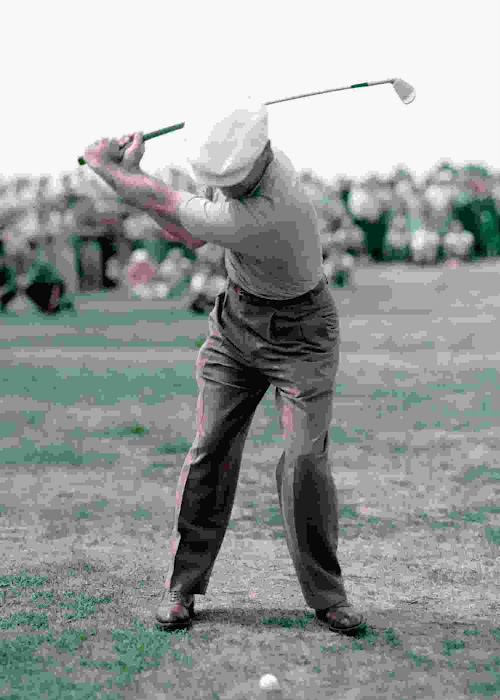
Then, please see the photo of a golfer on the turned shoulder plane at impact in post #18.


We aren't taking about Impact and the Flat and Level Left Wrist. The thread topic is "Bending the Plane". :boxing:

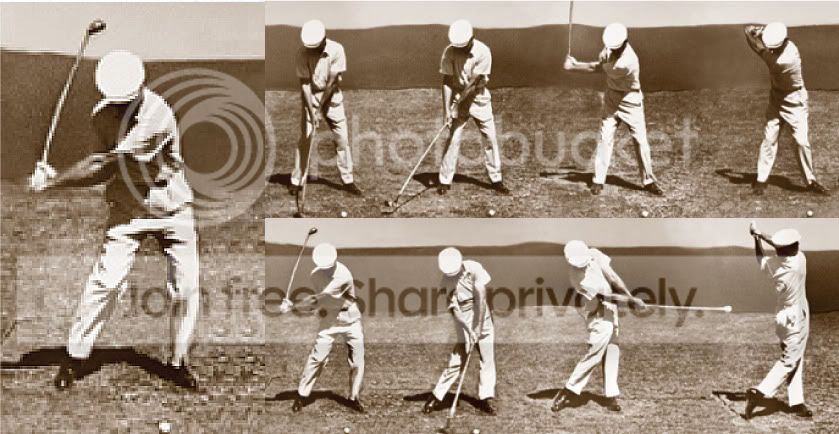
Did Hogan have a Flat Left Wrist throughout his Downstroke and Release, and Shift planes and Uncock and roll on the same delivery line? No, he didn't have a Flat Left Wrist during the Downstroke. All that I've said about Hogan was that he found a way to uncock and roll on the same delivery line by using his "Swivel" as illustrated in "5 Lessons" and presented in post #6 above. :occasion:


O.B.Left 11-16-2009 08:09 PM

2 Attachment(s)
D thanks for the info on the radiused soles. I hadnt seen that, it makes good sense. TSP lives I guess for some.

But this fella you show here. That is a very steep plane he is on. You dont show him at impact exactly or at Top to see where his right shoulder is. To my eye he looks more like:

Quote:


10-6-C SQUARED SHOULDER. The reference point for this Plane Angle is the point occupied by the Right Shoulder (or Left-- for Putting) at Address. With this Steep Plane, Angled Hinge Action becomes almost Vertical Hinge Action (2-D). Accumulator #3 can be zeroed out.

Zeroing out #3 , Vertical Hinging, I hope this fellow has bent his lie angles up a few degrees. Do you think he started on this plane, 10-7-A Zero Shift or did he start on the Elbow Plane then shift to the TSP and leave it there. 10-7-B Single Shift.

I prefer a lower plane angle for impact myself. Homer said we generally use the Elbow Plane almost totally subconsciously which to me implies that it is very "natural", if you will. Im assuming the Right Elbow to be on the clubs shaft plane, lie angle, which isnt necessarily the case.


http://www.lynnblakegolf.com/forum/a...d=125841663 5

http://www.lynnblakegolf.com/forum/a...d=125841663 5

12 piece bucket 11-16-2009 08:32 PM

Quote:

Originally Posted by Daryl (Post 69025)
First, take a deep breath. Exhale slowly, then count to ten. :clock:


:violent: Please See Post #1. "These are not illustrations of the Left Arm and Clubshaft at Impact."

Then, please see the photo of a golfer on the turned shoulder plane at impact in post #18.


We aren't taking about Impact and the Flat and Level Left Wrist. The thread topic is "Bending the Plane". :boxing:

Did Hogan have a Flat Left Wrist throughout his Downstroke and Release, and Shift planes and Uncock and roll on the same delivery line? No, he didn't have a Flat Left Wrist during the Downstroke. All that I've said about Hogan was that he found a way to uncock and roll on the same delivery line by using his "Swivel" as illustrated in "5 Lessons" and presented in post #6 above. :occasion:

Doo Doo Ball . . . how is this NOT a flat left wrist???


12 piece bucket 11-16-2009 08:33 PM

How is this a bent plane line???


Daryl 11-16-2009 08:34 PM

Well, I agree that the TSP isn't for everyone. I also agree that the Elbow Plane is more natural although I think that Homer's use of the word unconscious meant "without consideration".

But release motions need to occur on the same delivery line or else the clubhead orbit becomes 3 dimensional. So, those with Hand paths not matching the Clubshaft plane or vice-a-versa, will need some mechanism to arrive at impact without bending the delivery line.

Ben Doyle has suggested that the Plane might be concave. I haven't found much to support that but I find lots of ways golfers get-around the problem.

That's a problem that anyone with a downstroke plane shift must resolve (Hand paths not matching the Clubshaft plane). "Plane Shifts are Hazardous".

But anyone with Hand paths matching the Clubshaft plane can use a Flat Left Wrist Throughout the Stroke and a TSP offers that and more.

Most of my video of Hogan's swing shows that he mastered getting the Clubshaft On plane at the end of startdown, yet he still used the Hogan Swivel where a Flat Left Wrist would work perfectly well. With Shorter clubs he didn't do as well so maybe he figured keeping it for all strokes was better than forgetting to use it on shorter length clubs.

Daryl 11-16-2009 08:36 PM

Quote:

Originally Posted by 12 piece bucket (Post 69037)
How is this a bent plane line???

It's not. Hogan never bent the delivery line.

Daryl 11-16-2009 08:40 PM

[quote=12 piece bucket;69036]Doo Doo Ball . . . how is this NOT a flat left wrist???

It may very well be a Flat Left Wrist. I wish I had video or pictures of Hogan executing chip and pitch shots because I betcha he used a Flat Left Wrist procedure with those strokes.

But, you must admit, along with the golfing world, that typically, Hogan used a Bent Left Wrist during his downstroke.

It's getting cold outside, almost winter. Have you brought the Hogan Shrine indoors yet? Winter is a harsh environment to be on your knees an hour each and every day.

O.B.Left 11-16-2009 10:45 PM

Quote:

But release motions need to occur on the same delivery line or else the clubhead orbit becomes 3 dimensional. So, those with Hand paths not matching the Clubshaft plane or vice-a-versa, will need some mechanism to arrive at impact without bending the delivery line.
Where does Homer mention that the Hand Path (Delivery Path) must match the Clubshaft Plane? Assuming one is using the TSP the Hands and the clubshaft travel this plane for instance no? If you are tracing.

While he recommends using a bench or rail for demonstrative purposes he doesnt preclude a plane shift during Release.

Quote:

4-D-0 RELEASE MOTIONS This term refers to the Release of Accumulators #2 during either half of the Release Motion. etc

It is mandatory that there is no break or bend in the Delivery Line direction during either half of the Release Motion. Both halves, as well as, the Release and Finish Roll (2-G), must be executed on the same Delivery Line (2-J-3) – On Line or Cross Line, but not both. Construct an Inclined Plane such as shown in 10-5, or find a low bench, fence rail – or anything providing the Clubshaft with a straight edge or flat surface – and swing the Clubshaft back and forth along that edge or surface while executing the above Wrist and Hand Motions until you thoroughly understand their relation to 10-5. Study 2-N very carefully. That is why item 12-3-22 is capitalized. Study 3-F-6.

Remember a flat plane has a straight baseline. A circle is two dimensional and can lie on a flat plane. If the Plane Line loses it straightness the Clubhead Orbit becomes three dimensional and precision vanishes.


Quote:

Ben Doyle has suggested that the Plane might be concave. I haven't found much to support that but I find lots of ways golfers get-around the problem.
OK I think I get you, now. The geometry is tuff. I have it on good authority that you can with great effort seek to understand it or you can merely trace a straight line Base Line and you'll be ok. A concave plane is not a plane, not a flat plane and therefore wouldnt have a straight line base line. So in fact youd be tracing a new base line or lines and by definition you'd have a bent plane line.

The geometry is confusing but for a flat plane ,that shifts angles, the straight line base line stays the same, the club rides the plane with one end or the other pointing at the base line BUT ASSUMING A SHIFT THE HAND PATH, DELIVERY PATH IS NOT A STRAIGHT LINE. See 10-23-B, C and D. Each photo of Dianne in 10-23-B #1, 2, 3 has her club pointed at the straight line base line. Her Hand Path running down plane, her club following and doing likewise.


Quote:

That's a problem that anyone with a downstroke plane shift must resolve (Hand paths not matching the Clubshaft plane). "Plane Shifts are Hazardous".
Shifting your weight is hazardous. Going to End instead of Top is hazardous. Homer used that Hazardous sentence in connection with choosing a Plane Angle higher than the TSP, it requiring a shift back to the TSP before Startdown. That is hazardous, but still good enough to win many a major championship.

Quote:

But anyone with Hand paths matching the Clubshaft plane can use a Flat Left Wrist Throughout the Stroke and a TSP offers that and more.
You're going to have send a diagram on what this relationship means to you. Where is this in the book? What do you mean by clubshaft plane here? Look at Dianne in those photos, her hands and her clubshaft are traveling the same plane angles as she shifts. Elbow, TSP, Elbow, Triple Shift, 10-23-B Angled Line.

Shift'n isnt a bad thing. Not at all.

Daryl 11-16-2009 11:41 PM

Where does Homer mention that the Hand Path (Delivery Path) must match the Clubshaft Plane? Assuming one is using the TSP the Hands and the clubshaft travel this plane for instance no? If you are tracing.

You may know the concept by its Given Name. “Left Arm Flying Wedge”

While he recommends using a bench or rail for demonstrative purposes he doesnt preclude a plane shift during Release.

It isn’t the Plane shifting but the risk of the 3 dimensional Clubhead orbit resulting from a shift not properly compensated.

OK I think I get you, now. The geometry is tuff. I have it on good authority that you can with great effort seek to understand it or you can merely trace a straight line Base Line and you'll be ok. A concave plane is not a plane, not a flat plane and therefore wouldnt have a straight line base line. So in fact youd be tracing a new base line or lines and by definition you'd have a bent plane line.

Wow. Great thinking. That got by me.


The geometry is confusing but for a flat plane ,that shifts angles, the straight line base line stays the same, the club rides the plane with one end or the other pointing at the base line BUT ASSUMING A SHIFT THE HAND PATH, DELIVERY PATH IS NOT A STRAIGHT LINE. See 10-23-B, C and D. Each photo of Dian in 10-23-B #1, 2, 3 has her club pointed at the straight line base line. Her Hand Path running down plane, her club following and doing likewise.

For a Swinger to uncock on the left arm wedge when its delivery line is not the plane line where the ball sits, will require taking the Clubhead out of orbit to reach the ball. Additionally, not executing the “Roll” at the Hinge, will take the Clubhead out of Orbit.

Shifting your weight is hazardous. Going to End instead of Top is hazardous. Homer used that Hazardous sentence in connection with choosing a Plane Angle higher than the TSP, it requiring a shift back to the TSP before Startdown. That is hazardous, but still good enough to win many a major championship.

And Country Club Championships as well. IMHO, “Hazarous” is code for “find a compensation”.

You're going to have send a diagram on what this relationship means to you. Where is this in the book? What do you mean by clubshaft plane here? Look at Dianne in those photos, her hands and her clubshaft are traveling the same plane angles as she shifts.

I see the misunderstanding. Homer is providing photographic aid to help people understand Plane Shifts. Plane Shifts don’t cause Bent Delivery Lines, uncocking off plane or rolling off plane does. So, if you’re uncocking on the Plane of the Left Arm Wedge, but the Left Arm Wedge is not on the Impact Shaft Plane, then you’ll be uncocking off plane. If a Swinger with a sequenced release doesn’t “Roll” at the Hinge, then he’ll “Roll” off plane.

If your Left Arm is pointing to the ground 12” inside the Plane line, and you uncock on the Plane of the Left Arm Wedge (left arm wedge has a flat left wrist), how is the Clubhead going to reach the Plane Line?


This boils down to the Left Arm Wedge. The Wedge has a Flat Left Wrist. At release, if the Left Arm Wedge is On Plane and when you Uncock the Left Wrist, the Clubhead path is On Plane headed toward the delivery line, then...... But what if you Lower your left hand to the Elbow Plane (about 6"). Can the clubshaft uncock toward the delivery line and left arm wedge plane with a flat left wrist at the same time?

Quote:

It is mandatory that there is no break or bend in the Delivery Line direction during either half of the Release Motion. Both halves, as well as, the Release and Finish Roll (2-G), must be executed on the same Delivery Line (2-J-3) – On Line or Cross Line, but not both.
I have probably taken a simple concept and made it complicated.

O.B.Left 11-17-2009 01:11 AM

Quote:

It is mandatory that there is no break or bend in the Delivery Line direction during either half of the Release Motion. Both halves, as well as, the Release and Finish Roll (2-G), must be executed on the same Delivery Line (2-J-3) – On Line or Cross Line, but not both.
Both halves being release of #2 and #3, Delivery Line referring to clubhead. Arc of Approach or Angle of Approach.

The Left Arm is not on the Inclined Plane (see photo 10-13-D #2) , unless #3 angle is zeroed either by gripping the club along the life line as in putting or when the left wrist is fully uncocked, post impact. The Left Arm is on the Plane of the Left Arm Flying wedge however. The vertical plane, the plane of the left wrist cock and uncock. The Left Wrist is geometrically flat only, not literally flat. But Cocking and Uncocking of the Left Wrist seems to me to be done on the Inclined Plane.

I realize the inconsistency here. Its still in the incubator for me. I can only say that the cocking and uncocking is along the Inclined Plane and at whatever Plane Angle that may be, given shifting. Meaning shifts dont make plain line compliance, tracing or on line release difficult to my mind.

I realize that given this riddle you have chosen the other way round. The uncocking is along the plane of the LFFW. Meaning the left hand is not on the inclined plane and neither is the clubshaft, nor any release motions.

My head hurts again. But Im a Hitter, or a Swinger with thoughts primarily of the Right Forearm Flying Wedge and its frozen right hand staying on the plane the right wrist bend at all times and the pp#3 tracing. Its easier on my brain.

12 piece bucket 11-17-2009 01:47 AM

[quote=Daryl;69041]
Quote:

Originally Posted by 12 piece bucket (Post 69036)
Doo Doo Ball . . . how is this NOT a flat left wrist???

It may very well be a Flat Left Wrist. I wish I had video or pictures of Hogan executing chip and pitch shots because I betcha he used a Flat Left Wrist procedure with those strokes.

But, you must admit, along with the golfing world, that typically, Hogan used a Bent Left Wrist during his downstroke.

It's getting cold outside, almost winter. Have you brought the Hogan Shrine indoors yet? Winter is a harsh environment to be on your knees an hour each and every day.

WHERE in the down stroke? Pitch a tent over the shrine . . . burnt offerings keep the heat bill down.

Daryl 11-17-2009 08:34 AM

Quote:

Originally Posted by 12 piece bucket (Post 69051)
WHERE in the down stroke?

The Pictures in Post #20 indicate the Entire Downstroke.


Quote:

Originally Posted by 12 piece bucket (Post 69051)
Pitch a tent over the shrine . . . burnt offerings keep the heat bill down.


:occasion:

Daryl 11-17-2009 09:40 AM

Quote:

Originally Posted by O.B.Left (Post 69049)
Both halves being release of #2 and #3, Delivery Line referring to clubhead. Arc of Approach or Angle of Approach.

Quote:

2-J-3 VISUAL EQUIVALENTS Delivery Paths (7-23) guide the Hands but Delivery Lines are needed to guide the Clubhead and the Right Forearm (5-0). The true geometric Plane Line is the Basic Delivery Line.
Quote:

Originally Posted by O.B.Left (Post 69049)
The Left Arm is not on the Inclined Plane (see photo 10-13-D #2) , unless #3 angle is zeroed either by gripping the club along the life line as in putting or when the left wrist is fully uncocked, post impact. The Left Arm is on the Plane of the Left Arm Flying wedge however. The vertical plane, the plane of the left wrist cock and uncock. The Left Wrist is geometrically flat only, not literally flat. But Cocking and Uncocking of the Left Wrist seems to me to be done on the Inclined Plane.

Photo 10-13-D #2: The Left Arm is not on the Inclined Plane and Neither is the Flat Left Wrist. This is because the Shoulders and Arms are Turned to the Plane. But the Clubshaft is On Plane.

This is about Release Motions and concerns the Left Arm Wedge Location and Angle where Release is Concerned.

Quote:

Originally Posted by O.B.Left (Post 69049)
I realize the inconsistency here. Its still in the incubator for me. I can only say that the cocking and uncocking is along the Inclined Plane and at whatever Plane Angle that may be, given shifting. Meaning shifts dont make plain line compliance, tracing or on line release difficult to my mind.

You can't win tournaments if you bend the delivery line. I'm serious. You don't have a problem with bending the plane line. But do you know what you do that solves the problem?

In the above paragraph, you said that "Cocking and Uncocking is along the Inclined Plane". That's exactly as it should be except replace "Plane" with "Delivery Line".

So, for swingers that have swiveled to plane on the backstroke, you would also agree that if your Left Arm pointed inside the Plane Line (Left Arm Wedge) then you need to Bend your Left Wrist so that your Clubshaft will be on plane when you Cock and Uncock?

Hitters using a Single wrist action downstroke don't have this problem. .......... But a Single Wrist Action On Plane Release is a mind numbing experience to visualize and execute without a Plane Board for training. AND, you can't "Swing" a Single Wrist Action On Plane Release (not without other problems). It requires Right Arm Thrust down the Angle of Approach. ..........Hmm? Maybe that's the simplest procedure of all. ...... Imagine the complexity of holding the left wrist vertical and yet keeping the shaft on plane during release.


Quote:

Originally Posted by O.B.Left (Post 69049)
I realize that given this riddle you have chosen the other way round. The uncocking is along the plane of the LFFW. Meaning the left hand is not on the inclined plane and neither is the clubshaft, nor any release motions.

I say that Cocking and Uncocking should be executed on the Plane of the Left Arm Wedge with a Flat Left Wrist, as does TGM. I also say that the TSP simplifies the procedure because the flat left wrist exists throughout the swing. I also say that for swingers not using the TSP, need a more complex way of uncocking on plane so as not to bend the delivery line during the first half of the release sequence. And I say that Bending the Left wrist is the "more complex way". I also say that it's perfectly suitable and has been adopted and proven in competition.


Quote:

Originally Posted by O.B.Left (Post 69049)
My head hurts again.

I keep a bottle of Advil on my desk.


Quote:

Originally Posted by O.B.Left (Post 69049)
But Im a Hitter, or a Swinger with thoughts primarily of the Right Forearm Flying Wedge and its frozen right hand staying on the plane the right wrist bend at all times and the pp#3 tracing. Its easier on my brain.

I don't think that Hitters have this same problem. As long as a Hitter thrusts the right forearm down the Angle of Approach, and uses a Single Wrist Action Downstroke, bending the delivery line shouldn't be an issue once a level of proficiency is reached. In this regard, Hitting is a superior procedure because no matter what the plane angle, right forearm thrust uncocks the flat left wrist On Plane. I hate to admit it.

More trade-offs. Hit or Swing.

O.B.Left 11-18-2009 01:49 AM

Quote:

Originally Posted by Daryl (Post 69057)
Photo 10-13-D #2: The Left Arm is not on the Inclined Plane and Neither is the Flat Left Wrist. This is because the Shoulders and Arms are Turned to the Plane. But the Clubshaft is On Plane.

This is about Release Motions and concerns the Left Arm Wedge Location and Angle where Release is Concerned.

Photo 10-13-D #2 clearly shows the Left Arm above plane and the Left Hand and club shaft laying flat to the Inclined Plane. A slight cup in the wrist, consistent with the cup associated with vertical left wrist cocking given a 10-2-B Strong Single Action Grip. Flat is not literally flat but geometrically flat. Search function.


Quote:


You can't win tournaments if you bend the delivery line. I'm serious. You don't have a problem with bending the plane line. But do you know what you do that solves the problem?
Yes, I do. I trace a straight line base line , Arc of Approach or cover the Angle of Approach. I also attach some lasers to both ends of a club and see whats going on. I can shift and have pretty straight lines no problem. It isnt that hard.

Quote:

So, for swingers that have swiveled to plane on the backstroke, you would also agree that if your Left Arm pointed inside the Plane Line (Left Arm Wedge) then you need to Bend your Left Wrist so that your Clubshaft will be on plane when you Cock and Uncock?
Or is this bend just the plane of the left wrist cock? Try cocking a 10-2-B vertically with your left arm held straight in front of you. Cups right? It must.

I admit there is some fog around the geometry of the plane of the left wrist cock and the on plane release motions for me. I do. You cant cock the left wrist vertically along the plane of the left arm flying wedge and be on plane when the left arm isnt on plane, I dont think. But I know from my own experience that you dont need to manipulate the left wrist to do so (which is per Homer a clubface manipulation as opposed to a shaft plane manipulation as you suggest). Nor do you need to zero out #3 and swing on a super steep, what you call a TSP but which looks more like a Left Shoulder Plane to have release motions on plane and straight line base line compliant. This I know from experience although I do get the geometric reason for your assertion.

Is anyone listening to this or is it just you and me? What were we talking about again? After we knock this doozer off I have a few questions about the Angle Of Approach.

Daryl 11-18-2009 05:34 AM

Obviously, we failed to change each others mind. Perhaps if I were more knowledgeable or used video I could have explained my thoughts more clearly. :)

I'm convinced that Uncocking and Rolling on the same delivery Line is a problem for most Golfers. I thought that Uncocking off-plane was an easy point to illustrate. Once one learns to Uncock on plane, he needs to understand how to roll on the same delivery line. That's more difficult to illustrate and explain even though it seems completely clear to me.

I think that Hitters and Swingers have different Problems and maybe this is one that Hitters don't have.

Daryl 11-19-2009 01:19 AM

I studied Video's today of Hogans swivel. I clearly see a Bent Left Wrist during the downstroke and into release. It seems his swivel is a mechanism that Transforms an on plane left wrist into a Vertical Left Wrist for release and impact. Uncocking is on a Vertical Plane of motion and he uses a simultaneous release.


I observed the swivel in short and long shots. When we see his left wrist arch, it is the arching that creates the vertical left wrist. So, the swivel transformed his standard wrist action downstroke to single wrist action for release and impact so that bending the delivery line wasn't an issue. Anyone can use Hogans swivel and experiment themselves and arrive at this same conclusion.

BerntR 11-19-2009 01:56 AM

Quote:

Originally Posted by O.B.Left (Post 69083)
Is anyone listening to this or is it just you and me?

I'm listening.:happy3:

Am curious to see where this goes.

Plane bending must imply some form of steering. Not in the usual golf sense perhaps. But still. Linear forces that partly drive the club away from the ball. Then linear that partly works in another direction than the object they are applied on. Forces to correct the offset created earlier in the stroke. Some work will be done that is counterproctive in a strict geometrical sense in the early part of the downstroke. And some of the linear forces will be "wasted" on bending the plane, which isn't really work in a Newtonian sense and which will not energize the clubhead either.

But maybe there is some good physiological justification for it still.

lakewoodgcc 11-19-2009 02:50 AM

Some Pics to Ponder
 
3 Attachment(s)
Daryl,

Hogan's left wrist looks flat to me prior to release... I tried the bent left wrist at release and I could not get arched fast enough...got flat...but had some over-roll issues... w/ a flat left wrist the clubhead came around the corner nicely on the elbow plane.

Lake

Daryl 11-19-2009 07:43 AM

Quote:

Originally Posted by lakewoodgcc (Post 69110)
Daryl,

Hogan's left wrist looks flat to me prior to release... I tried the bent left wrist at release and I could not get arched fast enough...got flat...but had some over-roll issues... w/ a flat left wrist the clubhead came around the corner nicely on the elbow plane.

Lake

"it came around the corner nicely on the elbow plane" with a Vertical Left Wrist.

I see what you see. The left wrist looks flat. But do you see that the shaft in the first picture isn't on the elbow plane as it is in the last frame? That's not typical Hogan either. Look at the pictures in post #20.

All videos that I reviewed are on You tube. I'm not surprised, given the time period, that so few videos exist. But in "Five Lessons" every illustration shows a bent left wrist during the Downstroke.

Look at his Waggle in "Five Lessons". His waggle is unusual because at the end of his backward waggle his left wrist is vertical. Nobody I've seen waggles that way except BH.

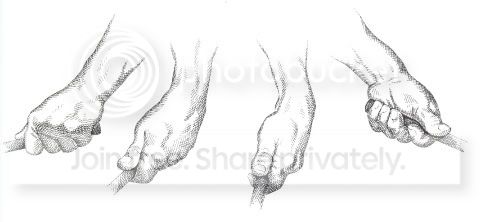
See page 99 and notice his Vertical Left Wrist in illustration #1. First Paragraph, page 101, is his great description of a Simultaneous Release assisted by Arching the Left Wrist. Look at the famous swivel sequence on page 102. The First Illustration having a Bent Left Wrist, the second, a Flat Left Wrist and the fourth illustration is clearly a Vertical Left Wrist. Page 106 illustrates his Downstroke sequence and #2 shows his Bent Left Wrist Downswing.

It appears to me that his swivel transformed an On Plane Left Wrist with Standard Wrist Action to "Single Wrist Action".

The illustration below is not "Time Sequenced". Viewing his video in slow motion reveals that the distance between hand position 1&2 is about 2 inches but between 2&3 as much as 6 inches. So his Left Wrist became Vertical long before Impact.


The following quote is taken from "The Secret" by Martin Davis. It's on the "Ben Hogan" golfclub website. (http://www.benhogan.com/legacy/book/chap2.html) 8th paragraph.

Quote:

The second adjustment, involving a twisting or cocking of the left wrist, was the more important one. On the backswing Ben would bend his left wrist backward and inward forming a slight V, thus opening the clubface to its fullest at the top of the backswing and not allowing the club to close quickly enough on the downswing to cause the dreaded hook.
Hogan revealed in life magazine that the "secret" involved cupping the left wrist at the top of the back swing and using a weaker left hand grip (thumb more on top of the grip as opposed to on the right side.... Hmm?, with a "weaker left hand grip", Elbow Plane, "Single Wrist Action", what better way to insure the clubface is prohibited from closing to much making the ball go left.

I didn't claim that BH Cupped his left wrist .....Ben Hogan did.

My claim is that while on an Elbow Plane, his cupped Left Wrist, weak grip, and his swivel, combine to transform a Standard Wrist Action to Single Wrist Action and prevented Hogan from "Bending the Delivery Line" because it allowed him a Simultaneous Release. A Simultaneous release won't bend the Delivery Line.

His early release allowed him the space needed to complete the swivel and create a vertical left wrist well prior to impact. Although the Left Wrist for Swingers and Hitters is considered Vertical for Impact, they don't become vertical in the same location before impact.

Quote:

Then understanding and executing the Left Wrist Action per 2-N-1, synchronizes the entire procedure. Trigger Delay alters little geometrical but magnifies the physics. The Paddlewheel Action of the straightening Right Elbow (10-10-C) initiates and sustains the #3 Accumulator Hand Motion (4-D-0) unit the Both-Arms-Straight and Zero Accumulator #3 position of Full Extension – but, of course, under the guidance of the Flat, Vertical Left Wrist Hinge Action (2-G). Accumulator #3 Action is not Lever Assembly Extension. See 2-P. With the Endless Belt Effect, The Belt (Hands) and the Clubhead have the RPM but the Surface factor sets in and gives the Clubhead greater MPH – in reverse proportion to the size of the Pulley (the smaller, the faster). That is, raised Hand Position – reducing the Accumulator #3 Travel –plus Trigger Delay. Conversely – a larger Pulley (lowered Hands) requires a higher Handspeed and an earlier Trigger. See 6-B-3-A, 6-F and 6-N-0.

O.B.Left 11-20-2009 12:40 AM

If one end of the club is pointing at the plane line you're good.

12 piece bucket 11-25-2009 09:23 AM

Quote:

Originally Posted by O.B.Left (Post 69140)
If one end of the club is pointing at the plane line you're good.

MAYBE . . . IF you don't disrupt #3 in the process . . . see Hogan.


All times are GMT -4. The time now is 02:40 PM.