
|
Perception of hands in space
Would appreciate some elaboration of how, from the player's point of view during the swing, the hands should be perceived as they approach and continue through impact. Primarily swinging, hitting also.
For a long time (prior to TGM), for me a go-to simple swing concept has been "make a smooth circle with the hands". Not literally, but an image that helps me keep my mind in my hands and on my effective rhythm. It still is, but with some TGM learning I am beginning to improve my understanding and implementation of this notion. I am improving the frequency of my more effective rhythm and my PP#3 accepting and sustaining lag pressure, and where I may best perceive my hands should be to optimize my sequence. Backstroke and transition seem to be fine, through impact is still a work in progress. A specific concern: approaching impact, the hands have a "down" component to their travel .... when does this component start to change to "up"? Thanks. |
Quote:
There is a HUGE relationship of the Hand Path to the Plane Angle . . . if you are swinging on a steeper plane your hands will move in a more vertical up to down fashion to comply with the Plane. If you are swinging on the flatter Plane Angles your are going to feel more "around" to comply with those planes. This also impacts the handle location as well and the #3 Accumulator Angle. Imagine what your hands are going to feel like if you swing like Nicklaus or Hoch vs. what they would feel like if you swing like Hogan or Trevino. Generally you don't feel "up" until after follow through . . . all strokes down and out until both arms straight. But keep in mind the "feel" and the "real" is going to be different for different planes. Also consider this . . . the steeper planes generally are going to have less #3 accumulator angle and thus the face is going to tend to rotate MORE with the Turning & Rolling. But generally you should FEEL DOWN to both arms straight . . . but it may be different for different Plane Angles . . . so test drive it and see how it feels and what works best for you. Look at the "handles" and #3 Angles . . . 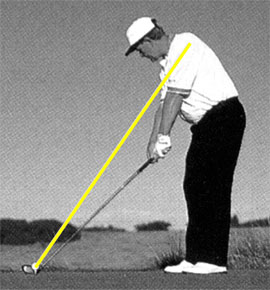 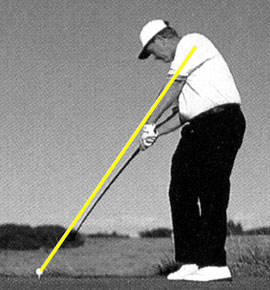 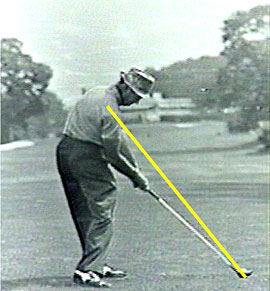 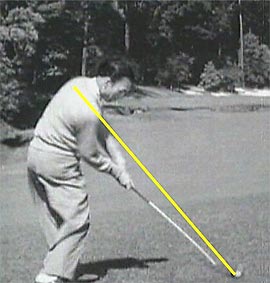 |
If the left shoulder has a distinct "up" component through impact and both-arms-straight might not fully occur until after the hands have passed the left shoulder (viewed side-on), then shouldn't the hands location begin to have a real and perceived "up" component passing the left shoulder?
(My full swing plane angle favors flat just a bit, on video it usually appears reasonably consistent and efficient. My current in-swing issues seem to be more about sequence, rhythm and balance ... elusive lag pressure, but I'm making progress. Still working on a chronic pre-swing problem of improperly aligning right of target, it's a perception-over-the-ball problem, that is all the AI I worked with two years ago left me with to work on, from behind looking down the target line his video of my swing showed the shaft getting on my right forearm soon and efficiently compared to most of his students. I fought a tendency to lay the shaft off just at the top, a compensation for a shoulder injury, it led to some inconsistencies, that glitch is much improved this past year.) |
Quote:
I'd say you'd want to feel down through the ball through low point through the aiming point and through both arm straight. At both arms straight generally your hands are coming back up plane but the feeling is down. |
"At both arms straight generally your hands are coming back up plane but the feeling is down."
Understood and agreed, however I'm thinking I'm overdoing the feeling. |
Quote:
|
| All times are GMT -4. The time now is 11:29 AM. |