
|
Horizontal hinging versus swivel
I am trying to understand what's the difference between horizontal hinging versus a swivel action.
In another thread, Bagger recommended that one fan the right forearm in the backswing when intending to perform a horizontal hinging action post-impact. I presume that fanning the right forearm during the backstroke causes the left forearm/arm to rotate in the takeaway thereby producing the start-up swivel action. Then, during the downswing, there is a release swivel action, which starts when the hands reach the delivery position - and this phenomenon seemingly is the reverse of the start-up swivel (from a biomechanical perspective) in the sense that the left hand undergoes a 90 roll (rotation) in the late downswing so that the back of the left hand faces the target at impact. Now, during horizontal hinging, doesn't the left hand continue to roll so that the back of the left hand ends up facing directly away from the ball-target line (= parallel to the ball-target line) when the clubshaft becomes parallel to the ground (mirror image of its delivery position). If correct, then horizontal hinging could be perceived to be a part of a post-impact swivel action that is really a continuation of the release swivel action, and that subsequently evolves into the finish swivel action. Is it incorrect to think of horizontal hinging as being part of a post-impact swivel action that seamlessly evolves into the finish swivel action? Jeff. |
Quote:
Swivel is an independent roll and turn of the hands. Hinge action is performed by the pivot rotating the arms and shoulders- it turns the hands in rhythm with the body. Toe up down the line via pivot. Do NOT swivel as a hinge action- take the hands out of impact. blend the two actions but don't use one as the other. Angled Hinge has a later finish swivel but is still performed by the arms and shoulders via pivot (hip action). Swivel to Impact-HINGE-Swivel to Finish LOOK ma- NO HANDS! :) |
6Mike
Thanks for replying. It is still not clear to me, because you state that the swivel is an independent roll of the hands. Independent of what? From my perspective, I can envisage the release swivel involving a 90 degree rotation of the left hand (from the delivery position to the impact position), but it is not clear to me that part of the rotation doesn't occur at the level of the left shoulder socket and orbiting arm. Likewise, when hitting short pitch shots, I can utilize different hinging actions which are not due to the pivot motion (which may be minimal), but due to an independent controlled left arm rotation at the level of the left shoulder socket +/- a certain degree of forearm rotation. Jeff. |
I believe the swivel is when the club face lays (parallel) on the inclined plane - back swing and follow through. The horizontal hinge action is at the bottom of the swing when the club face is more or less perpindicular to the plane slightly open, to square, to slightly closed). A lot easier to show in video or live than describe.
|
I have still not received an informative opinion that explains the biomechanical difference between a finish swivel action and horizontal hinging - with respect to the movement of the left hand.
Consider this particular problem from this angle. Here is photo of Kevin Na's clubhead path through the impact zone. 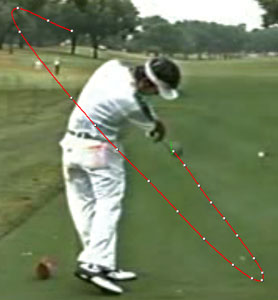 One can see that his splined clubhead path demonstrates that he is swinging his clubshaft on the inclined plane and that he is tracing the base of the plane line post-impact. At the same time, his clubface has rotated counterclockwise while the clubshaft is travelling on the inclined plane - and this represents his horizontal hinging action. HK states that it occurs due to rotary forces operating at left shoulder level, and one can imagine that there is a hinge joint horizontally oriented at the level of the left shoulder - as demonstrated in this TGM photo. 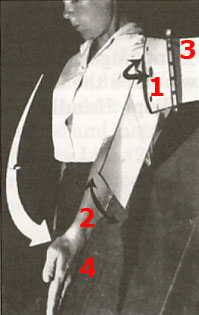 The effect of this hinge action is that the back of the left hand supinates slightly while it is moving up the inclined plane. Supination is a rotary motion, which means that the left hand is rotating during this horizontal hinge action phenomenon. Tiger Woods describes this "feeling" as the feeling of turning the knuckles of the left hand towards the ground after impact. He is therefore aware of a rotation of the left hand. That left hand rotation (supination) is no different to the more complete rotation (supination) that occurs fractionally later in time (during the finish swivel) as the left hand supinates more fully so that the back of the left hand lies against the inclined plane. The only difference is that the first left hand rotation (during the followthrough) primarily occurs due a rotation of the left shoulder socket left-backwards (as part of the torso pivoting action) + rotation of the left arm/forearm unit at the left shoulder socket level, while the second left hand rotation (during the finish swivel) primarily occurs due to left elbow folding and left forearm fanning combined with an active pronation of the right forearm. Although the biomechanical driving mechanisms are different, surely the left hand is rotating (supinating) throughout the followthrough and finish phases of the swing, and it is really a continuous rotary movement. Jeff. |
Quote:
Like many things TGM, you may be making the application of hinging more complex than it really is. But keep working on the biomechanic aspects because there are opportunities for further learning there. Homer differentiated Hinge Action from Swivel and even though they are tightly related, you can't describe swivel as a hinge action because they can be separate as well. For instance, you can have the appearance of a horizontal hinge swivel while executing angled hinging. Rhythm is intregral to the hinge action motion. Also keep in mind that clubface motion differs for each hinge action. Horizontal is closing only, angled is simultaneous closing and layback, and vertical is layback only. There will be a video up tonight of Jeff Hull demonstrating how he applies hinge action. The video was shot a few days ago at the ATT Classic while Jeff was on the practice range. It should help many peel a few layers off the onion. |
Bagger - I realize that one can choose not to have roll action (horizontal hinging) during the followthrough phase of the swing and that one can instead choose a non-roll action (angled hinging) or reverse-roll action (vertical hinging). However, I am interested in the biomechanics of left hand "roll" in the horizontal hinging action and in learning whether the left hand "roll" of horizontal hinging is any different to the left hand "roll" that occurs moments later during the finish swivel action, or whether they are a seamless left hand rolling action (occurring due to different biomechanical actions at different anatomical/biomechnanical levels).
I look forward to learning more from your "new" Jeff Hull swing video - when it becomes available. Jeff. |
Watch Antony Kim
http://www.youtube.com/watch?v=_jNRNRmS1pQ A foot before contact watch the club head go form open to close after contact. That is the Horizontal hinge. Just like a door opeing and closing. The left arm has not swiveled. As both arms go to straight the left arm swivels the the club face back on the inclined plane. Pretty amazing that Homer Kelley. |
Jeff, I have always seen the hinge action as a form of external rotation of the upper arm without independent action of the radius and ulna...
and swivel is primarily a radius and ulna action with minimal further external rotation at the left shoulder.... I think that you are saying something similar? |
mb606
Surely you are wrong to label the change in the clubface angle from open-to-close that occurs one foot prior to impact a horizontal hinging action. That surely is the release swivel action as it occurs pre-impact. Horizontal hinging occurs post-impact and one can see horizontal hinging occurring in Anthony Kim's post-impact swing (during the followthrough phase). What interests me about the left hand movement that occurs in the horizontal hinging action is that the left hand not only moves up the inclined plane - it also seems to supinate slightly while moving up the inclined plane, thereby causing the knuckles of the left hand to face slightly more groundwards during the followthrough phase of the swing. During the finish swivel, the left hand supinates much more (due to a different set of biomechanical actions). However, my interest in the left hand motion during horizontal hinging relates to whether the left hand supination (roll) phenomenon that occurs during horizontal hinging blends seamlessly with the left hand supination (roll) phenomenon that occurs during the finish swivel action. Golfbulldog I agree with your understanding of the different biomechanical mechanisms underlying the supination (roll) of the left hand during both horizontal hinging and the finish swivel. My main interest lies in the supination-roll "feel" that occurs during horizontal hinging and whether it blends seamlessly with the supination (roll) of the left hand that occurs during the finish swivel action. I also would like to know whether Nick Bradley's description of the puck release in his book "The Seven laws of Golf" is a description of the supination (roll) action that occurs during the horizontal hinging period and finish swivel period. Here is the photo showing his puck release swivel action. 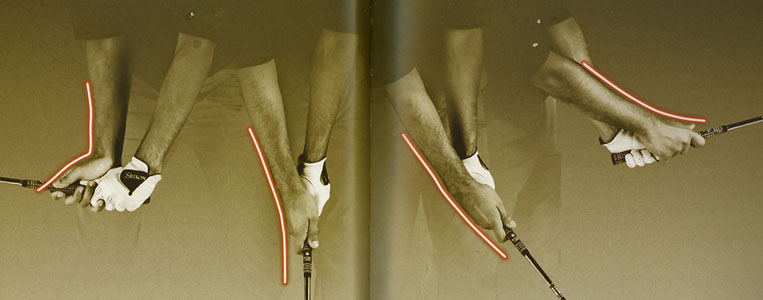 Jeff. |
| All times are GMT -4. The time now is 01:59 AM. |