I guess my point is that when you cock the left wrist (move it up and down), the right wrist must also cock (move up and down).
When you bend the right wriste (move side to side), the left wrist must also move side to side.
If both hands are on the club, I do not see how it is physically possible to not cock the right wrist, and not bend the left one.
Try splitting your hands on the grip. Keep the Right Wrist Level and bend your Right Elbow. Your Left Wrist will Cock and your Right Wrist will remain Level if you allow it to.
The Right Elbow Cocks the Left Wrist. Now just slide your hands closer together and do the same.
This is a KEY G.O.L.F. alignment that is the Right Forearm Flying Wedge and its LEVEL Right Wrist that DOES NOT COCK.
Try splitting your hands on the grip. Keep the Right Wrist Level and bend your Right Elbow. Your Left Wrist will Cock and your Right Wrist will remain Level if you allow it to.
The Right Elbow Cocks the Left Wrist. Now just slide your hands closer together and do the same.
This is a KEY G.O.L.F. alignment that is the Right Forearm Flying Wedge and its LEVEL Right Wrist that DOES NOT COCK.
I do not see how it is physcially possible to have both hands on the grip, cock your left wrist, and not have an up and down movement in your right wrist as well.
I am holding both hands out in front of me in a simulated grip on a golf club. I am cocking my left wrist up and down. Because the hands are connected, the right wrist must also move up and down.
I would like to see a video that shows this concept to me. I do not believe it is physically possible to do what you are saying. Ig the left wrist moves up and down... it seems the right wrist must follow.
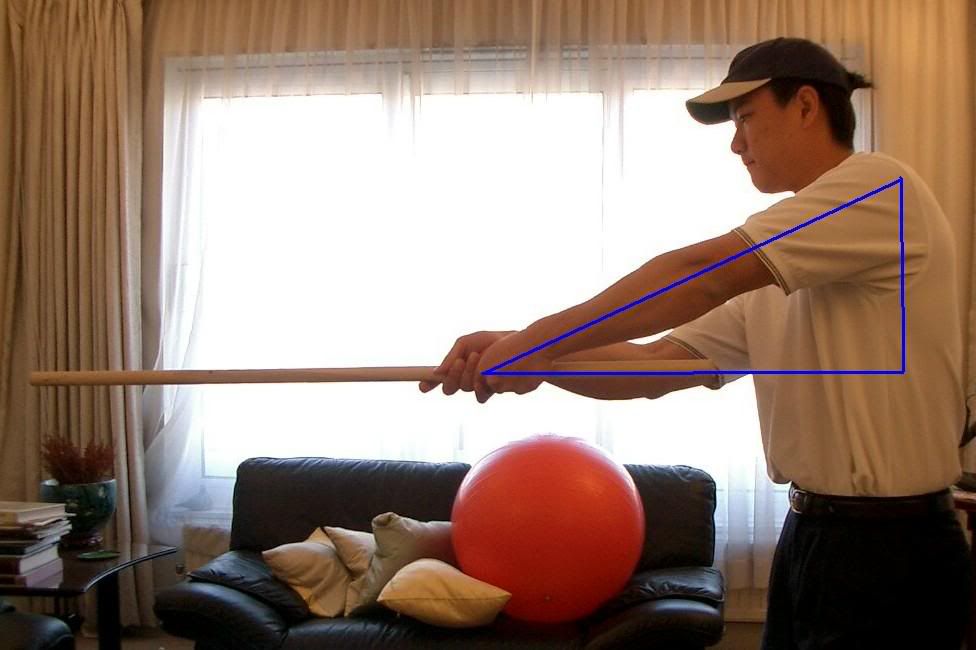
Both the left and right arm flying wedges represent the relationsip between the forearm and grip (a wedge shape or angle), but that angle or wedge refers to different parts of the forearm for each wedge. Grab a club with your normal left hand grip only. COCK the club up and down and notice the angle between the forearm and shaft. This is the left arm flying wedge.
Next, grab the club with only the right hand grip as Yoda demonstrates in the video (i.e. right forearm aligned with the clubshaft with the shaft in the palm of the right hand). Now BEND the right wrist back and forth and notice the angle between the club and the "underbelly" of the right forearm. This is the right forearm flying wedge.
Left wrist cocks but doesn't bend. Right wrist bends, but doesn't cock.
DukeNasty
Thanks, the fog is clearing but still a bit of haze. Why the reference to wedges-if a wedge is a static shape but the machine wedges are dynamic? It the intent to maintain one or both wedges?
I do not see how it is physcially possible to have both hands on the grip, cock your left wrist, and not have an up and down movement in your right wrist as well.
I am holding both hands out in front of me in a simulated grip on a golf club. I am cocking my left wrist up and down. Because the hands are connected, the right wrist must also move up and down.
I would like to see a video that shows this concept to me. I do not believe it is physically possible to do what you are saying. Ig the left wrist moves up and down... it seems the right wrist must follow.
Watch Chapter #3 The Hands from the Tom Tomasello video series found in The Gallery. You'll find the answer there.
Thanks, the fog is clearing but still a bit of haze. Why the reference to wedges-if a wedge is a static shape but the machine wedges are dynamic? It the intent to maintain one or both wedges?
CW
It's not the size of the Wedges that matter. For example, by changing the amount of Left Wrist Cock I can change the size of my Left Arm Flying Wedge. Or by adjusting my Right Wrist Bend, I change the size of my Right Forearm Flying Wedge.
The important thing is that the plane of the Flying Wedges remained undisturbed. Otherwise, you get some bent-looking Wedges. For example, if I Bend (4-A-2) my Left Wrist, that will deform my Left Arm Flying Wedge, so it's bad.
The Cocking motion of my Left Wrist is on a vertical plane, but the Bending motion is on a horizontal plane.
The Right Forearm Flying Wedge is on a horizontal plane. So if I make any Vertical motion (Cocking or Uncocking) with my Right Wrist, this will conflict with the plane of my Fight Forearm Flying Wedge.
As you can see, the planes of the two wedges are perpendicular or 90 degrees to each other. And as long as the Left Wrist remain flat, and the Right Wrist remain Level (4-B-1), the Wedges will still have this all-important 90 degree relationship with each other. This is true even if you Cock or Uncock your Left Wrist (keeping the Right Wrist Level, obviously) since this only changes the size of Wedge, but the vertical plane of the Left Arm Flying Wedge remains exactly the same.
That answers the questions I had. The wedges are dynamic in their respective planes. Your pictures in the new thread are great, I have a question re: pic 2 that I'll post there.
Should one attempt to maintain the flying wedges (particularly the right arm wedge) as long as possible on the downswing??
The wedges travel as a 'unit' during their motion, and yes, you should keep your wedges in place through both arms straight at least. The 'unit' rotates around PP#1, the 'tip of the triangle'.
Leo - I love the first pic - excellent alignments and a great perpective.
__________________
"Support the On Plane Swinging Force in Balance"
"we have no friends, we have no enemies, we have only teachers"
Simplicity buffs, see 5-0, 1-L, 2-0 A and B 10-2-B, 4-D, 6B-1D, 6-B-3-0-1, 6-C-1, 6-E-2




 Linear Mode


