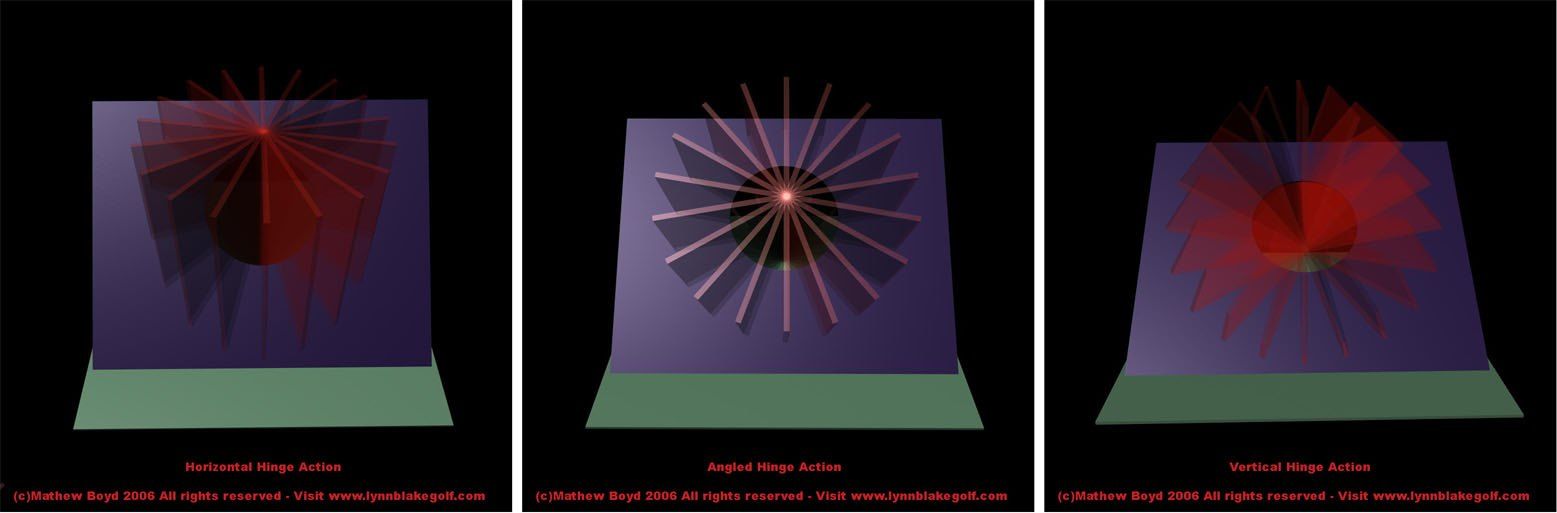
Nice pictures Mathew but theres still something that confuses me about hinge action. When i look at the right picture of the angled hinge i can see that it looks do-able as it lays flat on the plane. But the horizontal hinge seems to go through the plane. I just can't get my head around how you can do that and not change the plane to a flatter angle without independantly rolling your forearms?
Cheers,
Danny
Last edited by danny_shank : 09-07-2006 at 01:51 PM.
Yes,
but I think Lynn says that hinge action begins from impact and ends at followthrough. These pictures show that the way clubface comes into impact is different, too.
Yes,
but I think Lynn says that hinge action begins from impact and ends at followthrough. These pictures show that the way clubface comes into impact is different, too.
Coming to impact, the flat left wrist is put in a vertical condition by a partial kind of swivel (or just a not plane related roll), then hinge action starts (controlling the left wrist staying vertical to the hinge action associated plane) from the point where the vertical condition to the intended line of flight is reached.
I think less power leakeage can be found by :
at impact when the hinge action (clubface starts and mantains to be vertical all the time to its associated plane) if that hinge action and vertical condition to its associated plane is present in the swing a millisecond (or a considerable but not great ammount of time) before first contact with the ball. So from first instant the ball is in contact with the clubface to the end of contact when the ball leaves the clubface, hinge action is constant and during the whole time of that period, vertical to its associated plane. So if it is always vertical to the associated plane, less chance the contact point clubface-ball will be changed/lost. I think that is tru with angled hinging and maybe with vertical hinging. But with horizontal hinge action... the same clubface geometry during impact will give us with any hinge action a repeatable/similar ball flight trajectory. But if during contact the hinge action is started, perfect clubface precision is not mantained during the whole "moment of truth", or to the ball.
A horizontal hinge action may have more applied force but no ball flight precision (draw), because at impact the motion of the clubface has not stopped, and continues to apply forward(in direction to the target) motion to the compressed ball, although the clubface remaining vertical to the ground, the left hand/clubface rotation with maximized accumulator nº3 at impact time transmits more energy to the ball because the definition of horizontal hinging allows further rotation of the left flying wedge beyond the moment when reaching vertical position to the flight line and continues to rotate and move the clubhead forward to the target with that further roll in relation to the assembly that is accelerating or resisting to deccelerate. Not so much force obtained from a roll of an erratic-direction swivel action at impact, but horizontal hinging has more roll power at impact than vertical or angled hinge action.
The feel of a reverse roll.
The feel of no roll.
The feel of roll.
Coming to impact, the flat left wrist is put in a vertical condition by a partial kind of swivel (or just a not plane related roll), then hinge action starts (controlling the left wrist staying vertical to the hinge action associated plane) from the point where the vertical condition to the intended line of flight is reached.
I think less power leakeage can be found by :
at impact when the hinge action (clubface starts and mantains to be vertical all the time to its associated plane) if that hinge action and vertical condition to its associated plane is present in the swing a millisecond (or a considerable but not great ammount of time) before first contact with the ball. So from first instant the ball is in contact with the clubface to the end of contact when the ball leaves the clubface, hinge action is constant and during the whole time of that period, vertical to its associated plane. So if it is always vertical to the associated plane, less chance the contact point clubface-ball will be changed/lost. I think that is tru with angled hinging and maybe with vertical hinging. But with horizontal hinge action... the same clubface geometry during impact will give us with any hinge action a repeatable/similar ball flight trajectory. But if during contact the hinge action is started, perfect clubface precision is not mantained during the whole "moment of truth", or to the ball.
A horizontal hinge action may have more applied force but no ball flight precision (draw), because at impact the motion of the clubface has not stopped, and continues to apply forward(in direction to the target) motion to the compressed ball, although the clubface remaining vertical to the ground, the left hand/clubface rotation with maximized accumulator nº3 at impact time transmits more energy to the ball because the definition of horizontal hinging allows further rotation of the left flying wedge beyond the moment when reaching vertical position to the flight line and continues to rotate and move the clubhead forward to the target with that further roll in relation to the assembly that is accelerating or resisting to deccelerate. Not so much force obtained from a roll of an erratic-direction swivel action at impact, but horizontal hinging has more roll power at impact than vertical or angled hinge action.
The feel of a reverse roll.
The feel of no roll.
The feel of roll.
Not true. Hinge action itself is not power control but ball control. Angle hinging is no more or less powerful than Horizontal. And both control ball flight when the player understands what they do. Angle hinging naturally produces a fade- it has a natural power leakage as the ball rolls up and off the face because the clubface lays back a little and produces a cut. A player can close the face alignment and ball position and produce a different ball flight.
Same with Horizontal hinge action. HH naturally squares the face due to the throw-out of the clubhead. The ball leaves the face at 90 degrees, so where the ball is prior to square produces a flight pattern of the ball.
Either hinge action should control the ball to where the player wants it to go after they know how to do it.
Nice pics Mathew.
But for reasons that might be optical illusions the "motion" of the HH doesn't look to be parallel to the ground, and the "motion" of the VH doesn't look to be perpendicular to the ground. Shouln't they be?
Nice work anyway.
...and by the way, are you working on a 3D-"flying wedges" illustration? It would be supercool!
Nice pics Mathew.
But for reasons that might be optical illusions the "motion" of the HH doesn't look to be parallel to the ground, and the "motion" of the VH doesn't look to be perpendicular to the ground. Shouln't they be?
Nice work anyway.
...and by the way, are you working on a 3D-"flying wedges" illustration? It would be supercool!
Thom.....I did some work on 3D flying wedges. Unfortunately, The computer I did this with has crashed....but I still have a few pics saved online.
__________________
"Golf is not a subject but a motor skill which can only be learned and not taught." - Michael Hebron
"The Body, Arms and Hands have specific assignments during the Golf Stroke, and they must be coordinated into one efficient motion." - Lynn Blake
Not true. Hinge action itself is not power control but ball control. Angle hinging is no more or less powerful than Horizontal. And both control ball flight when the player understands what they do. Angle hinging naturally produces a fade- it has a natural power leakage as the ball rolls up and off the face because the clubface lays back a little and produces a cut. A player can close the face alignment and ball position and produce a different ball flight.
Same with Horizontal hinge action. HH naturally squares the face due to the throw-out of the clubhead. The ball leaves the face at 90 degrees, so where the ball is prior to square produces a flight pattern of the ball.
Either hinge action should control the ball to where the player wants it to go after they know how to do it.
Vertical- I don't use it much at all.
I take the risk of being right or wrong, but examine this:
Chapter 2 - Hinge Section:
The KEY to this Rhythm is the #3 Accumulator (6-B-3-0). As part of the above drill, hold the 45 degree Arm position while rotating the Hands and the #3 Accumulator through the three Hinging positions, over and over until you see that each position changes the LOCATION of the Clubhead. The Point to note here is that with each Hinge Action the #3 Accumulator has a different “In Line” motion – Dual Horizontal Hinging having the longest travel and Dual Vertical the shortest. This agrees with the “Roll Characteristics” discussed in 7-10 and must be so executed to produce proper Rhythm. Doing the above drill with Zero Accumulator #3 (6-B-3-B) will show that then, all Lag Loading and Hinge Action have Angled Hinging Travel AND Rhythm. So – intentional use of Zero Accumulator #3 can be useful while unintentional use can be hazardous.
The point I wanted to make in the previous post is that with horizontal hinging the clubhead will be have more kinetic energy at impact time.
My opinion is that hinge action is ball control but it is quite related to power.
6bMike, please explain why you said "Angle hinging is no more or less powerful than Horizontal" in comparison to the words Tom Tomasello in one of his videos says " 90 percent of the golf swings are horizontal hinging. That is the one you really need to master. To hit the golf ball straight, fall left, TO GET YOUR MAXIMUM DISTANCE." Roll power is involved more with horizontal hinging, than .. lets say vertical hinge action . In horizontal hinge action while the ball is compressed the clubhead continues to move toward the target. Looking impact interval while having the hands as reference point (not the left flying wedge) and with maximum nº3 accumulator.You can see that in horizontal hinging the clubhead moves ahead of the hands(as in the end of follow through) which means the clubhead having more velocity than the hands(mantaining a flat wrist).
And with vertical/angled hinging the clubhead does not pass the hands position at impact or after impact (eliminating finish swivel from this experiment). So vertical/angled hinging will have a clubhead moving forward with less velocity related to the hands velocity, than horizontal hinging's clubhead.
This site is about understanding golf and the golfing machine's studies, so everybody will be happy about the explanations here.
6bMike, please explain why you said "Angle hinging is no more or less powerful
than Horizontal" in comparison to the words Tom Tomasello
in one of his videos says " 90 percent of the golf swings are horizontal hinging. That is the one you really need to master.
To hit the golf ball straight, fall left, TO GET YOUR MAXIMUM
DISTANCE." Roll power is involved more with horizontal
hinging, than .. lets say vertical hinge action .
In horizontal hinge action while the ball is compressed
the clubhead continues to move toward the target. Looking
impact interval while having the hands as reference point
(not the left flying wedge) and with maximum
nº3 accumulator.You can see that in horizontal hinging
the clubhead moves ahead of the hands(as in the
end of follow through) which means the clubhead
having more velocity than the hands(mantaining a flat wrist).
And with vertical/angled hinging the clubhead does not pass the hands position at impact or after impact
(eliminating finish swivel from this experiment).
So vertical/angled hinging will have a clubhead
moving forward with less velocity related to the
hands velocity, than horizontal hinging's clubhead.
This site is about understanding golf and the golfing machine's studies, so everybody will be happy about the explanations here.
A couple of things- lets take the Vertical Hinge (VH)
off the table. I can’t remember the last time I used it.
It is at best, used for small shots around the green,
so yes; a Horizontal Hinge (HH) will be more powerful.
Hinge motions and actions are NOT part of the
power package- it is ball control. The motion of a
Hinge is a few inches- not much power in that.
The Hinge Motion, ball position and delivery path, controls the ball.
Swinging uses HH, Hitters use Angled Hinging (AH) –
both strokes have power, not because of the Hinge
but because of the physics of the swing- how the power, through its alignments, impacts on the ball.
Homer said to learn all the Hinges so you can
feel the difference among them- knowing one Hinge motion
would not teach you anything. So when Tomasello said
the only one to master was HH, I hope he wasn’t saying
that AH and VH was not to be learned.
Homer also wrote that Swingers will feel the Roll of the
hands used to throw out the club as one big HH action.
FEELS like but isn’t. You are feeling the Roll Line Prep-
the natural throw out from Centrifugal Force as the hinge Action.
Hitting. Few driving ranges can hold a ball hit by Ted Fort-
a pure Hitter, ball crusher. His AH action is not the
power source- he would not Hit it further with HH action.




 Linear Mode


