Although I can understand the mechanical logic of moving the right shoulder parallel to the downswing plane (eg. elbow plane), I would imagine that one's ability to do so depends on spinal flexibility.
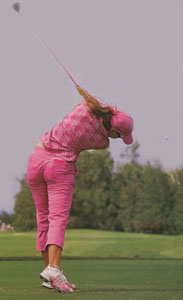
Here is a photo of Paula Creamer during the downswing.
She has amazing spinal flexibility and can tilt her right shoulder significantly downwards. I think that middle-aged/elderly male golfers are severely handicapped in terms of spinal/torso flexibility. Is there a suitable compensatory movement that can help them?
Jeff.
Tell me what you think she is doing and ill tell you why its wrong from pure logic....
This is why I hate discussing things now. I do not mean to be condescending but there is nobody which is on my intellectual par to discuss with anymore. Not because people couldn't be but because no one really wants to put the effort to really understand the deep relationships that occur and constantly I get things like this - resorting to pictures that show some weird offplane motion isn't debate.
Tell me what you think she is doing and ill tell you why its wrong from pure logic....
What she's doing is winning a lot of money with that swing. Her swing works. Don't say why it's wrong, tell us how it's right.
Once loaded the right shoulder is better off staying on plane throughout the downswing...no? Maybe not always on the same plane as the pp3 at impact..ie. the shoulder does not have to be on the same elbow plane as pp3might be using at impact....but it can still be on plane....ie tracing??
Once loaded the right shoulder is better off staying on plane throughout the downswing...no? Maybe not always on the same plane as the pp3 at impact..ie. the shoulder does not have to be on the same elbow plane as pp3might be using at impact....but it can still be on plane....ie tracing??
So what I think your saying is that you believe the right shoulder can stay on a singular plane throughout the downstroke.
Ok think of it this way - you have a stationary point fixed in space and lets just for the sake of simplicity take that as the point between the shoulders. For any specific plane angle this stationary point is going to be a set distance above the plane. Now each shoulder is a set distance apart from this stationary point. If the right shoulder is on one specific plane angle then the left shoulder is going to be moving parallel and twice the height above the plane as the distance that the right shoulder and the stationary point.
Now an exercise - Visualise this and tell me whats wrong with the idea...
You wrote-: "Tell me what you think she is doing and ill tell you why its wrong from pure logic...."
OK. I notice that her shoulder turn angle in the photo is roughly on the same plane angle as her clubshaft in the photo. So, I presume that she is turning her shoulders in the downswing along a plane angle that is very close to being parallel to the inclined plane angle that her clubshaft will travel along when it passes through the impact zone.
You wrote-: "Tell me what you think she is doing and ill tell you why its wrong from pure logic...."
OK. I notice that her shoulder turn angle in the photo is roughly on the same plane angle as her clubshaft in the photo.
So you think the club, r shoulder, l shoulder, stationary point is somehow working on the same plane. Well ...obviously this is not happening on the downstroke nor is it happening at the top of the backstroke.
Quote:
So, I presume that she is turning her shoulders in the downswing along a plane angle that is very close to being parallel to the inclined plane angle that her clubshaft will travel along when it passes through the impact zone.
Jeff.
So which now is it - is it parallel or is it on the same plane? You can't contradict yourself in the same post.
You can't take what I wrote and use a picture and say that it is mean't to be an exhibit to disprove me and now say this is an example of it (still not getting it right) just after making some statement about both shoulders and the club being onplane.
Tell me what you think happens in her stroke from the top of the backstroke where the right shoulder is on the inclined plane and then the left shoulder and stationary point is above the inclined plane to the picture in question and then tell me what you think it is mean't to portray.
I simply think that HK correctly implied that the right shoulder should move downplane during the downswing to support the clubshaft and that it should be tracking close to parallel to the inclined plane in the late downswing and early followthrough. That's what I think Creamer is doing. I think that it is physically impossible for the right shoulder to move on the same plane as the clubshaft (eg. elbow plane) because the human body cannot contort to that degree. It is my understanding that HK merely implied that when the right shoulder moves downplane, that it should move as close to parallel to the inclined plane so as to better support the movement of the right forearm/clubshaft.
I also think that it is physically impossible for the right shoulder to move steeply downplane at the very start of the downswing. I think that the pelvis has to shift left-laterally first, so that secondary spinal axis tilt is produced, and that those biomechanical events allow the right shoulder to move more steeply downplane later in the downswing. During the early downswing, the right shoulder has to move around along a less steep angle.
"The Push of the Right Shoulder accelerates the Swinger's Left Arm and
causes it to Pull the Hands and Club (6-B-4-0). The direction of that
Pull is toward its source (the Pushing Right Shoulder). Therefore, when you
Turn your Right Shoulder Down Plane (toward the Ball), i.e., 10-13-D #3 per
2-H, 2-L and 6-E-2-1, that is the direction taken by your Left Arm and Club
-- the Golfer's Flail (2-K)."
Lynn Blake words above, my bold...
10-13-D On-plane shoulder turn...Homer Kelley's words and photos...dianne's pics show the right shoulder moving down the turned shoulder...single plane throughout the downstroke..."the right shoulder moves toward timpact precisely on the preselected downstroke clubshaft plane..."
Homer Kelley's words above...
These words seem to have established in my mind that the right shoulder moves on a single plane on the downswing...now I will go back and read Matthew's words again...
PS. guys - the thread was about plane of left wristcock...and left arm.... it has been interesting chat so far...very illuminating but maybe we need a 2-H thread for shoulder motion as a whole?
So what I think your saying is that you believe the right shoulder can stay on a singular plane throughout the downstroke.
Ok think of it this way - you have a stationary point fixed in space and lets just for the sake of simplicity take that as the point between the shoulders. For any specific plane angle this stationary point is going to be a set distance above the plane. Now each shoulder is a set distance apart from this stationary point. If the right shoulder is on one specific plane angle then the left shoulder is going to be moving parallel and twice the height above the plane as the distance that the right shoulder and the stationary point.
Now an exercise - Visualise this and tell me whats wrong with the idea...
Why is there a stationary point between my shoulders?
Why do you interpret Homer's words as NOT stating that the right shoulder should turn on a single plane on the downswing?
He called the downstroke shoulder turn "on plane"....as in 10-13-C...really hard to interpret that as anything other than on plane...TSP as recommended in 12-1-0 and 12-2-0....
To restore civility to this thread, I have deleted in full several offending posts and have edited others to remove insensitive and inflammatory remarks. For now, the thread remains open based on the merit of its content.
We at LBG take very seriously violations of the site's collegial atmosphere, and disrespective behavior of any member toward another will not be tolerated. Membership at LBG is a privilege, not a right, and we will not hesitate to suspend or even revoke permanently those privileges should the violations continue.




 Linear Mode


