When is the clubshaft on plane during the downswing?
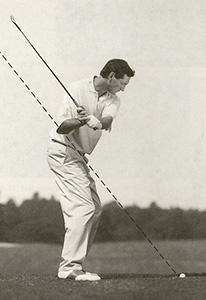
There are many TGMers who would state that the clubshaft is "on plane" when the end of the clubshaft that is nearest to the ground points at the ball-target line (or its extension) at all time-points during the downswing, when it is not parallel to the ground. That means that the clubshaft end should always point at the ball-target line even when it is shifting planes during the downswing. So, for example, many golfers shift planes from the turned shoulder shoulder plane (at the start of the downswing) to the elbow plane (at impact) and HK's "on plane" idea is that the clubshaft end should always point at the ball-target line even while it is shifting planes. However, I presume that this is not an ironclad rule, but a generally useful guideline.
Hank Haney has his own idea of being "on plane". He states that when the clubshaft is on a plane that is above the clubshaft-at-address plane, that the clubshaft should always be parallel to the clubshaft-at-address plane. Therefore, according to Hank Haney's model, when the clubshaft is shifting from the turned shoulder plane to the elbow plane in the downswing, it should always be parallel to the clubshaft-at-address plane. Haney calls these parallel planes "congruent planes".
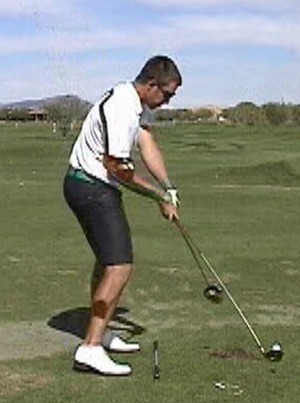
Here is a photo showing Hank Haney demonstrating his parallel clubshaft plane idea.
Note that the butt end of the club doesn't point at the ball-target line, so Hank Haney's idea of being "on plane" is incompatible with HK's idea of being "on plane". It would seem to me that neither Hank Haney or Homer Kelley has an ironclad theoretical justification for their "on plane" theory, and that it is only a rough guideline. It would seem to me that the clubshaft's behaviour will fit in more with Hank Haney's model during the early/mid downswing if the hands (and therefore) clubshaft drops down (groundwards) more per unit time than the left arm rotates counterclockwise per unit time, and that it is individual golfer-dependent. Consider three golfers.
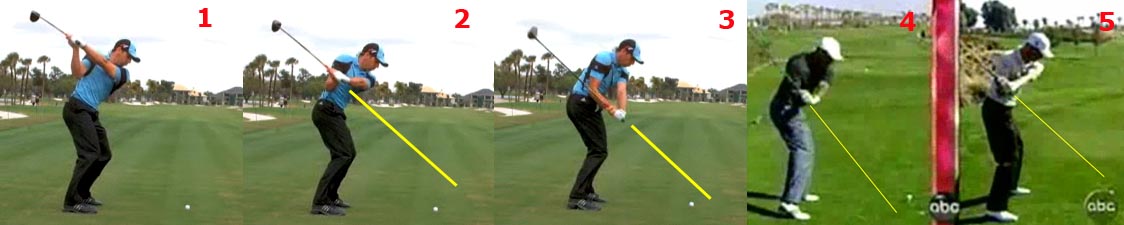
Images 1-3 show Sergio Garcia at varying time-points in the early/mid downswing, and you can see that his clubshaft is nearly parallel to the clubshaft-at-address plane. In other words, he better fits Hank Haney's model simply because his hands drop more per unit time (relative to the degree of left arm counterclockwise rotation per unit time) than the "average" professional golfer. Image 4 shows Tiger Woods and image 5 shows Adam Scott, and neither of their clubshaft-ends precisely points at the ball-target line, but they are closer to the HK model. From my perspective, it only means that their clubshaft is dropping groundwards less per unit time (relative to the degree of left arm counterclockwise rotation per unit time) than Sergio Garcia's clubshaft, and that it is only an individual golfer characteristic.
In other words, there is seemingly no "fixed" rule that specifies how much the hands should drop per unit time (relative to the degree of left arm counterclockwise rotation per unit time) during the downswing. The only critical time point is when the hands reach a below-waist-level position, and at that time point the clubshaft should point at the ball-target line so that the final clubshaft release can be "on plane" (as can be seen in this photo of Aaron Baddeley).




 Threaded Mode
