Either way can work, as along as the pivot is tightened up and the upper body and the lower one move in synch.
Otherwise, it's a "Throwaway" of "Pivot Lag".
__________________ Yani Tseng, Go! Go! Go! Yani Tseng Did It Again! YOU load and sustain the "LAG", during which the "LAW" releases it, ideally beyond impact.
"Sustain (Yang/陽) the lag (Yin/陰)" is "the unification of Ying and Yang" (陰陽合一).
The "LAW" creates the "effect", which is the "motion" or "feel", with the "cause", which is the "intent" or "command".
"Lag" is the secret of golf, passion is the secret of life.
Think as a golfer, execute like a robot.
Rotate, twist, spin, turn. Bend the shaft.
I understand why you are offering me that advice. A bigger hip turn in the backswing allows one to get the hands deeper and further back in the backswing. I have tried that maneuver. It does help me get my hands slightly deeper and that's advantageous.
However, I have zero hula hula flexibility, and if I over-rotate the pelvis during the backswing, then I have to perform a greater amount of rotary pelvic movement during the hip squaring phase of the downswing, and that really throws my right shoulder into a roundhousing action that causes me to come wildly OTT (due to my lack of hula hula flexibility).
Jeff.
Boss . . . . That don't make sense . . . . when you DON'T rotate your hips what do you do? Looks like if you don't turn your hips and you spin then you would even MORE wildly swing your hands over the top. The hip turn would give you more "lattitude" to spin because you have more "range" to cover before you hands get too far out to be actually over plane. There's a difference between over the top and swing over your backstroke. Most players hands go over where they did in the backstroke.
Try this . . . . make a bigger hip turn and DON'T TURN AT ALL . . . just go FORWARD and release #4. Not to get this debate going . . . but it sounds like you have no trouble spinning . . . so go forward and swing your arms down (sorta like Tomasello).
Not releasing #4 and spinning is a big recipe for shooting the hands off the plane. Your hand have to go DOWN THE FACE of the plane . . . .a big piece of that is releasing #4 (master accumulator and all) . . . that with tilting your axis.
I think you got hula hula way mixed up . . . . can you stand up straight and scratch your right thigh below you pants pocket?
Nah I wasn't thinking postion...BUT I was wrong nonetheless. On second looksy it looks fine and dandy. I jumped the gun. I think it was a Rorschach kinda deal...I lose my alignment by getting a bit archy...so therefore everybody does! Other than gripping down on a dowel left hand only what other drills do we have for keeping the LFW intact? My tendency I think is to add more right wrist bend than I need...it is a bit of a bugger!
I concur with Doctors Bucket and Yoda. Your Sir have a stuck right hip which can lead to a severe roundhousing on the way back and on the way down.
Here for what its worth are some screen captures from Greg McHattons blob man showing an overhead view of the Wee Iceblob's right hip in a full swing.
The lowest part of the curve is preceded by a south westerly 45 degree angle....this is the move V.J. described where the Hawkblob's right hip is still turning back as he slides his hips laterally to tilt his axis. All of this achieved prior to start down.
Being a swing physician myself I would like to prescribe the following pills:
-MacDonald drill #6. Prior to going to bed every night or before a golf swing or thought of any kind.
-Moe's swing thought #26. When taking the MacDonald Drill #6's. They are in fact the same medication although the #6's have more information and are therefor more medicinal.
-Start Down Waggles. With milk, the right hip held back and your axis tilted. Two times after every pull shot or bent to the left plane line.
-Extensor Action. As often as possible unless you are operating a motor vehicle or employing a lagging takeaway. The right shoulder will not be able to hit the shot properly without it. Swinging or hitting.
Jeff you just gave me something to look at. I can't stop coming over the top especially with the longer clubs. The only way I can remotely control my OTT tendency's is to stop my backswing short and keep my hands low. Your elbow description may be the little thing I need to focus on and change. Normally my elbow flies back behind my shoulder and back. I took some practice swings in the house focusing on the elbow and not letting it get back behind me. It really felt like I was flinging the right arm unlike before. It feels weird but at the same time it felt a lot smoother. I can't wait to look into this on the range.
Thanks
**Edit** Just came back form the range. The elbow thing wasn't the magic OTT driver cure I was hoping for. With that being said, I seemed to hit the wedges a little more accurate as well as the irons. It seemed I was making a smoother swing and a little cleaner contact. I was still pulling the driver... UGGGGHHH. I guess I'll wait till Christmas so I can finally unwrap and view the Alignment Golf DVD. Hopefully I'll then be able to diagnose what's going on here??? Back to the 4w and hybrid off the tee box...
It is my mistake for posting that capture frame from a swing video lesson where I didn't turn my hips but just assumed a hitter's end-backswing position to demonstrate a point in my swing video lesson on hitting (for my personal website).
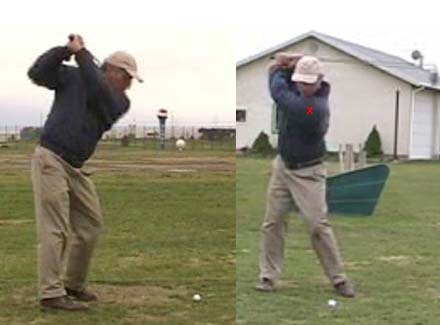
Here are capture frames from a swing video of my driver swing.
I think that I get an adequate hip turn. However, I cannot get my left arm across my chest and my hands far enough back, so my left arm bends at the elbow and also slides up my chest (off plane) and my hands get too high above my neck causing an across-the-line clubshaft position. I placed a red X to show you where my left humeral head is located.
I didn't want to focus on my personal (imperfect) swing. I merely wanted to talk about biomechanical factors that may cause a golfer to choose a reactive pivot swing rather than an active pivot swing.
I think that if you consider my test for determining hula hula flexibility, that I am correct to state that I have zero hula hula flexibility - defined as an inability to turn the hips forward in the downswing without immediately feeling the shoulders turn passively due to forces transmitted up the spine. If someone holds my right shoulder back in that test, then I cannot rotate my pelvis forward even 1 inch.
Here is another biomechanical factor that I have never seen discussed re: limitations in getting your hands far enough back in the backswing - a limitation being due to left scapula movement limitations rather than an inability to rotate the upper torso. I think that many people regard a shoulder turn as being equivalent to an upper torso turn. However, I think that the left shoulder socket can move >3-4" further than the upper torso turn due to the sliding of the left scapula forward.
Here is an example.
Anthony Kim
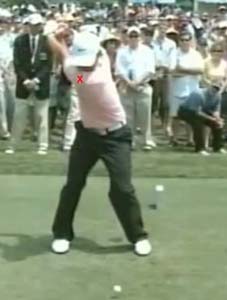
Here is a capture image from that video
I have placed a red "x" at the location where I think that his left humeral head is situated. Can you see how much he can slide his left scapula forward across his left upper back thus allowing his left shoulder socket to get far more around to the right (compared to me).
I personally have far more limitations in left scapula movement than upper torso rotational movements and it is the main reason why I cannot get my left arm/hand far back.
It is my mistake for posting that capture frame from a swing video lesson where I didn't turn my hips but just assumed a hitter's end-backswing position to demonstrate a point in my swing video lesson on hitting (for my personal website).
Here are capture frames from a swing video of my driver swing.
I think that I get an adequate hip turn. However, I cannot get my left arm across my chest and my hands far enough back, so my left arm bends at the elbow and also slides up my chest (off plane) and my hands get too high above my neck causing an across-the-line clubshaft position. I placed a red X to show you where my left humeral head is located.
I didn't want to focus on my personal (imperfect) swing. I merely wanted to talk about biomechanical factors that may cause a golfer to choose a reactive pivot swing rather than an active pivot swing.
I think that if you consider my test for determining hula hula flexibility, that I am correct to state that I have zero hula hula flexibility - defined as an inability to turn the hips forward in the downswing without immediately feeling the shoulders turn passively due to forces transmitted up the spine. If someone holds my right shoulder back in that test, then I cannot rotate my pelvis forward even 1 inch.
Here is another biomechanical factor that I have never seen discussed re: limitations in getting your hands far enough back in the backswing - a limitation being due to left scapula movement limitations rather than an inability to rotate the upper torso. I think that many people regard a shoulder turn as being equivalent to an upper torso turn. However, I think that the left shoulder socket can move >3-4" further than the upper torso turn due to the sliding of the left scapula forward.
Here is an example.
Anthony Kim
Here is a capture image from that video
I have placed a red "x" at the location where I think that his left humeral head is situated. Can you see how much he can slide his left scapula forward across his left upper back thus allowing his left shoulder socket to get far more around to the right (compared to me).
I personally have far more limitations in left scapula movement than upper torso rotational movements and it is the main reason why I cannot get my left arm/hand far back.
Jeff.
Jeff . . . . I don't know if I get your test deal . . . dude you have plenty of differentiation of the hips shoulders on that backstroke! Just do the same thing on the down stroke??? Actually if you compare where your upper spine is to Kim's . . . you're not in that bad of a spot. Looks like you just slid your hips too much. Straighten your right leg a little (Standard Knee Action). Your arms are probably getting blocked from going back up and in because your right hip is in the way.
Also your arms are getting way lifted off of your chest . . . I mean if you want to get on the turned shoulder plane that's fine but you got some excessive lifting. Feel like you have somebody holding a dowel directly behind you and touching you at the bottom of your neck. Swing the club under that. You'll have to get your hands in and deeper. And your right elbow won't shoot up and off your body as bad.
That's a big part of your OTT issue. If your hands are "high" and you spin they shoot over really fast. So you have to slide EARLY and A BUNCH to keep them on the plane. A lot of that has to do with right elbow location. You need to feel like you are swinging in a room with a 6 foot ceiling.
See how right elbow location effects the plane angle? Also to keep the hands from flying out over the plane you have to SLIDE to keep the hands from flying OUT over the plane . . .PLUS you have to release #4 FAST FAST FAST . . . Furyk releases #4 as fast as anybody in the game. Hogan had a really fast release of #4 too . . . but notice that he doesn't have that much range to cover to keep his hands coming down his selected plane. Check Snead's start down . . . he doesn't release #4 as early and shifts it OUT more . . . Then down the plane.
__________________
Aloha Mr. Hand
Behold my hands; reach hither thy hand
Last edited by 12 piece bucket : 12-03-2008 at 10:46 PM.
Snead #4 isn't releasing at the same rate as Hogan nor are his hips going as much forward as Hogan's. Look at where their hands are relative to each other at about the same spot in the motion as they start down . . . hogan's hands are in more and lower (#4 and more hip slide) relative to Snead.
__________________
Aloha Mr. Hand
Behold my hands; reach hither thy hand
Last edited by 12 piece bucket : 12-03-2008 at 10:59 PM.




 Linear Mode


