
|
Only Vertical Pivot Hinge Pins
Quote:
Draw the yellow line vertical (to the ground) from what you perceive to be the Stroke Center (Turned Head or 'Point Between the Shoulders). :) On second thought, given the bias in your last rendering, just draw it from the 'Point between the Shoulders'. :laughing9 |
Imperfect
Jeff,
One last thing... you should put a disclaimer on your vids about your self-proclaimed inability to demonstrate about which you speak... be it accurate or not. Don't leave it up for someone to guess that "Imperfect Golfer" means "what you see is not what I mean" ..... I would expect more from someone who prides themself on the accuracy of their written word. It might give the viewer the proper perspective to use while viewing. I for one am quite wary of those that can't demonstrate what they believe should be happening in a golf swing. You just added another reason to think that way. CG |
Cometgolfer
This is my last post concerning my personal website, which is merely a pet hobby interest. If anybody wants to discuss it, they can send a PM. I am here to discuss HK's ideas and learn more about the TGM system. I have made a disclaimer in my first swing video about my visual demonstrations not being accurate. Secondly, I am not an "TGM expert". My website represents my personal views, and it is is only TGM-influenced. It is not ever going to be a TGM website. You wrote-: "I for one am quite wary of those that can't demonstrate what they believe should be happening in a golf swing." Many, many people have expressed similar sentiments. That's fine. They should all ignore my opinions re: golf instructional material. You wrote-: "Please make sure you get the Gulbis sequence on there as well to support your theories." That statement reflects your character, and therefore your opinion doesn't represent a constructive comment that will help me make my personal website more accurate. Jeff. |
Yoda - I drew the yellow line exactly as HK specified in that sentence - between the top of the stationary head and a point on the ground precisely between the feet.
By the way, is the true swing center for all components the same swing center as the pivot center? Jeff. |
Quote:
Secrets in the sauce. O.B. |
Quote:
|
Thinking Man's Game
Quote:
"G.O.L.F. is a game for thinkers, and as detailed as this book is, it is still geatly dependent on thinking players" (1-G).:golfcart2: |
If the stationary head must be precisely centralized between the feet, and the hinge pin for the pivot center's rotation must be a vertical line drawn from the top of the stationary head to the ground, then the hinge pin line will simply be a vertical line drawn precisely between the feet with the pivot center located on that line at address.
That's why I think that most golfers (like Tiger Woods) do not have a pivot center in their swing. Jeff. |
Quote:
What do you mean your "final 18 posts". Did Bagger decode your evil hacker (and I mean this strictly in the computer sense of the word, respec) ways? O.B. |
Quote:
You're the one who muddied the LBG site with Gulbis as your "new-and-improved" version of pivot center being the "set distance of the left shoulder socket from the ball at impact". I'm not sure why my request that you post that same swing sequence on your website as a reflection of your understanding of a proper golf swing is now an indicator of my "character"? Sounds like more imprecision on your part. It would be a shame if your "pet hobby" messed up other people's hobby. CG |
Thin Ice
Quote:
Have you even bothered to look at your own 'Big Three'? Gary Player 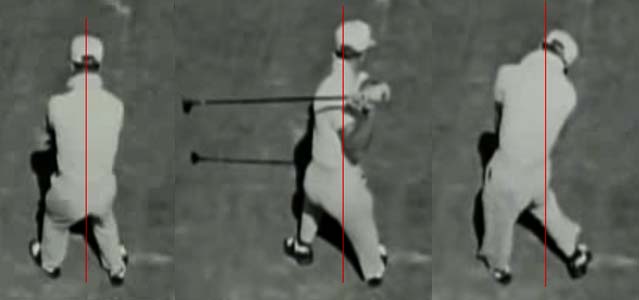 Arnold Palmer 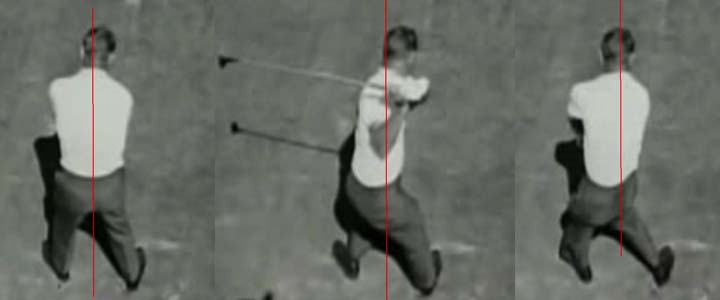 Jack Nicklaus 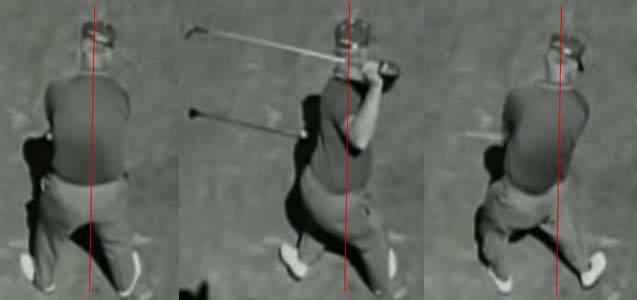 Assuming you may actually be interested in words other than your own, read my post #16 -- learn something -- and stop tilting at windmills. Meanwhile . . . Talk to The Hand. :hand: P.S. I don't know about the rest of you guys, but I'm all of sudden missin' DG! :laugh: |
Quote:
The premise of the book is that it is a machine, a golfing machine that we are trying to build. It doesnt take much to see the need for balance and a vertical c.o.g line about which to rotate. Like the spinning top. Now if you did have a machine that wobbled about at its top, which of the following would you prescribe in an effort to increase its efficiency: - More securely set its moorings to the floor in effort to stabilize it. Albeit with the knowledge that the wobble will still make for some inefficiencies, abnormal wear and tear, production delays etc etc. -Leave it to wobble around on the floor. See the Creamer, Gulbis machines and how they wobble about at their connection points to the floor at impact. (They are both on their toes). -Balance the machine so there is no wobble at the top and then for good measure secure it to the floor anyways (with some custom Maxwell golf shoes from England perhaps). Aye, now thats a Machine lad! O.B. |
Quote:
Hannah: "Maybe you're over pleasuring yourself or something?" Woody Allen: "..now your going to start knocking my hobbies?" Woody Allen, "Hannah and Her Sisters" |
At the risk of being far too basic for you guys...
The drill "Steady Head Drill" on the 2nd disk of Alignment Golf shows this perfectly. Lynn discusses keeping he head centered while creating tilt by moving the hips a little forward. This actually gives the illusion of the head being back, but Lynn shows us that the head is still centered between his feet. Homer Kelley's text along with Yoda's demonstration is good enough for me, I want as few compensations in my motion as possible! :golf: Kevin |
OB left
You wrote-: "Your looking at his driver swing, I believe. His iron swing is more balanced, centered if you will. No wobble at the top. The premise of the book is that it is a machine, a golfing machine that we are trying to build. It doesnt take much to see the need for balance and a vertical c.o.g line about which to rotate. Like the spinning top." I agree with your position about having a centralised swing and the idea of minimising any sway/wobbling. Tiger Woods stays more centralised, with less secondary axis tilt, in his short iron swing - compared to his driver swing where he has far more secondary axis tilt. I made that point in a previous post where I stated that I believe that a stationary head is a marker of a stable pivot structure. I compared Mike Bennett to Anthony Kim, and I stated that Mike Bennett's COG remained closer to the center and that one could conceive of him having a very centralised pivot center and a very centralised pivot axis - like a spinning top. I think that it's a much better technique than the idiosyncratic technique of Natalie Gulbis. Natalie Gulbis is to Mike Bennett (re: centralised pivot axis and stationary head) like Jim Furyk is to Anthony Kim (re: keeping the clubshaft on-plane during the backswing). One can get away with atypical moves, but that requires a compensatory adjustment action. I prefer staying as close to the TGM model as possible. I simply don't think that HK's idea of a "stationary head" mandates a pivot axis in the center of the stance. I think that for driver swings (where one places a premium on distance) that certain golfers may prefer to have their stationary head (which stabilises their pivoting skeletal structure) just to the right of the center of their stance - like Anthony Kim. That allows them to have more secondary axis tilt and still remain stable and balanced. Jeff. |
Quote:
I don't see how it allows more secondary axis tilt. It just means you have to change your tilt less in the downswing, it does not change the range of motion. The modern "got to have it now" generation. A bunch of teachers see axis tilt at impact in good players and don't in poor players, so they preset it at address (reverse K), instead of teaching people how to change the axis tilt dynamically. It is just fine with a ball high on a peg. And there are other compensations one can make to hit the ball off the ground. But why? |
Jeff
You wrote..........a frig it. Couple of notes: -as per another one of your threads, axis tilt as defined in TGM assumes the head is centered. The ability to do this is a display of "Hula hula flexibility" with the hips and a resulting tilt of shoulders. -the head back move, I think, is a compensation regardless of who is doing it. It allows more time for the primary lever assembly to lengthen by moving low point further back in the stance. A common move for junior golfers who cant support the increasing mass of the levers extension with their power packages or throw out action. A moved that once learned is hard to break especially for the physically weaker adult golfer be they male or female. This is C.O.A.M. as Homer defined it (6-C-2-B) and as it should be applied when building your own machine. The reason we release a driver earlier than a wedge for instance. The reason some hang back. A reason for kids clubs. You could with a long enough lever move the world but who here amongst us could move a lever of that length? I played with a guy who overcame his driver yips by cutting it down to 5 iron length. He didnt seem to lose much distance. Where is Golfgnome? O.B. |
O.B.Left,
I hope you guys don't mind the thread jack, but your driver yips comment hit close to home... I quit the game this summer because of the driver yips. I couldn't even hit drivers on the practice range, buildings and other golfers weren't safe, and I didn't want my members to see me, I needed to give a few lessons and didn't want them to see how bad I was hitting it... :) I solved the problem by beginning my journey of learning TGM, finding out that I had lost ALL MY LAG PRESSURE, along with losing all sensation of where the club-head and club-face were, and working with the Pure Ball Striker while reading the yellow book to get the lag feeling back. Sorry if that looks like a plug, but I consider it as a public service announcement. It has allowed me to play golf again, Just in time for the snow. :) Now so it doesn't look so much like a thread jack, I'm keeping my lag pressure through the line of compression, with a steady head placed right between my feet, and striping it! Kevin Quote:
|
O.B.
You wrote-: "as per another one of your threads, axis tilt as defined in TGM assumes the head is centered. The ability to do this is a display of "Hula hula flexibility" with the hips and a resulting tilt of shoulders." I don't understand why axis tilt implies that the head be centered. I prefer Yoda's advice given in post#16. The head position is dictated by the head position at impact. If one has a greater degree of secondary axis tilt at impact, then the head will need to be further back (away from the target). In Tiger's short iron swing, he doesn't have much secondary axis tilt at impact and his head position at impact would be centralised between his feet. However, when Tiger hits a driver he has a large amount of secondary axis tilt at impact, and that would cause his head to be behind the center of his stance. In that sense. Tiger Woods is following HK's advice by starting with his head at its impact location - which will be slightly behind the center of his stance when using a driver, and in the center of his stance when using a short iron. In both situations, that "head position" choice will allow the head to remain stationary. Jeff. |
Hennybogan -- PGA TOUR Warrior
Quote:
They have no peer on this site. :salut: |
Quote:
Quite right, instead of "Centered", I should have written "motionless" or similar. Axis tilt as defined in the glossary: "To change the plane of the Shoulder Turn without moving the Head, the golfer must tilt the Shoulder Axis by moving the Hips" As for preferring Yodas posts to mine I can only say that I am outraged. But I like Henny am wondering why anyone would want to have a compensated swing that held his head back in fix etc. To what end? Why not manage low point better and move the ball up in the stance with the head or pivot center in its uncompensated alignment? O.B. |
O.B.
You asked-: "But I like Henny am wondering why anyone would want to have a compensated swing that held his head back in fix etc. To what end? Why not manage low point better and move the ball up in the stance with the head or pivot center in its uncompensated alignment?" That's a good question. I will express my biased opinion, which is based on human biomechanics. I agree with Yoda that the ideal swing is to stay centered within one's stance. As Yoda pointed out in a previous post, look at the great three players - Player, Palmer, Nicklaus - and note how they pivot around an imaginary pivot axis that is centralised between the feet. I think that approach works very well for ALL golfers for iron shots and most golfers for driver swings. However, if a very flexible golfer, who has a lot of hula hula flexibility, wants to drive the ball a very long way, then there is a mechanical advantage to having a great deal of secondary axis tilt at impact. Here are a series of photos of Jamie Sadlowski from the latest issue of GD magazine. He recently won the 2008 Long Drive Competition with a drive of 418 yards. 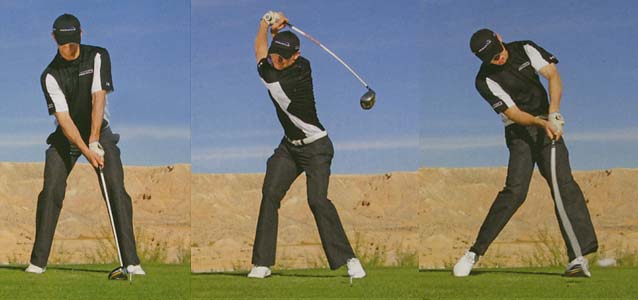 Note how much secondary axis tilt he has at impact. I think that he needs that much secondary axis tilt to stay in balance - considering the force of forward momentum of his arms/clubshaft that are swinging towards the target. I previously argued that a golfer needs to have a braced skeletal structure (from the top of the stationary head -through the spine-through the pelvis-down the left leg to the left foot) at impact. I think that Sadlowski anticipates the need for that braced skeletal structure, and its shape, at impact, and he therefore sets his head behind the center of his stance at address. Then he simply needs to keep his head stationary as he swings into impact against a firm supportive (braced) left leg and a braced rightwards-tilted spine that is kept braced by a stationary head. That's why I think that HK was very wise to allow for that need in special circumstances - by stating that one should start with one's head at the anticipated impact location. Most of the time that will mean a stationary head centralised in the stance, but under special circumstances (as above) it may be better to have one's head right-of-center. Jeff. p.s. The Gulbis photo was posted as a joke - and it is equivalent to recommending Furyk's steep off-plane backswing clubshaft movement as a role model for the average golfer. Although HK catalogued that backswing variation in his book, I presume that he would recommend a backswing plane in the steepness range that is some where between the elbow plane and the turned shoulder plane. |
I think I saw this guy do an expo at the tour event in Moline. Don't remember the name, but he looks about the same. He was flying it about 370. He also missed the entire range about half the time. He had no idea where it was going. They also play with drivers in the 5 degree loft range.
Long drive guys just have to get one of six in the grid. Golfers want straight and far. |
Quote:
Jeff The other other way at looking at this is that he is managing his low point for the shot at hand. The ball forward of low point, his head back in an effort to launch a sky high ball for extreme distance. An artificial uphill type shot. The ball struck on the upswing, the ball teed high and inside the base of the plane. Hes probably is trying to minimize spin with a low lofted club. This is a special procedure as per Yodas post #16 , a compensated swing, as described by Homer. What sort of machine would this make for? In my opinion one that was designed to hit the ball on the upswing, at red lined rpms, with a wobble at the top and the bottom. A special purposes machine subject to a lot of strain , breakdowns , inconsistency etc. More of a dragster than a Mercedes. When it doesnt blow up or crash its fast and long for sure. By the way, Im no doctor but would not recommend that you set your machine up like this if you have a bad back, Jeff. O.B. |
Words from Long Drive Champion
"Hi it’s Jason Zuback, five-time Remax World Long Drive Champion, with another golf tip. You’ve probably heard a lot of Tour coaches talking about the stack and tilt philosophy. What I’m going to try and do is simplify that and just call it turning around a central axis, meaning that when we are trying to generate the maximum amount of power we don’t want to sway too far off the golf ball.
"When we sway too far off the golf ball we tend to lose our contact, meaning inconsistent contact, hitting it all over the face and not getting as much energy transfer, but as well what we lose is some of that coil, the tension that’s created, that torque that helps propel our body and eventually the golf ball with the maximum velocity. "I’m a scientist, my background is as a pharmacist and I look at a lot of data from all over, I look at the best longest hitters on the PGA Tour to guys that hit it real far a long time ago, to current guys who really bash it out there, as well as current long drive champions. And without a doubt the one constant thing that they all do that you can emulate in your own golf swing is they turn around that central axis. They are not swaying too far off the golf ball. A little movement is OK, but move a long way and you’re losing power, you’re losing contact, ultimately you’re losing distance and velocity. Here is the link of video: http://uk.youtube.com/watch?v=Izmb_3F0y88 Any comment? |
Quote:
|
Quote:
OK I'm back- WOW! It really did work - I was hitting it another 40 yards off the tee- I drove two par four's and usually I have a full wedge into those holes! |
Court Reporter
Quote:
=D> |
Quote:
Amen to that. HB can teach AND play a little as well! :salut: CG |
Minimizing Backspin With the Driver
Quote:
Backspin is Compression Leakage. Under normal circumstances, it is a desired effect that results in Ball Control. But 'long drive' contestants are far more interested in Distance than Accuracy. Hence, they attempt to minimize Backspin, and in so doing, produce the near-equivalent of the baseball pitcher's knuckleball. A teed, intentional "flyer". Interestingly, Deane Beaman, the former PGA TOUR Commissioner and also a former U.S. Amateur Champion and TOUR player, on several occasions beat Jack Nicklaus (and everybody else) in the exhibition long-drive contests held at various TOUR stops. What makes this a big deal is that Deane was one of the shortest hitters on TOUR! His secret? He would deliberately hit the ground just before impact, create a grass-driven flier, and let the 'no spin' knuckleball effect take care of the distance. The long-drivers of today are accomplishing much the same thing . . . Without the grass! :golfcart2: |
eureka
Quote:
Thanks Ben After some reflection I noticed that the head (and pivot center) is attached to the left shoulder (low point). Further studies revealed its also attached to the right shoulder as well. I know you see the implications and use them like colours on your paint palette. Just some of the tools of the trade. O.B. |
O.B.
You wrote-: "The other other way at looking at this is that he is managing his low point for the shot at hand. The ball forward of low point, his head back in an effort to launch a sky high ball for extreme distance. An artificial uphill type shot." I disagree. He is making no attempt to hit up on the ball. He simply knows that if he gets his hands opposite his left thigh by impact, that the club's forward kick will cause the clubface to be facing upwards - if the ball is teed a little further. Jamie Sadlowski was trained by Jason Zuback. There is no hip sway in Jamie's swing. The only difference to Jason Zuback's swing is that Jason positions his head centrally while Jamie positions his head further back - because he knows that he is going to have a lot of secondary axis tilt at impact when he swing his clubhead at >150mph through the impact zone. Here is a swing video of his swing. http://uk.youtube.com/watch?v=5hCP3z4DITk He does not sway in the backswing. Note how he braces his left side to keep in balance. He also needs secondary axis tilt to keep in balance. He only weighs 165lbs and his frame is much smaller than Jason's heavy torso. Jason can perform a more centralised swing and still keep in balance because of his heavy frame, but Jamie's body frame is different and he chooses to have more secondary axis tilt to keep in balance. Jeff. p.s. You don't have to worry about "increased secondary axis tilt" hurting my back. I have such little hula hula flexibility that I cannot achieve 50% of Jamie's secondary axis tilt. I guess I don't need it with a clubhead speed of 95mph. |
Quote:
While there are some aspects of setup and swing that lend themselves to both greater control and distance, some are mutually exclusive to each other, and you have to make a choice as to which components you'll need to comprominse (either in totality or in degrees) in order to gain more of one over the other. |
Quote:
Jeff Dont get me wrong I am very impressed by his swing given what it was built to do. I see a lot of good fundamentals for a monster. Never said he swayed, dont even have an opinion. With the ball in front of low point which way is his club head going: Down , out and forward, or up, in and forward? O.B. |
Quote:
   Zuback even extends his spine on the back stroke ala Monty . .  No PIE HERE EITHER . . . . no reverse K |
You wrote-: "With the ball in front of low point which way is his club head going: Down , out and forward, or up, in and forward? "
Is has to be going up and not down. However that is significantly due to the club's independent kick-point action where the peripheral end of the clubshaft is not traveling in perfect straight-line-unison with the central part of the clubshaft. If you look at the central part of his clubshaft you will note that it has forward shaft lean - due to the fact that he is actually trying to get his hands ahead of the ball by impact. If he didn't have that much forward central shaft lean at impact, then he would be hitting more up at the ball at the exact moment of impact and he would lose considerable distance to a high ball flight trajectory. In other words, although his clubhead is going up at impact, his thrust action is down-and-out-and-forward, and not up-and-in. Jeff. |
Quote:
Not trying to give you a hard time, Jeff. Just clearing some things up. |
12PB You wrote-: "To hit the ball far . . . you extend from the feet up . . . each segment . . . . probably the biggest segment (really bunch of little segments) is the spine . . . . people who hit it really really long EXTEND/stretch out their spine . ."
I agree that long drive competitors need to brace their spine and left leg for maximum stability and I think that goal is best achieved when the spine is straight (extended) and the left leg is straight (extended), and the spine is angled back slightly so that the skeletal axis from the head to the left foot is optimised for power and balance. Your photos demonstrate that even Jason has considerable secondary axis tilt at impact. Jeff. |
Bigwill - don't apologise for giving me a hard time. Like every forum member, I have to defend the rationale of my opinions.
You wrote-: "I'm pretty sure he's trying to hit the ball on the upswing.". He is trying to get the clubhead to hit the ball on the ball on the upswing, but he is not trying to hit up at the ball with his hands/central clubshaft. Note that his central clubshaft near the grip end of the club has forwards shaft lean, which means that his thrust action is still down-and-out-and-forward. Jeff. |
Consider Hogan's head position and degree of secondary axis tilt at impact.
 Jeff. |
| All times are GMT -4. The time now is 01:45 PM. |
