
|
At Impact Fix set up.
|
Yodas Luke
I understand your idea of the COG of the clubhead and I have no problem understanding the lathe example. I also can understand Toolish's comment about how the hosel twists around the COG of the clubhead when one twirls the vertical club. I don't disagree with all these points. I can even agree that PP#3 traces the SPL through the sweetspot when the clubhead in the immediate vicinity of ball impact (when the clubhead has rotated so that there is a small, but significant, difference between the sweetspot plane and the clubshaft plane). What I cannot understand is what relevance these "facts" really have with respect to the golf swing. I never sense the hosel rotating around the sweetspot-PP#3 axis in a golf swing. I can only sense the clubface closing and opening, and it "feels" like the clubface is rotating around the clubshaft axis. It is my present belief that the reason why I harbor this "belief" is that I presently believe that natural human biomechanical actions dictate opening of the clubface opening in the backswing and clubface closing in the downswing/followthrough, and that these actions have no necessary causal connection with the idea of there being a axis between the sweetspot and PP#3. However, I am open to new insights. I can understand why human beings open the clubface in the backswing, because the left wrist has to remain flat and the left arm has to rotate clockwise in the backswing to get the left hand to the usual end-backswing position. However, I do not know whether the Robot-Fit type machine also rotates the clubface that much in the backswing, and if it does, how it gets the clubface to rotate back to square by impact if the wrist joint simply consists of two enmeshing gears that operate passively in response to centrifugal release forces. Jeff. |
I think the sample of a center shafted club would be great tool for analysis, especially in such a discussion.
So, if we swing such a club without changing anything else, would it mean that we would hit the ball dead center of the face = where the shaft is attached behind...or...would we toe the ball each time ? NMGolfer remarks have a lot of sense, IMO. Cheers |
speaking of theories gone bad...
Quote:
TGM: 10-22-A FULL SWEEP This pattern starts the Loading Action at the beginning of the Backstroke and smoothly and evenly accelerates the Club ahead of the Hands so as to arrive in position at the intended Assembly Point. 10-24-A FULL SWEEP RELEASE This procedure Triggers the Release at the Start Down by either the Hand Throw or Right Arm Throw (10-20) Non-Automatic Trigger Types. All the employed Accumulators slowly and evenly straighten and the Clubhead slowly and evenly accelerates through Impact per 2-N. See 6-C-2-B. 6-N-0 RELEASE TYPES There are two Release Types – the Automatic and the Non-Automatic – which are paired with a Release Point per 10-24. The two Types differ in that: 1. The Automatic is triggered mechanically (10-20) – the Non-Automatic is a deliberate muscular manipulation 2. The Automatic drives the Hands at the Aiming Point (6-E-2) – the Non-Automatic drives the Hands to their Impact location (visual reference point) (3-F-5). 3. There may be a “Starting to Hit” in the Non-Automatic but not with the Automatic. These are discussed in greater detail in Chapter 10-24. The earlier in the Downstroke the Release occurs, the larger, longer and slower the Release Arc will be for both Clubhead and Hands. Other things being equal, this will require higher Hand Speed to produce yardages equivalent to that of the short quick arc of Maximum Delay. This involves Angular Speed which is measured by the number of degrees of an Arc through which the motion moves per second. From Release to Impact is just so many degrees of travel – at the Left Shoulder and/or at the Left Wrist. Doubling the travel time (for instance) halves the travel rate. Also see 2-P and 7-23. (7th edition) 6-N-O, paragraph 3 - add "The smaller the Release Arc (Endless Belt Pulley - constant Hand Speed) the faster the Right Elbow must straighten and the faster there will be "Extension" (Lever Assemblies 2-P) and "Overtaking" (6-F #3 Accumulator) until the Right Arm becomes straight. All without affecting The Travel Rate of the Endless Belt." Since the human has a limit to horse power, Maximum Delay equates to greater distances. The robot can use a Full Sweep Release, because the Hand Speed is almost unlimited. The presumption that I've made is that the robot would be made to use the same gears in the Backstroke and Loading as it would in Delivery and Release. Mechanically, it would be the simple way to design the gears. Quote:
Quote:
Quote:
TGM: 3-F-7-A STEERING is the Number One malfunction – The Bent Left Wrist and Clubhead Throwaway. Any or all of the following faults during Impact may need to be adjusted out – holding: 1. the Clubface square to the Target Line 2. the Clubhead on Target Line 3. the Clubhead on a level or upward path A very successful anti-steering therapy is an exaggerated “inside-out” Cut Shot per 10-5-E. Study 2-J-3, 2-N and 12-3-39. You always Swing along the Plane Line but not always along the Flight Line. So learn to dismiss the Flight Line. Depend on Clubface alignment for direction control (2-J). In fact, learn to execute all Plane Line Variations (10-5) to remove all uncertainty from your Computer (14-0). I'm sure your father using the toe-in alignment is a good compensation for Steering. One might be able to close the Clubface at Address and employ Steering to "ALWAYS" hit it down the middle. And, I'm sure you'll tell me that distance is not a problem for him. :rolleyes: Quote:
12-3-0 Section 2 – Impact Fix 3. Grip – Flying Wedges 4. Clubface Alignment 5. Approach Arc/Angle 6. Right Forearm Position 7. Clubshaft Alignments 8. Extensor Action 2-J-1 IMPACT ALIGNMENTS The geometry of all alignments stems from the Impact geometry requirements. So, the first step in preparation for a Golf Shot is the establishment of the Impact Conditions. See 7-8. The Clubface must be exactly square to the Target Line (10-5) only at the Point of Separation. So the Clubface alignment at Impact Fix must fit the selected Hinge Action (7-10, 10-10). For Horizontal Hinging, it is Slightly “Open” at Impact Fix to allow for “Closing” during Impact. The longer the shot, the more “Open.” Angle Hinging gives the Clubface a Slice producing uncentered motion so while the Clubface does “Close” during Impact, Clubface alignment is slightly “Open” for short shots but for longer shots it must be set up more and more “Closed.” The alignment for Vertical Hinging and Cut Shots are the same at Impact Fix as it is intended to be at Separation because these are “No Roll” procedures. Alternative alignment procedures are presented in 7-10. The Machine (1-L) is positioned and adjusted to the Stroke – not vice versa (8-0). Remember – the Impact Point must become “On Line” at Separation. The Grip and Clubface Alignment are chosen at Impact Fix. I'm not sure where your "set-up" is located. If you're using an Adjusted Address, the Left Wrist and Clubface are not in their Impact Alignments. |
Yodas Luke
I have been thinking about this statement-: "There can be a rotational center that runs through the COG, and this is what we're seeking. We're looking on the Z axis, as a center of rotation could be found on other axes. The Clubshaft cannot be a center of rotation, since there is nothing on the underside of the hosel to counterbalance the Clubhead." You seem to be implying that golfer needs to find the center of rotation of the club's COG. However, I increasingly believe that such a situation would only be necessary if the golf swing mimicked the action of a grandfather clock - where there is a single fixed fulcrum point and where the pendumum swings in a vertical arc under the fulcrum point. However, a human golfer swings a golf club i) along an inclined plane and ii) he significantly opens the clubface in the backswing and closes it in the downswing and iii) there is no "fixed" single fulcrum point. It is the way the human body is constructed that allows a golfer to square the clubface without having to worry about a golf club having a "theoretical" axis of rotation going through the sweetspot. I am not a good golfer but on a "good" day I can hit my five-iron about 165 yards towards a distant target and all my shots will land within 10 yards radius of the target. I regard that as being reasonably accurate. How do I achieve that level of accuracy considering that I never think of any axis of rotation going from the sweetspot-to-PP#3? I simply know that if I keep my clubshaft on-plane throughout the backswing and downswing, that I will create a rounded clubhead arc that is symmetrical to the ball-target line. I know that if my clubshaft is parallel to the ball-target line at the third parallel position, then I am on-plane.Then I only need to ensure that my left hand swivels passively into impact so that the back of the left hand faces the target at the time of ball-clubface separation. If I achieve those goals, the ball goes straight towards my target and the ball is constantly struck within 1/2" of the sweetspot. I never have to mentally think of an imaginary axis between PP#3 and the sweetspot. How would that help me? Jeff. |
Quote:
Nice idea. Id think that assuming we are swinging the sweet spot, we would hit the sweet spot. Homer Kelley in his tape with Tom Tomessello (on the Peter Croker site) said something to the effect that "if you are not swinging the sweet spot, you're swinging the shaft and if you are doing that, your in trouble". Im thinking shank. He also spoke of old long nosed clubs and how they promoted CF closing the face. This makes sense to me. Take a center shafted putter and compare it to a heel shafted putter. Even at these low speeds you can feel the heel shafted putter "gateing". Crenshaw's old 8802 putter for example, you have to time its closing but it is sweet and packs a little extra punch too I think. OB |
shanks are relevant to some
Quote:
Let's examine each example: 1. The Clubshaft traces the Delivery Line and the Clubshaft is the center of rotation. This results in aiming the hosel at the ball, with obvious consequences. In this example, the hosel would remain on the Delivery Line before, during, and after Impact. The Sweet Spot would rotate around and outside the ball and the hosel would hit the ball. 2. The Clubshaft traces a parallel line that's inside the Delivery Line and the Clubshaft is the center of rotation. In this example you'd have to be a proponent of tracing a line that doesn't extend through the ball. The Sweet Spot would have to rotate out and around the hosel. I'm seeing a windshield wiper type of effect, just like in the previous example. The force vectors are terribly scattered. 3. The center of rotation that extends through the COG traces the Delivery line. Here, the Sweet Spot is being Delivered to the ball. This is the obvious choice for solid contact. The hosel approaches the ball on the same Plane with the Sweet Spot, but it rotates away from the ball (counter-clockwise) as the center of rotation moves down the Delivery Line. Do something for me, and I'll promise that it will help you to see the options. You need to see the center of rotation. Take short iron and tape a piece of string to the Sweet Spot and to the #3 Pressure Point. This is your new 'shaft'. Trace the Delivery Line with every option that I listed, above. Then, let me know what you find. Quote:
|
goals
Quote:
But, 165 yards is between an 8 iron and 7 iron for me. My 5 iron goes 200 yards. Understand that I'm not trying to get into a pi$ contest with anyone. I'm just making a point about distance. Shorter hitters can hit the ball straighter at times. But, short and straight doesn't get it done from 7,200 yards. We have three pieces to this puzzle: Clubhead - Pressure Clubface - Directional control Clubshaft - Geometry/Plane Because the distance seems short, direction is good, and you're telling me the Plane is good, I would be looking at the power leakage. In doing so, you'll find inter-relationships in the puzzle. Finding the causes and effects begin the peeling of the onion. Any level of success is not necessarily directly correlated to form and function. You could be the most talented athlete that ever walked the planet. If you are, those are less than stellar numbers. If you have trouble dressing yourself, those are magnificent numbers. What's important is getting 100% of what you bring to the table. |
Quote:
Therefore, we can go further and create a variable weighted toe/heel of such a club and see if e.g. with a heavy toe/light heel center shafted club (imitating the proportions of a standard club to a degree) the shaft plane still equals the sweetspot plane. Cheers |
Yodas Luke
Here is my ideal swing. Anthony Kim http://www.youtube.com/watch?v=ZJyqplX4sRc I always attempt to mimick his swing pattern - by attempting to be on the same inclined plane in the backswing and downswing (while slowly and progressively shifting planes between the elbow plane and turned shoulder plane in the backswing and vica versa in the downswing), and to always be on-plane even during the followthrough and early finish. I try to always get my clubshaft to be parallel to the ball-target line at the third and fourth parallels. This is the clubhead path that I try to emulate. 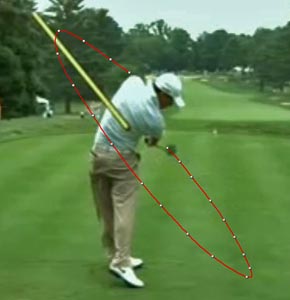 When starting the backswing, I trace the SPL during the takeaway - and that means that the PP#3-sweetspot axis line points at the ball-target line. After the first parallel, it is the butt end of the club that points at the ball-target line and not any "hypothetical" axis of sweetspot rotation. For me, the most critical part of the swing in terms of being on-plane is between the first parallel and the third parallel. If I can keep on-plane during that time period and get to the third parallel perfectly on-plane, then I know that my clubshaft will be perfectly on-plane during the downswing time period between the third parallel and impact. In other words, I am mainly focused on ensuring that my clubshaft is on-plane when the club is above waist level, and during that time it is the butt end of the club, and therefore clubshaft, that points at the baseline of the inclined plane. In other words, all your theorising about options 1,2, and 3 have no relevance with respect to my above-waist biomechanical movements that are required to keep the clubshaft -on-plane. I have tied a string between the sweetspot and PP#3 and it is no value, because the only time that I actually see the string is during the takeaway, at which time I can easily stay on-plane. The string has no value for the critical biomechanical movements that occur above waist level- in both the backswing and downswing. Seeing the string blur between the third parallel and impact has no potential value because if I am not on-plane during that time period, then it is far too late to alter events. In fact, I have now trained my hands (specifically PP#3) to move correctly by "feeling" it trace the SPL and I never even think of the clubshaft and/or the sweetspot. My only awareness of the clubshaft is after I have completed the shot - when I replay the shot in my mind. I can then usually recall where the clubshaft was situated at the third and fourth parallel, and I know retrospectively that if the clubshaft wasn't parallel to the ball-target line at those two time points, then I obviously didn't succeed in my goal of being on-plane throughout the entire swing. Jeff. p.s. I am not a good golfer by Ben Hogan's standards, but I am a great golfer by my standards. I never dreamt that I would ever regularly break 80 (from the senior tees) considering my degree of physical inflexibility and lack of golf athleticism. I never play 7,200 yards courses because I am not a masochist. I only play 6,000-6,500 yards courses by always playing from the senior tees. My driving distance is 220-240 yards. |
Basic Motion
Quote:
I have no problem with Kim. He has great Alignments. But, it seems like everything is Plane oriented. Do you ever work on the physics? I am a masochist. I played last week with my best friend in Franklin, TN last week. We played from 7,190. It was 38 degrees and the wind was blowing, and it was soaking wet. I hit 3 wood into four par 4's and one par 3. I normally hit 3 wood 250 yards, but I wasn't planning on that distance in that weather. I shot 76 with two doubles, two bogeys, and two birdies. No one died, but we felt like it. |
Yodas Luke
You wrote-: "I have no problem with Kim. He has great Alignments. But, it seems like everything is Plane oriented. Do you ever work on the physics?" I don't understand your statement that everything is plane-oriented. Anthony Kim has an incredible ability to swing on-plane, but I don't think that doing so causes some other part of his swing action to be deficient. Do you? What do you mean when you ask about working on the physics? I am not consciously masochistic like you - I do not enjoy playing in wet 38 degrees weather with heavy winds blowing. I have played in Ireland or Scotland every year for the past 4 years, and the wind there causes me immense trouble. I recall one hole in Ireland that was only 320 yards in length, but the wind velocity was >40mph. I hit a perfectly executed drive which only traveled 150 yards. I then hit a really solid three wood and the ball went about 100 yards. I finally hit a perfect 8 iron that traveled 60 yards. I missed my par putt. I personally don't enjoy the experience of hitting the ball (as well as I can) and having to hit three well struck shots in order to reach a 320 yard hole. Jeff. |
the closet masochist
Quote:
As far as you not being a masochist, I think you just gave your secret away. Although, I do like the way you slipped the word consciously in there. You've played every year for 4 years! If you don't like the pain, why would you keep going back? :laughing9 The only other alternative is that you're an eternal optimist (crazy). You would have to believe that the weather there was going to be better next year. Good luck with that. :) |
Seeking better conclusions
I am playing golf tomorrow. Reading this thread and thinking too much about it will likely cause me a few shanks tomorrow. :eyes: But please don't quit the thread yet as there remain a few issues to be concluded. With Jeff's strive for truths, Yodasluke's golf skills, nmgolfer's physics, we can go a long way..... I now want to stir up some dust ......
I would like to differentiate between (a) the COG of mass of the whole club, (b) the COG of the mass of the clubhead which again is different from (c) the sweetspot on the clubface. 1. My current thinking now has shifted from keeping the clubshaft on the swing plane. I now believe that for an optimum swing from p3 to p4, we should keep pp#2 and (a) the COG of the club on plane. 2) So if we draw a straight line between pp#2 and (a), this straight line will sweep the swing plane and the centripetal and the centrifugal forces act along this line. Let me call this line the force line. 3) Under centrifugal acceleration, all the mass of the club will seek to be in line with the force line so the COG of the clubhead (b) will seek to line up with the force line. 4) The swivel rotation to close the club face is not around the hosel but should be around the line pp#2 to (a) which is now a balanced rotation. :salut: |
#3
Quote:
|
Quote:
Not sure I follow you 100%, but Id think that with a heavier toe the sweet spot would move and you'd be back to a non aligned shaft and sweet spot. All of this begs the question: Why arent there face balanced , center shafted irons? There must be a very good reason. We must need the rotation perhaps? Or is there something else? Homer suggested the long nosed, low profile irons of the 1930's were a delight to hit. I've sort of struggled with tracing conceptually as there seemed to be a parallax issue. I now realize that while I was swinging the sweet spot, I was trying to trace the shaft plane. Lukes point about tracing the sweet spot plane, the imaginary string from #3 to sweet spot is insightful. Like pointing your finger at a bird in flight, tracing. This way I am aiming that which I am swinging, the sweet spot! Per 2-F PLANE OF MOTION. "Regardless of where the Clubshaft and Clubhead are attached it will always feel as if they are joined at the Sweet Spot---the longitudinal center of gravity, the line of pull of Centrifugal Force." Regards OB |
Yodasluke,
I would like to know your age. Age and athleticism are big factors in how far a person can hit. I know this because I often play will a group of older-timers which I wager to guess have been on the planet hitting golf balls long before you were even a twinkle in your mother's eye. These guys sit around an remiss saying things to each other like: "when did you start losing it".... (They mean distance). Just because Jeff does not hit hit his 5 iron as far as you does not mean he has a "power leak". Besides... golf is about three games.... distance off the tee is only one of them, then there is the short game and putting. Winning means being reasonably good at all three. I'm backing out of this thread now because.... Frankly none of what you wrote (in that last post) make a damn bit of sense to me (I don't know the book chapter and verse and never will). But I thought were were talking about the face opening on the backswing and closing on the downswing not release. I thought the issue was what causes shanking. Anyway. .... Here are a couple of parting thought on the dreaded "S" word... 1) Check your balance.. if you are going forward (on your toes) you will shank it 2) Try gripping down a bit. One-size fits all clubs don't work (men's adults for instance) but can be played by about anyone but only if you compensate for your individual anatomy. If, say your arms are longer than normal or your legs are shorter than normal or god forbid both, then you are going to have too much club shaft between your hands and ball. That will cause a shank... and it may even vary from day to day. Bobby Jones would adjust his hands up and down the grip on any given day and we should too. |
clank shank hosel rocket
Some more from 2-F
"So there is a "Clubshaft" Plane and a "Sweet Spot", or "Swing", Plane. But herein unless otherwise noted, "Plane Angle" and "Plane Line" always refer to the Center of Gravity application,. Study 2-N. Except during Impact, the Clubshaft can travel on, or to and from , either Plane because Club Shaft rotation must be around the Sweet Spot-not vice versa. So Clubhead "Feel" is Clubhead Lag Pressure (6-C) and is a Golfing Imperative. (2-0), If Lag Pressure is lost the Hands tend to start the hosel (instead of the Sweet Spot) toward Impact---the mysterious "Shank"..............." And we sense this lagging sweet spot with the pp #3. Both ends of Lukes string. While common sense would seem to suggest a shank is caused by getting too close to the ball , which maybe the case sometimes, this is another very interesting cause. Perhaps there is a chicken and egg relationship too? The loss of swing radius as a possible effect rather than cause? Swinging the clubshaft causing us to encroach, shorten our radius and shank? Another reason why lag pressure is an imperative. Regards OB |
Quote:
I would risk to say that because of tradition. Backing to the middleages when golfers played with wooden stick bent at one end (looking similarily to a walking stick for elderly people)...and it was much easier to manyfacture it instead manufacturing a center shafted club. Sir Winston Ch. could be right - we are playing with tools that are wrongly designed to this goal...;) Cheers |
OB Left - You wrote-: "All of this begs the question: Why arent there face balanced , center shafted irons? There must be a very good reason. We must need the rotation perhaps?"
Exactly. Golf is a sport where the golfer swings the arms and clubshaft around a rotating torso at an angle to the ground. We need the rotation because human anatomy dictates the need to rotate the flat left wrist/hand unit during the backswing to get the hands far enough back (near the right shoulder) and human anatomy dictates that the golfer must perform a similar reverse-rotation (as a mirror image movement) in the followthrough/finish phase. The clubface will only be square to the ball-target line at impact. During the downswing-followthrough motion, the clubface rotates from open to closed because it is moved in that manner by the flat left wrist/hand. At no time point does the clubshaft rotate about its longitudinal axis (like a spinning top). If it did, then the idea of an axis between PP#3 and the clubface sweetspot, and the idea of the hosel rotating about that axis, may have some definite relevance. So far, Yodas Luke has only inferred that the imaginary straight line between PP#3 and the sweetspot has relevance during the takeaway. That's only a small fraction of the clubshaft's total movement during the golf swing. Regarding the issue of shanking, I think that a major causal factor is a failure of a golfer to understand that the clubface must rotate from open-to-close through the impact zone, and that the closing clubface phenomenon is due to the release swivel action where the flat left wrist/hand rotates 90 degrees in the late downswing. I think that the mental idea of the "clubhead rotating about the hosel" would actually help those golfers because they are essentially dragging the clubshaft towards impact as if the clubhead were center-shafted. I think that they need to realize conceptually that the toe of the club must rotate about the heel of the club during the pre-impact phase of the golf swing, and that it will happen automatically if they correctly rotate the back of their flat left wrist/hand. Jeff. |
Luke, Drewit anybody.
1L-11 "Clubhead Force and Motion is On Plane at right angles to the Longitudinal Center Of Gravity and varies with the Speed , Mass and Swing Radius." Im having trouble picturing this one fully. By clubHEAD is he referencing the force and motion of lag pressure? What is meant by "right angles to the LCOG"? Is LCOG referring to the string or the sweet spot point on the clubface? Where does force (when focused) point? Down the sweet spot plane and tracing the plane line like a laser or flash light? I dunno. I really dunno. OB |
Quote:
Maybe but I tend to think that there is a very good reason that manufacturers dont make clubs that way. I think. They would never lie to us would they? No need for an answer. Remember titanium centered golf balls? Perhaps trying a center shafted, face balanced putter at full speed vs a heel shafted, toe drop one would answer this question but maybe ruin some putters. Im thinking that with the face balanced one it would be harder to control the initial direction of the ball (face angle) and less powerful. Just a guess though. I do know that Homer thought the old school 1930's longer nosed irons enabled CF to "have more control over the alignment of the club face, more powerful, more difficult to disturb". Here is the link to the Croker sites audio tape. Its mainly about hip motion, action, Hula Hula etc but about 5 minutes in there is some stuff relevant to this discussion. http://www.crokergolfsystem.com/Home...n_2-64kbps.mp3 Cheers OB |
Quote:
Hey Jeff Nice thread again. With lots of contributions and food for thought. I have responded above In caps. Regards OB |
OB Left
You wrote-: "MAYBE THEY THINK THEY ARE DOING THAT. BUT IF THEY ACTUALLY ARE ROTATING THE CLUBHEAD ABOUT THE HOSEL , THEY ARE IN FOR A SHANK". I don't think that a golfer ever rotates the clubhead around the clubshaft axis. It only "feels" like it is happening when the golfer notes that the toe passes the heel in the followthrough. What causes the clubface to close is simply the phenomenon of the flat left wrist/hand rotating in space. What causes this rotation? Pre-impact, the release swivel action is due to external rotation of the left humerus within the left shoulder socket combined with a small amount of left forearm supinatory movement - all these biomechanical actions are passive and are merely the reversal of the rotary biomechanical actions that occurred in the backswing. Post-impact, the flat left wrist/hand rotates around to the left due to a horizontal hinging action, which is biomechanically due to external rotation of the left humerus within the left shoulder socket while the left shoulder socket moves left/backwards due to continued torso rotation. The clubface remains neutral relative to the left hand and it doesn't roll-over relative to the flat left wrist/hand because the left hand always firmly grips the club and never allows the clubshaft to rotate within the grasp of the left hand. The clubface simply rotates to exactly the same degree as the flat left wrist/hand rotates pre-impact and post-impact. Jeff. |
1 Attachment(s)
Quote:
I think there is more at play here than just the swivel. Swivel does play a part but not the only part Im guessing. Consider this photo of Homer Kelley. Somewhere on this site (I cant find it) is a post by Yoda describing what it is that Mr Kelley is swinging around his head. Something like a balsa wood club head with a small metal screw acting as the sweet spot and creating a COG similar to a real club. You'll note the position of the string from #3 to the sweet spot. Not so "imaginary" here is it? Also of note is that the club face stays aligned nicely via CF without any involvement what so ever of forearm rotation or swivel. It was Yoda who took this photo, he said the smiles seen here were due to Mr Kelley's first failed attempt that saw the string wrap itself around his body. Regards OB http://www.lynnblakegolf.com/assets/...attach/jpg.gif |
PP#2 vs PP#3
Yodasluke. Anybody.
Why should the "virtual clubshaft" be defined as the string from pp#3 to sweetspot? Why not pp#2 to sweetspot instead, since the CF is involved with pp#2 as one of the swing centers? |
Quote:
|
39 for a few more days
Quote:
I'm 39 until the 26th of this month. I'm aware that some use age as an excuse, but I won't put up with that garbage. Tell them to get in the gym, take a lesson, or stop complaining. Unfortunately, there's news that they are eliminating the Super Senior Division at the World Long Drive Championship. There's a man that's taken many lessons from me that has competed in the event. But if you saw him walk up, you'd bet your life savings that you could hit it past him. He's presently 60 years old, and he's had both knees replaced. He doesn't walk as well as he swings. He just set his personal best drive of 343 yards, last year at 59 years old. Another student, age 51, is the one that I've written about recently that in one year has gone from 84 mph with the driver to averaging well over 100 mph in clubhead speed. He's having the time of his life and has taken double digits off of his handicap. So, I'm not playing the violin for your "old-timers". I don't believe that Gary Player will drop a tear, either. Quote:
Quote:
|
Yodas Luke
You wrote-: "I'm 39 until the 26th of this month. I'm aware that some use age as an excuse, but I won't put up with that garbage. Tell them to get in the gym, take a lesson, or stop complaining." Phew! I have seen that attitude among many golf instructors. It is a great pity! The problem is not age per se, it's age-related physical inflexibility problems. Many elder people don't suffer from age-related flexibility problems - like Gary Player. However, others do - like Arnold Palmer. He has such poor torso flexibility at present that he virtually has to stand erect to execute a torso rotation. The age-related torso inflexibility problem is not remedial with gym workouts if the problem is genetic - an increased age-related genetic predisposition to calcification of spinal ligaments and/or increased fibrosis of the intervertebral discs and paraspinal ligaments that causes a major loss of disc/ligament elasticity. OB Left That photo of Homer has no relevance. Look at how he swings the string - his hand and arm is outstretched away from his body. In a "real" golf swing, a swinger has his right elbow in a pitch position alongside his right hip at the delivery position with the right elbow still bent - like Aaron Baddeley in the next photo. From that position, consider the biomechanical events involving the left upper limb that must occur if he wants to rotate the flat left wrist/hand 90 degrees into impact. 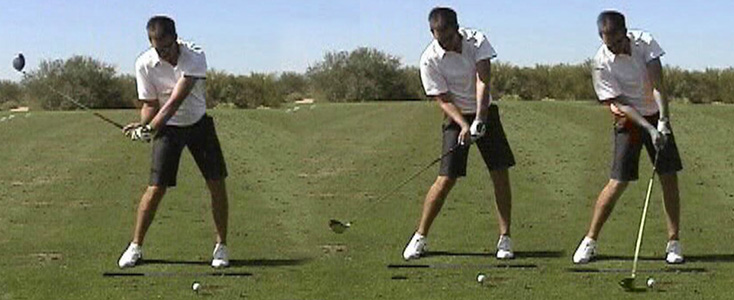 Jeff. |
Quote:
Id bet that in Homers swirling balsa wood clubhead experiment, the club face conditions and string line from #3 to sweet spot would be present regardless of any degree of bend in his right elbow. These things have nothing to do with the right elbows condition in his demonstration. That is the reason for the string line, there being no mechanical or rigid connection, just CF seeking to establish an aligned club face. This should be good news! I cant fathom how to play good golf without this sweetspot "feel". This phenomena is our best friend when properly applied. Imagine swinging the club shaft instead: "Ok so this is now my pitching wedge and therefore given its heel to sweetspot measurement of x inches I now need to swing x inches parallel to and inside of the target line" And then, "Now for a 9 iron the measurement changes so Im just going to swing ........Ok now for my 6 iron which has a different measurement again .......etc etc. A different plane line for every heel to sweetspot measurement! Why not just swing the sweetspot at the ball or aiming point? It's the sweetspot that our hands feel afterall. OB |
attitude
Quote:
Some of my students have had or have polio, MS, stroke victims, birth defects, etc. Not one complains about what they can't do. They are proactive in learning what they can do. That's the attitude that I want in a student, and that's the attitude that I have as a teacher. It's always about the positives. If you don't think you can succeed, stay home. If you live by the motto "I can't", then you won't. When my guy with a polio ravaged right arm takes your money on the course :crybaby: , you'll stop feeling sorry for him. |
OB Left
I never "feel" the sweetspot and I always hit the sweetspot when I hit a golf ball. Off-center hits are not one of my problems. I don't think of the sweetspot or the clubshaft when I swing - I primarily think about my "hands". I want my hands to produce an i) on-plane swing, and ii) forward shaft lean at impact - which requires a flat left wrist and a bent right wrist at impact. When you state that you "feel" the sweetspot - when do you "feel" it? Yodas Luke I don't know why you have gone off on a tangent by writing about "motivation". I was only stating that golf instructors have to understand human biomechanics and teach golfers to swing efficiently within the framework of their biomechanical limitations. It is my experience that many golf instructors are near-clueless regarding the topic of biomechanical limitations and their "effects" on the optimum execution of the golf swing. Jeff. |
No excuses
Quote:
Jeff, You know what the irony of that statement is? Sure enough Yodasluke will be the one in his group that develops age related physical problem.. arthritis something ... he will be striken. He acts all high and mighty now, while he's barely into middle age but you watch... when life dishes out some of its lessons to him (and its surely will with such a self-righteous attitude... karma) he'll be screaming excuses at the top of his lungs to some young know-it-all punk telling him to get to the gym and quit making excuses :crybaby: . Anyway Jeff, you're doing fine given your age and late taking up of the sport. Congrats.. |
Quote:
I agree... Its because golf clubs are "supposed to look that way". So many sub optimal things we get stuck with because of decision made long before. Someone mentioned the standard keyboard which was deliberately "de-tuned" to slow typists down to avoid jamming in ancient mechanical devices. I'd like to see someone risk it ... at least for the driver which bends every which way due to inertial forces. |
Quote:
IF the machine is perfectly on plane - the line of pull. The design of the club will pull the toe 'out' for proper impact. Try swinging a hockey stick, or any number of aids that exagerate the 'toe' of a club, they force that shaft to turn around the COG - sweetspot. A perfectly on plane swinger, or machine, doesn't need to cause the out. Realistically, nobody is that perfect, so the release is often 'caused' by the golfer (release swivel). the design of the club, and the physics of the COG plane, require that the shaft rotate around the sweetspot (per Ted's baseball bat example). |
prove it to yourself...
Not sure I follow you but...
Take a dowel rod... that represents the shaft. Take a push-pin or nail and put it in the end. Find a hex nut and tie it on a string then tie the other end to the nail or push pin on the dowel. The nut is the COG of your "club head. Take it out side and swing it every which way...up, down inclined... it doesn't matter. The Nut will never move off the plane of the swing (as defined by the dowel). The nut dutifully follows the shaft (unless/until it "releases" in the plane of the swing not perpendicular to it). There is no physical force/torque which causes the club face to open and close besides that which is supplied by the golfer's hand. Golfing machines use gears to achieve what the golfer's hands do naturally. http://www.golflabs.com/Images/tse_4.jpg Quote:
|
Ed
Could you please expand on your belief that the clubshaft rotates about the COG of the clubhead? When I swing a golf club or a hockey stick across the front of my torso, I can see the clubface closing so that the toe of the club eventually passes the heel. I can also see that the clubshaft hosel has a rounded arc motion. However, I cannot see the clubshaft rotating around the COG of the clubhead. Where should I be looking to see that phenomenon happening? Jeff. |
Quote:
Watch the shaft rotate around the sweetspot. |
nm golfer
I cannot clearly understand your experiment. Do you have a small flexible piece of string of finite length (eg. 3") between the nut and the peripheral end of the dowels stick? If yes - then I can imagine the string following the plane of clubshaft movement with the hex nut dragging behind in the same plane. However, what happens if you attach the hex nut to the peripheral end of the dowel stick with a piece of rigid metal about 3" in length and then move the dowel stick in a rounded arc - as if you were swinging it like a golf club across the front of the body? Jeff. |
mb6606
I have no problem seeing the clubshaft hosel rotate around the sweetspot in your example - where the grip end (fulcrum point) remains stationary and the clubshaft hangs vertically, and the sweetspot remains in the same spot in space while the club is being twirled. However, the clubshaft's grip end is moving continuously in space along a rounded arc of motion during the golf swing, and while it is moving the clubshaft's grip end is also rotating in direct proportion to the degree of rotation of the flat left wrist/hand. While this is happening, I cannot see the clubshaft hosel rotating around the sweetspot. Can you? Jeff. |
| All times are GMT -4. The time now is 12:50 AM. |