|
So whats the difference between an inside out impact for a straight line plane line and an inside out stroke?
Is it just a matter of degree? Does Trackman or D plane measure what we'd call Hinge Action? A rate of clubface closing or whatever? |
Quote:
Trackman and D Plane do not measure hinge action as it is irrelevant. The balls comes off the face at some time no matter which hinge action is employed. |
Makes sense, thanks.
Hinge Action irrelevant in what context? Surely you dont mean irrelevant in a general sense. The effects of Hinge Action can be clearly seen in the simplest of shots, a chip shot for instance. I like what little I know about Trackman , dont get me wrong. If it doesnt measure it as of yet, I'd imagine it will in the future. |
Quote:
I would highly recommend reading some of their(trackman) newsletters. Very interesting stuff. |
Quote:
But .........I do know that Hinge action is a factor in ball behavior.......... its been around as long as golf has been played hasnt it? I'd say its central to any good golfer's shot planning, whether he calls it Hinge Action or not. |
Hooks and Slices and Draws and Fades have very different meanings and Set-up procedures.
Quote:
If a Swinger (relying on CF to Square the Clubface for Ball Separation) used his standard Procedure for Drawing and Fading, then, additionally applied a Grip Adjustment, then, he would hit Low Draws and High Fades, or High Draws and Low Fades without sacrificing the Line of Compression. Drawing and Fading refer to Plane Line Adjustments, Hooking and Slicing use parallel Plane and Target Lines. Or, "call it whatever you like". :) |
Quote:
D Plane Theory doesn't use the concept of Hinge Action, Line of Compression, etc. It recognizes "Moment of Inertia" of the Ball as a "Listed" factor in "Effective Loft" but the connection to this "Advanced Level" of "Ball Control" is ignored because it isn't the primary purpose of "D Plane". Quote:
Quote:
 |
Quote:
Second paragraph is perfect. D Plane is not concerned with what is used to create impact alignments. It only explains how those alignments will affect the flight of the ball based on impact conditions. |
That's not what I've been told. Trackman people could have given me the wrong info or is it something new?
|
Quote:
|
Quote:
One of the reasons there is a big difference between the two. |
Music Man
Quote:
Further, if Clubface Alignment doesn't matter, then Clubface Hinge Motion doesn't matter. And if Clubface Motion doesn't matter, then what is happening during that violent, 4/10,000th of a second collision we call Impact, doesn't matter. How nice. Nothing much matters. Except Trackman. Only one problem . . . We've now got to do something to improve our 'numbers'. And just what would that be? Well . . . Since the Hands and their Hinge Action don't matter, and . . . Since the Clubface and its Hinge Motion don't matter . . . Let's dance! http://www.youtube.com/watch?v=NKcY75LIkRw :laughing9 |
If Hinge Action is irrelevant in a general sense, that is to say it has no effect on ball behaviour, then holding the clubface square to the hole should work just fine.....with no loss of compression. Steering is back in vogue. Well that form of Steering anyways.
|
The parts that deal with hinge action and ball compression in chapter 2 are always in contention on my TGM favourites list.
|
The argument for why hinge action is irrelevant, as I understand it,is that the ball is on the face of the club for such a short period of time that there is no effective difference between the direction of the club face at impact and that of the face at separation. Because nothing happens between impact and separation, there is nothing that hinge action does.
In discussions with those who advocate the irrelevance of hinge action, I have asked why then does hinge action seem to make a difference that can be seen and felt in, for example, the simplest of shots (as remarked by OBLeft). The answer I received was that hinge action sets the face prior to impact, which then leads to the ball flight. Horizontal hinging tends to a closed face at impact, etc. The point that is made is that nothing significant happens during the impact interval because the time the ball and the face of the club are in contact is so short. |
Ok, I'm sorry if this sounds like an Innercityteacher post.
I don't have the background in 'Mechanics' to expand the subject of Horizontal Hinging as outlined and described by Homer Kelley. I can only add some personal notes that probably won't be useful to anyone that hasn't experienced Horizontal Hinging with compression. Most of us have been to a practice range and hit different pitch shots to a green with Horizontal and Angled Hinging. The effects of the two different Clubface motions through the Impact interval are easily identifiable. In fact, it's so simple that almost anyone here can teach almost any golfer to use a full roll feel or half roll feel through the ball. And after a few attempts, he can apply either procedure and witness the results for himself (including innercityteacher). If anyone thinks that the above, is Angled and Horizontal Hinge Action "Ala Homer Kelley", then I've got some really bad news for you. It is and it isn't. With Horizontal Hinging, the ball travels with the Clubface for the split second that they're in contact. The Impact Point and Separation Point are the same (or almost the same). The High Pitched Click sound of nearly perfect compression results from this kind of strike along with that very heavy feel of the Ball being stuck onto the Clubface. The Rate of "Closing only", and Swing Radius seem perfectly matched and perfectly even. I'm not saying that for 99% of all golfers that the ball doesn't roll up the face of the club before separation. I say for them, it does a lot. I've played golf with over a thousand people in the past ten years and I've only heard that kind of compression maybe 5 times. Listen to VJ Trolio hit the ball. The Clubhead is accelerating through Impact. The Hinge Radius, although it's at the Left Shoulder for the Primary Lever, it goes way beyond that for the stroke radius because the shoulder is moving too. Homer Kelley may say that the Radius extends all the way to your Feet. In that split second, every alignment and motion is perfect. I know maybe 3 swing Patterns. I can produce that kind of compression in only one of them. One of three. So not every Pattern is going to produce those results. I know two people that do it everyday on every shot. I know one guy that has compression with his putts. 3 foot putts too. That's freaky. I've experienced the full meaning of Hinging, not only the feel. So, anyone who says that Hinging doesn't matter, I say great, play without it because even if you wanted it, you may never get it anyway. I'm saying that you can practice for it for ten years and not be able to produce it. It's that hard to perform perfectly. If some people just "Have it", then they don't know how lucky they are. |
Quote:
Im no scientist but the thing that seems odd to me is that, brief though the impact interval is , the ball is completely squished and rebounds......that we all agree on Id imagine. So why is not enough time for the ball to roll up the face a little bit more for the layback inherent with Vertical Hinging? The ball seems to get a lot done in that little bit of time , why not react to layback too? My guess is that what may be irrelevant for Trackman measurements has been extrapolated into a general irrelevance and probably with some malicious intent towards Homer........but remember that Homer didnt invent Hinge action he only identified it. Hinge Action is as old golf itself Id say. Actually given the cor of a feathery it might have been even more "impactfull" in the early days. |
If "rprevost" doesn't want to understand hinge action I wish he would go somewhere else and tell someone who gives a sh*t because I could care less what he thinks.
We were having a good discussion on Low Point and I'm really pis*ed off about some asshole who enters the thread and just wants to fu"* around. |
Daryl am I missing something....... rprevost seemed anything but what you accuse him of being.
Seems to me if somebody wants to call hinge action irrelevant then they could possibly Steer themselves to golf death.... There's guys Ive heard who say they love Moes swing but dont like his "flashing face" (horizontal hinging). You take that away from Moe and you dont have Moe anymore Im thinking. Pipeline was straight , saw him myself at least 40 or 50 times..... How can a guy that straight have a "flashing face"? |
Quote:
|
Quote:
A little background, I took a lesson from Yoda about two years ago. It was a great lesson. He introduced me to the Robert McDonald drills and explained to me how to keep the club on plane. This summer that lesson came to fruition when I achieved my quest of over 20 years to break 80 (I shot a 78 ). For that achievement, I am indebted to Yoda and all the TGM regulars on this site. Since that lesson, I have been a regular reader of this site. I rarely contribute because I don't really know that much. I am a bogey golfer. One of the reasons I come back to this site is that in my experience, Yoda has been a model of civility. In any case, your language was a bit harsh. I am tempted to borrow a quote of Yoda's from his remarks in an earlier, different thread, "I deserved better", but I won't. |
rprevost the Robert McDonald stuff is great isnt it? I believe Lynn picked it up from his time with Paul Bertholy. Lynn moves forward and backward but always towards the truth about things I have found, however old it may be or however new.
|
O.B., I just want you to know that I've been working for days on this Low Point / Separation issue and I'm starting to think that you were right in your first post and your interpretation that Separation occurs at Low Point. I need a few more days.
|
I'm looking forward to discussing the vertical dimension of this issue. It affects how deep divots you're taking and what you need to do to avoid slicing the club under the ball instead of driving the club straightish through.
I think this is even more intriguing than the hook/draw/straight/fade/slice/push/pull dimension. I can slice a draw anytime I want. It is really easy to do with a wedge and with the ball back in the stance. It's THE way to make a a lob wedge that was supposed to carry 82 yards and spin left towards the pin, to stop short of the bunker:sad2: I've been a digger throughout my time as a golfer. Ball compression is much better with a thin divot or even without a divot, and when separation happens on the shallowest angle. If I had a stroke where the ball left the club at low point I wouldn't be a digger. I've got the digging under reasonably control now. But I'm still digging more than I like with all clubs except the driver, and it probably costs me a few yards. And I still hit the occational "perfect" shot that ends up short. A few years ago that beast haunted me regularly and this has turned me into a distance control freak. |
Quote:
And you can quote me on this if you wish. But to tell you the truth I was actually going to discuss how the Angle of Approach is maybe even more out to right field if you make separation 3/4 of an inch forward of a ball played back in your stance. Eh? Think about it. Where's that cord pointing? Which I have now learned has implications to plane line alignment given Trackman and anyone else who might have published similar stuff back in 69. You know I absolutely nuked a high down wind drive today by playing it forward , (hitting up and in) but moving the plane the line to the right to compensate for the fade tendency.....hope i got that right ......the ball sure liked it. I always used to fade those things but today I could hit em straight or draw them with my plane line adjustment. Thinking about this stuff these last few days has changed the way I set things up. But I look forward to your findings Doctor. |
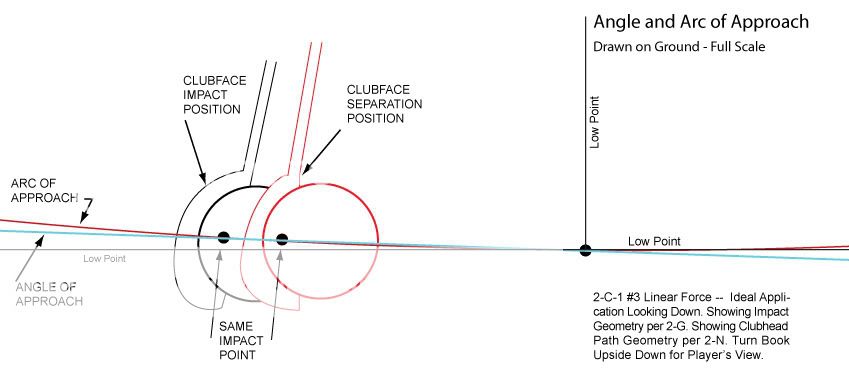
Bernt, I don't know if this would make any difference to you, but the Book description of Low Point uses the Center of Gravity of the Clubhead, on the Sweetspot Plane, passing through the Impact Point and Low Point.
If we visualize Low Point in relation to the Bottom of the Clubhead Arc, then it may follow that Ball Separation at Low Point would have the Bottom of the Clubhead only brushing the Ground. It seems that Non-TGM people have adopted the term Low Point to define it this way. But if we adopt HK's view as outlined in 2-N-0, and the COG of your Clubhead is 4 grooves up with a 9 Iron, you may take a decent Divot even if Ball Separation was at Low Point. I'm doing some illustrations. So far they indicate that the Impact point, on the Ball is where it should be for a 9 Iron (That seems to be the "Given") and the Low Point along that Arc on the Sweetspot Plane, is about 1/4" above the Ground, which makes your 9 Iron dig about a 1/2" ( or a little less) Divot when Separation is at Low Point. A lot of book info leads me to believe that Separation occurs before Low Point and that Low Point is directly below the Hinge (or should be in a normal and practical golf swing). Quote:
|
Yes,
It makes a difference. The fog seems to disappear. |
Quote:
Guys I realize I have a bit of unfinished business from 2010. I love D's drawing here. Its a reworking of the diagrams of 2-C but with the Impact Point moved back of low point.......as you would get for balls played back in the stance. The diagrams of 2-C are really about compression to my mind, hinge actions as opposed to ball curvature but the lend themselves well to what Homer discussed in 7-2. When I started this thread I didnt know the difference between Inside OUt Impact and an Inside OUt stroke in terms of the effect on ball behaviour. I had wrongly assumed the inside out approach angle with a straight plane line to produce a straight shot! Now I know the geometry better.......this after decades of curving golf balls ....sometimes where I wanted them to go, even. Im in good company here so I dont feel like too big of an idiot. No more than usual. So the specifics of Daryls drawings above aside .....and I do wish that D would continue on with these drawings per 7-2 etc. If in the process of moving the ball back in the stance you also "Rotate the Grip" (rotate the handle in the loose hands) so the Face is still pointing down the Target Line.... given enough clubhead speed and divergence in path and face, the ball will draw left of the target line. Requiring you to select a Plane Line suitably right of your intended destination in the first place. If you dont Rotate the Grip and allow the FAce to open as you move the ball back in the stance. Depending on how far back you go , how much divergence ......Push to Push Fade assuming no hand manipulation. This is for full shots. For chip shots where there isnt enough clubhead speed for the ball to curve in accordance with any ,as Homer put it, "tilted backspin" (not side spin) you will see the ball land where the face is pointing approximately but roll out in different manners Id imagine. Hope I got this right. 7-2 is one tough read. Homer seemed to have a personal preference for the first procedure where you rotate the grip , be you a Hitter or what he termed a Manipulated Hands Swinger. They're in the same boat geometrically. A True Swinger on the other hand being one allows CF alone to square the face, no grip rotation , no hand manipulation , no hinge action, just the natural Horizontal that CF produces. All of which I believe requires a slight notation beside 6-H-0-F-3............but thats for Lynn to decide as I could be wrong again......but that particular IMPERATIVE relates to True Swinging only I believe. |
I don't think your version of my posts seems that bad.
Quote:
Which part of your reasonable, self-effacing post is supposed to be bad? I think we have all been inside too long and need some 55 degree weather. Happy New Year! :golfcart: ICT |
What's today? January 2nd? I don't like Winter anymore. Can you imagine how awful it must be to live in Maine?
|
| All times are GMT -4. The time now is 09:23 AM. |