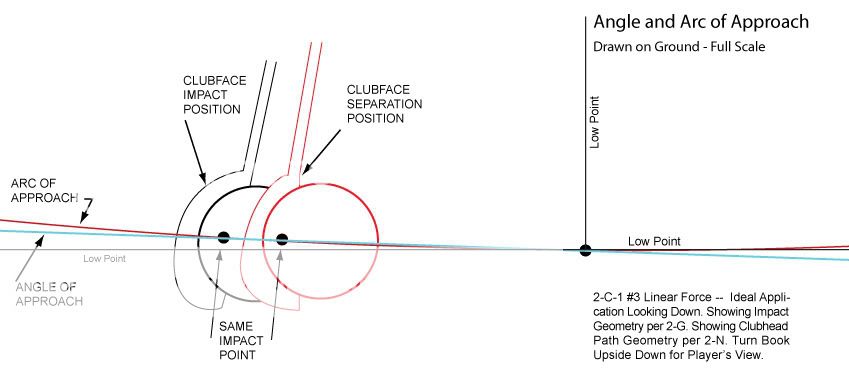
|
Ive lost count but Im thinking its:
3 people say draw. 1 says straight. And a great story from City. |
Quote:
Centrifugal Force will always Swivel the Clubface Square to the Longitudinal Center of Gravity of the Club. The Pivot must be designed and executed to coordinate that with Turn and Roll for Plane Line compliance. So, a Push or Pull can be a very well executed Stroke. Because Swingers use CF to Swivel the Clubface, Side Spin can be developed by changing the Plane Line/Target Line relationship and by moving the Ball Aft and Forward to coordinate Turn and Roll. This is ALWAYS an On-Plane Stroke. Because it's an On-Plane Stroke, they are named Fades and Draws. Cross line Strokes are named Slices and Hooks. Fades and Draws don't produce the high side spin Rates associated with Cross-line strokes combined with Clubface Alignment adjustments. 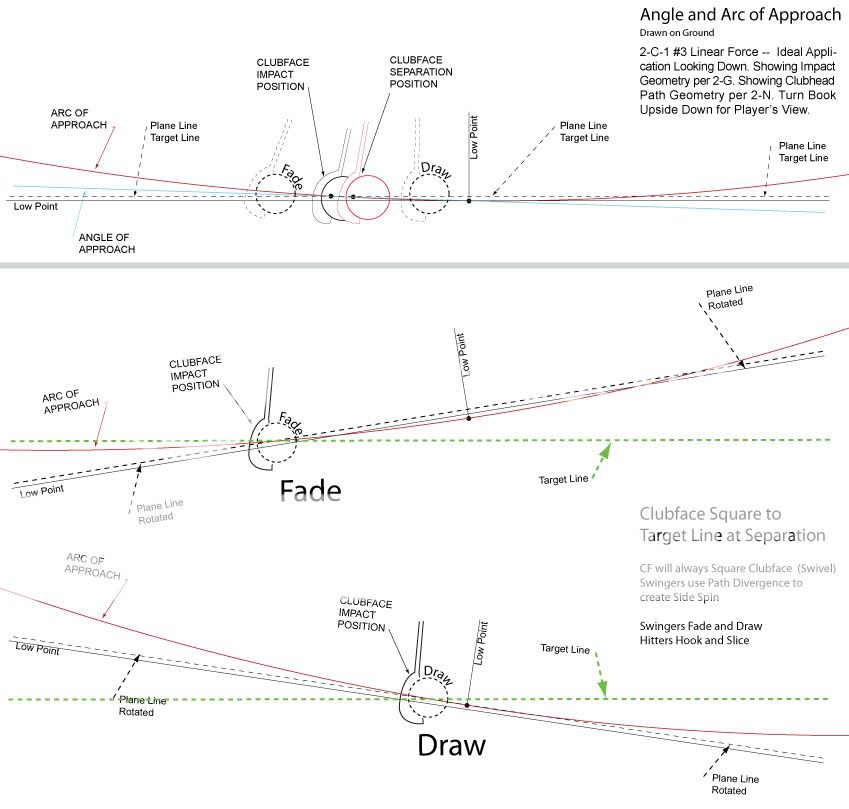 |
Those are fantastic drawings Daryl. But Im not sure about the "fade" and "draw" in the first one. I know your coming from a True Swinging perspective , but the face angles seem wrong to me. The fade looks like a push fade to me........my head hurts...
Per 1-L-17 the ball leaves at right angles to the clubface at Separation. Side spin coming from any divergence in the clubhead path to the clubface angle. The opposite of the old ball flight rules but now confirmed by Trackman.......which casts a peculiar light on a lot of past champion's own instruction books. Homer was adamant that they couldnt have actually done what they were teaching. A belief that didnt go over too well with his listeners but he insisted. And we now know he was right. To think that some of golfs greatest champions were manipulating the clubhead path and face angle perhaps subconsciously, in the direct opposite manner than that to which they subscribed theoretically makes for an interesting discussion. Sean Foley has said that he likes his players to draw the ball with an open face angle of 3 degrees and then create the side spin with their arcs. So the ball starts right then curves back. He's probably got a Trackman on the range at OCN I'd imagine. |
Quote:
The Top drawing only shows the amount of clubface Roll with three different ball locations with an On-Plane Swing.
Quote:
Trackman sets up behind the ball and doesn't "see" the actual Clubface-Ball contact because the clubhead obscures it. I'm not a mathematician and I couldn't begin to wonder how complex or simple the calculations might be although models to determine distance have been used by clubmakers for a long time now. I don't know if Trackman measures ball flight and then calculates clubhead/face path and geometry or the other way around or a combination of both. What if you swung the club without a ball? If Trackman uses any ball flight data to calculate clubhead path, face angle and swing plane, I can't be a "True Believer" in it's use as a training aid because I can't accept mystery. Besides, ball flight cause and effect are Apples and Swing Mechanics are Oranges. But I imagine it would make an excellent clubfitting tool and it does make for fun TV ball flight instant replays. Quote:
|
Quote:
Im still wondering. Straight shot or Draw? Maybe we have to assume a Hinge Action.......so lets say Horizontal and Arc of Approach, manipulated hands swinging or Hitting. I was initially thinking straight cause its not an inside out stroke but now I honestly dont know. Life line.....Yoda!!!!!!! |
Draw.
If the club head closes and the impact point doesn't move from contact to separation, the ball will "close" too. It will rotate the same way as the club face did during impact. And there you have the draw. If you hit the ball human-like and produce a fade, there's o way you can keep the impact point on the ball fixed during the release interval. Perfect ball compression and a fade would require reverse horizontal hinging. |
What's up?
Daryl,
Can you elaborate on what you mean by "Centrifugal Force will always Swivel the Clubface Square to the Longitudinal Center of Gravity of the Club." |
Quote:
Background: There are three Clubface Alignments. We're concerned mostly with 2.
A Swivel is a Rotation of the Toe of the Clubface and Heel of the Clubface around the Sweetspot on the Clubface. Simply stated, it’s the Toe and Clubshaft Rotating around the Sweetspot. The Sweetspot Plane is the longitudinal center of gravity of the Golf club. It’s an invisible line that connects the Sweetspot on the Clubface up through the top Right side (ideally) of the Golf club grip (because of the forward leaning shaft). Simple Experiments: These are "Swivel"
My intention while addressing the Swivel issue during a discussion or Fades and Draws, is that CF will Orientate the Clubface (Hood-Layback) while the Player moves the Ball Location Fore and Aft for Plane Line/Target Line (Pivot Turn and Roll). This controls trajectory on Fades and Draws. But more important, it's integral to sustaining the Line of Compression during all three procedures, Closed, Open and Square Plane Line relative to the Target Line. Hey, it was just a passing thought. |
Quote:
|
Quote:
|
| All times are GMT -4. The time now is 04:22 PM. |