
|
Quote:
That is NOT at impact! |
Quote:
   |
KOC
This is Jason Zubacks' secondary axis tilt and head position at impact.  Jeff. |
The change
Jeff,
That is a great picture for hitting really far. To my eye, his power package looks good TGM-wise, but his club is moving up because of the extreme tilt., which is a good thing if you want to win long drive contests. You might notice how much the tilt has changed from the top. It is much more dynamic to change the tilt in the downswing than to pre-set it at address. But.....Jason does not have to hit his next shot off the ground like a golfer would. As for how high they launch it. You might try to find some launch monitor numbers for the long drive guys. It is a big adjustment to actually see the ball when you are standing next to them, because it launches so high. |
HB
You wrote-: 'It is much more dynamic to change the tilt in the downswing than to pre-set it at address." It is much more dynamic to change from a slight reverse tilt (pivot) at the end-backswing to a large degree of secondary axis tilt at impact. However, I suspect that it far less mechanically efficient than Jamie Sadlowski's swing. He has no reverse tilt (pivot) at the end-backswing position. He has the classical reverse K position seen in Hogan's swing. Jeff. |
Jeff,
Would you post a frame by frame of Jamie's swing, face on from address to impact? |
|
Quote:
Jeff If you were to consider this photo impact for a moment and draw a line from Z's left shoulder down to the clubhead you could argue that this is a new low point line given his shoulder tilt. In that manner he could be said to be still hitting down and out! This is what I was referring to when I mentioned the artificial up hill shot. You disregard the flat ground and artificially set up as if going uphill to launch the ball high. You need to make some adjustments so as not to bottom out early in the oh so real flat earth however. There was another Canadian prior to Z who in the age of persimmon would tee a ball on a golf pencil for height, and then tilt way way back. Twenty years ago or so my buds and I would call this a Kelley Murray shot as we took our 10 degree persimmons over the tree tops on dog legs. Down wind it was a go to shot. The advent of metal drivers, that are so "just tee it up and hit and it will be ok" has taken away the need for most specialty shots off the tee. The high hook in a right to left wind that added 30 yards, the teed low heeled cut shot on a tight hole etc etc etc. Jeff I should point out however that if you buy the "new low point" (NLP) you should in fairness also draw a line down from Z's head parallel to the NLP line. You will find it to be centered in his Imaginary new stance line ("INSL"). A new and centralized pivot center. Thanks to Daryl and Jeff Hull for their "spirited" discussion on this and Hip Action in the Trophy Room of the Atlanta Country Club. Make that "wines and spirits". Come back, Daryl, we miss ya. O.B. |
Quote:
Bucky Whats the explanation of this phenomena? Does it have a practical application for the tournament golfer under normal conditions? Dont be scared, this aint a trap. I dont care what you are reading or anything. PM me if you want. O.B. |
Mythful Thinking
Quote:
Where in his post did O.B. Left say that Jason Zuback was attempting to 'hit up'? Reread his post. What he 'said' and what you 'heard' are two totally different things. I'll save you some trouble, here is what this very educated golfer deliberately said: ". . . the ball struck on the upswing, the ball teed high and inside the base of the plane." In other words, with the Ball properly teed post-Low Point, there is no need to 'hit up'. The Clubhead Orbit (2-N-0) goes DOWN (and OUT) to Low Point and then it moves UP (and IN) thereafter. Hence, O.B.'s observation that the Ball must be "teed high and inside the base of the plane". So, for those who understand and implement these Geometric Basics . . . Just swing. The resulting Upstroke is God's Plan. And, Jeff, you need to seriously investigate this "forward kick" stuff. At some point, no doubt you will. But no fair relying on manufacturer's 'claims' (advertising) or TOUR players paid opinion (more advertising) . . . we're looking for independent research and PROOF This should keep you busy for awhile once we've thoroughly hammered-down all this Pivot stuff. We here at LBG are with you all the way! :super: Meanwhile . . . Know that the 'Centrifugal Line of Pull' is between the Sweetspot and the #3 Pressure Point (Right Forefinger). [BTW, did you notice the bandages on Mr. Zubak's right forefinger and thumb? I thought you did!] If the Clubshaft's inertia can keep up with this Line of Pull -- highly doubtful with the LongDrive MuscleMen -- then you will have a straight-line relationship. Otherwise, the Shaft will evidence its parabolic bend between the two. You interpret this Shaft Bend as "Kick" that Lays Back the Clubface. The truth is that Shaft Bend itself supplies neither 'Kick' nor 'LayBack'. For Swingers, it supplies only Centripetal Force. For Hitters, it supplies both Centripetal Force and something to Push against through Impact. :xmas-smiley-004: |
Quote:
Would you please read those 12 sections of the golfing machine esp. the impact and follow-through alignment and see what is the following pictures and yours refering to...(pay attentiont to the Impact hands in the first picture)   |
Them Big Arms
Quote:
Power is Zone 2-- ARMS. Just once, I would like to execute my swing with those arms! Whoa! :eyes: |
Quote:
Thanks Yoda You know it's really your own words and Mr Kelley's that are coming back at you all garbled up. Hope you didnt read my post 88 where I threw it all away like a Sunday afternoon hacker. Dont think that stuff is in the book and probably has HK tossing in his grave. I blame Daryl and Golfgnome. O.B. |
Quote:
http://www.youtube.com/watch?v=R8UqU...eature=related http://www.youtube.com/watch?v=Ifb6dT-tso0 http://www.youtube.com/watch?v=GZsplhHXQy0 |
Yoda - you wrote-: "You interpret this Shaft Bend as "Kick" that Lays Back the Clubface. The truth is that Shaft Bend itself supplies neither 'Kick' nor 'LayBack'."
I don't understand your statement in the context of this photo. 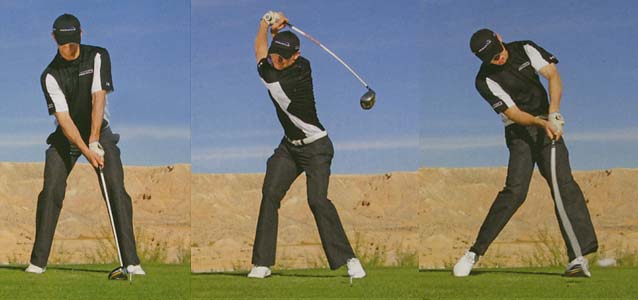 Jamie's clubshaft looks like it has bent forward so that the peripheral end is closer to the target than the central end. Do you believe that this phenomenon is not really happening" If it is really happening, why would it not cause clubface layback? Also, take a look at Jamie's forearm muscles. Very wimpy for the world's best long drive swinger I would think. I had a conversation with Jason Zuback and I asked him whether he used his right forearm/arm actively in his swing as a major source of power. He said that he didn't, and that he didn't feel that he was using any right arm power in his swing. Jeff. |
Here is some good Zuback slow mo - go to the 5:50 mark and it appears the club is hitting up on the ball while breaking the world ball speed record.
http://www.youtube.com/watch?v=FkTHw...eature=related |
Me and Bob Feller -- Rock-Skipping Revisited
Quote:
http://www.youtube.com/watch?v=Ifb6dT-tso0 Naah, Bob and I never skipped rocks together. :smile: But . . . As an avid little-leaguer, I knew a lot about him. I first read his name at age eleven in The Stars And Stripes, the American newspaper for military personnel (read, my father and us) stationed overseas. Little known to me, Bob was already retired, and his legend was in full bloom. Curious, I checked out his biography from the library at The American School On the Rhine and learned that he was an American Indian who threw the fast ball faster than anybody ever. http://www.amazon.com/gp/offer-listi...condition=used Wow . . . what a story! I loved that book and read it a million times. I even carried it with me to school! Fast forward twenty years . . . At age 31, I met him personally one evening at a 1977 financial conference in Toronto where he represented one of the sponsors. There, he was at first diplomatic and then amused. But, when I looked him straight in the eye and quoted his stats: :shock: Where was I? Oh, yes . . . Bob's left leg came down as his right arm swung back . . . and then he "let'er go!" See my Post #150 here: http://lynnblakegolf.com/forum/showt...t=6241&page=15. :salut: |
Quote:
BTW Nice Belly Button! |
Hard At Work In the Playpen
Quote:
The noted bend -- produced by the Sweetspot striving to maintain its in-line condition with the #3 Pressure Point -- is exactly what I rerferenced in my Post #90 above. I know you can -- and need! -- to draw that line, so please do, for the benefit of all. :smile: However, in the interest of future discourse, PLEASE try to connect the dots of prior posts. :salut: Thank you. . . . Regarding Clubshaft "kick" producing Clubface Lay Back . . . Please. The Left Wrist (vertical to one of the three Associated Planes) controls the Clubface . . . not the Clubshaft 'kick'. :salut: |
I have drawn a yellow line between the clubface sweetspot and PP#3.
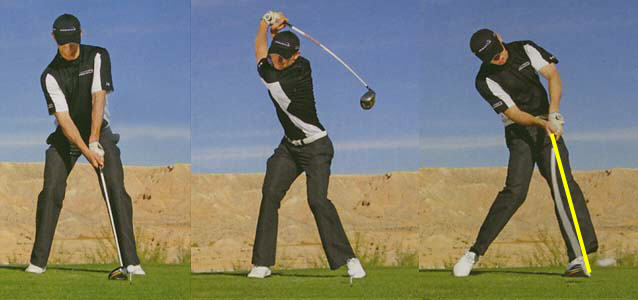 Have I drawn the line correctly? What are you therefore implying? Are you implying that his thrust action is slightly upwards at that time point? Jeff. |
As I Said . . .
Quote:
See the "parabolic Clubshaft bend" I mentioned above? That is not Clubshaft "kick" . . . It is Clubshaft Inertia not being able to keep up with Centrifugal Pull. Get it? &B |
Yoda - I don't get it.
Are you stating that the clubhead has a certain speed at that time point due to the CF-release force that causes the clubhead to be in that position, and that the central clubshaft cannot keep up? If correct, where do you perceive the PP#3's thrust action force being directed at that exact moment in time - is it down-and-out-and-forward; level and forward, up-and-forward-and-inside? Jeff. |
Thrust And Threadjack
Quote:
You know what makes my life so difficult with you? Its because of posts like the above. First, you call me out -- "Yoda". Second, you put words in my mouth ("Are you stating . . ."). Always gotta be careful there! Third, you ask a multi-part question. Finally, you imply you want only a simple 'Yes' or 'No', yet your responding bombast always demands far more. Once I've satisfied myself that you've reasonably summarized any prior comment I may have made -- no easy task! -- I then have to parse your typically voluminous posts and questions. In this last instance, you have dictated your premise, "The Clubhead has a certain speed" -- and, then, as usual, there are at least FOUR questions to give a 'go' or 'no go' (all of which are based on a previous mountainous distillation): -- At that time point;Any one of which I get "wrong" -- even if only by omission or contrary opinion -- or fail to address adequately, and you and other detractors stand ready to roll out the cannon. I don't like this. I applaud your efforts, but I cannot continue to devote my time -- this past week or so was a gift -- to digesting your voluminous posts, correcting your misguided concepts and answering your indefatiguable challenges. I am the proprietor of this site, but I am not your personal 'pocket pro'. Nor will I leave blatant challenges unanswered in open Forum. To the point, I'm done here. You are a significant contributor, and I encourage your innovative efforts. However, I have come to believe that you need your own Forum to do it and hereby establish Golf By Jeff. Challenge Homer, me, the world order or the nature of the universe . . . I won't care as long as participants adhere to a reasonable decorum. Given your innate curiosity, scientific background and visual posting capabilities, I expect your Forum to be very popular. I will participate as I see fit, but my lack of comment will not be deemed acceptance of any outrageous and incomplete ideas posted therein. I've previously Private Messaged you on this coming constraint. You will post only in your own Forum or another as approved personally by me. Otherwise, nada. :smile: ----------------------------------------------- Now, to your first question: Yes. More precisely, the Sweetspot leads . . . but for now, your term "clubhead" will do. :) Quote:
But, careful, Jeff . . . You're risking jacking your own thread. :eyes: Thrust Direction is a Delivery Path Concept (#23), not a Pivot Concept (#12). Here we go everybody . . . Hold on! :sleigh: |
I think Homer said something about the clubhead lining up with the point of origin of the force . . . the #3 pressure point.
|
Yoda - thank you for very much for giving me a place in your forum where I can ask probing questions, debate the validity of certain TGM concepts etc. It is very gracious of you. There is zero chance that certain others would do this, because it requires a great deal of confidence for a TGM golf instructor to allow certain TGM beliefs to be deeply explored and even challenged.
I will definitely adhere to the guideline of decorous behaviour and I would not think of insulting another forum member who has contrary opinions. I like contrary opinions because it forces me to rethink my own position, and I often change my thinking in response to insightful posts that are contrary to my own thinking. I also will not expect you to participate in the forum and I will therefore not address my posts to you. Of course, you can post freely if you are interested and you want to selectively make a point. My interest in participating in this forum is to learn more about TGM and about golf mechanics and biomechanics in general, and any LBG forum member should freely participate if they are interested. ------------------------------------------ Regarding the clubhead kick situation. This represents my understanding at present. Consider this composite photo.  Note that Jamie's clubhead is sagging at the end-backswing position. If one looks at his early dowswing, one will see that the clubshaft bends backwards. I believe that this is due to clubhead inertia. Long drive competitors, like Jamie, pull the grip end of the club forward with tremendous force and the COG of the club is near the clubhead. Therefore, the clubhead lags behind in the early downswing due to its inherent inertia, and that causes the clubshaft to bend backwards. Theoretically, in a double pendulum swing system the peripheral arm is rigid and cannot flex. However, despite the golf manufacturers making their lightweight shafts extra-stiff for long-drive competitors, they cannot make them so stiff that the shafts cannot flex/bend at all. In the final image, I have drawn a yellow line indicating where the clubshaft should be if it were ultra-rigid and incapable of flexing. I base the position of the yellow line on the direction of the central clubshaft, which has a very small amount of forward shaft lean at impact. Note that the clubhead has kicked forwards, which causes the clubface to have a slightly greater amount of loft at impact (layback situation) because the ball is positioned slightly forwards of the standard position (which is usually behind the low point). Why does the peripheral end of the clubshaft bend forward? This represents my explanation. I think that Jamie is a swinger and that he uses PA#4 and then PA#2 and then PA#3 in that sequence. After PA#2 release, the clubhead is traveling at increasing speed towards impact and it probably reaches >160mph when it approaches impact. However, the hands, and therefore central clubshaft slow down just prior to impact, due to COAM and other biomechanical factors. One can see Tiger's left hand slow down just prior to impact in this photo - giving time for release of PA#3 and squaring of the clubface. 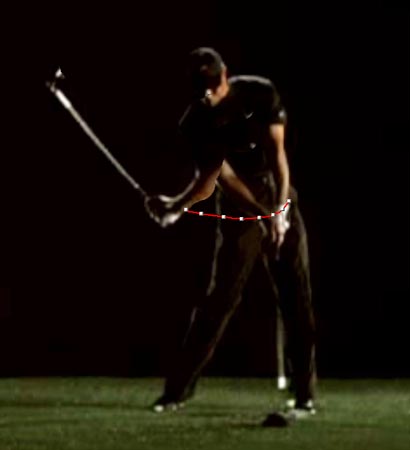 I presume that Jamie's hands, and therefore central clubshaft, also slow down just prior to impact - like Tiger's hands. However, the clubhead is traveling so fast that it cannot slow down and it passes the "expected" clubshaft-line and bends the peripheral end of the clubshaft. In other words, it has kicked forwards. When the clubhead kicks forwards, the clubface loft (which could be around 5 degrees) becomes greater (? 9-10 degrees) which allows for an optimum ball flight trajectory. I suspect that Jamie anticipates this clubshaft bending phenomenon, and he therefore places the ball in the optimum position for optimum ball launch conditions. There are those that argue that Jamie is actually hitting up on the ball. I don't think that its possible for two reasons. First of all, one can see that his central clubshaft near the hands has forward shaft lean, which is consistent with a descending clubshaft path. Secondly, it would make no sense for him to change his downswing thrust direction from down-and-out-and-forwards to going upwards in the later downswing. I believe that Jamie starts his downswing with a thrust towards an aiming point that causes the thrust to be directed down-and-out-and-forwards. That thrust causes release of all the PAs and I suspect that the thrust is maintained until all the PAs have fully released - which is when both arms are straight (end of the followthrough). In other words, the thrust is still directed downwards even when the club has passed the low point of his swing's clubhead arc. So, when one sees the clubhead moving slightly upwards at impact, it doesn't mean that he has changed his thrust direction. It simply means that the clubhead is traveling so fast that it bends the clubshaft forward at its peripheral end as the left hand/central clubshaft slow down just prior to impact. Regarding the low point of the clubhead arc in long drive competitors who have a lot of secondary axis tilt - is the low point moved forwards? I don't know the answer. If any forum member has access to a slow-mo swing video of Jamie Sadlowski's swing, I would like to examine his clubhead arc to see where his low point is situated. Here is Tiger Woods' clubhead arc through impact. 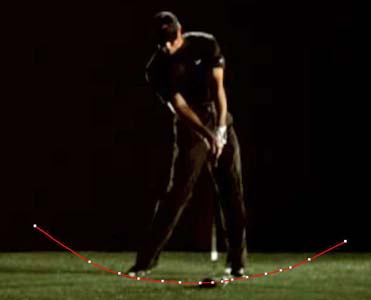 One can see that the clubhead arc is very shallow pre-impact, and that the low point appears to be behind the ball, or just at the ball - which is a point opposite his left shoulder socket. Jeff. |
Back To the Future
Quote:
I think your Forum will be a great success and that we will all learn a lot. I will participate when I think I can add value, but only as my time permits. I expect the decorum to be a two-way street. Respect for opposing opinion -- however hotly debated -- will be the standard. :salut: Quote:
No, Jeff. The correct line is the one you drew (at my request) in your post #100. It runs from the #3 Pressure Point to the Sweetspot. Note also that the line points in the direction of the Primary Lever's fulcrum, the Left Shoulder. The "direction of the central clubshaft" is irrelevant. :) |
Yoda - at this time point we hold contrary viewpoints. I remain open to serious, well-intentioned input from interested forum members and I hope that their input can help clarify matters. I am willing to change my viewpoint in the face of a solidly convincing argument
The problem that I have with the idea that the "sweetspot must be in line with the PP#3 point" is the "belief" that there is a causal connection between the two observed phenomenon. In a swinger, there is no thrust at PP#3. A golfer senses/monitors clubhead lag at PP#3. However, sensing clubhead lag doesn't necessarily prevent a clubhead throwaway problem where the clubhead bypasses the hands near impact, or at impact. In this situation of i) the clubhead traveling at 160mph and the ii) hands slowing down just prior to impact, I can imagine that the golfer can lose his sense of clubhead lag pressure at PP#3 whether he likes it, or not. This loss of a sense of clubhead lag pressure at PP#3 would not necessarily occur if the clubhshaft was not capable of flexing in response to the clubhead's enormous pre-impact momentum, and I could then easily imagine a straight-line relationship between the PP#3 point and the clubface's sweetspot. Jeff. |
Quote:
Jeff, How do you think the club flexes during the golf swing? How would you differentiate between flexing and kick? If at all. How would these things change for a hitter versus a swinger? How would these things change if the plane angle was flat or upright? Look forward to your comments. |
Are launch angles like hem lines going down this season?
Quote:
Henny As a side note and given your experience on tour: When I get into a launch monitor for a driver fitting the techs are always trying to get me to launch it super crazy high. I can understand how this would max out carry etc but I hesitate to fully embrace it as a standard operating procedure. What do you see guys on tour doing these days? Are launch angles going up or down of late? The fitting guys are also advocating the same procedure into the wind ,in the belief that a high, low spin ball will push through the wind better. I dont doubt their research results but am still hitting it low or moderately high into the wind, thinking that I dont want it to blow around up there. Perhaps Im merely dating myself. What do you see on tour into a strong wind? Tiger seems to tee it low and hit it on the downswing a lot. Sometimes he tees it really low, almost old school if you will. To get even further afield Im seeing some Titleist guys now going to the slightly smaller driver head. I remember tennis racquets getting huge and then coming back a little. Regards O.B. |
Mike
Those are excellent questions. I don't know the answers. I can understand that if a shaft flexes, that it has inherent elastic properties that will induce it to spring back to a straight line alignment. Therefore, when one sees a clubhead ahead of the hands/central clubshaft at impact - the question becomes - did that phenomenon happen because the clubhead's momentum caused the clubshaft to flex forwards or could there be a spring-back clubshaft-flex action due to the fact that the clubhead was lagging behind the clubshaft earlier in the downswing, causing the shaft to bend backwards, and now the clubshaft is simply flexing forwards in response to being previously stretched the other way (a whiplash action). Do you have any insights to share that can differentiate between these two theoretical possibilities? I imagine that the clubshaft should behave very differently between a hitter and a swinger. A hitter applies a push-force continuously on the clubshaft all the way through impact. I imagine that there is therefore less of a whiplash phenomenon. By contrast, a swinger induces a definitive whip lash motion, in the sense that pull-power is imparted to the clubshaft during the early-mid downswing, and no further power is imparted to the clubshaft during the near-impact phase of the downswing. At that time point, the clubshaft is moving towards impact due to the passive release of PA#2 ( due to centrifugal forces). I could imagine the clubshaft behaving very differently under those conditions. Please share any insights you have regarding this matter. I don't imagine that an upright versus a flat plane should have a significant effect. Do you? Jeff. |
Quote:
Do you have a photo of this long drive guy - at impact with the ball still on the face? |
chip shots from the lunatic fringe
Quote:
Since it impossible to thread jack this topic now: Are all these levers here a source of power? Lets number em all in Jeffs forum. Lets start with the lower lumbar and move up to L3 (no not Lauren Conrad idiot) What about lateral moves? Is golf more rotational or lateral? Lets give the lateral move a number too. Not number 2, number tooooo. Each one with an associated pressure point. What flat wrist? Prove it dammit. "I want the truth, You cant handle the truth." "Im out of order, this whole system is out of order". "I, am not a crook"........."What we got here is a failure to communicate"........Hey can Mike O and You riff all you want in the Jeff forum? WAit DG and Jeff in a cage match on the right arm............this will be good. Pay per view maybe. Ultimate TGM. Just when I was starting to understand TGM! "Looks like I picked a bad day to give up chewing gum". |
Mike - I don't have an image with the ball on the clubface. I only have the still photos from GD magazine. I really need a slow-mo swing video of his swing (captured at >500 frames/second) to be able to get a capture image of the ball on the clubface. Why is it important?
By the way, I looked up the topic of "flexible shafts" in Jorgensen's book "The Physics of Golf". He is very vague in his calculations and he claims that shaft flexibility can increase clubhead speed by 3%. He does not discuss whether any increased forward shaft flex at impact is solely due to the whiplash phenomenon of shaft flex or whether is it due to the "effective mass of the clubhead" at impact. I am going to PM nmgolfer, who is a forum member, and ask him whether he can shed any light on this issue. Whether the forward shaft flex at impact is due to shaft flexing (whiplash effect) or due to the clubhead's large momentum (due to its >160mpmh speed) at impact, it seems to be an incontestable fact that the peripheral end of the clubshaft is flexing forward. What is interesting to me, is that the clubhead/clubface is not-in-line with the V-groove of the hands. Normally, when analysing swing videos of professional golfers using my V1 Home software program, one doesn't see the clubhead ahead of the hands at any time point during the downswing, and I don't think that the forward shaft flex is intentional. If Jamie was intentionally flipping his hands at impact to get the clubface to go upwards into the teed ball, then the V-groove of the hands should be in-line with the sweetspot of the clubface. Jeff. |
Is there a chance that the clubshaft bending that far forward is a optical illusion caused by the shutter speed of the camera or something? I ask because I've seen some high-speed camera slow-mo of Sadlowski's swing, and the shaft dosen't kick anywhere near where that picture has it. I know it flexes during the swing, but not that much, does it??
BTW, Jeff, here's some slow mo of Jamie, at about the 30 second mark. http://www.youtube.com/watch?v=SdjhA...eature=related |
Shaft bend!
Quote:
I have seen some ultra slo-mo shots that show some really distorted shaft positions throughout the swing on some players that don't come close to this young man's speed. Don't believe you would see this kind of distortion on shorter shafts. The longer driver shafts, even though they are tipped very firm, have what I believe to be a recoil effect immediatley after impact. |
Quote:
|
Snakes And Pressure Points
Quote:
Homer said that the degree of clubshaft distortion didn't matter. "The clubshaft can look like a snake," said he, "but the sweetspot is still trying to get in line with the #3 pressure point." :salut: |
Bigwill/Bond007
I agree that one cannot trust what one sees when looking at capture images of swing videos - especially when the frame rate is only 30 frames/second. I have seen swing videos where the clubshaft was bent 90 degrees. The reason is due to the fact that the camcorder is operating at 30 frames/second and it has multiple moving images occurring within that single frame time period (1/30th second) and the camcorder simply recreates a composite image according to the camera manufacturer's algorithm. Even the Bizhub Swingvision camera, which operates at 500 frames/second, may result in distortion when dealing with fast club speeds. Here are capture images from that slow-mo section of the Sadlowksi swing video.  I put in image 1 for fun - to show his amazing clubhead lag. Images 2-5 show the clubshaft movement through the impact zone. There was no frame that captured the clubshaft at impact. Note how blurred the clubshaft images are - I cannot trust their accuracy even though this is a slow-mo swing video. However, there is an interesting point. Look at the clubface sweetspot in relationship to the hand angle. I can believe that one can draw a straight line between the sweetspot and PP#3 and I can believe that the sweetspot is trying to get inline with PP#3. However, that GD photo of Jamie post-impact didn't look right to me - the hand angle didn't look right relative to the sweetspot. I still think that the sweetspot should have been where I drew the yellow line. I don't think that we can resolve this issue because even the GD photos, which were presumably taken with camera that has a very high shutter speed, may be distorting reality. Jeff. |
Jeff
Know what you mean, interesting note and with many implications. Horse racing for instance. But the GD photos are super sharp and one normally tends to go with that for accuracy no? Could the video blur be hiding a bend? it doesnt appear so but.. Why would the film show a sharp in focus bend instead of just a blur? O.B. |
The video blur could be hiding a "true" bend.
It shows a sharp focused clubshaft because the camcorder's inbuilt algorithm instructs the camera to produce a composite photo that is compositionally coherent when faced with multiple blurred moving images. It chooses one-of-many clubshaft images that occur within the time space of one frame as being a representative clubshaft image. I think that one can trust the accuracy of the Tiger Woods Nike Commercial swing video because the frame rate was 4,000 frames/second. Interestingly, there is no clubshaft bend post-impact in that video. I don't know if the GD photo series was made with a still digital camera, which can have a fast shutter speed of 1/8,000th second and where each image is a single frame captured at 1/8000th second. If the images were captured with a still camera operating at >1/8,000th second, then they should be accurate. Jeff. |
| All times are GMT -4. The time now is 10:05 AM. |


