
|
accommodations
Quote:
It's important to be able to accommodate. One of my students is a double amputee from above the knees. I would say that's not the best case scenario for golf. But, other than looking a little stiff, you'd never know. I've seen him hit it about 240 with a driver. My goal for him is 100% of his potential. It's not to lament over his "limitations". |
The High and Mighty
Quote:
|
do you have to see it?
Quote:
|
Yodas Luke
I think of the word "abilities" and "limitations" being equivalent from a biomechanical perspective - because I don't harbor any emotional feelings about any golfer's limited biomechanical abilities. I am totally neutral, and I simply try and understand how to best optimize a golfer's golf swing biomechanics/mechanics/physics for his "given" set of biomechanical abilities (limitations). Jeff. |
Yodas Luke
You wrote-: "I cannot see the fingers of the pianist playing Mozart that misses a key, but I can hear it. Must everything been seen to know?" I think that's a weak argument. You are using your auditory sense organ to assess the accuracy of a pianist's note-playing. That's appropriate because you are using the appropriate sense organ to sense sound waves. However, if you want to assess whether the pianist's fingers are moving in space properly, then you must use the appropriate sense organ - the visual sense organ (or its appropriate surrogate substitute, a high speed swing video camera). If the clubshaft hosel is actually moving around the clubhead sweetspot in space during the golf swing, then surely it must be visually-apparent. Jeff. |
Occam's Razor...
if you took a strip of sheet metal say 1 inch wide by 6 inch long and wrapped it around the end of the dowel and attached it to a weight, it's stiffness would prevent it from "releasing" in the plane of the golfswing while still allowing to rotate out of the plane of the swing (provided it doesn't bind up) if indeed it were subjected to a force that caused it to want to rotate out of the plane of the swing. I submit there is no force that causes it to want to rotate out of the plane of the swing.
Generally speaking.. Any object (a shaft for instance) will naturally want to rotate about an axis defined by its angular momentum vector. But all real objects are constrained to rotate about random axis which due to manufacturing tolerances is never aligned with the angular momentum. This unavoidable misalignment between angular momentum vector and axis of rotation causes imbalance forces. (Lathe imbalance for instance). But this has nothing to do with the face of a golf club opening and closing. What we have with a golf club is the CG of each element of its contruction (head and shaft) wanting to find their way ONTO the plane of rotation (not off of) the plane of rotation. But... the club head being attached to the hossel is forced to rotate off plane (against its natural inclination) as the golfer's hands cause the shaft to rotate about its longitudinal axis. Quote:
|
teaching
Quote:
|
nmgolfer
You wrote-: "f you took a strip of sheet metal say 1 inch wide by 6 inch long and wrapped it around the end of the dowel and attached it to a weight, it's stiffness would prevent it from "releasing" in the plane of the golfswing while still allowing to rotate out of the plane of the swing (provided it doesn't bind up) if indeed it were subjected to a force that caused it to want to rotate out of the plane of the swing. I submit there is no force that causes it to want to rotate out of the plane of the swing." You state that there is no force that would cause the clubhead to rotate out of the plane of the swing. That would be true if the hands propelling the dowel stick didn't rotate the dowel stick about its own axis while the dowel stick is being moved in a rounded arc. However, the left hand holding the dowelstick may swivel counterclockwise while the left hand is moving the dowel stick in a rounded arc. Wouldn't that cause the clubhead to change its position relative to the clubshaft, and wouldn't that change in position of the COG of the clubhead cause it to rotate even more - because the COG of the clubhead has shifted in space relative to the overall orbit of the dowel stick's hosel? I am thinking of a similar argument to your argument about the release phenomenon - where the club acquires angular velocity because the hand directional pull is not in-line with the COG of the club. Jeff. |
Quote:
Ted will also never tell you that he ran track in college and did not start the game until his senior year. I did not even know Ted and we went to the same school and ate at the same Athletic facility. So since we both left college I would say that he has done quite well for himself as a teacher and a player, especially since I only had almost 20 years experience on him. I think Ted would agree that he is no where close to the Physical shape he was in during his college years. Yet because he knows a more efficient way of swinging (or in Ted's case hitting) a golf ball, he has gotten longer with age and with less "physical abilities". Ted and Lynn are both far to nice to ever tell someone exactly how they feel. You really have to push Ted's buttons to get him riled up. I think you may be close to doing just that. So let me save you some time and effort by telling you to back off and stay on task. I have read this thread and feel that Jeff and yourself derive much pleasure from arguing worthless points. There is probably a reason why Jeff is not allowed to post on any other area of this site, or any other site for that matter. This site is for all golfers to learn about how to play better golf, not to allow Jeff to ask bizarre questions and then argue the answers given. I suggest you and Jeff get together and create your own site and stay off this one. I for one would enjoy being a part of it more. Golfgnome |
Golfgnome
You wrote-: "I suggest you and Jeff get together and create your own site and stay off this one. I for one would enjoy being a part of it more." I can appreciate the fact that you don't enjoy my posts and that you don't find them instructive. However, I cannot understand why you would enjoy LBG's website more if this "Golf by Jeff" forum didn't exist. You are not compelled to visit this forum section of Yoda's website if it disturbs your mental state of equanimity. Why must a poster's opinions conform to your personal need to avoid mental/emotional disccomfort? Why don't you just avoid reading their opinions? Jeff. |
Quote:
Trust me, I do not need anyone's personal opinions to conform to my own. I usally give my opinion, try to back it up with facts and move on. I can't tolerate arguments over MY OPINIONS. If I express something as fact then by all means prove it wrong. But when you argue opinions nobody wins. As many on this site who have ever met me can tell you, I care little about what others think about me. However, I care passionately about protecting the "team", this includes Ted, Lynn, and the many others who make a "positive" contribution to this site. Even though you have your own area, in my opinion you are not part of this team. When you were posting about "switting" and I tried to explain that there is no such word on this site you argued that fact. When I tried to defend a great teacher and personal friend, once again you come back with statements about "my opinions" that you have no clue about. All you seem to do is use big words and technical terms that very few on this site comprehend or care about. This site is about learning to play golf better. There is plenty of information to help everyone do just that. Try not to confuse everyone with your own personal agenda. |
clubshaft orbit
Who knows where the camera is, but it looks like it's within a few miles of being On Plane. The Sweet Spot is ON Plane in all three pictures. The hosel is not On Plane at Impact.
In the first picture, the hosel looks like it's very close to the Sweet Spot Plane. In the second picture, the hosel is not on the Sweet Spot Plane. In the last picture, the hosel is approaching the Sweet Spot Plane, again. I'd prefer to have the next frame, but Tiger would be blocking the view.    |
O.B. and NMG,
Read this quote, please: "The second example refers to the MOI of the clubhead about the shaft axis. Little is spoken about this MOI in equipment marketing, but it is an important head design factor that can affect the accuracy of the shot, not the distance. The bigger the head or the more weight that is placed far out on the toe of the clubhead, the higher the MOI of the head will be about the shaft's axis. The smaller the head or the more weight that is positioned in the heel area of the head, the lower the MOI of the head will be about the shaft's axis. The higher the clubhead MOI around the shaft, the more tendency there is for a golfer to leave the face open at impact. The lower the clubhead MOI around the shaft, the more tendency there is for a golfer to rotate the face more closed at impact." Now, it seems that the closer is the sweetspot to the hosel, the easier is to rotate the whole clubhead, and viceversa. Going further, it seems that it would be the easiest for a golfer to a center-shafted club. OTOH, it would be more difficult to close the face of a very long-nosed club with a lot of weight on the toe part. It got me thinking if: - one could ever play with a center-shafted club and full swings without risking of a premature closure of the clubface; - depending on a weight distribution it is possible to find a unique solution that would guarantee an automatic closure of the clubface while maintaining neutral torque in the arms the whole swing. - lastly - it proves the theory that somehow the clubhead does not turn around the hosel, neither around the sweetspot (because the sweetspot depends on where the CoG of the clubhead is located), but rather around an imaginary line coming trough the MOI axis of the total club as NM Golfer suggested (that can come also through the sweetspot of the clubhead in many cases and maybe such clubs are "the best"). I wonder what are your comments on this, Gents. Cheers |
Yodas Luke
I cannot fathom why you presented the last three photos of Tiger Woods. You have drawn a red line through the ball at impact and stated that the hosel is not on that plane line. Of course it cannot be on that plane line if the sweetspot is on that plane line. At impact, the hosel and sweetspot cannot possibly be on the same plane. However, they are on the same plane at the extremes of the impact zone. What can one conclude other than the fact that there is only a very small difference between the clubshaft plane and the sweetspot plane within the vicinity of the ball (roughly within 1 foot of the ball) while there is virtually no difference as one gets closer to the third and fourth parallels? Also, the difference between the clubshaft plane line at impact and the sweetspot plane line at impact is very small and of no apparent practical significance. If I drew the red line from PP#3 to the hosel, I would be able to demonstrate that the hosel is also very close to that red line when the clubshaft is near the third and fourth parallels. I personally don't think that my demonstration would help to clarify matters. Jeff. |
Golfgnome
You have stated nothing of relevance, other than express your personal sentiments. I am using this Yoda-provided forum to explore/discuss golf swing issues. If you think that the questions that I pose, and the opinions that I express, are not of interest to you, then do not visit this forum. You also don't have to be so pretentious and infer that you are very concerned about the quality of this "LBG-website" while inferring that I am not equally concerned. We simply use different measuring sticks and I personally think that I am doing everything possible to make my forum a serious intellectual forum devoted to exploring golf swing issues while simultaneously discouraging unnecessary ad hominem attacks. Jeff. |
a first
Quote:
|
Quote:
As I stated quite clearly before, you simply can't argue opinions which is clearly what you have done once again. If I present something that is factually incorrect then prove it wrong, otherwise accept the same treatment that you give others. |
Mayflower Moment
Powerdraw's post soliciting help for his shanking and subsequent responding posts -- including Golfgnome's explicit prescriptions -- were inappropriate to this thread. These posts have now been moved to a new thread under his name in the forum The Golfing Machine -- Basic. Same thing with O.B. Left's post regarding center-shafted clubs.
And now, please continue, but be aware of the ever-present threat of threadjack. We have many forums on this site. Please post appropriately. Thanks. |
Golfgnome
When I use the term "relevance" it has nothing to do with your opinions regarding the golf swing. Your opinions regarding the golf swing are as relevant as any other forum member's opinions. What I find irrelevant are all your opinions regarding my attitude and motives (eg. allegations of arrogance or boorsishness or secret/unwholesome agendas). They may have relevance to you, but they have no relevance to golf swing issues. I never question the motives/attitudes of other forum members - I simply argue passionately about golf swing issues. If I disagree with another forum member who passionately argues on behalf of his personal opinion, I don't accuse him of arrogance or boorishness because he relentlessly pursues his argument. He is entitled to harbor strong personal opinions with as much intensity as I harbor personal opinions. You also stated-: "As I stated quite clearly before, you simply can't argue opinions which is clearly what you have done once again. If I present something that is factually incorrect then prove it wrong, otherwise accept the same treatment that you give others." This is bizarre. I only argue about opinions and not facts. If something is known to be factually correct, then I wouldn't waste my time arguing about that point. I only bother to argue about "opinions", which I think are not factually correct. I have never complained about other forum members treating my personal opinions in the same way. I expect other forum members to question the legitimacy of all my opinions regarding the golf swing, and I never resent them questioning my personal "opinions". "Equally qualified". I find that concept meaningless. I judge a forum member's opinion based on the quality of his argument and not on the basis of whether he is supposedly qualified to harbor an opinion. I don't disqualify any forum member from expressing an opinion in this forum, and I don't judge the legitimacy of their opinion based on their "status", but solely on the logical strength of their argument. The main reason why I have been banned on other golf forums is because I unhesitatingly question every forum member's expressed opinion - irrespective of their "expert" status. I was banned from GolfWRX because I unceasingly questioned the legitimacy of Jim McLean's X-factor theory. I was banned from iseekgolfguru.com for unceasingly questioning an "expert"'s opinion to the dismay of other forum members who didn't like my constant questioning of Lagpressure's opinions (eg. questioning the legitimacy of Lagpressure's belief that one can reactivate PA#4 after impact and questioning his belief in a 5th power accumulator or questioning his belief that one should pull a club out of its orbit post-impact). I was banned from Brian Manzella's website because I questioned his authority. I have no regrets for unceasingly questioning the legitimacy of other forum members' expressed "opinions" regarding the golf swing. I think that the constant questioning, and requestioning, of all forum members opinions (without fear of consequences and without indulging in overt ad hominem attacks) is what a good golf discussion forum is all about - and that belief about an "open forum" that is free of restrictive rules doesn't only apply to me; it applies equally to all forum members who participate in the forum. Jeff. |
Jeff....
Do you think you were banned because you questioned opinions or because of the way you go about questioning opinions and presenting your case? I enjoy a good debate on all things golf, and I have my own opinions on a lot of matters, but there is a time to 'agree to disagree'. That said I don't think I have ever properly understood any post you have ever made. |
Break!
Quote:
I have specifically asked Golfgnome to refrain from further engagement on this thread and in this forum. His talents and time are too valuable to waste in further unproductive interaction here. . . . I am both founder of LynnBlakeGolf.com and one of its resident experts. Hear me: I do not fear your questioning attitude or your exhaustive posts (you are right a lot, and you are wrong a lot). At the same time, I will not allow you to dominate my site and obscure its mission. Hence, I have not banned you, but instead have established your own appreciated -- but necessarily quarantined -- presence here. :salut: |
Yodas Luke
I hope that you perceive no personal slight because I question the relevance of those photos of Tiger Woods regarding the question-issue of the appropriate "clubshaft orbit through the impact zone". I will restate my position in a different fashion. At impact, the idea of a clubshaft plane with its base on the ball-target line has no relevance because one doesn't hit the ball with the hosel (heel) of the club. At impact, the baseline of any theoretical clubshaft plane must be inside the ball-target line, so that the sweetspot can hit the ball. In other words, at impact the only plane of practical relevance is the PP#3-sweetspot plane. We agree on that point. We even agree that during the early takeaway that one could use the imaginary PP#3-sweetspot axis line to trace the ball-target line (SPL). I only think of the "clubshaft being on-plane" concept as being relevant because it helps a golfer move the clubhead in an arc that is symmetrical to the ball-target line, and that results in an in-to-square-to-in clubhead swingarc that is perfectly symmetrical with respect to the ball-target line. To achieve that goal, a golfer must focus his attention on the clubshaft. From my perspective, one could also use a dowel stick (which doesn't have a clubhead) to train a golfer to swing the clubshaft on-plane (where the end of the dowel stick nearest the ground always points at the ball-target line - except when the dowel stick is parallel to the ball-target line). In Lynn's Alignment Golf DVD there is a drill performed by VJ Trolio where he runs the clubshaft along a railing (made of PVC tubing) that is about 18" high. Isn't that drill supposed to help a golfer acquire a sense/feel of being on-plane through the impact zone? In that drill, it is the clubshaft which is tracing a SPL, and not the imaginary PP#3-sweetspot axis line. Hopefully, all golfers understand that the drill is only an approximation because there is a subtle difference in the sweetspot plane, relative to the clubshaft plane, in the immediate vicinity of the ball. Finally, in my mind, I can hold the following mental image. I can mentally imagine the clubshaft tracing a SPL through the impact zone (in the manner that I described VJ Trolio's low-fence drill), but I also simultaneously realize that the SPL must actually be inside the ball at impact (and not through the center of the ball). I can then readily mentally picture the clubface closing during the release swivel phase and followthrough phase and I can mentally picture the sweetspot path being slighly curved as the clubhead moves through the impact zone. It "feels" is as if the clubhead toe is rotating around the hosel (while the hosel traces the SPL). I can also think of the same situation using an alternative mental image. I can imagine the PP#3-sweetspot axis line (not the clubshaft) tracing the SPL, which then forces me to imagine that the hosel tracks along an inward curved path through the impact zone. I find this mental image disconcerting - because I cannot really imagine the hosel curving inwards (towards the toes) as it moves from the third parallel position to the fourth parallel position. Can you really imagine the hosel of the club following an inward curved path as it moves through the impact zone - while your hand thrust is down-and-out-and forward? Jeff. |
Yoda - I respect your decision to quarantine me here. I harbor no ill-feelings. I think that's it's a good decision because I have an irrepressible urge to pursue my arguments to the nth degree, and I can easily understand how my behavior can upset many forum members if I dominate the threads.
I hope that you realize that I enjoy participating in your delegated forum because i) I respect your tolerance for alternative opinions (even if you think that they are wrong) and ii) because I always hope to sometimes be proven wrong (so that I can learn something new). My ultimate goal remains a relentless probing of golf swing issues so that I can better understand the mechanics, biomechanics and physics of the golf swing - while I simultaneously try to avoid indulging in unproductive ad hominem attacks. Jeff. |
Thinning Ranks
Quote:
As I did with Golfgnome, I have asked YodasLuke to disengage from this Forum. He is a generous, but working professional with a limited amount of discretionary time. In my judgement, that time is largely wasted here. My Contributing Professionals are here with a purpose; namely, to help our readers and students play better golf. My observation has been that their participation in your Forum rarely contributes to that purpose. Carry on . . . :salut: |
Quote:
As the toe is passing the heel, the shaft has to move 'out' around the sweetspot, if it didn't, you would be blocking or off plane. Even thought Ben's finish swivel is more than most, his hinge action can still be correct, because hinge action is only in effect from impact to separation. In the example of the stick/string - that has no offset of the clubface from the shaft, so there would be only one line of pull. A golf club has shaft droop - because the physics are trying to align the clubface/head with the line of pull, which is offset from the shaft. |
Ed
I don't know why you state that a hinging action only lasts for the duration of ball-clubface contact. It is my understanding that a hinging action continues to the end of the followthorugh (when both arms are straight) and that there can be no clubface roll-over towards the ground during that time period - because that would represent a swivel action and it is my understanding that a swivel action should only occur during the finish phase of the swing and not during the followthrough phase of the swing. Jeff. |
Jeff - in short, when the ball is gone, hinge action is over.
|
Ed
I don't understand your viewpoint. The effect of a hinging action on the ball is obviously over when the ball leaves the clubface but the golfer is still performing the motions of a hinging action until the end of the followthrough. Also, the biomechanical motions of a swiveling action should not occur prior to the completion of the followthrough - which means that there should be no supination of the left hand during the followthrough phase. Jeff. |
Ed
Another point. You wrote-: "As the toe is passing the heel, the shaft has to move 'out' around the sweetspot, if it didn't, you would be blocking or off plane." If the shaft is moving out, does it still remain in contact with a low rail about 18" above the ground? Homer descibed that idea in his book (somewhere) and VJ Trolio demonstrates it in Yoda's Alignment Golf DVD. Jeff. |
Quote:
Luke already alluded to this point. Analogies, however good are always somewhat flawed. So too with plane boards, rails, benches. ob |
Ob Left
I have produced the following short video of a club traveling on the surface of an inclined plane board. http://www.youtube.com/watch?v=PIw1DERYvps I am using a short (child's) club and I have placed the club along the surface of the board. The club is running continuously along the surface of the board and it remains in contact with the board before and after the low point of the clubhead swingarc. Note the movement of the hosel - it remains along the surface of the board and there is no rotation of the hosel off-the-board or around the sweetspot. I believe that this visual demonstration shows exactly what is happening to a golfer's clubshaft, hosel and clubface when it travels through impact when the golfer employs angled hinging. Do you disagree? Jeff. |
Ed
You wrote-: "As the toe is passing the heel, the shaft has to move 'out' around the sweetspot, if it didn't, you would be blocking or off plane." Here are capture images of Anthony Kim's swing. 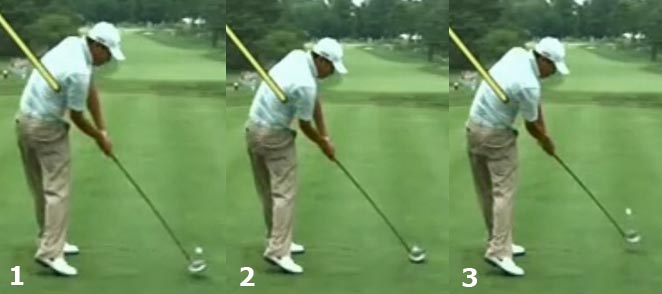 These images demonstrate the toe passing the heel. Can you see the shaft moving 'out' around the sweetspot? Jeff. |
Quote:
Amongst other things this looks more like vertical hinging to me. In this procedure the sweetspot plane and the shaft plane are different for a prolonged distance. A reverse roll feel in the hands. The club face laying back only. ob |
Quote:
|
Quote:
I should add that when using center shafted, face balanced putters; 18" high rails, string lines etc would accurately represent the plane of motion as the shaft plane and the sweet spot plane are the same throughout. I think. ob |
chbkk
You wrote-: "I appreciate your effort in the visual demonstration. But I think it misses a crucial ingredient: under centrifugal acceleration, the clubshaft bends from the drooping of the clubhead. You can now keep the grip-end of the bent clubshaft on your plane board with the clubhead swinging below the plane board. For a well matched club, the sweetspot should now be on plane too. I have no difficulty envision the rotation of the clubhead around the sweetspot under this scenario." If you look at the photo series of Anthony Kim, you will see the drooping clubhead. However, there is no rotation of the hosel around the sweetspot in that composite photo. If anything, there is a visual sense that the sweetspot is rotating around the hosel of the clubshaft in those photographs. If you look carefully (using the dark grass line as a reference point) - one can imagine the hosel tracking along the surface of an imaginary inclined plane board. OB Left The concept of layback applies to the roll of the clubshaft while it travels along the inclined plane board. If I kept the clubshaft neutral during its travel so that the clubface was always vertical to the inclined plane board, then there could no no layback (vertical hinging). The difference between the sweetspot plane and clubshaft plane would be less in that practical demonstration if I deliberately utilized a delayed release swivel action (rather than a neutral/gradual swivel action) and if I utlized horizontal hinging. If I utilized horizontal hinging in that example, the clubshaft would still go up the plane board and the hosel would still remain on the plane board. The only difference is that the rate of clubface closure post-impact would be faster. However, the hosel would never rotate around the sweetspot - in the sense of the hosel leaving the surface of the inclined plane board. Jeff. |
I think that I may understand why so many golfers "feel" like the hosel is rotating around the sweetspot post-impact.
As Yodas Luke pointed out, if one rotates the club in a lathe, the axis of rotation would be through the COG of the clubhead (sweetspot) and the hosel would rotate around the sweetspot. In other words, if a golfer "feels" like he is rotating his clubshaft very actively through impact, he may acquire the "feeling" that the hosel is rotating around the sweetspot. What would cause a golfer to rotate the clubshaft actively through impact? I believe that many golfers over-rotate their hands through impact under the mistaken assumption that one should have a supinated left hand post-impact, and that the clubface should be facing slightly groundwards post-impact. AJ Bonar teaches this action - called an active hand crossover release action. See - http://www.golf.com/golf/instruction...5175-1,00.html AJ Bonar uses this composite photograph to make his point. 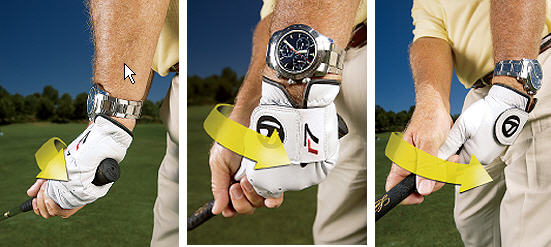 If you mimick that hand swivel action through impact, then you will certainly acquire a "feeling" that the hosel is rotating around the sweetspot. However, the true wonder of Homer's work on hinging actions is that he demonstrated that there should be no swivel action during the followthrough phase, and that the finish swivel action must be delayed to the post-followthrough phase of the swing. During the followthrough phase, there is a small amount of clubface roll-over when utilizing horizontal hinging action, but during that HH action the left wrist remains vertical to the ground. In other words, the left wrist does not supinate during the followthrough phase, and there should not be a "feeling" of the hosel rotating around the sweetspot. Consider this birds-eye view of Jack Nicklaus' swing.  Between impact and the fourth parallel (images 1-4) the clubface rotates 90 degrees. However, the hosel does not rotate around the sweetspot - because the clubshaft is always kept in front of his rotating body (butt end points at his navel) and there is no independent hand rotation. Note that the back of his left hand is vertical to the ground - as if there is a vertical hinge mounted in his left shoulder socket allowing the entire left arm-clubshaft to rotate at the same rpm. If more golfers pivoted as well as Jack Nicklaus post-impact, then I think that there would be less sympathy for the idea that the hosel rotates around the sweetspot post-impact. Jeff. |
Jeff.
I would recommend Bonar's hand motion to those who would like to hit it really low and don't care where it goes. |
Roll a club on a tabletop. The grip end stays on the table (plane), the hosel moves out, around the sweet spot.
The shaft is NOT "the" plane. Jack is angled hinging. The straightening right arm controls the rate/rpm of the rotation, and no, I am not suggesting a swivel as hinge action a AJ does. |
Ed
We obviously disagree on many points. It is true that the hosel rotates around the sweetspot when one rolls the club on a tabletop. However, that happens because the clubshaft is rotating around its longitudinal axis with no lateral movement of the entire clubshaft in space. That phenomenon doesn't happen in the golf swing. The clubshaft only rotates in space due to the fact that the left hand rotates in space - due primarily to the movement of the left arm in the left shoulder socket while the left shoulder socket simultaneously moves in space because the upper torso rotates in space. If a golfer has a synchronised swing - where the arms rotate synchronously with the rotating torso - then most of the rotation of the back of the left hand, and therefore clubface, will be due a global/proximal movement and not due to the clubshaft rotating independently around its longitudinal axis. That's what I tried to demonstrate with the Jack Nicklaus composite photograph. I would like to see you attempt to present a solid TGM-based argument that demonstrates that the straightening right arm controls the rate/rpm of rotation of the left hand/clubface. It is my belief that the left hand controls the clubface via the biomechanical action of a hinging action (variable degree of external rotation of the left humerus in the left shoulder socket while the torso continues to rotate). Jeff. |
| All times are GMT -4. The time now is 09:55 PM. |