|
Quote:
Quote:
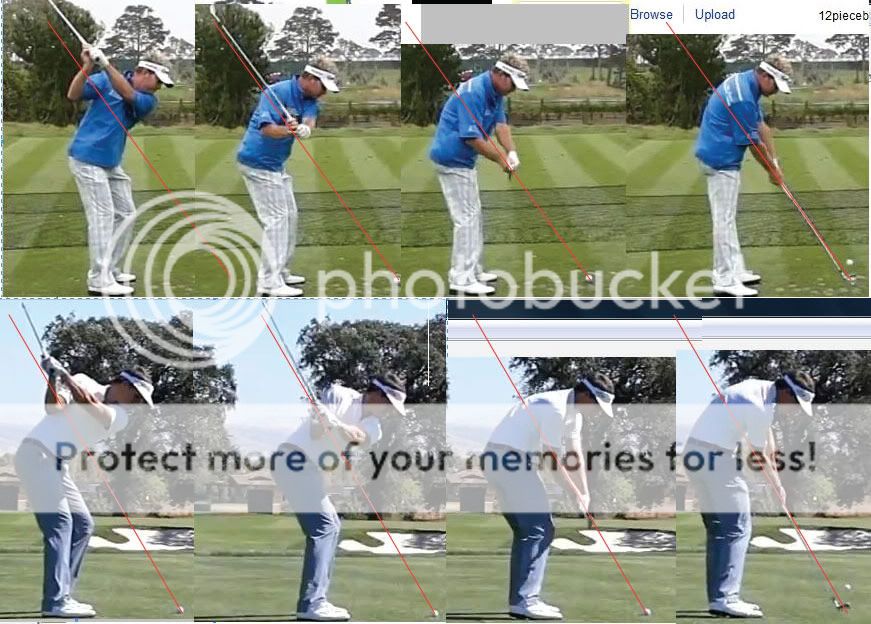
In my mind, if you look at Mr. Gay's shoulder turn as compared to Mr. Lovemarks, they are very similar in their inclination to the spine, which is exactly what I was trying to say. Bucket and Daryl do such a good job of showing it visually. Thanks Guys!:salut: Kevin |
Quote:
Its a poor Zone 1 issue, then throw in a poor right shoulder motion. I have found though the better the right shoulder works (on plane) the less a Zone 1 issue is created. When I miss around with Rotated Shoulder turn it seems to create a better alignment with the shoulders on the downswing.........but it feels like crap to me, less powerful as well. |
Quote:
Reminds me of a comment from YODA. Rotated Shoulder Turn is great, as long as you always play down wind. :naughty: :) :laughing9 Kevin |
The difference in Right Forearm alignments at the delivery position are pretty drastic in those pictures. I always thought the ideal was Lovemark because its pointing at the ball and not coming in "too high"....I think reading this my understanding is wrong....is it just a matter of being on plane at impact?
I agree with Bucket on the right shoulder on the downswing, going back to his epic thread a few months ago. |
Quote:
|
How "big" is chapter 13??
I think that "enough" consideration of component compatability is often lost! Compatability? Although components may have numerous variations their Compatability with preceeding and following componentn variations gets lost. This thread may be a fine example of that. Shoulder action, hip action etc. are likely very dependent on , such as, Address position, Adjusted?, FIX, etc. and very dependent on elbow position, Pitch?, Punch?, etc. So I more likely think to myself "how does that component variation selection FIT between the "bookend" components (with their selected variation). HK I am sure you said that, in a very articulate way, probably in the Preface. But I aint't gona look for it BECAUSE I think that EVERYONE should REDISCOVER that on their own.:)
HB |
Quote:
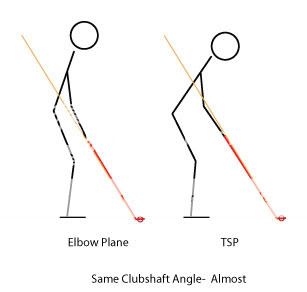
Is it just me or does Brian look a tad laid off there at Top? Dont think Ive seen that in any of his recent swings. Ever so slightly arched? Any who both those guys get on their Impact Plane Angles really early .......the sooner the better to my mind. Both have a very minimal shift from Top to get down there too......also a very good thing to my mind. In the first frame Brian is TSP'n it , in the second frame he's TSP and has dropped down to his Impact Plane Angle so he has shifted if ever so slightly during Startdown. Double shift but very minimal in terms of degrees ......something I think makes good sense if shifting is hazardous. Lovemark's Rotated but doesnt shift much either. I say Rotated but if he Slides and Tilts his Axis it wont be Rotated by definition anymore. Not sure if he does that or not. If he does it Rotated/Down combo maybe even though its not actually planed like Bucket says? Still dont have my book with me to look up the proper terminology. Anyways in regard to this posts initial question: Look at Brian Gays first frame there. Since we're talking Homer and Lynn around here assume he wants a TSP angle at Top. (And I do have to state a preference for them personally) He's got himself on one there nicely, fairly close to his Impact Plane Angle which D has drawn for us right? Not much of a shift required therefore. Now imagine him making a steeper turn of the shoulders in Startup.......in doing so he'll find a TSP angle which is further away from the Impact Plane Angle , the red line there....... Requiring a bigger shift on the way down in terms of degrees. Bigger shift bigger hazard. Thats my final answer on Flat back, why? Im interested in other opinions .......Rotated , Right Shoulder above Plane .....interesting stuff. |
Quote:
Rotated/Rotated was short shots only, wasnt it? |
Just Thinking
Quote:
My thinking: No, No, No, 1-L can do R/R, and LONG shots, but, not musch else- no shift or slide etc. :lurk: HB |
Quote:
How does that happen? Well, it's an Alignment. If you stand behind the Golfer (during Impact) and look down his Right Shoulder, down the Angle of Approach of his Right Forearm, are the #3 PP, Elbow and Right Shoulder in Alignment to the Angle of Approach. It doesn't mean that the Right Shoulder stays On-Plane all the way until Impact or how high or low the Right Forearm. And, you can't measure that from drawn lines of a down the line view as in the photos of these two golfers. To see if you're getting Right Shoulder support, tie a string from your Right Shoulder to your #3 PP, and imagine a vertical plane of the string. Then at Impact, is your Elbow aligned/touching that String Plane? |
| All times are GMT -4. The time now is 10:05 AM. |