
|
Hennybogan
Point understood! The AJ Bonar methodology is a recipe for disaster - a recipe for an inconsistent ball flight direction because it is so dependent on exquisite timing. I am not surprised that professional golfers use a release swivel action followed by a hinging action - and that they do not use any "active" hand manipulations through the impact zone. Jeff. |
Quote:
|
Ed
You wrote-: ". I don' think you quite understand what you think you do re: the finer points of TGM." That is very likely true. That's why I like to read other forum members' opinions. I always hope to continually improve my knowledge re: the finer points of TGM. Hopefully, Yoda will make an insightful post regarding the Sergio Garcia and Tiger Woods swing sequence that he requested that I produce. Jeff. |
I think there was an earlier post which asked that you take a club and hold it between your finger and thumb (top of the grip)and let it hang .Then rotate the grip back and forth.The shaft does not hang vertically.The clubshaft rotates around the sweetspot(as does the toe of the club),do you think this FACT will not occur when free swinging a club -with no clubface manipulation(ie horizontal hingeing)?:confused1
|
The Spider's Web
Quote:
You are wrong. :) Your argument ignores the fact that the Horizontal Hinge Action is DUAL (10-10-D). That is, the Horizontal Motion of the Clubface (Closing Only) through Impact (Ideal applciation / 2-C-1) is executed on an Inclined Plane. In TGM, the orbiting Sweetspot defines the Inclined Plane, and for this reason, the Clubshaft cannot possibly remain on its own Address and Impact Plane. Hence, it must rotate to and from the Plane of the Sweetspot. Of course, the Hackers of the world agree with you and do their dead-level best to avoid this required rotation. Homer Kelley understood this applied misconception and aptly labeled it Steering . . . The First Snare (3-F-7-A). :salut: |
Yoda
You state that I am wrong. That may certainly be true. However, I would better appreciate that fact if you provided a detailed explanation. In 10-10-D, Homer states that the angled hinge keeps the clubshaft on the inclined plane while the horizontal hinge keeps the clubface turning. That's exactly what I was demonstrating in this short video. http://www.youtube.com/watch?v=PIw1DERYvps I placed the clubshaft on the inclined plane. I could then theoretically vary the degree of roll-over of the clubface while the clubshaft travels on the inclined plane - by varying the instantaneous degree of rotation of the clubshaft during its travel on the inclined plane. Where is my error in the interpretation of 10-10-D? You also wrote with respect to the clubshaft-: "it must rotate to and from the Plane of the Sweetspot." How does the clubshaft rotate to/from the plane of the sweetspot when Homer stated in 10-10-D that the clubshaft is maintained on the inclined plane? Neil - let me ask you a simple question. If you can imagine the clubshaft twirling on its axis so that the hosel rotates around the sweetspot, can you please provide photographic evidence of exactly where in the golf swing this phenomenon is happening? Thanks. Jeff. |
Point / Counterpoint
Quote:
Quote:
Quote:
Quote:
"What I said is a fact. And anyone who understands Sweetspot Plane versus Shaft Plane understands that fact. In person, I can demonstrate it in five seconds. Regarding photographic proof, it ain't my job to jump through your hoops." :) |
Quote:
You are advocating the center of mass (COM) of the clubhead to move in a non-planar like fashion. In a real full swing, we now need to identify a force - a significant one indeed - to change direction of the COM like you stated. I like your fighter spirit - cornered but still fight hard. |
Yoda
I agree that I was demonstrating angled hinging. To demonstrate horizontal hinging, I would merely have had to increase the degree of instantaneous clubshaft rotation per unit time while the clubshaft remained on the inclined board. You didn't comment on the fact that under 10-10-C/D, Homer stated that the clubshaft remains on the inclined plane. I have read 2-F, and I have stated many times in this thread that I have no problem understanding the concept of PP#3 tracing the sweetspot's SPL - because it is the sweetspot that hits the ball and not the hosel. The hosel has to be inside the baseline of the sweetspot's inclined plane at impact. In that sense, one could argue that the hosel leaves the sweetspot's arc of rotation at the third parallel and returns to it at the fourth parallel. I can easily understand those points. The actual difference in the arc of rotation of the hosel and sweetspot is very small. Here is a composite photo showing the arc of rotation of the hosel and sweetspot in Anthony Kim's swing. See - http://www.youtube.com/watch?v=ZJyqplX4sRc 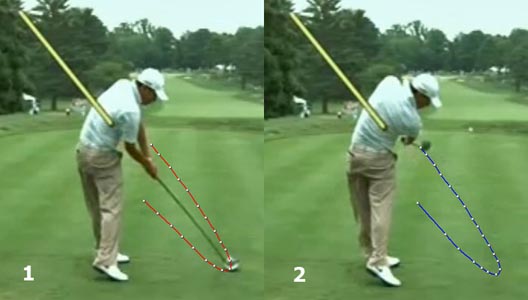 The red arc delineates the sweetspot arc. The blue arc delineates the hosel arc. They are very close together. The yellow line was drawn by the TV commentator and it represents the clubshaft angle in mid-downswing. Note how it goes through the clubshaft at impact. In other words, in a general sense, the clubshaft is still on-plane at impact - although it is obvious that the only "real" plane of relevance is the sweetspot plane because it is the only plane that is precisely located on the ball-target line. The base of the hosel's inclined plane must theoretically be slightly inside the ball-target line at impact. I still think that the mental idea of the hosel rotating around the sweetspot has no real relevance because the clubshaft never rotates about its own longitudinal axis to a significant degree at any instantaneous moment in time. The clubshaft rotates very slowly in space throughout the downswing/followthrough and it therefore causes the hosel's arc of rotation to be different to the sweetspot's arc of rotation. I like Homer's statement when he states-: "Except for Impact, the clubshaft is an acceptable Visual Equivalent for both planes, especially if the Clubface is Turned "On Plane"." Jeff. |
It Is What It Is . . . Or Isn't
Quote:
:eyes: |
Night Tracers
Quote:
I walked over and asked him if he had ever hit a draw. He said no. I told him I was about to change his life. In twenty minutes, I adjusted his ball position and his address hands location. I unfroze his right hip and got his left foot and knee into action. All this allowed him to swing to top in a beautiful, classic alignment. This done, I taught him how to use his left hand through impact, i.e., how to rotate the shaft around the sweetspot. Results? Long, strong draw shots and tears in the eyes of a 52-year-old man who never thought he would or even could see such things. So, Jeff, you talk to me of "relevance", and I talk to you of joy. Readers choice. :) |
Say It Again, Sam
Quote:
:cool: |
Yoda - Consider again my demonstration of the clubshaft lying on the plane board.
In my example, I stated that the clubshaft lies against the inclined plane board throughout the impact zone. In that practical example I let the clubface close gradually pre-impact and post-impact. However, I also stated that I could vary the degree of clubshaft rotation during the pre-impact phase (to simulate the release swivel phenomenon) and vary the degree of clubshaft rotation post-impact to simulate different hinging actions. Here is a capture image showing the situation.  The yellow line represents the ball-target line and also the base of the sweetspot plane. The red line represents the sweetspot plane line (drawn from PP#3 through the sweetspot ). The green line represents the clubshaft plane - note that the base of the clubshaft plane is inside the ball-target line. Do you believe that this practical example is actually happening in a golf swing? In other words, do you think that the clubshaft is traveling on its own clubshaft plane through the impact zone while the sweetspot is traveling on its sweetspot plane? If your answer is yes - then consider your statement in your last post. You stated-: "the clubshaft has rotated onto the plane of the sweetspot." Do you imagine the hosel rotating around the sweetspot? If you imagine the hosel rotating around the sweetspot post-impact, then does the hosel have to leave the surface of the clubshaft plane to achieve that goal? If not, then how do you mentally envisage the hosel rotating around the sweetspot? If the hosel has to leave the clubshaft plane to rotate around the sweetspot, then how one can infer that the clubshaft is on its own inclined plane through the impact zone? If you are tempted to answer that the hosel leaves the clubshaft plane in order to rotate around the sweetspot post-impact, then look at the following Martin Hall swing video. http://www.youtube.com/watch?v=JXhNHb1kv_A Note that he is using a simulated golf club that has very long clubhead (>12" in length). If that club has the same club lie angle as a regular club, then doesn't Martin have to swing the club along the same clubshaft inclined plane (along the surface of that plane board) even though the sweetspot plane angle in this example is going to be very different to the clubshaft plane angle. Then, in what sense do you imagine the hosel rotating around the sweetspot of that clubhead post-impact? Also, in what sense do you imagine the clubshaft rotating onto the sweetspot plane of that club post-impact? Jeff. |
The Interrogation Room
Quote:
Quote:
Quote:
Quote:
Quote:
"Except for Impact" means exactly what it says. Those words imply -- and I infer -- that otherwise, the Clubshaft is in the process of rotating to or from the Sweetspot Plane. Quote:
:laughing9 Seriously, Jeff, I'm out of time for now. I'll see what I can do later. Whew! |
In a previous post I think that OB Left stated that he felt the sweetspot through PP#3 during the downswing, and I presume that he tries to trace the base of the sweetspot plane via PP#3 throughout the entire dowswing (and not any clubshaft plane).
OK. Now consider this example. See - http://www.youtube.com/watch?v=ZJyqplX4sRc Anthony Kim is swinging on-plane during the early-mid downswing and that plane is represented by the yellow line drawn by the TV commentator. Here is AK's clubshaft through impact. 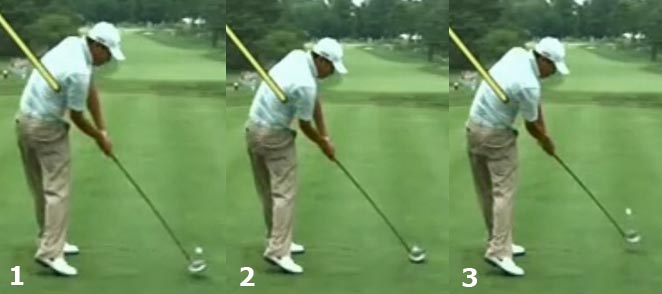 Note that his clubshaft is in a straight line relationship with the yellow line when the clubshaft travels through impact. So, does AK have to trace the sweetspot plane's baseline to achieve that goal, or is he simply swinging on the same clubshaft plane that he was swinging on when his clubshaft was above the third parallel? Consider this next example.  Imagine that AK was swinging a specially designed club that had a clubhead of 12" width and presume that the club lie angle was the same as his regular driver - represented by the blue lines. Then, he would have to position the ball further away (about 6" from the hosel) to hit the ball in the center of his clubface. The red line represents the sweetspot plane. Do you imagine that AK could hit the ball well by tracing the baseline of that sweetspot plane? How would he get the bottom of his clubhead to be parallel to the ground if he didn't have the clubshaft tracing the same path (traveling along the same clubshaft plane) as occurs in his regular swing? To achieve that goal, he would have to trace the clubshaft's SPL and not the sweetspot's SPL because one couldn't trace both the clubshaft SPL and the sweetspot SPL at the same time. If you imagine the hosel leaving the clubshaft plane post-impact to get to the sweetspot plane (so that the hosel can rotate around the sweetspot post-impact), then how would that be possible if he was obliged to keep the clubshaft on the same clubshaft plane throughout the post-impact time period until he reached the fourth parallel? Jeff. |
To be honest this thread has been eye opener for me too. I now have a better appreciation of the difference between the sweetspot plane and shaft plane. Thanks for that.
Close your eyes and swing. That feeling, that weight at the end of the shaft feeling is the sweetspot, the longitudinal center of gravity. Not the shaft or merely the clubhead. We thrust that COG knowingly or unknowingly at the target (aiming point). Makes it sound like an easy game, eh? What could possibly go wrong? ob |
A swinger rotating the clubface will have the sweetspot and club shaft on the same plane much of the swing but not at impact. Just as Yoda explained.
|
Plane Boards: Theory Versus Reality
Quote:
Look, this is not that hard. Because the Sweetspot is 'outside' the Clubshaft, and because they are aligned on essentially the same Plane throughout most of the Golf Stroke, then either the Clubshaft must have rotated to the Sweetspot Plane or the Sweetspot must have rotated to the Clubshaft Plane. There are no other alternatives. When you demand -- in either Martin's demonstrations or your own -- that the Clubshaft adhere to the Plane Board (except during Impact), you also demand that the Sweetspot leave its Sweetspot Plane and go the Clubshaft Plane. In other words, you insist that the Sweetspot rotate off its own Plane and onto the Plane of the Clubshaft (as made visible by the Plane Board). And that wobbly motion, sir, just ain't the way it works. The Plane Board is a useful and practical theoretical conception. But, the truth is that if the Shaft stays on it throughout the Stroke, you will necessarily disrupt the Sweetspot's orbit. And that particular malfunction has a name . . . Steering. :( |
Yoda
We operate in parallel mental universes. In my mental universe, Martin Hall has to swing his clubshaft along the plane board in order to keep the sole of his 12+" wide clubhead parallel to the ground at impact. You simply choose to ignore the need for the sole of his wide clubhead club to be parallel to the ground, and roughly on ground level, at impact. Consider this photo of Anthony Kim produced from the following swing video. Swing video - http://www.youtube.com/watch?v=ZJyqplX4sRc 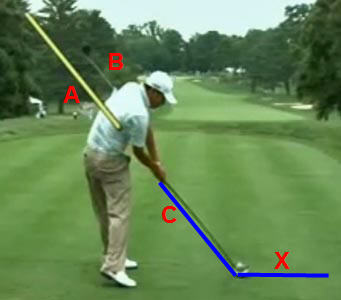 In this photo, A represents his clubshaft plane in the mid-downswing. B represents his clubshaft plane in the finish phase. Both A and B are on the same inclined plane as C ( C is his clubshaft plane at impact) because Anthony Kim has a perfectly symmetrical swing. Now imagine Anthony Kim swinging a club that has a clubhead width of 18" and an identical club lie as his regular driver - represented by the blue lines. Point X is the sweetspot at impact and it is 9" from the hosel. In my mental universe AK has to swing his club so that his clubshaft is exactly on plane C at impact - in order to get the sole of his 18' wide clubhead to be parallel to the ground at impact and just touching the surface of the ground at impact. In my mental universe, X rotates to B - in other words, the sweetspot rotates to the clubshaft plane at B (while the clubshaft simply remains on-plane between C and B). Jeff. |
What is being swung?
I am really enjoying the dialogues between you and Yodas and learning.... So very sorry to interrupt. But in you hockey-stick golf swing in your mental exercise now without the support of the plane board. What are you swinging? The COM of the clubshaft? The COM of the whole club which should be near the straight-line segment joining point C and point X? Or the COM of the clubhead which is near point X?
|
Oh .... BTW...
It was point out (somewhere) that there is a design rule regarding location of the shaft relative to the club head. This is why we won't see shafts in-line with the COG (which would reduce unwanted flexing which varies with swing-speed and is a source of variability which adversely effecs accuracy).
|
Bonar folly
Quote:
|
chbkk
From my perspective, the biomechanical movements of the torso/arms will be exactly the same if the clubhead has a width of 4", 8", 12" or 18" (presuming an identical club lie angle) because the essential need is to get the sole of the club parallel to the ground, and just touching the surface of the ground, at impact. In fact, if AK was swinging a dowel stick of the same length as his driver's clubshaft, but without a clubhead, his swing pattern (biomechanical movements) would likely remain the same as when he swings his regular driver. In all these cases, the hosel (and peripheral end of the dowel stick) would get to the same point at ground level. However, the distance of the hosel at its impact position from the ball-target line would depend on the width of the clubhead ( 50% of 4", 8", 12" or 18"). Regarding the COM (center-of-mass) question, it depends on the weight of the clubhead versus the clubshaft. Swinging an 18" wide clubhead may not be as easy or as fluid or as efficient or as biomechanically comfortable as swinging a 4" wide clubhead, but the clubshaft at impact must be on plane C, and a golfer must perform the standard biomechanical movements that AK performs to get it there - irrespective of the practical difficulties involved with dealing with the COM problem. In that AK blue-lines example, one can draw a line between PP#3 and the sweetspot (which is 9" from the hosel). At impact, that sweetspot plane is much shallower than his clubshaft plane (plane C) at impact. If the club was swung post-impact onto that same sweetspot plane by the 4th parallel position, then AK would have to suddenly shallow his clubshaft plane post-impact while the clubshaft was traveling from impact to the 4th parallel (in order to rotate the clubshaft's hosel to the sweetspot plane). Can you imagine the "strange" biomechanical movements that would be necessary to achieve that goal? Jeff. |
Apples and oranges
Quote:
When swinging the club... force is imparted not the the cog but to the shaft through the grip. It would be leading (on the plane of the swing) and the Cog would naturally want to "fall in line" on the plane. The face would want to open not close. But because of golfer anatomy the wrists rotate on the downswing taking the face with (provided grip doesn't slip) |
OB Left
You wrote-: "Close your eyes and swing. That feeling, that weight at the end of the shaft feeling is the sweetspot, the longitudinal center of gravity. Not the shaft or merely the clubhead. We thrust that COG knowingly or unknowingly at the target (aiming point)." I agree that if one swings with the eyes closed, that one can 'sense" the weight of the clubhead. However, I don't believe that one can precisely sense the sweetspot. If a golfer thrusts (or throws) that "'clubhead weight" at the aiming point, without understanding human golf biomechanics, then he should expect shanks and/or all kinds of mishits. One needs to execute the "correct" biomechanical movements during the downswing i) to get the clubshaft to descend down to the ball on-plane and to ensure that the clubshaft at impact has the sole of the club parallel to the ground and touching the ground; ii) to get the clubface to swivel 90 degrees into impact during the release swivel phase (from the 3rd parallel position to impact) so that the clubface is square at the time of ball-clubface separation and iii) to get forward shaft lean at impact (FLW and bent right wrist). That is what "educated hands" is all about - moving the clubshaft and clubface "correctly" in space to achieve those goals. That's also what TGM is all about - precise biomechanics, precise mechanics, precise physics and precise geometry. Jeff. |
Quote:
I always associate swing plane with swing force ... centrifugal, irrespective of the shaft, which can be crooked, bent. So in my thinking, AK should align his torso/arms to the force line linking the wrist swing center - PP#2 to the sweetspot X (the COM of the club should be on this line too) - I called this the virtual club shaft. AK should prepare to swing the virtual clubshaft not the real clubshaft. Let's do a mental experiment with my high-school physics. Suppose we have access to a swing machine with a fixed swing axis and a fixed swing plane. Let's do two experiments with your golf club with the extra long-width clubhead: 1) Put the hosel of the shaft on the fixed swing plane; and 2) Put the COM of the whole club on the fixed swing plane. In 1) the COM of the club will try to get on plane stressing the mechanical wrist joint to the point of breaking it. Unless they allow the off-plane hinging of the clubshaft, which is to allow the clubshaft to go off plane! In 2) the swing will work out just fine except for the usual drooping of the clubhead and the associated bending of the clubshaft. |
chbkk
I think that you theoretical example has no relevance to a "real" golf swing. Remember that the sole of the clubhead must lie flat against the ground at impact - irrespective of whether the clubhead width is 4", 8", 12" or 18". That's an absolute necessity. Therefore, that absolute requirement defines the exact clubshaft angle that must exist at impact - it depends on the club's lie angle. A golfer must achieve that "correct" clubshaft plane angle at impact. To get to that "correct" clubshaft plane at impact in a very efficient manner, one simply has to perform the same biomechanical movements that Anthony Kim performs - whether the clubhead width is 4" or 8" or 12". Of course, the stresses and efficiency associated with swinging a 12" wide clubhead is going to very different when compared to swinging a 4" wide clubhead. Jeff. |
An Inconvenient Fact
Quote:
:) |
Yoda - you wrote-: "an orbiting Sweetspot is indifferent to the alignment of the Clubhead's sole (however long) at Impact."
I agree with you. That's why swinging a golf club using your orbiting sweetspot model would not work that well with a clubhead width >4" where the clubhead sole is non-cambered. By contrast, the Anthony Kim swing model would work equally well with non-cambered soles and his swing model doesn't incorporate any "steering" actions. According to that AK swing model a golfer must generate a perfectly symmetrical swing where the clubshaft decends "on plane" from the TSP at the end-backswing to the elbow plane by the 3rd parallel, remains on the elbow plane from the 3rd parallel to the 4th parallel (as if it were running along the surface of a plane board inclined at an elbow plane angle), and then ascends gradually to the TSP again as the clubshaft moves "on plane" from the 4th parallel to a finish point on the TSP - as exemplified by Tiger Woods in these next photos. 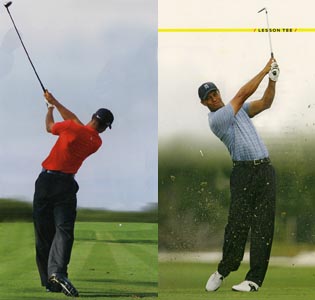 If one swings in a perfectly symmetrical like Anthony Kim, and remains on the elbow plane through the entire impact zone between the 3rd and 4th parallel positions, then there is no "steering" actions occurring between the 3rd and 4th parallel positions. The clubhead arc will be perfectly symmetrical below waist level because the clubshaft simply travels on the surface of an imaginary plane that is inclined at the same plane angle as the elbow plane. Jeff. |
Reality Show
Quote:
Quote:
Quote:
. . . with a Clubhead 18" long with its Sweetspot (X) located in the middle of the Clubface (9" from the hosel), and you do not adjust the Lie Angle (C-X) to accomodate that moved Sweetspot (and consequently Flatter Sweetspot Plane Angle), then Mr. Kim, in spite of his considerable talents, is going to have a very rough go of it. Unless the shaft is stiff as a crowbar (which would raise a whole new set of issues), there will be a terrific amount of clubhead 'droop' through Impact. That's because Mr. Kim's educated Right Forearm and #3 Pressure Point will do their dead-level best to stay in line with the Sweetspot (X) and the Clubshaft must comply. As a result, I suspect you would see a lot of 'toe deep' divots and shouts of "Fore right!!" :eyes: |
Yoda
The 18" wide clubhead was obviously not intended to be a realistic design goal. It was only created as an "idea" to get across certain concepts - that if Anthony Kim (or any other golfer) swings perfectly on-plane (per Homer's definition of an on-plane swing) and gets to the elbow plane by the 3rd parallel, then he is going to be staying on the elbow plane between the 3rd and 4th parallels. I also think that he is going to have the "feeling" that the sweetspot rotates to the clubshaft plane post-impact (X rotates to B) and there will never be a "feeling" of the hosel leaving the elbow plane post-impact and rotating around the sweetspot. I am not at all convinced that a golfer who mentally thinks of an orbiting sweetspot, but still swings on-plane to the elbow plane by the 3rd parallel (like Anthony Kim), will generate a different clubshaft/clubhead arc of movement than Anthony Kim. A question - the baseline of the sweetspot plane must exist outside the baseline of the clubshaft plane. During which part of the swing is the golfer tracing the sweetspot plane (aiming at the sweetspot plane)? Can a golfer practice tracing a SPL with a dowel stick, which doesn't have a clubhead and a rotating sweetspot that is a finite distance away from the longitudinal axis of the shaft in the impact zone? Jeff. |
Quote:
In our mental experiments, both of them, we design the experiments to adjust the swing axis and the swing plane of the swing machine so that the sole of the clubhead to lie flat against the ground at impact! With (1) the clubshaft in the swing plane: would be a more upright swing. (Swing axis more horizontal) With (2) the COM of the club in the swing plane: would be a flatter swing. (Swing axis more vertical) Both intend to start with the soled clubhead and with the soled clubhead at impact. BTW, (2) is similar to swinging with a centered-hosel club with the clubshaft on plane. Wish I could easily upload images. |
Cavalry's Comin'!
Quote:
Bambam! Call to arms! http://www.15thnewyorkcavalry.org/Media/cal2arms.wav Assembly! http://www.15thnewyorkcavalry.org/Media/assembly.wav Charge! http://www.15thnewyorkcavalry.org/Media/charge.wav :salut: |
Thanks Yoda
Thank you Yoda.
I am certain you are a teacher. A great one. I will try hard to make Jeff understand. Here they are.....   |
Final Rounds
Quote:
Quote:
"So, there is a Clubshaft Plane, and a Sweetspot, or Swing Plane. But, herein, unless otherwise noted, Plane Angle and Plane Line always refer to the Center of Gravity [Sweetspot] application."You would have the good Mr. Kim held hostage to the Shaft's original Angle of Inclination, yet you move the Sweetspot NINE inches outside the original Plane of Motion. That, sir, is not only bad science, it's downright goofy. Apologies in advance if you consider that last sentence an "ad hominem' attack. Quote:
Quote:
Quote:
Quote:
#-o |
chbkk
I can see your two images. However, I have no idea what you are trying to demonstrate. A golfer doesn't stand with the left arm in-line with the clubshaft or COM at address. Jeff. |
Quote:
I am trying to illustrate the 2 mental experiments on a swing machine like an Iron Byron. Image 1 for experiment 1: Swing with the clubshaft on plane. Image 2 for experiment 2: Swing with the sweetspot on plane. Experiment 1, we may break the mechanical wrist joint from the stress of the COM of the golf club trying to move on plane. Experiment 2, will work out fine. |
Yoda
You wrote-: "All parts. Per 1-L #6, "The [Sweetspot (which replaces the Clubshaft per 2-F)] always the points at the Plane Line except when they are parallel to each other". From my perspective, the sweetspot and the clubshaft are on the same plane when the clubshaft is above waist level (above the third parallel). Therefore, during the early-mid downswing, the butt end of the clubshaft points at the ball-target line (as if the club is merely a dowel stick without a clubhead). Therefore, I "feel" as if it is the clubshaft that points at the ball-target in the early-mid downswing. From the delivery position to impact, a golfer simply performs a release swivel action that squares the clubface. I do not believe that a golfer can change his on-plane condition after the golf club has passed the third parallel position without "steering". I believe that if I am not perfectly on-plane by the time my clubshaft reaches the third parallel position, then it is too late to alter my imperfect off-plane condition. Also, the absolute difference between the base of the clubshaft hosel plane and the base of the sweetspot plane reaches a maximum value of about 2" at impact and decreases to zero at the 3rd parallel and 4th parallel conditions. That results in only a small angular difference in inclined plane between the clubshaft plane and sweetspot plane in the impact zone (and which only exists to a significant degree within a distance of about 12" behind/in front of the ball) and that very small difference is something my brain automatically computes on a subconscious level. Jeff. |
Image of a Imaginary Club
 Hope it can be of help. |
chbkk
Thanks. I can understand your viewpoint about the different stresses experienced at wrist level. Jeff. |
| All times are GMT -4. The time now is 09:20 PM. |