
|
Quote:
Very interesting and insightful post. I took these pictures of Yoda and remember the procedure he was displaying. Ill leave it to Yoda to discuss in full but your observations are very perceptive. He was laying it on real hard in release with an active right arm. The pictures dont reveal what the naked eye saw and ears heard. Like a war on the practice field. O.B. |
The Counter-Intuitive Forward Clubshaft Bend
Quote:
1. The Clubshaft has inertia. Tipped-stiff or senior flexible, it has inertia. 2. At the same time, Centrifugal Force has a Line of Pull. That invisible line is from the #3 Pressure Point (first joint of the right forefinger) to the Sweetspot. This Lag Pressure Point Pressure (1-L #7) is what is driving the Club, not the Clubshaft. 3. The inertia of the clubshaft cannot keep up with the Centrifugal Line of Pull. Hence, it lags behind. This 'reverse' parabola (reverse in that the forward bend is counter-intuitive) made a dramatic appearance in Ben Hogan's first book, Power Golf. With the exception of Elbow Postion (Pitch versus Punch), the photo on page 97 of that book (hardcover version) is virtually identical with Image #2 (below) in your post.  If somebody could put that up, I'd appreciate it. Thanks! :salut: |
Yoda - you wrote-: "At the same time, Centrifugal Force has a Line of Pull. That invisible line is from the #3 Pressure Point (first joint of the right forefinger) to the Sweetspot. This Lag Pressure Point Pressure (1-L #7) is what is driving the Club, not the Clubshaft."
Could you please expand on your argument? I believe that CF is primarily driving the clubhead and the peripheral end of the club (where the COG is located) and not the entire club (which consists of a clubhead, peripheral shaft, central shaft and grip end of the shaft). I believe that the hands are simultaneously driving the grip end of the club while CF is driving the clubhead and peripheral end of the club. Your argument seemingly presumes that when the club starts to release and CF comes into play, that the hands are no longer driving the club. However, the hands are still moving the grip end of the club during the process of club release and they are applying a pull force on the club (in a swinger) while the club is in the process of releasing - and this pull force (which is at an angle to the COG of the club) adds supplementary angular velocity to the clubhead and peripheral end of the club during the release process. See -http://perfectgolfswingreview.net/Ne...%20Science.htm HK's endless belt keeps moving while the belt moves around the end pulley, and the club is still attached to the endless belt and therefore subject to its continuous motional forces. ----------------------------------- Add additional point - I was writing my post and I didn't see that Yoda was simultaneously modifying his post to read as follows-: "the lag pressure point is what is driving the club" (see next post #204). I originally thought that Yoda was stating that CF was driving the club. I then have to slightly modulate my argument. I cannot understand what it means when one states that PP#3 is driving the club in a swinger's action. I thought that PP#3 only senses/monitors clubhead lag pressure and that it doesn't drive the club. The club is driven in a drag loading manner by the left hand pulling on the club in a swinger's action. The right hand doesn't apply push-pressure drive via PP#3 in a swinger's action. By the way, we are presumably talking about a swinger's action because there is no centrifugal pull in play in a hitter's action. Yoda will independently decide whether he wants to expand on his post - per my request. Jeff. |
Added Text For Consideration
Quote:
"At the same time, Centrifugal Force has a Line of Pull. That invisible line is from the #3 Pressure Point (first joint of the right forefinger) to the Sweetspot. This Lag Pressure Point Pressure (1-L #7) is what is driving the Club, not the Clubshaft." You could not have known this as you were responding, and I have so notified you by Private Message. Therefore, as I've advised, please take the added text into consideration and amend/edit your post as you see fit. Thank you. |
Hello Yoda,
I learned tonns about the golf stroke from the time before this site was launched. The flying wedges and the separation between swinging and hitting cleared up my head. But I still think there are unclarities in TGM with regards to some of the mechanics involved. And the part that has some relationship to golf shafts have always struck me as odd. I am wondering whether HK simply forgot to regard the club itself as an energy storage device. You can load it with energy, and it will release the energy when the moment it is subjected to is reduced under a certain threshold. Whether the energy is wasted or well spent is a question that is very similar of nature to the compression leak issue. The shaft bending and release kind of works in the same way as a capacitor in an electric curcuit - you deliberately charge it, and it uncharges itself when the voltage is reduced below a certain threshold. And the centripetal force - the pure rotation - well - it stores energy pretty much the same way as an inductor. It will do it's best to keep the current constant. (Modeling the golf mechanics as an electrical circuit could prove to be an interesting exercise, but perhaps not in this thread): Quote:
I believe you are talking about the phenomen I described under the pure rope handling : Quote:
For an Iron the centripetal force will flatten the lie angle of the club - pretty much as we see in your picture. ANd of course this isn't something we will se upfront at impact. And for a driver with COG well behind the sweeetspot it will also bend the shaft forward. But since this kind of shaft bending is a function of the centripetal force - and that will pretty much be intact until impact - the shaft will not straighten or whip back midway. I sustain that a lot of players is applying a vicious newtonian moment with their hands on the shaft. So in many swings there are two sources of shaft bending. Actually three if you also consider the collision with the ball. If you apply your right hand #PP's and have the right hand below the left on the shaft - it is in a way - something that can't be avoided. Quote:
Since the COG of the clubhead isn't in the extension of the shaft, the (virtual) rope is actually bent to begin with. The centripetal force will try to pull the rope to it's full length. And the shaft bends such that the distance between the hands and the COG of the clubhead increases. Quote:
And there's absolutely no doubt whatsoever that picture 1 has a shaft bend that works agains the bending you will see from a pure rope pulling technique. Like it or not; Some of the top ball strikers are bruteforcing the club to swing - at least in parts of their stroke. But Zuback seems to be quite moderate in this department though. Maybe it is because he only has a moderate wrist cock at the top and in his early downswing. So I guess anyone who is willing to settle for around 200 MPH ball speed doesn't load the shaft in the early downswing :laughing9 |
Message To Another 'First Responder'
BerntR,
I added text to my post #202 immediately after posting (per my post 204) and while you were responding. Does it make a difference in your post? If so, please edit appropriately. Man, you guys are fast! |
Case Of the Missing Word
Quote:
:thumleft: Assuming the conventional Swinging motion -- which is what all these heretofore presented 'axis-string-ball' models have been about -- Centrifugal Force IS driving the Club. But, Jeff . . . You've made a serious error. :shock: Please re-read my post. You missed a word in your typed quote above, a very important word that I now will resurrect, return to its proper place, enlarge and highlight in red: "This lag pressure point Pressure (1-L #7) is driving the club." And the Lag Pressure Point Pressure is Centrifugal Force being transmitted through Pressure Point #3. In both versions -- original or edited with additional information -- my post stands. :salut: |
Quote:
|
Yoda - you wrote-: "This lag pressure point Pressure (1-L #7) is driving the club."
The Lag Pressure Point Pressure is the result of Centrifugal Force transmitted through Pressure Point #3." ----------------------------------- I certainly don't understand your viewpoint. I believe that CF only comes into play in earnest when PA#2 passively releases (left wrist uncocks passively), and the club releases. In a swinger the club is loaded against PP#3 at the end-backswing - when the clubshaft is parallel to the ball-target line. At that time point, the only pressure felt at PP#3 is due the weight of the club. Then, during the early downswing, the left hand is pulling the club down to the ball (while the left arm is kept loaded against PP#4 via the pivot-drive). Under those conditions, the sense of lag pressure felt at PP#3 increases because the clubhead has inertia and resists following the hands - it "feels" like one is leaving the club at the top while the entire power package is being pulled down intact to waist level via the lower body shift movement. I don't believe that there is any CF in play during the early downswing because the hands are moving along the straight line portion of the U-shaped hand arc. If the hands are moving more-or-less in a straight line, then there is no centripetal acceleration of the hands, and therefore no need for a counterforce (a CF). During this phase of the swing, I cannot understand how CF can be driving the club via lag pressure at PP#3. Then, when the hands move around the rounded curve of the U-shaped hand arc, the hands are moving in a circular arc that has a small radius. If the hands are tracking along a hand arc of small radius then the hands are traveling at an acute angle relative to the COG of the clubshaft and that induces the clubshaft to release with great speed (and this represents the CF release phenomenon). The clubshaft releases because it develops angular velocity, and the angular velocity is acquired because the direction of the pulling force at the grip end of the club is at angle to the COG of the club. nmgolfer explains the release phenomenon in his html document. See - http://perfectgolfswingreview.net/Ne...%20Science.htm From the delivery position (3rd parallel) to impact, the club releases by 90 degrees (left wrist uncocks 90 degrees). During that time period, lag pressure sensed at PP#3 should theoretically decrease for a given degree of hand speed - because the left wrist is uncocking. However, an experienced golfer maintains a sense of near-constant lag pressure at PP#3 by ensuring that the right elbow straightens with sufficient isotonic force that allows the straightening right arm to keep up with the left arm (and allows the right hand to keep up with the left hand). In other words, the degree of lag pressure sensed at PP#3 is the result of the interplay of a number of biomechanical phenomena that are occurring simultaneously - i) the left hand is being driven around the small pulley of the endless belt due to the release of PA#4 which drives the left arm towards impact; ii) the speed of left wrist uncocking (which occurs passively secondary to the speed of CF release of the club); and iii) the speed of right elbow straightening which allows the right hand to keep up with the left hand. In this scenario, - PP#3 senses lag pressure, but does not drive the club. I think that two forces are driving the club at this stage of the downswing - i) the left arm pulling the left hand towards impact due to release of PA#4 => left hand pulls the grip end of the club continuously along the endless belt track; ii) CF that causes the passive release of PA#2. However, because the release of PA#2 is passive and activated by the left hand pull action at the grip end of the club (with no push-force from the right hand), then it can be said that the source of all power driving the club is essentially derived from a left hand pull action where the left hand travels along a circular arc (around the end pulley of the endless belt system). It is the left hand that drives (pulls) the club during the downswing in a swinger's action and the CF release phenomenon is simply activated by the left hand pull action (according to the principles of the double pendulum swing model). I have no idea what you mean when you state that lag pressure sensed at PP#3 drives the club, and that the lag pressure is derived from the CF acting through PP#3. Jeff. |
Only Two Trees In the Forest
Quote:
Yes, Jeff, this is correct. Pressure Point #3 does not drive the Club. Centrifugal Force drives the Club. Quote:
You have answered your own question: Centrifugal Force drives the Club. :golfcart2: |
Dear Yoda,
To your previous post; I assume the addition was addressing this issue, that you highlighted in your response to Jeff: Quote:
BUT - I do not follow you when you say that the lag pressure is centrifugal force. (Actually I think centripetal force is the right term here, but it is beside the point I want to get through). The point is that centripetal force doesn't add energy to the golf swing. It only stores the energy that has been added throught the work of tangential forces: http://hypertextbook.com/physics/mechanics/centripetal/, a little down on the page: A centripetal acceleration … occurs whenever a moving object changes direction, does not change the speed of an object, acts at right angles to the velocity at any instant, and is directed toward the center of a circle. A centripetal force … is the force that makes a moving object change direction, is not a particular force, but the name given to the net force responsible for circular motion, acts at right angles to the velocity at any instant, and is directed toward the center of a circle. Directions in circular motion: Velocity is tangential (lies on a tangent to the path). Centripetal acceleration and centripetal force are radial (point toward the center of a circle). Centripetal acceleration and the object's velocity are always perpendicular. Centripetal force and centripetal acceleration are always parallel. ______________ To put it in my own words: It takes tangential force to create swing speed. Force with the same direction as the clubhead. The centripetal force that we have to produce to keep the club swinging is an effect of the velocity introduced by tangential forces. It is an effect of swing speed and not a cause. For simplicity, assume a one-lever system (no lag pressure between hands and club). To analyze what the pull from a left shoulder on a one-lever system does to the swing, the pull should be decomposed into two force vectors; One centripetal force component - pointing at the swing centre. And one tangential component that points in the same direction the swinging object is moving. The angle of the lever vs the angle of the centripetal force (the line from MOI to the swing center) provides all the info we need to estimate the tangential force. The tangential component is the one that increases the swing speeed. It adds velocity energy to all the moving parts of the swing. The centripetal component changes the speed simply by changing the direction of the movement. The velocity energy of the system is not affected by this. Applying only centripetal force is the same as hanging the lever assembly around your neck and just stand still. In a perfect, friction free and without earth gravity world , it will spin forever at a constant speed. Of course you will have to apply tangential force initialy to get the spin rate up. We can do the same analyzis on a two-lever system from the hands and down; The hands pullling the club will induce a drag force* on the club. This drag force can be decomposed in a tangential component and a centripetal component. More clubhead lag (the further the golf shaft points away from the neck) will mean a larger ratio of longitudunal /centripetal force. The actual golf stroke is an harmonic blend of tangential force that builds speed and centripetal force that purely helps us store the speed that's already there. You need to apply a centripetal force of increasing size to account for the ever increasing energy that is accumulated by tangential force. I think it is important to undestand that tangential force is the only kind that builds swing speed. Even though the force we feel the strongest just before impact is likely to be the centripetal force, it's the tangential forces that do the work. And those who hit the ball long applies more of it than most others. There is a lot of complicated things going on in the golf swing. The hand radius changes, the clubface radius changes etc etc. Looking for energy accumulation and release in the swing simplifies IMO some of the most basic mechanical understanding of what's going on. What it all boils down to then is that tangential forces are the only ones who add energy. We can use centripetal acceleration to store the energy in a circular move and we can use a few "tricks" to redistribute some of the energy towards the clubhead just prior to impact etc. But all the energy that eventually is transmitted to the ball comes from tangential forces. I believe there's a lot of confusion between cause and effects here, also among experienced instructors. The major part of the strong pull that we feel from "pulling the rope" through impact is actually a simple reaction to the energy that's already accumulated in the swing. And the other part - a much smaller one - does in fact produce tangential force. But only as long as we're pulling from a point that is offsett the swing center. ____ * When the right hand PP's work on the club below the left hand / club hinge - there will in addition be imposed a Newtonian moment on the club ref my first post in this thread - a momoment that will energize the spring effect of the shaft & clubhead. This energy will be stored and released later when the moment is reduced. |
Bernt
Your opinions make no sense (to me). You state-: 1) "I agree that the lag pressure point is driving the club. And by "driving" i mean adding energy to the club." How does PP#3 add energy to the club considering that PP#3 is simply the right index finger against the back of the club? 2) "The point is that centripetal force doesn't add energy to the golf swing. It only stores the energy that has been added through the work of tangential forces." How does a centripetal force store energy? Stored where? To what purpose? Is that energy eventually released? When, and how? 3) "The centripetal force that we have to produce to keep the club swinging is an effect of the velocity introduced by tangential forces." Why is a centripetal force needed to keep the club swinging? You then immediately state that centripetal force is an "effect" and the "cause" of that effect is the "velocity produced by tangential forces". From where is this tangential force derived? When those tangential forces act to increase velocity - velocity of what? How does velocity of "what" produce a centripetal force? 4) "The tangential component is the one that increases the swing speed. It adds velocity energy to all the moving parts of the swing. The centripetal component changes the speed simply by changing the direction of the movement". How does a change in direction increase swing speed? Speed of "what"? 5) "More clubhead lag (the further the golf shaft points away from the neck) will mean a larger ratio of longitudunal /centripetal force." Why? If the club lag is 90 degrees, why is there a higher ratio of longitudinal/centripetal force compared to a situation where the clubhead lag is 75 degrees? 6) "The actual golf stroke is an harmonic blend of tangential force that builds speed and centripetal force that purely helps us store the speed that's already there. You need to apply a centripetal force of increasing size to account for the ever increasing energy that is accumulated by tangential force." Where does the centripetal force store the speed? If one uses a tangential force to move "what" why is energy accumulated? If the swinging "what" travels at a faster speed, why must centripetal force increase? Jeff. |
Quote:
|
Pistol - I am not a physics expert.
To understand a person's viewpoint, I need very simple explanations where every sentence is well-defined in terms of definitions and concepts, and where all the sentences are carefully connected so as to finally produce a coherent storyline. Here is a photo of a golfer's clubhead swingarc. 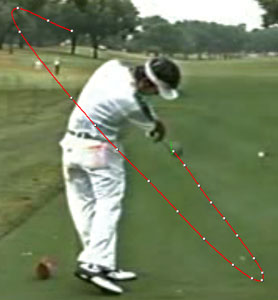 One can see that the clubshaft/clubhead moves down-and-out-and forwards along a circular arc in the downswing. Therefore, the forces needed to move the clubhead need to achieve two goals from an energy perspective - i) move the clubshead at a finite speed in space and ii) move the clubhead in a circular arc (which is equivalent to supplying the clubhead with centripetal acceleration while it is traveling at its finite speed). I would like to see Bernt use that simple model to describe the forces needed, and their mechanism of energy storage and release. Jeff. |
1 Attachment(s)
Quote:
Here you go. Now this looks excessive. http://www.lynnblakegolf.com/forum/a...d=122997808 9 |
Quote:
Boy Howdy.... That's some massive toe down deflection.. was he playing hickory? |
Quote:
He concludes (from examining the shaft behaviour of one golfer) that the "flexing of the shaft forward as the clubhead comes in to hit the ball is a general characteristic of the golf swing. Photographs made with the use of a focal plane shutter must be ignored in this context. There are few photgraphs in the golf literature made with stroboscopic light sources, but of those I have examined, all of them show clubs flexed in this manner" So exclude focal plane shutters and some video cameras ...before theorising too much about shaft flex photos . |
Quote:
Quote:
Quote:
The energy is released as the club stops to move. Quote:
Quote:
Quote:
Let me see - what is moved during the swing? Clubhead, clubshaft, hands, arms partly upper body. Anything that moves in circle is subjected to a centripetal force. But you need to understand what a centripetal force really is to have any progress in this regard. Quote:
Quote:
Quote:
Quote:
|
Quote:
At the same time you need centripetal force to make the club move in a circle instead of flying down the driving range. You should also be aware that the centripetal force is not a force per se in the golf swing. Because there isn't anything in there that is pulling from the swing center. The centripetal force is merely result of decomposing the total force on the club in a centripetal component and a tangential component - and possibly other components too - that will will reduce the quality of the stroke. |
What??
I've got to say... re. BerntR
That (what you said) don't make a whole lotta sense to me. You start out good re... the centripetal acceleration stuff, but then you lose me when you say: centripetal stores energy (no) and things in the golf swing are harmonic (sinusoidal as in sin and cosine) (no) and golfers are a drag. Whoa nelly.... Lets take a step back here. Everyone knows that there some guys who can hit pretty darn far with club head tied to string. Who was that instructor? famous guy who's name escapes me... anyway it don't matter. Lets forget for a moment any torque (pun not intended) the golfer might impart via push/pull between that hands and consider the "pure swinger" case (club head on string) If at any time during the downswing we drew a free body diagram of the club head it would show only one force acting on it (for the time being forget about gravity too ok... trust me its a minor contribution). We would call that one force acting on the club head (drum roll please..... no not centrifugal.... no not centripetal.... no not tangential no not radial...) we would call that force TENSION. Furthermore if we consider the "local coordinates" of the club head (see 2/3 down the page here: http://en.wikipedia.org/wiki/Centripetal_force ) we would find TENSION has both a tangential and radial (aka centripetal) components (again...is in local coordinates Tension has both tangential and radial (orthogonal) components). The force is tension... and it has two components: tangential and radial or centripetal. {{{ Its worth mentioning that only w^2/r of the radial component is "centripetal" ... and excess us just radial }}}} NOW the radial or centripetal component (being, by definition, directed at the instantaneous center of rotation (not left shoulder... not hands ... but at the instantaneous center of rotation as defined solely by the path of the club head itself) is what's know as a "central force" ( http://en.wikipedia.org/wiki/Central_force ) .... (and here is where we (mostly) agree Berntr... central forces (ie radial ones) generally do not increase the angular velocity of a rotating obect and the centripetal central force NEVER does. Said another way, the centripetal component of the tension in the rope tied to the club head (usually) does not increase the speed of the club head. Its that tangential component which increases the speed of the club head. (But there is a caveat to this ... central forces (NOT the CENTRIPETAL variety) in general CAN pump in energy see http://www.lynnblakegolf.com/forum/n...wreply&p=59297 ) This is why when Jeff swings his ball on a string, the central pivot must trace a curvilinear path.... in order to generate a tangential component which is solely responsible for making the ball rotate, the tension force in the string must not point at center of rotation. Anyway in the ball on a string case, we must do that because the ball has AERODYNAMIC DRAG which acts in a tangential direction which must be overcome. Were the ball already spinning in the vacuum of space , then tension need only point to the center of rotation. The club head is subject to AERODYNAMIC "DRAG" too. Just a thought... |
1 Attachment(s)
I've tried to make an illustration. For simplicity it's just a one-lever swing.
|
Noodle shafts
Quote:
I think Ted jorgensen did a good job and I strongly agree with is concern re interpreting photographs... but its been a while since I read his book... I'm not sure what he means by that statement. On the matter of club shaft flexing I agree with Wishon (inertial loading from the top is generally speaking in the wrong plane to contribute CH speed at impact due to "snapping back" and I agree with Sasho MacKinsey : http://library2.usask.ca/theses/avai...ted/Thesis.pdf who says basically shaft bend is mostly toe down and forward (which adds dynamic loft to the club head) as a result of the centripetal force pulling towards the instantaneous center of rotation against the club head's inertia . Its act on the CG of the clubhead. Imagine you could tie a string to the CG of your clubhead and then you did a tug of war.... the shaft would bend like we see in the pictures (toe down and forward) Post impact all bets are off.... other dynamics come into play as the club rapidly decelerates. But we should not care what happens after the ball is gone IMHOP. BTW... I'd sure like to see some equip mfg.s do that (design a driver that had the hossel in-line with cg of the clubhead.... There would be whole lot less bending going on I bet... more consistent shots for sure... No more toe down , closing of the face, dynamic lofting etc. .... just a thought. Probably would look funny though and nobody would buy it.. |
Gents, it is about the TORQUE of the shafts, not about the FLEX. If someone witnesses a shaft phenomenon that looks like Hogan's in 'Power Golf' it mainly means that the torque index of such a shaft is too high for the swing parameters. Granted, usually, the flexier the shaft, the higher is the torque, even nowadays, but if the technology permits someday to invent a flexible shaft with a very low torque - why not soon as we are in the nanotechnology era - it would be a dream for clubfitters.
Such a shaft won't look like this as well as late Hogan's "telephone pole" shafts never looked like his pre-secret shafts. IMHO, what Hogan really wanted was low torque, not overhuman stiffness - but in his times it was impossible to tear those two issues apart and he ended with extremely stiff shafts that gave him the torque low enough. Associate this with the clubheads CoG in relation to the shaft end in a rapid rotary motion and you will have the answer why the clubhead motion can simultaneously rotate and bend the shaft. Cheers |
Torque is axial.... Bending is longitudinal Are you saying you see torsion in this photos? I'm not following you.
Quote:
|
Try to imagine what would happen with a shaft that is subject to the head's CoG movement that is located where it is in relation to the axis of the shaft = each other are not in line in any of the three dimensions. Pay special attention to where the clubhead's CoG is in relation to the shaft.
That's why I said to try to associate those two things together in a 3-D reality.The shaft always is re-torquing in the downswing, same as torquing up in the backswing (due to the forearm rotation). Somewhere in the motion (depending on the ability of maintaining lag, I guess) the shaft must re-torque down and it dos not stop in the original position but goes further due to the inertia, making the shaft turn around its axis and bow simultaneously. Cheers |
Clubhead Throwaway . . . Not!
Quote:
Quote:
Quote:
Thanks, O.B. Left. We will use your upload and contrast with my own image in my post #202 (and its exception). :salut:  |
Bernt
I live on a different planet. That limits my ability to intelligently communicate with you regarding this topic. nmgolfer What do you think of his centripetal arrow pointing towards the swing center in his diagram? The presumption is that the swing center is the center of the clubhead's arc of travel. However, it is nowhere near the center of a circle transcribed by the clubhead arc. Here is Tiger Woods clubhead arc - only roughly outlined in red. Blue is the swing center. Yellow is the radial distance to different points on the clubhead arc. 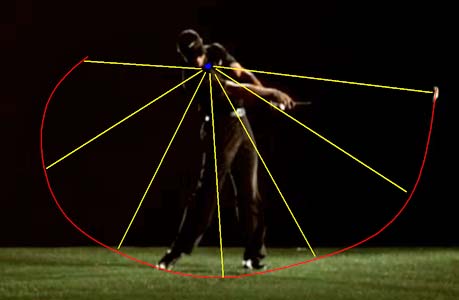 What do you think of Bernt's statement "that centripetal force conserves speed and stores energy"? Surely centripetal force is only relevant to the clubhead's circular motion at each instantaneous moment in time - as it constantly changes direction in a circular manner, and moves from one point on the clubhead arc (point X) to another point (point Y), and the centripetal force is the force needed to centripetally accelerate the clubhead from point X to point Y. The direction of the centripetal force is surely drawn towards the center of the instantaneous circle of rotation, which changes from moment-to-moment because the clubhead arc is not perfectly circular. Jeff. |
Hello no_mid_golfer,
I was a bit surprised by your reaction because I don't se any major disagreement with what you wrote. And I have no problem with the pump action works. But the pumping up is very similar to what's happening when the shoulder rotates in the sketch I posted. Where the shoulder is pulling up. But I believe that pump-up as in the piston-driven experiment doesn't shifts the center of rotation in a way that provides a longitudinal force. In any case, we seem to a gree om some very important basics here. |
Christmas Gift - Understanding causation in a golf swing
I have produced a 2 minute swing video lesson on "what powers a swinger's golf swing". If you understand this simple double pendulum swing model demonstration, then you will understand what powers the golf swing in a swinger's action.
http://www.youtube.com/watch?v=fBu30VbvBRY Consider what I have demonstrated. One powers the golf swing by moving the left arm (central arm) in a circular manner. That "cause" produces an "effect". The "effect" is the circular motion of the left wrist/hand (peripheral hinge joint) in space. That "effect" becomes a "causal agent" with respect to releasing the club ("effect"). The circular movement of the left wrist/hand in space causes the release of the club. If you understand what I have stated, there are only two possible causative agents in this sequence. 1) The left arm moves in a circular manner (due to the release of PA#4). It produces an effect - the circular motion of the left wrist/hand in space. 2) The left wrist/hand unit moves in a circular manner in space. It produces an effect - the release of the club. The club release phenomenon is an "effect" and not a cause. I therefore think that it is nonsensical to state that an "effect" drives the golf club (via the lag pressure point at PP#3). Note that I don't need to use the word centripetal or centrifugal in my description of "how the golf swing is powered" in a swinger's action. I certainly think that it is nonsensical to believe that a centripetal force is necessary to "conserve speed and store energy". Jeff. |
Quote:
|
Jeff,
No problem with your demo. There is a difference between actively driving the hands in a circle and merely let the hands respond to a centripetal force. The first one accumulates energy, the second only preserves it. I don't think I have said that centripetal force is required to store energy. (At least not in this thread :-) But for those of us who prefere the traditional swing-like golf stroke I'm afraid it is unavoidable.) My main point about the centripetal force is that it doesn't power the golf swing. It is a deliberate drive of your hands in a circular manner that powers the swing in your video. The release sequeence (in your demo) also has a side that deals with redistribution of energy that I haven't addressed. As you know a good golf swing is typically dominated by body rotation in the early down swing. Then the body slows down as the arms take over. Then the arms slow down as the club take over. This overtaking action redristributes some of the velocity energy from the body to the arms and further to the club. And this plays a part in generating clubhead speed. But if you look at the club in isolation, you still need the tangential forces to make this transfer of energy happen. Some of the tangential forces will come from mass that already moves in a circular manner (hands, arms, body). This mass-velocity will resist slowdown. The release action is also similar to a gear shift in a car. It enables you to apply a significant tangential force - and build incredible swing speed while working at close to optimum body speeds. |
Quote:
|
Quote:
What if I want NOT to release the club so soon with circular hand path? |
Quote:
1. Circle Path - this relates to HAND PATH 2. Sweep Release - this releates to CLUBHEAD PATH You CAN have a Circle Path and NOT HAVE A SWEEP RELEASE. |
Quote:
|
12PB
The hand arc is not as circular as the clubhead path. The only time that the hand arc can be circular is a swing where the left shoulder socket remains stationary in space - as demonstrated with that double pendulum swing model where the fulcrum remains stationary (and as seen in an Iron Byron machine). A poor golfer may have a near-circular hand arc if he accelerates the hands from the top of the swing and starts the kinetic sequence incorrectly with a hand pull down motion. Good golfers start the downswing with a lower body shift movement that causes secondary axis tilt => they then rotate the right shoulder downplane => that allows the left arm to be pulled down to the ball (via the release of PA#4) along an inside track. That produces an U-shaped hand arc - as demonstrated in this next photo of Tiger Woods hand arc.  The upper portion of the hand arc is very "straightish" and that doesn't induce a release phenomenon. The release phenomenon doesn't only depend on the radius of the hand arc curve; it also depends on the hand speed as it moves through that portion of the hand arc curve. Tiger's hands aren't moving very fast during the "straightish" portion of the U-shaped hand arc because he hasn't yet released PA#4. The speed of hand movement in the early downswing is determined by the speed of the pivot rotation - because the left arm is still kept across the chest wall (PA#4 remains loaded) and the power package is kept intact. Tiger's hand speed becomes maximum when PA#4 is released and that happens when his hands are going around the bottom of the U-shaped hand arc. That means that his hand speed is maximum when the radius of the hand arc curve is smallest (tightest rounded curve) and that causes the passive release of the club. Although we commonly refer to this release as a centrifugal-induced release, a better explanation is nm golfer's mathematical explanation. Either way, the release is passive, and the "force" inducing the release is the circular motion of the fast-moving hands. KOC - I do believe in 10-23-A - see above photo of Tiger Woods. I simply use the term 'straightish" because the hand arc can never be perfectly straight. However, it can be close to straight if the kinetic sequencing is correct. To prevent a circular hand arc path that promotes a sweep release, a golfer needs to induce a more U-shaped hand arc (like Tiger Woods) by making sure that the thrust-direction of the hands is in a straight line direction towards a desired aiming point (eg. ball or point ahead of the ball on the ball-target line) and the kinetic sequence is optimised. Jeff. |
pictures and perspective
Quote:
Measuring a radius of a circle from an oblique camera angle can give you an invalid reading. Any measurement of the hand of a clock should be taken when facing the clock. It should not be measured in a 2-D picture taken from the side. http://www.kunstkurs-online.de/Seite...luchtpunkt.jpg |
Yodas Luke
You wrote-: "Measuring a radius of a circle from an oblique camera angle can give you an invalid reading. Any measurement of the hand of a clock should be taken when facing the clock." That's perfectly correct. I am presuming that all readers understand that all my photographs are only representative - that they are 2-D images of 3-D motions, and that there will be perspective distortion due to an imperfect camera angle relative to the relevant clubshaft/hand plane. However, I do not believe that the fundamental principles that I am attempting to demonstrate are incorrect - because of these camera angle problems. For example, the clubhead arc of Tiger Woods driver swing (from the Nike commercial) is obviously distorted because the camera angle is face-on - while the clubead arc motion is on the inclined plane. However, it remains a "fact" that the radius of the clubhead arc (relative to the swing center) is very different at different time points during the downswing and followthrough, and that the swing center cannot be conceived to be the dead-center of a circle of the clubhead arc's rotational arc motion in space. The same "fact" applies to Tiger's hand arc photo - it is only representative because the camera angle is not perpendicular to the hand arc's circular arc of motion in space. Jeff. |
Center of curvature
Quote:
Jeff... I do not understand those yellow lines. The center of curvature depend on the path (kinematics) not the golfers body or somebody's perceived swing center. Consider for instance the simple circle, which is just a special case of an ellipse. For a circle the instantaneous center of curvature is always the center of the circle and it doesn't ever deviate from that position. The radius of curvature is just the radius of the circle and it never deviates. Now consider an ordinary ellipse where that has different major and minor axis. (see image)  I the case of the ellipse the radius of curvature rarely points to the center of the ellipse and both the location of the center of curvature and the magnitude of the radius of curvature are constantly changing. This constant change scenario is the case for the vast majority of curves be they hyperbola, parabollas ellipses, spirals or general 3d space curves (which is what the golfer's hand path and club head path are) I think this from the centripetal force wiki is good stuff The centripetal force always points in the direction normal (perpendicular) to the path at any instant towards the instantaneous center of curvature. That location would rarely if ever be a golfer's body part (left shoulder... spine etc....) Its a location in space determined solely by the path of the object. Also... as the words "centripetal force requirement" imply, its something that is required to keep an object rotating but not something that does work (force through distance = work) or stores energy. Energy comes in the forms of Kinetic or Potential... Its not "stored per se" in the golf swing anywhere in my mind. PS .... This is really good stuff from that same wiki... we don't use rotating reference frames in golf... therefore CF should be purged from the lexicon. Quote:
|
no_mind_golfer,
Good point about the ellipse. But - what's the point of a back swing at all if there's no energy storage related to the golf stroke? Why not just move the club forward from address? (Rethorical quesion: Of course energy is stored through the down swing. You increase the mv2 all the way to the ball.) |
| All times are GMT -4. The time now is 01:01 PM. |