
|
nm golfer
I agree 100% with what you state about the circle of an ellipse. I drew those yellow lines because so many people think that the clubhead swingarc is circular, and they also believe that the body's swing center is the center of that circular clubhead arc. You wrote-: "The centripetal force always points in the direction normal (perpendicular) to the path at any instant towards the instantaneous center of curvature. That location would rarely if ever be a golfer's body part (left shoulder... spine etc....) Its a location in space determined solely by the path of the object." Exactly! That's the point that I have been making all this time. You also wrote-: "Also... as the words "centripetal force requirement" imply, its something that is required to keep an object rotating but not something that does work (force through distance = work) or stores energy." I think that centripetal force must do some work if it changes the direction of movement of an object (traveling at a constant speed) from a straight line path to a circular path. Force is surely needed to centripetally accelerate the object so that it moves more centrally (towards that instantaneous center of curvacture) while it is traveling at a constant speed. I agree that CP force cannot store energy - the CP energy is in constant use if the object continues to travel along a circular path (if it is constantly being centripetally accelerated). Jeff. |
circles
Quote:
When you wrote: "The hand arc is not as circular as the clubhead path." I don't know how you can arrive at such a conclusion, with or without faulty camera angles. Let's make the geometry simple, if anyone else is going to learn anything. And, we'll consider the center of the circle the left shoulder, since it's the top of the radius. Let's call the left shoulder "A". We'll call the hands "B" and the clubhead "C". Scenario #1, Hands: If the distance between "A" and "B" remains somewhat constant (Extensor Action), "B" should inscribe a circle on a piece of paper, like a compass. If we complicate it by letting "A" move (like the golf stroke), the circle becomes somewhat elliptical. Scenario #2, Clubhead: If we measure the distance between "A" and "C", we have to consider the cocking and uncocking of the left wrist (shortening and lengthening of the radius). Scenario #1: Constant radius = circle Scenario #2: Changing radius = not a circle So, I'm not following your quote. |
Yes No maybe so...
Quote:
Quote:
Quote:
Lets step back. Work is Force X Distance (has units of energy) Power is Work / time So for a force to do work it must move the mass through a distance otherwise no work is done. Lets say you tie a rope to you car bumper and you try to roll your car down the driveway but you forgot you left the parking brake on. YOU try like hell generating a big tension force in the rope but the car doesn't budge. How much work did you do? Your body and mucles may think you did alot but the answer is none. You release the parking brake and try again. You put 100 lbf tention on the rope and roll the car 20 feet before collapsing of exhaustion. How much work did you do? 100*20 = 200 ft-lbs of work Now lets say your wife was timing you and she watch you struggle for 20 seconds before bursting in to laughter when you collaped. How much power did you put out? 100lbf * 20 ft / 20 sec = 100 (ft lbf/sec) / 550 = 0.18 horsepower Quote:
Now... This is where it gets confusing and interesting... If said golfer supplys more force in the centripetal direction than is needed to maintain the rotation then the club head mass will begin move towards the center of rotation (zeta dot is non-zero in the equation shown) and consequently theta double dot (angluar acceleration) increases compensurately: Better golfers can inject an extra bit of energy (excess force in the centripetal direction) which translates directly into angular acceleration (theta double dot) which translates directly to increased club head speed. This is that parametric acceleration I keep harping about lately. Its why Jaime and Boomboom and little Alexis Thomson are all pulling up at the last second. |
Yodas Luke
You wrote-: "Let's make the geometry simple, if anyone else is going to learn anything. And, we'll consider the center of the circle the left shoulder, since it's the top of the radius. Let's call the left shoulder "A". We'll call the hands "B" and the clubhead "C". Scenario #1, Hands: If the distance between "A" and "B" remains somewhat constant (Extensor Action), "B" should inscribe a circle on a piece of paper, like a compass. If we complicate it by letting "A" move (like the golf stroke), the circle becomes somewhat elliptical." In your mind, the hand arc's 3-D movement in space should be dominated by the movement of B in a circular rotational arc around the axis point of A, which theoretically should produce a circular hand arc. However, you are minimizing the importance of the independent movement of A as significantly affecting the shape of the hand arc - when you write "somewhat elliptical". The reality is that the independent movement of A dominates the early downswing. In the early downswing, the pelvis shift movement pulls the power package assembly intact all the way down to waist level - without significant separation of the left arm from the chest wall (PA#4 remains loaded). That means that there is no rotational movement of B around the axis point of A, and most of the hand movement in space is due to the movement of the left shoulder socket (A). You can see that phenomenon is Ben Hogan's swing here. http://www.youtube.com/watch?v=QL_6M_xZvq0 Look at how much Hogan's hands move down in the early downswing - without any rotational movement of B around the axis point of A as a result of the release of PA#4. The loaded/intact left arm flying wedge's relationship to the left shoulder socket remains unchanged until the hands reach waist level, and it is only then that PA#4 releases allowing B to rotate around the axis point of A in a circular fashion. The same phenomenon can see in this bird's eye view series of images.  Note that the left arm-shoulder angle remains roughly the same during the early downswing (I incorrectly placed the apex of that wedge in image 1 which makes the angle look wider) - until the hands get down to waist level. That means that the first part of the hand arc (in the early downswing) essentially doesn't involve any rotational movement of B around the axis point of A (due to the release of pA#4), and is mainly due to the independent movement of A. That's why the hand arc is generally U-shaped, and not circular. Jeff. |
Concentric Circles
Quote:
Un-huh . . . And Amen! For the rest of us: Except as effected by Wristcock for Power considerations, the Hands and Clubhead ideally move in concentric circles. This is Rhythm (2-0; 6-B-3-0; and The Glossary / Rhythm / Wristcock). :golfcart2: |
Quote:
 At the top of the backswing our "kinetic linkage" is displaced to one end of its "range of motion" and our muscles are outstreched and ready to contract. Once the downswing begins muscles fire, the linkage begins moving and eventually some 22% (Nesbit) of that potential energy gets converted into Kinetic energy (1/2 m V^2) concentrated at the head of the club. None of it really ever gets stored (for long) or in a benificial way (i.e. club shaft bend doesn't help us). Like Wishon I believe "shaft kick" is a myth. Now setting all of this aside..... It is quite possible in the "optimal" (if there is such a thing) golf swing there is a point on the golfer's body that remains steady (motionless). I have no problem with people calling that a swing center or what ever as long as they realize is highly unlikely that this spot is where "centripetal force" gets directed for anything other than an instant and probably then just by coincidence. |
And Now . . .
Back to 'My Quizzical Kid' And Company!
:confused1 http://www.youtube.com/watch?v=Qes03KocZr8 :salut: |
Yoda - you wrote-: "Except as effected by Wristcock for Power considerations, the Hands and Clubhead ideally move in concentric circles. This is Rhythm!"
Un-huh! Especially in 10-23-A. Thanks for sharing your opinion, Now, I can go back to regular (I mean "reality") programming. Jeff. |
Another World
Quote:
Leave aside the fact that each of the Delivery Paths (10-23-A/B/C/D/E) have their separate identity from Rhythm . . . Let your world continue to unfold as you see fit. Thrill a minute on Spaceship Jeff! :salut: P.S. And, hey, I like that flak jacket . . . It's you! |
Yoda - you got it!
The different hand delivery paths get their separate identity from rhythm --- the rhythm between the i) torso rotational movement (including secondary axis tilt variations) and ii) the left arm rotational movement at the level of the left shoulder socket (including variations in left arm/hand plane shift during the left arm's rotational movement). Varying rhythm produces variably-shaped hand arc paths, and some of those hand arc paths are not perfectly circular in nature. Jeff. |
Wasted Time
Quote:
All those millions of balls . . . Keeping my Head steady . . . Leading with my Hands . . . Doing my dead-level best to generate Lag Pressure, and . . . Trace that Straight Plane Line. If only I had known . . . Quote:
|
Quote:
I'm giving up. |
Roadhouse Partners
Quote:
:occasion: No players allowed though. Otherwise . . . We're both out of a job! :salut: |
nmg,
Quote:
This is very basic fysics. And perhaps the point is so self-evident that you looked for something more "exotic" in my statements. Quote:
Quote:
Quote:
Further, I do not see a significant upside in moving this swing center around much. Good golfers + instructors introduces all kind of "tricks" to hit the ball furter. And a lot of ordinary golfers gets confused. X-factor, late release and your "jump on your toe" by the end. The reason I think the concept of work and energy storage is important in understanding the golf swing because: 1) As long as we can (more or less) accumulate energy until impact, it doesn't matter whether we energize the swing early or late. I don't regard the "late hit" as a magic formula for increased distance for instance. 2) Not even the purest swing is all about centripetal acceleration. Centripetal acceleration only helps us store the energy. We need to actively rotate mass to build swing speed. Tangential forces must be applied. Centripetal acceleration feels powerful but it doesn't add power. 3) A lot ofthe magic mystery moves that is supposed to increase swing speed is misleading. A stroke pattern that enables the golfer to apply max tangential forces throughout, and at the same time provide the required centripetal force to carry the m*v2 until impact is as good as it gets as far as swing speed is conserned. If that doesn't produce enough swing speed it's time to hit the gym. |
minimized vs. omitted
Quote:
Thank you for letting me know what I had in my mind. I had no idea. :eyes: It still doesn't justify the statement that you made and I quoted. I included the movement of the left shoulder in my statement. You've still omitted the ever changing distance between the left shoulder and the clubhead. If you're choosing to speak specifically about the Start Down, that's one small part. The "more circular" statement was vague at best, and it's still lacking. |
Yodas Luke
I am puzzled when you state that the clubhead arc is likely to be less circular than the hand arc because of the following problem - the everchanging distance between the left shoulder and the clubhead. I suspect that you don't spend much time studying golf swings using a swing analyser program and that you don't plot the clubhead arc and hand arc to see what is really happening. The clubhead arc is amazingly circular in reality, compared to the hand arc. Here is a strobe photograph showing the clubhead and hand arcs. 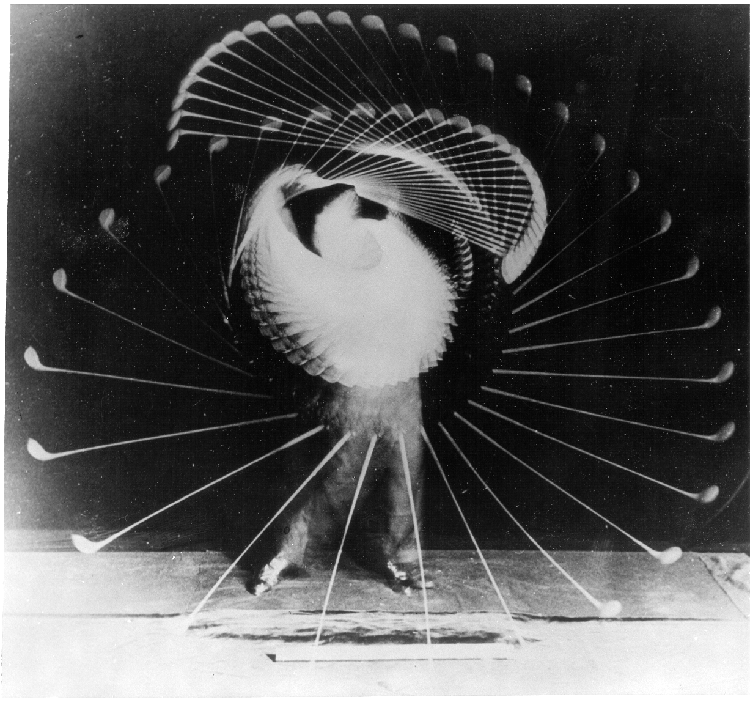 Note that the clubhead arc is much more circular than the hand arc. Here is a composite photograph of Aaron Baddeley' swing. 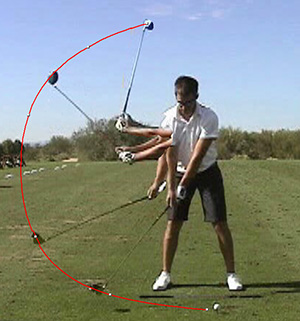 Note how circular the clubhead's path is in space -despite a varying distance from the clubhead to the left shoulder. I have previously posted photos of the hand arc of Tiger Woods, which shows an U-shaped hand arc. Here is Sergio Garcia's hand arc. 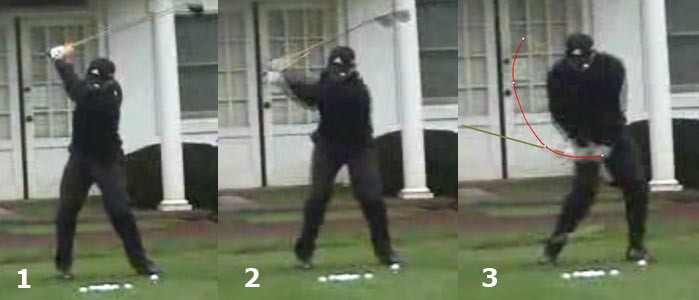 Even when taking into account the camera perspective distortion problem (due the camera not being perpendicular to the plane of the clubshaft and the plane of the hand motion), it should be readily apparent that the clubhead arc of a good golfer is more rounded than the hand arc. Jeff. |
nmgolfer
I like your mathematical expertise when dealing with problems in golf physics. However, sometimes you get it wrong. You wrote-: "Nope.... sometimes forces do no work and when the don't do work they can't contribute power (or store energy) Lets step back. Work is Force X Distance (has units of energy) Power is Work / time." Your formula is wrong when you state that work = force X distance. One also needs to consider the work force needed to stay in balance when moving in a circular manner. Centripetal force is constantly operating to keep an object in its circular track while traveling at a constant speed - and if the centripetal force is operant, then it is contributing to work (energy) output by preventing the object from flying off its circular path. Consider two cars having a 100 miles race. Car A has to travel 100 miles on a straight track. If car A completes the race in 1 hour by traveling at 100mph, then car A has expended a certain amount of energy (work output) to complete the race in 1 hour. Now imagine car B having to travel 100 miles on a circular track. If car B completes the race in 1 hour by traveling at a constant speed of 100mph, then car B has expended much more energy (work output) in the same time than car A. The extra energy was expended in trying to keep the car on the circular track at all times while it was racing around a constantly present amount of road bend at 100mph. That extra energy is the centripetal force energy required to constantly centripetally accelerate the car (to constantly keep the car moving along a circular path, rather than a straight path). Jeff. |
BerntR
I don't know "fysics" but I do know PHYSICS and to be very picky in this case speed and velocity are synonymous. You say speed I say velocity we get the same answer. Energy doesn't get banked (stored ... dollars in an account) ... the downswing converts potential energy to kinetic. Forces across levers create movement.... that's kinetic energy. As for the rest... you are entitled to your beliefs. Some people never stop believing in Santa Claus or the tooth fairy. Now we must now agree to disagree. Quote:
|
Quote:
Quote:
 Work ONLY gets done when it causes kinetic energy to change. If D (distance) is zero, no work gets done. Centripetal acceleration does not change the kinetic energy of a rotating body. IT DOES NO WORK. Quote:
|
nm golfer
Sorry. I cannot accept your explanation. You eliminate the possibility of using centripetal force as being part of your work output equation by framing your equation in that manner. If you "a priori" exclude centripetal force, then obviously it seems that centripetal force doesn't require energy to become operant. The energy may not be utilised to generate forward momentum (forward kinetic energy) along the race track (in the car example), but energy is required to keep the car on a circular track (and the car's tires know that). Consider a simple example. Imagine traveling in a NYC subway car that is traveling at 40mph on a straight rail track. Imagine that you are standing in the center aisle and holding onto a vertical post. Then imagine what happens when the subway car goes around a tight bend at the same speed. You will have to hang onto that vertical post for "dear life" to prevent yourself from being catapulted down the length of the subway car. It requires "energy" to remain stationary in balance and that energy is the energy required to offset a centrifugal force acting on your body. I would imagine that the subway car also needs to expend energy to stay in balance on its circular track, and that energy is centripetal energy. Jeff. |
Quote:
Quote:
If you are hanging motionless on a jungle gym there is a force in your arms .... but you're not doing work... you're not expending power... You're hanging there motionless. You don't do work until you do a pull up. When you do a pull-up you are moving that force (mass X gravity) through a distance ... THAT is work... THE requires Hp. Hanging Motionless does not..... but there is a FORCE present when you hang motionless... make no mistake about that! I'm done with this one.... believe what you want to.... makes no difference to me really.... Merry Christmas Jeff |
nm golfer
You state-: "'m sorry you're sorry you cannot accept my explanation but I assure you it is the one and only technically correct one. First off the force is called tension (axial load)... and it has two components (one in the normal, perpendicular to path i.e. centripetal direction and one in the tangential direction.) The normal component of the tension force does not move the object closer to the center of rotation and therefore it does NO WORK! The tangential component on the other hand accelerated the object along the path. The tangential component (and this is the one thing BerntR and I can agree on) is what does the work." You write that tension force has two components - a tangential component and a centripetal component. You then state that only the tangential component does work, because it propels the object along a a path. However, if the path is circular (rather than a straight path), then some other "force" must be doing work to make the object move along a circular path rather than a straight line path. In other words, that other "force" is doing "work" to centripetally accelerate the object (centripetal force is defined in Wikipedia as the force needed to move an object along a circular path rather than a straight path). You write-: "The normal component of the tension force does not move the object closer to the center of rotation and therefore it does NO WORK! " That statement makes no sense to me - if a moving object moves from a straight line path to a circular path, then it is moving closer to the center of rotation. Merry Christmas to you! Jeff. |
Quote:
By definition there is no point on a circle that is closer to the center of the circle than any other....... I'll leave it at that. |
nmgolfer - you wrote-: "there is no point on a circle that is closer to the center of the circle than any other."
That is correct. Imagine that there a million points on that hypothetical circle's circumference, and imagine that an orbiting object (traveling at a constant finite speed) has to move from from one point on the circumference to the next point on the circumference to the next point on the circumference -- and that it has to complete this process one million times to complete one orbit. In each of those movements (from one point to the next point), the orbiting object needs a tangential force to move it at its constant "finite" speed and a centripetal force to keep it moving on the circular path. After penning post #265, I have come back to this post to add another comment. My final statement above was "a centripetal force to keep it moving on a circular path." Keeping an orbiting object traveling in a circle requires a restraining force, a force that prevents the orbiting object from moving off into space (in a straight line direction at right angles to the circumference of the circle). That restraining force, which keeps the orbiting object traveling along a circular path, represents centripetal force, and the constant use of a restraining force (centripetal force) requires the constant expenditure of energy - and that represents work. Jeff. |
nmgolfer
You wrote regarding centrieptal force-: "NO it does not require energy! It requires a FORCE (see click here->Centripetal force requirement. Thi s is why we have a variety of words in the lexicon: FORCE WORK ENERGY etc. soforth.... They have different meanings. AGAIN.... SOME FORCES DO NO WORK." That's nonsense. If a force is operant, then it must be using energy and therefore doing work. You equate work only with displacement of an object in space. You do not consider it work to keep an object stationary in the face of opposing forces. However, it does require energy to keep an object stationary if there is another force acting to displace that object. For example, if person A is pushing a three foot X three foot diameter block of steel on an ice rink, then it requires energy to move the block against the resistance of the ice. If person B then stands opposite the block and pushes in the opposite direction with the same degree of force as person A is exerting to push it forward, then person B is using energy, and person B is doing work, even though the block of steel is now stationary (not moving, not being displaced). Therefore, in your example of a person hanging from a jungle gym by his arms, he is doing work even though he is stationary. He is constantly using muscle energy (doing muscle work) to overcome the effect of gravity on his body mass. If he didn't constantly perform that muscular work, gravity would pull his body down to the ground. You wrongly believe that he is only working when he he does chin-ups and pulls his body up. You sent me to the following website, which demonstrates that a centripetal force must be using energy, and the constant expenditure of energy represents work. http://www.glenbrook.k12.il.us/GBSSC...ircmot/cf.html In that first animation, the ball travels in a straight line if there is no force (requiring energy expenditure) to keep it stationary. In the second animation, a block provides a force that keeps the ball stationary - and that represents centripetal force. Any force that is constantly operant requires energy and therefore centripetal force must be performing work. In other words, energy is required to keep the ball stationary (from traveling forward in a straight line) and the restraining force that provides the "energy for restraint" is performing work. Hopefully, you are wise enough to realise that your car seat belts (or car airbag) will be performing work to keep you from being ejected through the windscreen if you hit another car head-on at 100mph. The work it is performing is to prevent you from becoming an instantaneous human projectile! Jeff. |
Wow!
Quote:
I've only given about 13,000 video lessons in the last ten years. I hope I can learn how to use the software before I start getting really busy. :read: |
Yodas Luke
You missed the point. I wasn't talking about using a swing analyser program as a teaching tool to study a golf student's swing. I was talking about studying the clubhead arc and hand arc of golfers using a spline tool to delineate the clubhead arc and hand arc of golfers. Jeff. |
Jeff,
No offense but.... before you go any further in your study of the golf swing you really need to STOP! and go take a high school level physics class. I'm dead serious. What you are saying is absolutely laughable. ITS COMPLETELY AND TOTALLY RIDICULOUS. I would be laughing if I weren't crying. No wonder GOLF myths have perpetuated for so long and are so deeply ingrained. Try the community college or take the online course at the link I've provided BUT DO IT! You need a basic understanding of these really simple physics principles or else you are wasting EVERYONES' (but especially your) time. Its like someone trying to operate having never studied anatomy. Show my profession some respect! I will not discuss this or any other subject with you any further. I've provided ample evidence and plethora of links that SHOULD DRIVE THESE VERY BASIC PHYSICS REALITIES HOME to you. But no... You either won't read them or don't believe them so what gives? If you can't find the time to learn the basics then STOP ANYWAY... Just a suggestion. One last try... READ IT http://www.physics.ucla.edu/k-6connection/forwpsa.htm Quote:
|
nmgolfer
You wrote-: "What you are saying is absolutely laughable. ITS COMPLETELY AND TOTALLY RIDICULOUS. I would be laughing if I weren't crying. No wonder GOLF myths have perpetuated for so long and are so deeply ingrained." Whenever I read statements like this, then I know that the person is not dealing with the "issues", but taking an escapist route to avoid dealing with the "issues". You have not provided any proof that my opinions re: work or centripetal force are invalid. You have not even provided a counterargument. As a physicist, you think that work is only performed when an object moves in space. Example 1 So, if a person leans against a 6 foot diameter redwood tree and pushes against the tree with all his strength in an attempt to move the tree, you state that the person is not doing any work because the tree doesn't move. If after 15 minutes of continuous pushing, the person falls to the ground in a state of total exhaustion, you are presumably stupefied because he didn't do any work. You apparently fail to understand that muscular energy was used to push against the tree, and that the use of muscular energy represents work - from the person's perspective. It may not be useful work, but energy was expended and the person therefore worked. The amount of muscular work performed by the person pushing against the tree could theoretically be computed by an exercist physiologist - even though you have already concluded that the person didn't do any work because the tree didn't move. Example 2 Now, if that same person leaned against a 1" diameter sapling tree, and the sapling tree bent-over horizontal to the ground, you would conclude that the person performed work - because he moved the vertical tree through a 90 degree angle. In your mental framework as a physicist, he performed much more work in this second example because he moved the tree - while in the first example he didn't perform any work because the tree didn't move. OK. We see the world differently. What really puzzles me is that you believe that it takes no energy (requires no work) to restrain an object been pushed by a force. So, consider the situation of a mother riding in a roller coaster while holding her 4 year child in her arms, and imagine that the mother is restrained with seat belts while her child is only restrained by the mother's hold with her arms. Then imagine the roller coaster going through a tight bend at 100mph. The mother has two choices. She could refuse to expend any energy by deliberately holding onto her child with her arms, and the consequence of that decision would be a child being propelled into space with an amazing amount of projectile force when the roller coaster enters the tight bend at 100mph. Alternatively, the mother could use all of her arm strength to hold the child tightly against her body to prevent the child from being ejected from the roller coaster. In my world, the mother used an enormous amount of energy to perform that holding action, and that represents work. In effect, I would say that the mother was performing the work of a centripetal action - the action of ensuring that her child continued moving at 100mph on a circular path rather than a straight line path. In your world, the mother was not performing any work because she didn't use tangential forces to move the child (having a certain quantifiable mass) a certain distance. Jeff. |
Quote:
Energy storage is a very essential topic in a lot of mechanical engineering subjects like noise control and vibration damping. Transducer technology is a subject I know pretty well where energy storage is an essensial challenge. In many cases the efforts are about minimizing energy storage. In other cases it's about tuning. Typical efforts to reduce energy storage in mechanical systems is to reduce mass and add mechanical resistance. Energy storage is often described with a Q-factor that deals with the ratio of reactive (energy-storing) components to resistive (energy-dissipating) components. http://en.wikipedia.org/wiki/Quality_factor The down swing converts potential energy (related to g) to kinetic energy, that's true. In addition it stores the kinetic energy that is added by the player working the club. Moving mass is one of the essential ingredients. Most of the mass in the clubhead is there to help the player accumulate energy until impact. |
Rsheehy & packard are the only two worth reading...
While edification is generally speaking elusive golf forums provide endless amusement....
Here we have Jeff, who is completely clueless about simple physics terms and absolutely refuses to admit it (and he refuses to read links), spinning aimlessly. And then there is you BrentR whom I strongly suspect is just yet another poser. You see scientists and engineers know the word is PHYSICS not fysics... they would NEVER make that blatant mistake or many of the others that scream out in your posts. Scientists and engineers generally make sense when they write and you don't. Nevertheless BerntR I suspect you do know a tiny little bit about transducers (got a job as an aid in a lab did you?) ... I suspect you may even know a tiny little bit about vibration measurment or perhaps acoustics and you are trying to transfer that modicum of superficial extremely cursory knowledge to "your" analysis of the golf swing. This is why we see you tossing out of big sounding totally irrelevant, totally inappropriate terms like "harmonic" or "q factor". See when all you have is a hammer everything looks like a nail... when you are a surgeon the only solution is to operate. Well guess what.... the golf swing is a gestalt... an event... it is not an oscillating system with or with out damping. Try again BrentR...YOUR MODEL DOESN'T FIT! No energy is stored in the golf swing anytime anywhere. Oh BTW merry Christmas! Quote:
|
Quote:
I do not know the vality in his posts but, To BerntRs defence, even though I dont know him personally, we spell it "fysics" in the nordic speaking countries.. and perhaps he forgot to translate:) It would be unfair to just judge him by this mistake. |
Quote:
|
nmgolfer
Instead of calling me clueless, why don't you use your superior knowledge to point out the errors in my understanding of the term "centripetal force". There are many other forum members who could benefit if you share your knowledge in a constructive fashion - by demonstrating my faulty reasoning. Consider my understanding of the term "centripetal force". In a previous post (#264) I wrote the following-: "Imagine that there a million points on that hypothetical circle's circumference, and imagine that an orbiting object (traveling at a constant finite speed) has to move from from one point on the circumference to the next point on the circumference to the next point on the circumference -- and that it has to complete this process one million times to complete one orbit. In each of those movements (from one point to the next point), the orbiting object needs a tangential force to move it at its constant "finite" speed and a centripetal force to keep it moving on the circular path." Now, consider the following diagram. 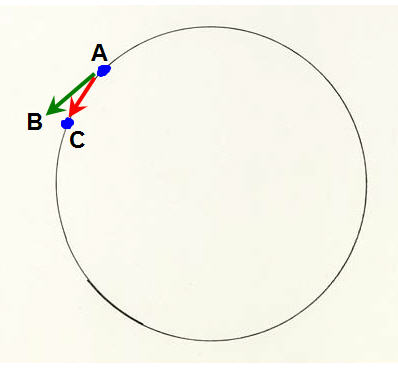 I mentioned that one could mentally picture that there a million time-points that the orbiting object will pass through on its circular orbit around one circumference of the circle in one second. Now, imagine that the orbiting object is at point A. Then, one millionth of a second later the object is at point C. What forces are in play to move the orbiting object from point A to point C, and do those forces involve the use of energy? I believe that two forces are in play. The first force is a tangential force that moves the object in a straight line direction with enough energy to keep the object traveling at the same speed. In one millionth of a second, if that tangential force was operant, and no centripetal force was present, then the object should end up at point B (having traveled in a straight line at a 90 degree angle to the circumference of the circle). If the orbiting object ends up at point C, then we can reasonably conclude that a centripetal force is present. What did that centripetal force actually do? I think that the centripetal force applied centripetal acceleration that moved the orbiting object more inwards (towards the center of the circle) so that it ends up at point C instead of point B. The centripetal force, in theory, should direct the orbiting object to the center of the circle. However, the amount of energy that the centripetal force has is only sufficient to bend the path of straight line movement of the orbiting object enough to get it to point C in one millionth of a second - in other words, the centripetal force has enough energy to keep the orbiting object traveling on a constant circular path. The centripetal force when operant is manifesting its force (energy) and it is therefore doing work to get the orbiting object to end up at point C instead of point B. Please explain the errors in my reasoning? Thanks, Jeff. p.s. I did read all those links. |
nmg,
I found your response rude and insulting. It's certainly not something I am used to from people with scientific pretensions. The Q-factor I linked to is more relevant to the the discussion than you seem to have comprehended: Physically speaking, Q is 2π times the ratio of the total energy stored divided by the energy lost in a single cycle or equivalently the ratio of the stored energy to the energy dissipated per one radian of the oscillation.[1] If we can exclude all the working forces and just "hold on to the rope" prior to impact we can actually measure the q-factor of the swing. It would be a function of swing speed reduction per degree of rotation. But of course, the experiment must be led by someone who knows how to measure the stored, kinetic energy. Here's another example of an energy storage device based on rotating mass. I've never heard of it before. I simply googled for something more similar to the golf swing: http://en.wikipedia.org/wiki/Flywheel_energy_storage The flywheel energy storage accumulates energy by rotating mass up to speed. Kinetic energy in the form of 1/2mv2. If you don't see that the same thing happens in the golf stroke then your understanding of physics and mechanics has serious flaws. |
Minute Differentiations
Quote:
In your opinion -- just asking :smile: -- does your explanation above differ from the basic laws Sir Isaac Newton expressed in his Philosophiæ Naturalis Principia Mathematica (1687)? http://en.wikipedia.org/wiki/Philoso...ia_Mathematica If so, how? Thank you. |
Oh my!
hehehehe..... hope I don't offend anyone who has posted within the last 28 pages, but do any of you guys physically go to a golf course, walk up to the counter, pay a green fee and tee it up? If you do can you keep in double-digits?
I get plenty of flak from my buddies who think I'm too analytical/mechanical in regards to the swing. If they only knew what else is out there!! Thanks again to Yoda for building a "quarantine wing" of the forum!! CG |
Treasure Hunters
Quote:
I was reading the most recent exchanges on Christmas Eve and thought to myself . . . In the history of CyberGolf, is there any precedent for this? Probably . . . But I haven't read it! :eyes: P.S. There definitely is new ground being plowed here. No doubt, a large portion of the text is dross. At the same time, what remains may be gold. The problem is, first, discerning between the two and, second, applying it to the Golf Stroke. Meanwhile, my hat is off to all those who participate. :salut: |
Yoda - you asked-: "In your opinion -- just asking -- does your explanation above differ from the basic laws Sir Isaac Newton expressed in his Philosophiæ Naturalis Principia Mathematica (1687)?: "
I have not read Newton's work so I do not know whether my explanation differs from the basic laws expressed by Newton in his work "Philosophiæ Naturalis Principia Mathematica (1687)". However, I do not think that my explanation differs from the explanations offered in these links that nmgolfer recommended - relating to the topic of Newtonian laws regarding forces and motion. http://www.glenbrook.k12.il.us/GBSSC...aws/u2l1a.html http://www.glenbrook.k12.il.us/GBSSC...aws/u2l1b.html http://www.glenbrook.k12.il.us/GBSSC...aws/u2l1d.html http://www.glenbrook.k12.il.us/GBSSC...aws/u2l3a.html http://www.glenbrook.k12.il.us/GBSSC...ircmot/cf.html http://www.physicsclassroom.com/Class/circles/U6L1d.cfm Jeff. |
Honest Answers
Quote:
Question: Do you feel your answer differs from a conventional understanding of Sir Isaac's work (as explained in your posted links or otherwise)? From your post, apparently not. This is not a trick question. I only want to know if you feel you are illustrating his principles with your models (and explaining them in your own words) -- nothing wrong with that and a lot to be commended -- or if you are 'plowing new ground'. :salut: |
| All times are GMT -4. The time now is 10:02 AM. |