LynnBlakeGolf Forums

LynnBlakeGolf Forums (http://www.lynnblakegolf.com/forum/index.php)
-   The Golfing Machine - Advanced (http://www.lynnblakegolf.com/forum/forumdisplay.php?f=17)
-   -   Eldrick Picture..good?bad? depends? (http://www.lynnblakegolf.com/forum/showthread.php?t=8548)

HungryBear 02-04-2012 10:01 AM

Magic!
 
The line in 6-b-3-0-1;
" AT RIGHT ANGLES TO THE LEFT ARM PLANE."
Seems. applicable to angled hinging-BUT- not horizontal or vertical(the dual hinges)
if, what is meant by LEFT ARM PLANE is the plane of entire primary lever assembly.

#3 remains on the plane and traces the line. The left arm wedge is perpendicular to the plane continuously for angled hinge only. And #3 roll on the shaft because the clubface and clubshaft are independant for horizontal and vertical hinging ??

hb

O.B.Left 02-04-2012 05:06 PM

Quote:

Originally Posted by HungryBear (Post 89896)
The line in 6-b-3-0-1;
" AT RIGHT ANGLES TO THE LEFT ARM PLANE."
Seems. applicable to angled hinging-BUT- not horizontal or vertical(the dual hinges)
if, what is meant by LEFT ARM PLANE is the plane of entire primary lever assembly.

#3 remains on the plane and traces the line. The left arm wedge is perpendicular to the plane continuously for angled hinge only. And #3 roll on the shaft because the clubface and clubshaft are independant for horizontal and vertical hinging ??

hb


Hey Bear.

You're touching on a really interesting subject for me. Maybe you should start a new thread as this topic could bring about some heathy debate, unless it relates to the discussion at hand somehow. Uh not sure what the heck that was but ... ? I think i got things off course a while back there all by myself. Poor little old thread jacker me. Somethin about Tiger maybe? I dunno.

Heres my take on the matter: The Plane of the Right ARm Flying wedge is the Plane of the Right Wrist Bend . Its relationship to the Inclined Plane is constantly changing. It lays flat to the Inclined Plane only at Fix and Impact , the rest of he time it is under the Inclined Plane (before impact) or over top of the Inclined Plane (after Impact). This holds despite the fact that the #3 Pressure Point Traces the Plane LIne prior to and after Impact!

:eyes:

I believe you can maintain the 90 degree relationship of the wedges to each other and Trace with the #3pp and execute any Hinge Action.

Daryl 02-05-2012 01:11 AM

Quote:

Originally Posted by HungryBear (Post 89896)
The line in 6-b-3-0-1;
" AT RIGHT ANGLES TO THE LEFT ARM PLANE."
Seems. applicable to angled hinging-BUT- not horizontal or vertical(the dual hinges)
if, what is meant by LEFT ARM PLANE is the plane of entire primary lever assembly.

Comment: #3 remains on the plane and traces the line.
Response: Always On-Plane. They Trace different Lines. With Throw-Out, The #3 PP Traces the Arc of Approach (or Plane Line because the Pulley is On-Plane) the Clubhead also Traces the Plane Line. With Drive-Out, the #3 PP Traces the Angle of Approach (the Angle of Approach is On-Plane but the Pulley is Vertical to the Ground) while the Clubhead "Covers" the Plane Line.

Comment: The left arm wedge is perpendicular to the plane continuously for angled hinge only.
Response: Only At Impact. The Shaft is ALWAYS On-Plane for Every Stroke. During Angled Hinging, the Clubface is Vertical to the Ground Throughout the Stroke.

Comment: And #3 roll on the shaft because the clubface and clubshaft are independant for horizontal and vertical hinging ??
Response: The Clubface and Clubhead are always independent for Dual Hinges. One Hinge Pin for the Clubface and the other for the Clubhead (or) one for the Left Arm Wedge and one for the Right Forearm Wedge (or) if you need simplification (like Bucket, O.B and Mike O) then simply "Left Wrist" and "Right Hand" - "Clubface + Clubhead".

hb

During Impact, for All Hinge Actions, The Plane of the Left Arm Wedge is Perpendicular to the Swing Plane and the Right Forearm Wedge is On-Plane. The Planes are at Right Angles to each other. + The Left Arm Wedge is Perpendicular to the Base Line of the Inclined Plane at Impact, 90 degrees.

This goes to some fundamental alignments. Some think about trying to create the 10-2-B grip however this is not the right approach. HK said that other grips "destroy the Wedges" but the reality is that the Wedges are never aligned when you take just any Grip. The better approach is to create the Wedges and align them at 90 degrees, and then Grip the Club. Impact Fix is your Only opportunity to Align The Wedges. So, all Strokes must begin with these Alignments at Impact Fix.

If you're on the first Tee and a guy is aligning His Right Forearm Wedge and Grip at Impact Fix and then he applies his Left Hand; don't bet him money ( unless his name is 12 Pc Bucket, then bet the limit).

12 piece bucket 02-05-2012 03:40 PM

Quote:

Originally Posted by Daryl (Post 89932)
During Impact, for All Hinge Actions, The Plane of the Left Arm Wedge is Perpendicular to the Swing Plane and the Right Forearm Wedge is On-Plane. The Planes are at Right Angles to each other. + The Left Arm Wedge is Perpendicular to the Base Line of the Inclined Plane at Impact, 90 degrees.

This goes to some fundamental alignments. Some think about trying to create the 10-2-B grip however this is not the right approach. HK said that other grips "destroy the Wedges" but the reality is that the Wedges are never aligned when you take just any Grip. The better approach is to create the Wedges and align them at 90 degrees, and then Grip the Club. Impact Fix is your Only opportunity to Align The Wedges. So, all Strokes must begin with these Alignments at Impact Fix.

If you're on the first Tee and a guy is aligning His Right Forearm Wedge and Grip at Impact Fix and then he applies his Left Hand; don't bet him money ( unless his name is 12 Pc Bucket, then bet the limit).

Interesting on the above....please explain....can you do pics? Always bet the house against a cat with greasy palms.

Daryl 02-05-2012 08:50 PM

Quote:

Originally Posted by 12 piece bucket (Post 89941)
Interesting on the above....please explain....can you do pics? Always bet the house against a cat with greasy palms.


Explained: The Left Arm Wedge is Vertical at Impact. The Right Forearm Wedge is On-Plane. The Plane Line is the Base Line of the Inclined Plane. The Left Arm Wedge at Impact, is 90 degrees to the Base Line of the Inclined Plane.

The 90 degree Alignment of the Wedges should exist from the end of Start-up to the End of Follow-through.

O.B.Left 02-05-2012 11:29 PM

Quote:

Originally Posted by Daryl (Post 89944)


Explained: The Left Arm Wedge is Vertical at Impact. The Right Forearm Wedge is On-Plane. The Plane Line is the Base Line of the Inclined Plane. The Left Arm Wedge at Impact, is 90 degrees to the Base Line of the Inclined Plane.

The 90 degree Alignment of the Wedges should exist from the end of Start-up to the End of Follow-through.


D, assuming startup from Fix and Horizontal Hinging when does the Plane of the Right ARm Flying Wedge leave its flat to the Inclined Plane condition? Id say immediately . How 'bout you?

Daryl 02-06-2012 12:27 AM

Quote:

Originally Posted by O.B.Left (Post 89945)
D, assuming startup from Fix and Horizontal Hinging when does the Plane of the Right ARm Flying Wedge leave its flat to the Inclined Plane condition? Id say immediately . How 'bout you?

I agree.

This condition exists from the end of Start-up until Release. During Release, the Right Forearm seeks it's Angle of Approach for Impact thereby rotating the Wedges. The Right Forearm will rotate the Left Arm Wedge to Vertical for Impact. The Left Arm Plane and Right Forearm Flying Wedge travel back and forth On-Plane while aligned to the Plane of the Right Wrist Bend.

The reason that the Left Arm Wedge returns to Vertical for Impact is because the Wedges were aligned at 90 degrees at Impact Fix. If you want to align them at 75 degrees or 120 degrees, then you can easily do so. But, the Target Line is set at 90 degrees to Low Point. So, the Wedges at 90 degrees will agree with the Target Line. When the "True Swinger" moves the Ball Aft he is actually Aligning the Wedges to something other than 90 degrees because he set the Wedges to 90 degrees at "Impact Fix - Low Point".

You don't need to set the Wedges at 90 degrees at Low-point if you want to play the Ball 3 inches Aft. You can set the Wedges at 90 degrees 3 inches Aft if you prefer. That is simply, "Rotating the Grip".

All of this helps explain how "Centrifugal Force" aligns the Clubface for Impact. Using the Right Forearm Angle of Approach, Centrifugal Force will ALWAYS return the Clubface to your Impact Fix Alignments.

The problem I'm having is that no one seems to understand the Right Forearm Angle of Approach.

O.B.Left 02-06-2012 08:25 PM

Quote:

Originally Posted by Daryl (Post 89946)
The Left Arm Plane and Right Forearm Flying Wedge travel back and forth On-Plane while aligned to the Plane of the Right Wrist Bend.

When you say "On-Plane" are you saying the RFFW 's Plane travels back and forth on the Inclined Plane ? Maybe for Angled Hinging, but otherwise I don't see that.

Quote:

The problem I'm having is that no one seems to understand the Right Forearm Angle of Approach.
OK lay it on us.

I see the Right Forearm Tracing , pointing at , the Delivery Line (of the Hands) while the #3pp traces the Plane Line. The Plane of the Right Forearm Flying Wedge rotating around the LCOG....... to a degree consistent with the Hinge Action employed when travelling through the impact area.

The Right Forearm Flying Wedge aligned to the aft of the Handle , well the aft of the direction the club head is travelling through impact. Grip Rotation determining the club face alignment relative to the Delivery Path of the club head.

Uh .... I think.

Daryl 02-06-2012 11:43 PM

Quote:

Originally Posted by O.B.Left (Post 89953)
When you say "On-Plane" are you saying the RFFW 's Plane travels back and forth on the Inclined Plane ? Maybe for Angled Hinging, but otherwise I don't see that.

The #3 PP and the Center of Gravity of the Clubhead Travel the Swing Plane for both Hitters and Swingers. The Left Arm Wedge and Right Forearm Wedge are Aligned on the Plane of the Right Wrist Bend. They "Saddle" the Swing Plane. The Right Wrist Bend varies so then, likewise, the Wedges Alignment to the Swing Plane will vary.


Quote:

Originally Posted by O.B.Left (Post 89953)
OK lay it on us.

I wish I could. If you knew about it, then you'd be playing on the "Hooters" Tour. That's why I'm doing the video. "Right Forearm Participation in the Golf Swing: per TGM"


Quote:

Originally Posted by O.B.Left (Post 89953)
I see the Right Forearm Tracing , pointing at , the Delivery Line (of the Hands) while the #3pp traces the Plane Line.

The Right Forearm can Trace the Plane line when it's On-Plane. The Right Forearm can be On-Plane when the Right Elbow is On-Plane.

Quote:

Originally Posted by O.B.Left (Post 89953)
The Plane of the Right Forearm Flying Wedge rotating around the LCOG....... to a degree consistent with the Hinge Action employed when travelling through the impact area.

Oh? Actually, the Right Forearm doesn't rotate around the LCOG. It Rotates around the Hinge.

When you throw a Javelin, you don't rotate around the LCOG. When you skip a stone on the surface of water, you don't rotate the LCOG. If you do, then the stone dives into the water and the Javelin impels a spectator. Both Throwing a Javelin and Skipping a Stone use Right Forearm Wedge Geometry. And with both activities, the Right Forearm Wedge Rotates around the Right Elbow. By the way, if you did rotate around the LCOG, you would be Swiveling. The Golf Shaft Rotates around the LCOG but not the Wedges.

You could make the argument that the LCOG and Wedges rotate together around the Hinge, but then I would point out to you that the Rotation is another one of Golf's illusions.

I know how difficult this stuff is to understand. Not for you so much but for almost everyone else. The things I say must sound like gibberish or at least as incoherent as 12 Pc Bucket after a weekend binge hugging the "Still". I'm not crazy like Mike O.

I can assure everyone that concepts in TGM are easy to understand.

O.B.Left 02-07-2012 01:51 AM

Quote:

Originally Posted by Daryl (Post 89954)

I wish I could. If you knew about it, then you'd be playing on the "Hooters" Tour. That's why I'm doing the video. "Right Forearm Participation in the Golf Swing: per TGM"

Im not on the Hooters tour? When did that happen? [/quote]


Quote:

The Right Forearm can Trace the Plane line when it's On-Plane. The Right Forearm can be On-Plane when the Right Elbow is On-Plane.
Yes agreed. This is a good point ...... Trace with the #3pp only.


Quote:

Oh? Actually, the Right Forearm doesn't rotate around the LCOG. It Rotates around the Hinge.

When you throw a Javelin, you don't rotate around the LCOG. When you skip a stone on the surface of water, you don't rotate the LCOG. If you do, then the stone dives into the water and the Javelin impels a spectator. Both Throwing a Javelin and Skipping a Stone use Right Forearm Wedge Geometry. And with both activities, the Right Forearm Wedge Rotates around the Right Elbow. By the way, if you did rotate around the LCOG, you would be Swiveling. The Golf Shaft Rotates around the LCOG but not the Wedges.

If the Plane of the respective Wedges maintain a constant relationship to each other (90 degrees say) and to the club shaft (top and aft) and the shaft rotates around the LCOG wouldn't the wedges rotate also? In other words don't the wedges rotate with Hinge Action as well as swivel action?


Quote:


I can assure everyone that concepts in TGM are easy to understand.


TGM , the yellow book about golf right ?

Etzwane 02-07-2012 09:29 AM

Quote:

Originally Posted by O.B.Left (Post 89955)

If the Plane of the respective Wedges maintain a constant relationship to each other (90 degrees say) and to the club shaft (top and aft) and the shaft rotates around the LCOG wouldn't the wedges rotate also? In other words don't the wedges rotate with Hinge Action as well as swivel action?

I'd say the Hinge Action moves the wedges that make the shaft rotate around the LCOG.

HungryBear 02-07-2012 12:07 PM

Home again
 
Returning to the Original question of this thread.

Recognizing the insight from O.B., Daryl and bucket from post reply #242 to present.

Looks like a good uncompensated swing.


Quote:

Originally Posted by 12 piece bucket (Post 88550)
What do y'all think about this picture?


Description? Opinions? Workable? Model? Complicated?


Following the rules:
Flat left wrist that only cocks and uncocks, never bends or rolls. AND A bend right wrist that never cocks or rolls. From FIX to FOLLOW THROUGH. NOTE- all roll is assembly roll of the wedge assembly.
an uncompensated stroke REQUIRES:
swinging- horizontal hinge, requireing- a pitch right elbow and a slap onplane forearm
JUST like Tiger picture.

Likewise hitting will require punch right elbow and a fanning right forearm.

Failing these elements, compensations are required.

Note that he ap-pears to have "perfect" 90 degree wedges and #3 pp is on plane but "high aft" on the shaft- ie. still rotating to the aft side which it will not reach until impact. Horizontal hinging, sequenced release

Now, assume assume he had arrived at the position of shaft level to the ground and parallel to the pl. With a punch elbow. pp#3 would be behind the shaft, on plane and the face perpendicular to the plane for ANGLED hinging.

Now- switching a drag start down to a punch release fit well. Just get to the punch elbow.

I know - HK wants CHOICES of components. But, would it not help many to say that uncompensated stroke requires a limited selection process?


HB

12 piece bucket 02-07-2012 05:37 PM

Quote:

Originally Posted by HungryBear (Post 89965)
Returning to the Original question of this thread.

Recognizing the insight from O.B., Daryl and bucket from post reply #242 to present.

Looks like a good uncompensated swing.


Following the rules:
Flat left wrist that only cocks and uncocks, never bends or rolls. AND A bend right wrist that never cocks or rolls. From FIX to FOLLOW THROUGH. NOTE- all roll is assembly roll of the wedge assembly.
an uncompensated stroke REQUIRES:
swinging- horizontal hinge, requireing- a pitch right elbow and a slap onplane forearm
JUST like Tiger picture.

Likewise hitting will require punch right elbow and a fanning right forearm.

Failing these elements, compensations are required.

Note that he ap-pears to have "perfect" 90 degree wedges and #3 pp is on plane but "high aft" on the shaft- ie. still rotating to the aft side which it will not reach until impact. Horizontal hinging, sequenced release

Now, assume assume he had arrived at the position of shaft level to the ground and parallel to the pl. With a punch elbow. pp#3 would be behind the shaft, on plane and the face perpendicular to the plane for ANGLED hinging.

Now- switching a drag start down to a punch release fit well. Just get to the punch elbow.

I know - HK wants CHOICES of components. But, would it not help many to say that uncompensated stroke requires a limited selection process?


HB

Disagree....perverted pitch elbow...no accumulator relase....no #4 pressure point...shoulders well closed....toe squashing bugs...butt cap pointing right too long.

12 piece bucket 02-07-2012 05:39 PM

Quote:

Originally Posted by Daryl (Post 89954)
The #3 PP and the Center of Gravity of the Clubhead Travel the Swing Plane for both Hitters and Swingers. The Left Arm Wedge and Right Forearm Wedge are Aligned on the Plane of the Right Wrist Bend. They "Saddle" the Swing Plane. The Right Wrist Bend varies so then, likewise, the Wedges Alignment to the Swing Plane will vary.


I wish I could. If you knew about it, then you'd be playing on the "Hooters" Tour. That's why I'm doing the video. "Right Forearm Participation in the Golf Swing: per TGM"


The Right Forearm can Trace the Plane line when it's On-Plane. The Right Forearm can be On-Plane when the Right Elbow is On-Plane.


Oh? Actually, the Right Forearm doesn't rotate around the LCOG. It Rotates around the Hinge.

When you throw a Javelin, you don't rotate around the LCOG. When you skip a stone on the surface of water, you don't rotate the LCOG. If you do, then the stone dives into the water and the Javelin impels a spectator. Both Throwing a Javelin and Skipping a Stone use Right Forearm Wedge Geometry. And with both activities, the Right Forearm Wedge Rotates around the Right Elbow. By the way, if you did rotate around the LCOG, you would be Swiveling. The Golf Shaft Rotates around the LCOG but not the Wedges.

You could make the argument that the LCOG and Wedges rotate together around the Hinge, but then I would point out to you that the Rotation is another one of Golf's illusions.

I know how difficult this stuff is to understand. Not for you so much but for almost everyone else. The things I say must sound like gibberish or at least as incoherent as 12 Pc Bucket after a weekend binge hugging the "Still". I'm not crazy like Mike O.

I can assure everyone that concepts in TGM are easy to understand.

Daryl....could you make a device say like putting two rulers together with a hinge that could be gripped with the hinge at the right wrist joint...the lower ruler griped like a club...the upper ruler running up the right forearm and sticking on the players right rib cage and some how attach a club to this theoretical device?

Daryl 02-07-2012 10:16 PM

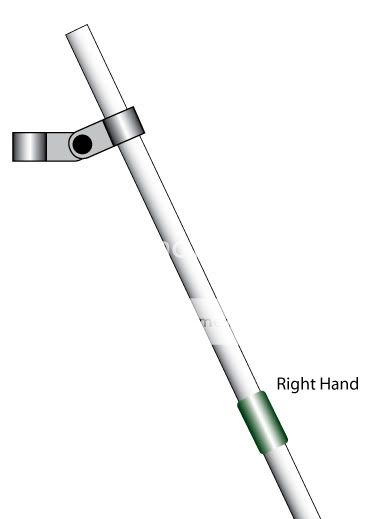
Been there, done that. I designed and built 3 Alignment Learning Aids to teach players how to Hinge and use the Right Forearm Angle of Approach. Dual Horizontal, Angled and Dual Vertical. You need only two Dowels and a coupler to connect them (or use your Left Hand)
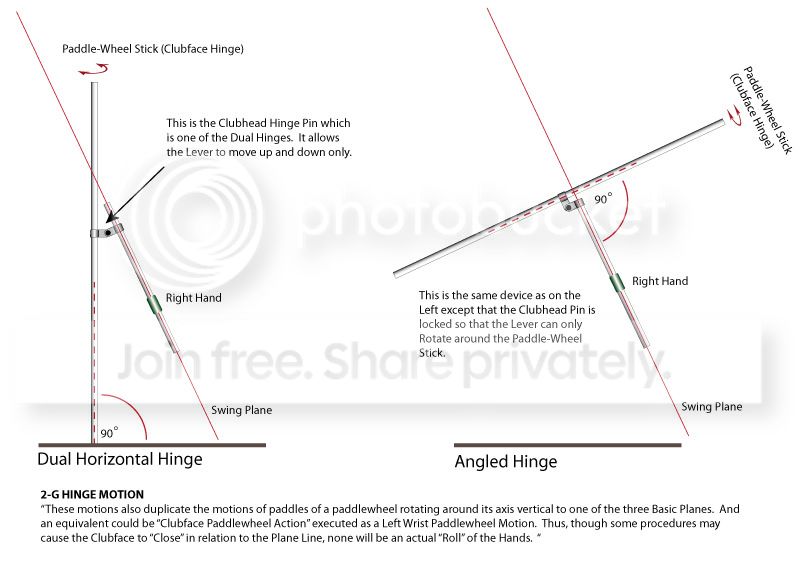


TO USE: Hold the "Paddle-Wheel" Stick Perpendicular to the Associated Plane with your Left Hand. With your Right Hand, Grip the Lever Stick at Impact Fix with your Right Forearm On-Plane and the #3 PP on the Aft Side of the Shaft. Move the "Lever" Stick back and forth with your Right Hand, Forearm and Elbow.

NOTE: Grip the Lever firmly with your Right Hand with a Bent and Level Wrist. Don't allow the right hand to rotate as you move back and forth. This is Hinge Action. If you loosen your Right Hand Grip and Allow the hand to Rotate while the Lever Stick moves, then you're Swiveling.

This teaches Hinge Action and the Right Forearm Angle of Approach for that Hinge Action(and much more). These devices will force you to Hinge through Impact and You CANNOT Swivel through Impact with these devices.

I plan to introduce them in my video.


O.B.Left 02-08-2012 12:24 AM

Nice D . Different point of view or machine so to speak from 1L but not inconsistent . Did you draw Vertical Hinging?

Sorry if this is getting away from the Right Forearm Angle of A....

Daryl 02-08-2012 08:03 AM

Quote:

Originally Posted by O.B.Left (Post 89975)
Nice D . Different point of view or machine so to speak from 1L but not inconsistent . Did you draw Vertical Hinging?

Sorry if this is getting away from the Right Forearm Angle of A....

It's the same as 1-L. The Paddle-Wheel Hinge Stick is HKs Main Hinge Pin. But HK only indirectly tells you that it's the "Right Forearm Angle of Approach" that creates the "Hinge Action". Almost all TGM'ers are "trying" to Hinge by literally holding the Flat Left Wrist Vertical to one of the available Associated Planes and "The struggle" is endless as evidenced in a recent "Thread" started by a new member who is having difficulty holding the Left Wrist Flat. Because Hinge Action is not "cause"; it's an "Effect". These devices teach the Right Forearm Angle of Approach. By having an Approach Angle to deliver the Clubshaft and Clubhead to Impact, rather than using a "Swivel Action", the Hinge is brought into existence. By Varying the Angle of Approach, you change the Hinge Action.

If the new member and his teacher would use one of the devices I created, the student would learn the Angle of Approach of the Right Forearm and begin Hinging immediately. No more Struggle and he would soon grasp that the Right Forearm Angle of Approach is the mother of the concepts in TGM.

Homer Kelley knew this to be true:


Quote:

6-B-3-0 THE THIRD POWER ACCUMULATOR

With true Throw-Out Action (no manual Clubface manipulation), Centrifugal Force automatically aligns the Clubshaft and Clubface for Horizontal Hinging (10-10-D) regardless of the Grip being used. And Ball Position (2-N) for straight-away flight must agree with the amount of “Hookface” designed into the Club, and is, therefore, unalterable except with manual override action or adjustment of the Plane Line. True “Drive Out” Action holds the Clubface in Impact Fix alignment (7-10) and automatically produces Angled Hinging (10-10-C). Study 7-3 and 10-11-0-3. Regardless of Lag Loading Procedure, Vertical Hinging (10-10-B) is a deliberate manual manipulation.

Underline by Daryl.

airair 02-08-2012 08:15 AM

Quote:
6-B-3-0 THE THIRD POWER ACCUMULATOR

With true Throw-Out Action (no manual Clubface manipulation), Centrifugal Force automatically aligns the Clubshaft and Clubface for Horizontal Hinging (10-10-D) regardless of the Grip being used. And Ball Position (2-N) for straight-away flight must agree with the amount of “Hookface” designed into the Club, and is, therefore, unalterable except with manual override action or adjustment of the Plane Line. True “Drive Out” Action holds the Clubface in Impact Fix alignment (7-10) and automatically produces Angled Hinging (10-10-C). Study 7-3 and 10-11-0-3. Regardless of Lag Loading Procedure, Vertical Hinging (10-10-B) is a deliberate manual manipulation.
Underline by Daryl.

What is the difference between "Drive Out" as you have quoted and "Throw Out" like it says in the 7. edition?

12 piece bucket 02-08-2012 09:29 AM

Quote:

Originally Posted by Daryl (Post 89981)
It's the same as 1-L. The Paddle-Wheel Hinge Stick is HKs Main Hinge Pin. But HK only indirectly tells you that it's the "Right Forearm Angle of Approach" that creates the "Hinge Action". Almost all TGM'ers are "trying" to Hinge by literally holding the Flat Left Wrist Vertical to one of the available Associated Planes and "The struggle" is endless as evidenced in a recent "Thread" started by a new member who is having difficulty holding the Left Wrist Flat. Because Hinge Action is not "cause"; it's an "Effect". These devices teach the Right Forearm Angle of Approach. By having an Approach Angle to deliver the Clubshaft and Clubhead to Impact, rather than using a "Swivel Action", the Hinge is brought into existence. By Varying the Angle of Approach, you change the Hinge Action.

If the new member and his teacher would use one of the devices I created, the student would learn the Angle of Approach of the Right Forearm and begin Hinging immediately. No more Struggle and he would soon grasp that the Right Forearm Angle of Approach is the mother of the concepts in TGM.

Homer Kelley knew this to be true:


Underline by Daryl.

I agree with this....but some variance in clubface motion could happen due to the location of the handle, trigger delay, plane angle and stance plane line combo no?

12 piece bucket 02-08-2012 09:31 AM

Quote:

Originally Posted by Daryl (Post 89974)
Been there, done that. I designed and built 3 Alignment Learning Aids to teach players how to Hinge and use the Right Forearm Angle of Approach. Dual Horizontal, Angled and Dual Vertical. You need only two Dowels and a coupler to connect them (or use your Left Hand)


TO USE: Hold the "Paddle-Wheel" Stick Perpendicular to the Associated Plane with your Left Hand. With your Right Hand, Grip the Lever Stick at Impact Fix with your Right Forearm On-Plane and the #3 PP on the Aft Side of the Shaft. Move the "Lever" Stick back and forth with your Right Hand, Forearm and Elbow.

NOTE: Grip the Lever firmly with your Right Hand with a Bent and Level Wrist. Don't allow the right hand to rotate as you move back and forth. This is Hinge Action. If you loosen your Right Hand Grip and Allow the hand to Rotate while the Lever Stick moves, then you're Swiveling.

This teaches Hinge Action and the Right Forearm Angle of Approach for that Hinge Action(and much more). These devices will force you to Hinge through Impact and You CANNOT Swivel through Impact with these devices.

I plan to introduce them in my video.


Interesting stuff....the device I was thinking of would be a hinge at the right wrist bend point that would only allow bending no cocking/uncocking of the right wrist disrupting the right forearm flying wedge alignments....

like your concept though...

HungryBear 02-08-2012 09:41 AM

Risky Business
 
AT THE RISK OF HAVING MY MOTIVES QUESTIONED

No! No! No!

The clubface is "the flat left wrist" and the hinge is in the left arm. Set it at fix and hold it.

I think there is a lot of confusion in inderstanding-
-----------------------------------------------------------------------------------------
6-B-3-0 THE THIRD POWER ACCUMULATOR

With true Throw-Out Action (no manual Clubface manipulation), Centrifugal Force automatically aligns the Clubshaft and Clubface for Horizontal Hinging (10-10-D) regardless of the Grip being used. And Ball Position (2-N) for straight-away flight must agree with the amount of “Hookface” designed into the Club, and is, therefore, unalterable except with manual override action or adjustment of the Plane Line. True “Drive Out” Action holds the Clubface in Impact Fix alignment (7-10) and automatically produces Angled Hinging (10-10-C). Study 7-3 and 10-11-0-3. Regardless of Lag Loading Procedure, Vertical Hinging (10-10-B) is a deliberate manual manipulation.
__________________________________________________ ______________________________________
Please read my "sweet spot" thread down in the lab. And think through the dynamics, please!!

Three dimentional alignments to move ON a TWO dimensional plane. The hinge is Left side and keeps the "peas on the spoon"

Sorry- just my opinion- without motive.

HB

Daryl 02-08-2012 02:07 PM

Quote:

Originally Posted by 12 piece bucket (Post 89983)
I agree with this....but some variance in clubface motion could happen due to the location of the handle, trigger delay, plane angle and stance plane line combo no?

Yes. Now you're adding the "Geometry of the Circle" to Hinge Action to create almost any Trajectory and Ball Flight Characteristics.

Daryl 02-08-2012 02:27 PM

Quote:

Originally Posted by HungryBear (Post 89985)
The clubface is "the flat left wrist"....

The Flat Left Wrist "represents" the Clubface and then only does so if the Primary Lever travels at the same RPM through the Impact Interval.

Quote:

Originally Posted by HungryBear (Post 89985)
.... and the hinge is in the left arm. Set it at fix and hold it.

The Left Arm is a Lever. The Hinge is at one end of the Lever. The Left Shoulder is at the End of the Lever. The Hinge Pins are Located at the Left Shoulder.

Quote:

Originally Posted by HungryBear (Post 89985)
Three dimentional alignments to move ON a TWO dimensional plane. The hinge is Left side and keeps the "peas on the spoon"

The Path of an orbit is three dimensional. The Orbit can exist on a two dimensional Plane. Hinge Action and keeping the peas on a spoon are two different vegetables.

HungryBear 02-08-2012 02:59 PM

Quote:

Originally Posted by Daryl (Post 89990)
The Flat Left Wrist "represents" the Clubface and then only does so if the Primary Lever travels at the same RPM through the Impact Interval.

I think "make the motion" in this case with the "generic" flat left hand/wrist and the clubface will take care of itself.

The Left Arm is a Lever. The Hinge is at one end of the Lever. The Left Shoulder is at the End of the Lever. The Hinge Pins are Located at the Left Shoulder.

I kind-of stuck it in the arm because there are some rotary alignments to maintain.

The Path of an orbit is three dimensional. The Orbit can exist on a two dimensional Plane. Hinge Action and keeping the peas on a spoon are two different vegetables.

What off plane forces/motion do you have in mind that will make the third, off plane, dimension?

............ Now that you mention it- I like peas
hb

O.B.Left 02-08-2012 03:11 PM

"The hinge.... keeps the peas on the spoon". I love that. That should be on a brass plaque in the archives. D, can you arrange for that???

I like the hinge at the left shoulder , think its ideal actually , but there are stroke types which don't allow for it to be so. Take for instance Billy Caspers zone 3 , hands, only putting in which he showed Vertical Hinging . He manipulated the Hinge Action ... used his Hands to Hinge. Or take the pure shoulder stroke putting method with any hinge action .... the Spine as the Hinge. Or my old uncle Terry who played golf with just his right arm after a bout with polio as a child left his left arm useless .... he had a beautiful Horizontal Hinge with Id say his Right Forearm or would it be right elbow as the location of the hinge.

Homer in the audio tapes said that any of the three zones could create the Hinge Action "as if it were located at the left shoulder". That said , I think "Right hand club head, left hand club face " is the ideal as using the right arm or hand for face control would necessitate the compliance of the right elbow , which is often one wild horse to have strapped to your club face alignment horse cart. Its got other things on its mind.

Daryl 02-08-2012 04:27 PM

Quote:

I kind-of stuck it in the arm because there are some rotary alignments to maintain.

The Path of an orbit is three dimensional. The Orbit can exist on a two dimensional Plane. Hinge Action and keeping the peas on a spoon are two different vegetables.

What off plane forces/motion do you have in mind that will make the third, off plane, dimension?
There are rotations of the Left arm. But those rotations are the Start-up Swivel and Release Swivel. They're independent of Hinge Action.

3 dimensional path = down-out-forward. No off-plane motion because the 3 dimensional path is within the 2 dimensional Plane.

HungryBear 02-09-2012 10:45 AM

On topic
 
two questions?

1. The tiger pix at #1 in this thread. Is there a video containing this "snapshot"?

2. Many times I read in comments/reply's "there is no #4 pressure". I seldom have more than a feel at pp#4 and accumulater #4 is still releasing after the left arm leaves the chest. Am I missing something?

hb

12 piece bucket 02-09-2012 11:25 AM

Quote:

Originally Posted by HungryBear (Post 90007)
two questions?

1. The tiger pix at #1 in this thread. Is there a video containing this "snapshot"?

2. Many times I read in comments/reply's "there is no #4 pressure". I seldom have more than a feel at pp#4 and accumulater #4 is still releasing after the left arm leaves the chest. Am I missing something?

hb

1. No video...just a snap shot....you can likely find some video this weekend of this move...playing at Pebble....

2. If you wall stab with the buttcap and have you shoulders that closed...you won't have any #4 pressure point....the cat only hit 2 fairways the final round at Dubia....or however you spell it.

HungryBear 02-09-2012 12:34 PM

Quote:

Originally Posted by 12 piece bucket (Post 90008)
1. No video...just a snap shot....you can likely find some video this weekend of this move...playing at Pebble....

Looks like the Chevon where Tiger won. A video of his swing there. Looks like the snapshot fit this swing.

http://www.youtube.com/watch?v=3mnXA8Z8bxY

2. If you wall stab with the buttcap and have you shoulders that closed...you won't have any #4 pressure point....the cat only hit 2 fairways the final round at Dubia....or however you spell it.

Add pivot power??

THE hb exploring the swing

3Putt 02-10-2012 08:20 PM

@airair

What is the difference between "Drive Out" as you have quoted and "Throw Out" like it says in the 7. edition?

Air, do a few searches. This has been asked a few times before. There is a typo in the 7th.

airair 02-10-2012 08:26 PM

Quote:

Originally Posted by 3Putt (Post 90033)
@airair

What is the difference between "Drive Out" as you have quoted and "Throw Out" like it says in the 7. edition?

Air, do a few searches. This has been asked a few times before. There is a typo in the 7th.

I'll settle for that "Drive Out" is correct and "Throw Out" is wrong in the quote from the book.

HungryBear 02-11-2012 01:41 PM

same question new flix
 
Same question:
Compare 5 year old vs present swing;

http://www.youtube.com/watch?v=cHcP6X7dEUo


http://www.youtube.com/watch?v=3mnXA...layer_embedded


What are the changes/differences?
Narrower stance?, Maybe the hands quit a bit now?

HB

12 piece bucket 02-11-2012 04:59 PM

Quote:

Originally Posted by HungryBear (Post 90048)
Same question:
Compare 5 year old vs present swing;

http://www.youtube.com/watch?v=cHcP6X7dEUo


http://www.youtube.com/watch?v=3mnXA...layer_embedded


What are the changes/differences?
Narrower stance?, Maybe the hands quit a bit now?

HB

1. Lower hands at set up
2. duck feet more
3. steeper shoulder turn and less head movement back
4. left arm closer to shoulder line
5. more hip slant
6. hands deeper
7. more waist bend
8. Left shoulder lower/right shoulder higher longer
9. More pitch elbow
10. handle/butt cap working more low and around
11. spine and hips more extended
12. right shoulder working less vertical and more out.

O.B.Left 02-11-2012 06:40 PM

Buck re 10, if possible can you go more in more depth on his release? Does he still replane it in Finish Swivel?

Daryl 02-11-2012 09:49 PM

Quote:

Originally Posted by O.B.Left (Post 90054)
Buck re 10, if possible can you go more in more depth on his release? Does he still replane it in Finish Swivel?

Ya Bucket. Could you add some detail. I feel as though you rushed through the video comparison.

12 piece bucket 02-11-2012 10:38 PM

Quote:

Originally Posted by O.B.Left (Post 90054)
Buck re 10, if possible can you go more in more depth on his release? Does he still replane it in Finish Swivel?

The "Foley" pattern is sorta a version of the S&T pattern IMO but more open with the shoulders and more cutty...

I see more #3 angle...lower hands...some version of "rotated shoulder turn"....one of the pieces is "no lifting of the arms off the rib cage"....so the left arm and the shoulder line will ideally match at the top....generally they will want to see the "butt on the wall and the head on the wall well thru follow thru"...keeping the torso's "inclination to the ground"...he will likely be trying to have the face "cutting the plane" through out...and the hands and hips tracing "concentric circles"...so you'll see him trying to get the handle low and around....much of the video is centered on where the hands "enter and exit" the torso measured by where the hands and club "cut" the bicep/humerous bone....so they will say the swing is "on plane through out" if all the "entrance and exits" are "mid-bicep"....they will try to have the club and hands exiting well underneath the shoulder with little rotation of the face ....minimal plane shifting....

My critique would be they are overriding the pulley with all that trigger delay and "taking the handle round the corner".

To the swivel question...they don't want none of that.

O.B.Left 02-12-2012 03:43 PM

Wouldn't flail wheat or scythe grass like that.
 
Thanks Bucket .

Id say Tigers swing is not as effortful as before , which I really like. If he's increased distance I don't think its due to brute force. Wonder if he's hitting his driver longer or is it just the irons? That be an indicator of a true power increase.

Im open to different patterns why not? Ill use anything that works. Id go left hand low for a driver shot if it worked better. But I do want to know the why and how etc.

So in that light, I admit to not understanding that Release... Why get to Pitch if you're not going to Release it fully on the other side of the ball with the roll of #3? Talking full power shots here ... everybody holds off some shorter shots. Maybe I should restate this question for clarity .

Can you release fully or attain your comfortable max power potential without replaining the shaft in Finish Swivel? There being implications to the Roll of the #3 Accumulator and potential implications to #2 uncocking rate pre impact if the whole system loses momentum, backs up.

If this sounds like I don't know my CFs vs CP's that'd be absolutely correct.

Etzwane 02-12-2012 04:47 PM

Some say that vertical swing planes give higher rate of closure of the face in the impact zone (I haven't been able to make my mind on this statement) so maybe the "release low and left" is an anti-hook feature ?

Daryl 02-12-2012 05:51 PM

Quote:

Originally Posted by Etzwane (Post 90070)
Some say that vertical swing planes give higher rate of closure of the face in the impact zone (I haven't been able to make my mind on this statement) so maybe the "release low and left" is an anti-hook feature ?

It's true. The more Vertical the Plane, the faster the closing ratio. But that's easily evident if comparing a nine iron to a driver. It's also important, to understand, when playing the ball aft a few inches that the plane must steepen to accommodate the Angle of Approach.

I don't think Tigers Plane Angle is the problem. But then, I don't think that Plane Angle is hardly ever the problem.

gmbtempe 02-13-2012 01:38 AM

Quote:

Originally Posted by Daryl (Post 90071)
But then, I don't think that Plane Angle is hardly ever the problem.

Its taken a long time for me to realized the accuracy of this statement.


All times are GMT -4. The time now is 03:57 AM.