
|
Bray - if you read this thread, we extensively debated the "issue" of whether the backward lean of his peripheral cubshaft is "real" or secondary to a camera artifact. This "issue" was never resolved in a rationally/scientifically conclusive manner - from my perspective. I still do not know whether it is "real" or whether it is a camera artifact.
Jeff. |
1 Attachment(s)
Quote:
So to itemize you: - dont think this photo is showing the real facts, that the shaft bend isnt real. A video artifact. But the handle end bend is real and revealing some true shaft lean. This is not an artifact. Interesting please explain. - dont think that low point is necessarily opposite the left shoulder. That it can be manipulated. -dont think this fellow pictured here is hitting up. These are your opinions and you are entitled to them. But I disagree. I tend to see things differently. But unlike you I can be swayed as these are only opinions or perceptions of mine and I am open to anything that improves my understanding of the games methods. Why? Because I want to improve my game. That is why I am here. Why are you here? To what end? I currently believe that: -that the high speed photos are accurate in their depiction of shaft bend. -that while it is possible to manipulate your swing so that you bottom out outside the left shoulder, low point is ALWAYS opposite your left shoulder. That is to say that a straight left arm and club, vertical to the ground and opposite its attachment to the body is as low as that sucker is ABLE to get. Like the six o'clock position on a clock, it is as low as is POSSIBLE. Sure you could come in with a shortened radius and then bottom out later but why? You would never get all of the "down" that is possible as in "down, out and forward". Three dimensional impact. Or is that less important? -i think that given his success he must be hitting up like most of those guys. That is how they reduce the spin and increase the launch angle. You have a curios web of beliefs and non beliefs that seems constructed as a defense of your previously proposed and still hotly defended hypothesis. All of it making for a huge construct of what? Your opinion. Which you are entitled to. But: Caveat emptor. http://www.lynnblakegolf.com/assets/...attach/png.gif |
OB Left
You wrote-"These are your opinions and you are entitled to them. But I disagree. I tend to see things differently. But unlike you I can be swayed as these are only opinions or perceptions of mine and I am open to anything that improves my understanding of the games methods. Why? Because I want to improve my game. That is why I am here. Why are you here? To what end?" Arrogance! You are implying that you are capable of changing your mind, but imply that I am incapable of changing my mind - that I cannot be swayed. Yet the "reality" is that I did change my mind when GBD presented "evidence" of potential camera artifact distortion problems due to focal plane shutters. That's why I changed my mind regarding this "issue" and why I adopted a more equivocal position of ambivalence. You are free to hold your strong opinion that the clubshaft is really bent forward (while I equivocate about this "issue"). You are also free to ignore, or reinterpret, the fact that the hands are pointing downwards and slightly backwards at impact. You are even free to believe that this appearance is due to camera distortion. However, from my personal perspective, I believe that i) the hands are "really" pointing slightly backwards and ii) that "fact" is biomechnaically incompatible with hitting up-at-the-ball. I believe that his hands and central clubshaft are facing backwards (and that it is not due to a camera artifact) for two reasons - i) the hands are traveling much slower than the clubhead and therefore they are less susceptible to the problem of camera artifact due to focal plane shutters and because of ii) evidence from other swings.  In this swing, one can clearly see that his hands are ahead of the club as he nears impact, and that the clubshaft is vertical immediately post-impact. That indicates that he is not hitting up-at-the-ball. By the way - the ball is teed behind the white line, which is just ahead of the red colored script. Also, if the low point is at the point where the clubshaft is vertical, then the low point must be ahead of his left shoulder. The low point is where his left arm is in a straight line with the clubshaft and where it is as straight as he can practically get it - considering the fact that he has a small degree of left elbow bend that causes his straight left forearm/clubshaft to be behind his left elbow but ahead of his left shoulder socket. Jeff. |
Check the right shoulder through impact. It's almost like his right shoulder joint is the pivot center.
|
Quote:
Jeff, In the quote above you say it's "biomechanically incompatible" for the hands to point slightly backwards and hit up through the ball. However it is possible. The Flying Wedges can be maintained whether they are traveling up or down, and in fact they are maintained......most player's set their right wrist bend in the backswing so the clubshaft is leaning slighly backwards as the club is traveling up back and in to the top or end of the backswing. The player then maintains that right wrist bend and flat left left wrist down out and forward through impact. Unless they have axis tilt......then it can be up out and forward through impact. Axis Tilt is a function of the movement of hips (amount of slide versus turn) and the upper body's reaction to that movement. Depending on the amount of Axis Tilt a player can hit up with a backward leaning shaft. Take a look at 6-b-3-O The flying Wedges and the Hula-Hula Motion As well as Knee Action and Hip Action (hope I qouted these right I don't have my book in front of me) And sorry if I did not read all 33 pages of this thread before posting I am just replying to your last post. Sorting Through the Instructor's Textbook. B-Ray |
Bray
You are correct to state that the right wrist remains bent post-impact and that it would be theoretically possible to hit up on the ball with a bent right wrist. However, that would only be possible if the ball was teed up well ahead of the left foot on a high tee. Also, the hands (despite a bent right wrist) would be angled forwards at that time point and not be angled backwards. Look at these photos of Tiger Woods. He maintains a bent right wrist throughout the followthrough phase of the swing - and he could theoretically hit upwards with his driver if he teed the ball more forwards - see image 2. 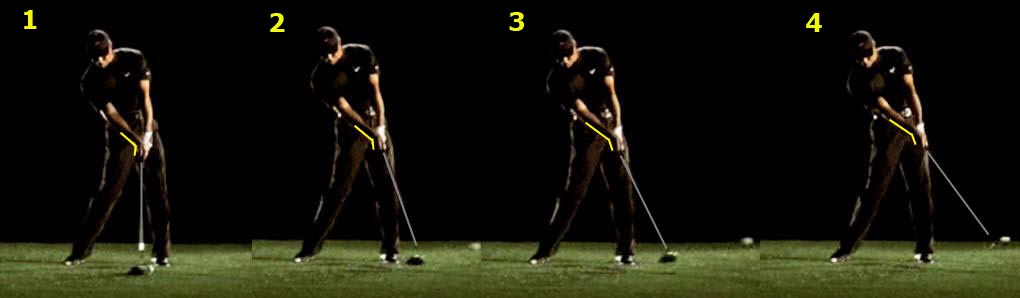 In image 2, it would be possible to hit up on a teed ball if the ball was placed on a long tee at that point - where the clubhead is located. However, his hands would not be angled backwards or be vertical (despite the bent right wrist) at impact. The hands would be angled forwards. Jeff. |
Arrogance? Cool. Because I sometimes disagree with...... YOU?
Then what about you? If I am arrogant then you must be something that supersedes arrogance. Have you ever thought about the number of brilliant golf minds that dont post very often in your caveat emptor forum. This is what motivated my previous post. Your inflexible, debate oriented style has driven them away. People who have devoted their professional lives to acquiring the knowledge you debate and often dismiss. This is an arrogance of a higher order. I love the evidence you presented of your ability to change your opinion. From disbelief to "adopting a more equivocal position of ambivalence". Wow. Thats some flexibility you got there. |
shoulder versus foot
Quote:
The following pictures are from the same frame (7 frames post Impact). The 2nd picture is zooming in on my hands, just to echo the ability of the Right Wrist to remain bent post Impact.   |
Yodas Luke
I agree with you regarding those scenarios. However, I presume that we both agree that it would not be a good idea to have a forward-leaning spine tilt at impact when hitting a driver. Also, I generally agree with you when you state-: "I could position the ball inside my foot and outside my Left Shoulder (very wide stance and/or too much axis tilt at Address), and I'd have the ability to strike the ball with an ascending blow." However, I think that Jamie Sadlowski has the ability to hit a descending blow under those same conditions - because his left upper arm is well ahead of his left shoulder socket at impact, and he also has a large degree of left elbow bend at impact which moves his left forearm behind (inside) his left upper arm and it also angles his left forearm backwards away from the target. OB left You wrote-: "Arrogance? Cool. Because I sometimes disagree with...... YOU?" Not at all. I welcome disagreements and I would never label someone arrogant for disagreeing with me. I actually like disagreements because it forces me to rethink my position. I only used the term "arrogant" because your statement implied that you are intellectually capable of changing your mind, while simultaneously implying that I am too rigid a thinker and therefore "a priori" incapable of intellectually changing my mind in the face of a good counterargument. I have changed my mind about many points regarding the golf swing - particularly since I started studying TGM in earnest (starting in April 2008 ). In particular, it has significantly changed my personal approach to my own golf swing. I never realized to what degree I was switter (because I unconsciously used "right arm power" in my downswing) until I more clearly understood the differences in power accumulator use in swinging versus hitting. I have now radically revamped my personal golf swing by becoming a much more "pure" swinger rather than a switter. I also recently changed my mind regarding head position in the golf swing. I used to keep my pelvis centralized at address, and I then tilted my upper torso rightwards to acquire some rightwards spinal tilt at address. That caused my stationary head to be positioned well right-of-center. I now much prefer Yoda's suggestion that one should keep the head centralized at adddress, and then shift the pelvis left-laterally at address to acquire a rightwards tilted spine. It works much better for me. The third major TGM-induced change of mind came when I more clearly understood the importance of extensor action - I only recently realized that extensor action is critically important in preventing chicken-winging of the left arm at impact, and that's another very useful insight. Hopefully, I will gain more TGM insights in the months/years ahead. Jeff. |
Jeff,
How does Jamie launch the ball twice as high as any tour player hitting with a descending blow and 4-6 degrees of loft on his driver? |
HB
You ask how JS hits the ball high with only a 4-6 degree driver loft and a descending clubhead path pre-impact? Good question. Maybe that forward kick of the shaft is "real" and not due to camera artifact. If you go to nmgolfers website at http://nmgolfscience.tripod.com you will find a 200 page research paper called "Role of Shaft Stiffness" by Sasho MacKenzie. Interestingly, it demonstrates that many golfers may have 5cm of lead deflection of the clubhead at impact. Here is a diagram from that research paper that shows how dynamic loft changes with lead or toe deflection. 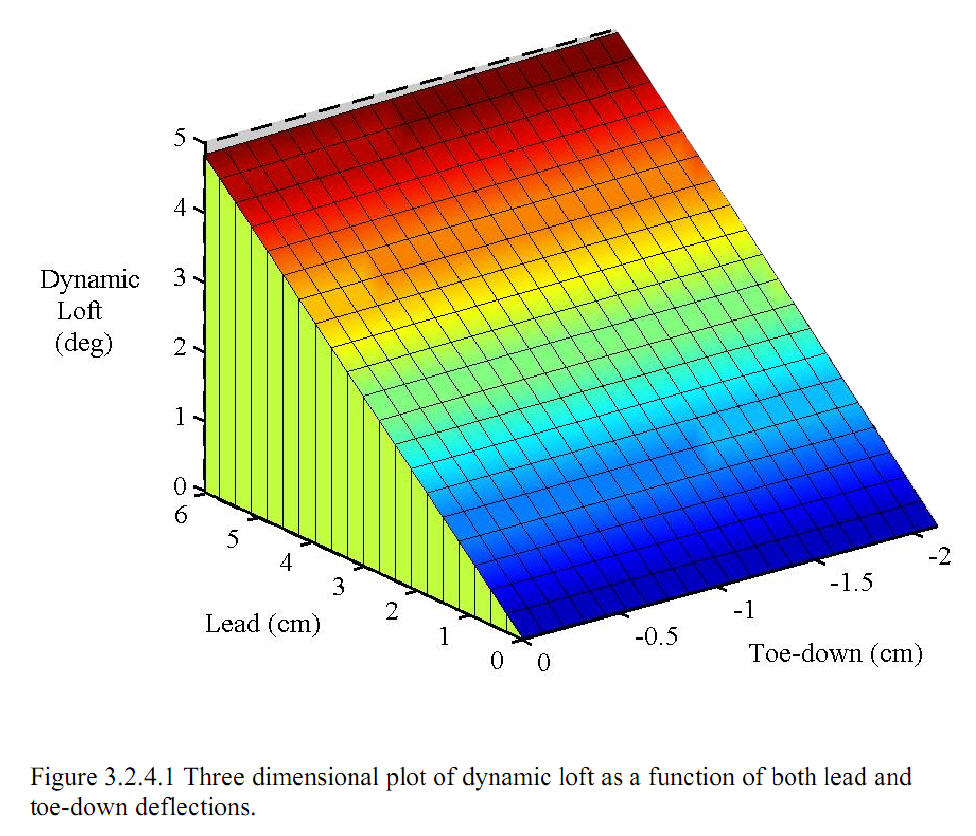 It shows that dynamic loft increases by 0.8 degrees for every 1cm of lead deflection. That means that 5cm of lead deflection would increase dynamic loft by 4 degrees. Jeff. |
FLW golfers or throw away golfers?
Wish I had time to read 200 pages! |
Golfguru
FLW golfers. Jeff. |
the fulcrum, launch angle, and spine tilt
Quote:
Quote:
|
Yodas Luke
You wrote-: "That's true, unless you've ever played at Kiawah Island. So, your presumption is too narrow. I can lower my launch angle by 8 degrees with forward spine tilt, which could be an advantage in a 50mph headwind." I can accept a small degree of forward spinal tilt in the downswing when hitting a short iron. However, I think that it could be very problematic when hitting a driver - because I believe that a rightwards spinal tilt allows the right shoulder to move downplane at the start of the downswing, while a leftwards tilted spine would predispose to roundhousing and an OTT move. I also think that it is much more difficult to keep in balance during a driver downswing when having forward spinal tilt. You also wrote-: "Then, as you have also shown, we agree about the use of the word "only". And, we also agree that the fulcrum, whether it's the elbow, the shoulder, or the wrist, is the deciding factor in the descending or ascending clubhead. It has little to do with the foot." I agree. Jeff. |
I try and hit down on a driver at 1 degree, yeah zero is perfect but if I feel like Im swing up is goes everywere.
You said, while a leftwards tilted spine would predispose to roundhousing and an OTT move. I also think that it is much more difficult to keep in balance during a driver downswing when having forward spinal tilt. So aim way right and throw the ball forward like Leggatt or DiMarco ect.. That gets you back to zeroish again. Or take monster divots. |
x factor like flexibility
[quote=Jeff;59757
OB left You wrote-: "Arrogance? Cool. Because I sometimes disagree with...... YOU?" Not at all. I welcome disagreements and I would never label someone arrogant for disagreeing with me. I actually like disagreements because it forces me to rethink my position. I only used the term "arrogant" because your statement implied that you are intellectually capable of changing your mind, while simultaneously implying that I am too rigid a thinker and therefore "a priori" incapable of intellectually changing my mind in the face of a good counterargument. I have changed my mind about many points regarding the golf swing - particularly since I started studying TGM in earnest (starting in April 2008 ). In particular, it has significantly changed my personal approach to my own golf swing. I never realized to what degree I was switter (because I unconsciously used "right arm power" in my downswing) until I more clearly understood the differences in power accumulator use in swinging versus hitting. I have now radically revamped my personal golf swing by becoming a much more "pure" swinger rather than a switter. I also recently changed my mind regarding head position in the golf swing. I used to keep my pelvis centralized at address, and I then tilted my upper torso rightwards to acquire some rightwards spinal tilt at address. That caused my stationary head to be positioned well right-of-center. I now much prefer Yoda's suggestion that one should keep the head centralized at adddress, and then shift the pelvis left-laterally at address to acquire a rightwards tilted spine. It works much better for me. The third major TGM-induced change of mind came when I more clearly understood the importance of extensor action - I only recently realized that extensor action is critically important in preventing chicken-winging of the left arm at impact, and that's another very useful insight. Hopefully, I will gain more TGM insights in the months/years ahead. Jeff.[/QUOTE] Jeff Glad to hear you are making some progress with several TGM induced procedures. They do shatter ones previously held golf beliefs in a rather pleasant way dont they. Compression plus being your guide etc. I withdraw my assertion that you are inflexible given the evidence you have presented to the contrary. Namely the three TGM based methodologies you now utilize. How bout "sometimes" or "slightly" inflexible?? Just kidding. You know, those three things could be like building blocks for a nice little motion. Try a little tiny bump of the hips together with some start down waggles and see what happens to your divot direction. Better be careful, lest you start "singing to the choir" about all things TGM. Oh, oh here comes the recent convert. OB |
OB Left
I know that I argue with extraordinarily stubborn vigor and that I don't easily give up arguing on behalf of my position. However, I am not really an ideologue. I don't adhere to any single swing philosophy, and I am constantly changing my opinions (albeit slowly and reluctantly at times). My personal golf website is unique in the sense that my website review papers contain many addendums - where I openly state that I have changed my opinions because of "revised" thinking regarding golf swing mechanics or biomechanics. I don't know of any other golf instructional website where the website owner openly/frequently states that he has changed his thinking about a golf swing issue. However, at the same time, I don't believe in "authority-based" golf swing fundamentals. I will challenge any belief that doesn't make sense to me - like the idea of a pivot center and a pivot axis. I still remain unconvinced by any argument that supports the idea of a pivot center and/or a pivot axis, but I will consciously remain open to any "new" thoughts regarding the issue. Jeff. |
Quote:
Doesnt it all just relate to the physics of rotation? What kind of spinning top would have no COG, no axis of rotation? Are you suggesting that golf is really more of a lateral move than a rotational one? OB |
Quote:
|
OB Left
A spinning top has a single axis of rotation because it spins over a tip point that is in-line with the center of its structure and its COG is in line with the tip point. Human beings have two legs and the pelvis cannot rotate around a single axis. The pelvis pivots over two separate femoral heads, and the backswing pivot action forces the spine to become angled when the pelvis rotates. That creates a reverse K posture of varying degrees of rightwards upper torso tilt. Here is a photo of VJ Trolio rotating during the his backswing - from his swing video at http://uk.youtube.com/watch?v=cov8R5Axt4k&NR=1 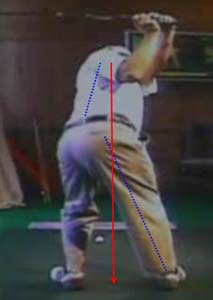 The blue dotted lines depict his reverse K posture. The red arrowed line shows that his head is centralised. Now, if you think that VJ Trolio is rotating around a centralised pivot axis that is straight in-line with his head, and if that thought helps you to improve your golf swing, then I do not feel impelled to convince you otherwise. I simply see reality differently. I simply see the end-result of a well-executed backswing pivot action - a reverse K posture where the body is generally left-centralised between his feet with his head in the center. His body is left-centralised because he favors shifting his pelvis leftwards in the late backswing in order to get his COG closer to his left foot. I can see and understand exactly what he is doing - and I do not have to think of a hypothetical "pivot center" or hypothetical "pivot axis" to make sense of his biomechanical actions. He has a rotary motion and not any lateral swaying motion. I think that a good backswing pivot action must have that type of rotary motion. However, I find it perfectly acceptable if a golfer has a rightwards-centralised body position because the COG of the body is closer to the center of the stance, rather than closer to the left foot, as in these images of Stuart Appleby. 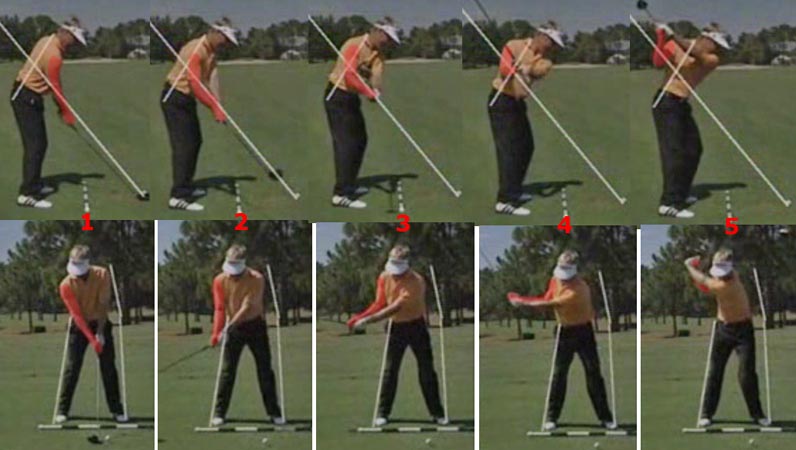 Stuart Appleby's head is right-of-center, but his COG is more centralised - compared to VJ Trolio. From my perspective, both backswing pivot actions occur according to the same rotary principles - with no lateral swaying. They simply differ in terms of their weight distribution at the end-backswing position. Jeff. |
Quote:
|
Quote:
To me the axis of rotation as Vj defines it and TGM's pivot center are different concepts. For the perfectly spinning top they would be on the same centralized line but the human golfer with multiple centers, levers etc who is playing most of his shots with the weight left at impact will not have the two aligned.. We all need to get on our left side for most shots. Now the spinning top analogy with the axis of rotation aligned with the COG and its implications to club head speed are relevant but should not be thought of as centralized between the feet for fuller shots for humans. The pivot center maybe is but not the COG or axis of rotation. Its been a while since I read VJs book but isnt his whole "move" one of getting his COG (which he defines as a spot for him anyways which is underneath his belly button but mid body, close to spine) over the axis of rotation (which is around his left foot). So as to reduce the wobble about the axis of rotation and thereby speed the rotors (body's) blades (arms) to the fullest? The Vj move and the main difference being his and Apps swings being that he gets it (COG and hips, axis tilt) there (left, over his axis of rotation) on his backswing rather than on his downswing. Apps will do this in the photos not included above, during his downswing. All pros get left dont they? Isnt that one of the things that sets them apart from us hackers? Now all of this goes out the window if golf is a non rotational motion. So does CF I guess too. Help me out somebody. Tag. OB |
Quote:
Bucket, Im struggling with this one a little. The vertical vs inclined plane thing seems great, please elaborate. Does this relate to CF throwing the hands to a position that is OUT irrespective of the inclined plane? Cool. Is this what you mean? The science behind the need for axis tilt, the on plane right shoulder and therefore the hands all from a lateral hip slide action? You're deep dude. "I gots to know". (Dirty Harry) OB |
OB left
You are correct that the TGM pivot axis (which is apparently a vertical line centralised between the feet while going through the base of the neck) is different to VJ's pivot axis. VJ has invented his own concept of a downswing pivot axis which is imprecisely defined. It starts at the left foot and goes up the left leg and then it is angled towards the center of the body. However, he states that the pivot axis changes constantly throughout the downswing and I don't think that he has precisely defined how it is angled at different time points during the downswing. He also states that the COG is near the navel. In his recommended backswing pivot action where the pelvis is shifted left-laterally in the late backswing, the pivot axis would then be very close to passing through his COG as it is situated at the end-backswing position. He believes that with the COG located near the pivot axis, that it allows a golfer to rotate more efficiently around his (idea of a) pivot axis without any need for a lateral pelvic shift in the early downswing. By contrast, Stuart Appleby would have to shift his pelvis left-laterally first in the early downswing (towards the left white line in those SA photos) before he could pivot in a rotational manner around this downswing pivot axis. I personally have more sympathy for VJ's pivot axis idea (than the TGM vertical pivot axis idea) because i) at least he acknowledges that the downswing pivot axis is located somewhere near the left femoral neck, the pivot point for the pelvis rotation in the late downswing/followthrough - rather than being arbitrarily located centrally between the feet; and ii) because he thinks of the pivot axis as being angled from the left foot to the base of the neck (roughly related to the idea of secondary axis tilt) - rather than being vertical. I think that those two defining points make more sense from a biomechanical perspective, and I can relate to it better than TGM's vertical pivot axis centralised between the feet that goes vertically upwards to the base of the neck - creating a hypothetical tripod-shaped structure. However, I cannot really relate to the idea of the torso being an unitary rotating cyllinder that rotates around that downswing pivot axis. I think of the "rightwards tilted spine and its angled relationship relative to the straight left leg" as being a braced skeletal structure (kept stationary by the stationary head) that provides structural support stability - so that the arms can swing efficiently and fluidly across the front of the rotating body after release of PA#4. Jeff. |
Swamp Lesson
Quote:
|
Yoda wisdom it is
Quote:
We'll find a way. |
Quote:
Hey Jeff Actually what I said was vj's "axis of rotation", TGMs "pivot center". TGM's "pivot center" as defined in the glossary is: "SOME POINT on the body kept stationary throughout the Stroke, to stabilize the motion". CAPS BY ME. VJ's axis of rotation for full shots is around the left foot. I dont have my Vj book with me but the two seem not to be mutually exclusive. VJ , if memory serves me correctly advocates shifting the hips, axis tilt, to align COG with his "axis of rotation" all the while holding the "pivot center" in place to stabilize the motion. I may be wrong but assuming the head is not the pivot center the heads weight will have to be counterbalanced to avoid a wobble about the axis of rotation. No? OK, now for the incubator stuff: Is this counterbalancing sort of like a fly wheel? Is there is a mechanical advantage to the counterbalance? Like in Leonardo's Flywheel. Click on the link and watch it go with just a flick of the hand. http://commons.wikimedia.org/wiki/Fi...o-Flywheel.ogg Jeff, perhaps your objection to the pivot center definition would change with MORE thought given to it not being the head but rather the base of the neck or somewhere there abouts? The head with all of its weight counter balancing the mass on the other side of the axis of rotation like in Leonardo's flywheel? Perhaps you could do a drawing? The head's weight is considerable and would take a substantial amount of body or hip to offset it. An optical illusion of sorts when trying to perceive a pivot center and axis of rotation. Im obviously out on a incubatorial limb here. Heck, just grip it and rip it. OB. |
I hope that this "Golf by Jeff" forum will be a forum where any LBG forum member can test his radical (or less radical) ideas using i) "objective reality" and ii) "logical coherency" and iii) "degree of concordance with well known biomechanical/mechanical facts" rather than authority-based dictums as the "gold standard" for estimating success.
I have tried to foster that attitude by never censoring any forum member who put forward an alternative opinion that contradicted my personal opinion - as long as the expressed opinion is related to mechanical or biomechanical "issues" relating to the golf swing (and as long as the expressed opinion is not an overt ad hominem attack). As long as this forum continues to exist and as long as I have the power to be a moderator, then I plan to maintain those high standards. I will never claim that I am an "expert" and therefore automatically "right" or accept any ideology that proposes that any other self-appointed "expert" is automatically "right". I expect every LBG forum member, irrespective of his knowledge and experience, to defend his opinions via the mechanism of a logical counterargument and I do not expect him to have to kow-tow to any authority figure. This "Golf by Jeff" forum welcomes all enterprising LBG forum members who are willing to argue passionately on behalf of their opinions and who refuse to give "authority-based" opinions any special consideration. My greatest admiration goes towards those forum members who disagree with my opinions, and who then take the trouble to pen a detailed counterargument. As long as that type of forum member continues to post in this "Golf by Jeff" forum, them my personal interest and participation will not wane. I hope to learn from them. Jeff. |
OB left
I do not recall VJ referring to the head as the pivot center. In one drawing, his pivot axis goes up the left leg and then through the cylinder to exit centrally at the top of the cylinder (equivalent to a torso with an exit point at the level of the base of the neck). On another page, he draws the pivot axis through the left side of the torso - well left of the spine and head. I personally do not think that the head acts as a counterbalancing force, and/or that it will necessarily create wobble of the torso if slightly offset. Here is a capture image from a Tiger Woods swing video - his head falls back-and-downwards during the downswing. However, I don't think that it affects his swing. 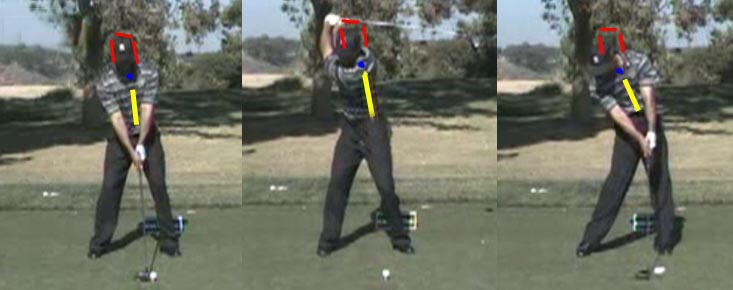 Whether one describes the base of the neck or the head as the pivot center, I can accept the implications of your posted HK-definition of a pivot center - "SOME POINT on the body kept stationary throughout the Stroke, to stabilize the motion." However, I cannot understand the concept of a centralised pivot center (being centrally located in the body or centrally located in the stance) with a vertical pivot axis going through that pivot center point. Jeff. |
Quote:
http://www.metacafe.com/watch/655973...s_darth_vader/ |
Pistol
There is one problem in your analogy - Darth Vader represents the "dark side". I believe in the "light side". By staunchly encouraging an "open forum" where all serious opinions regarding the mechanics and biomechanics of the golf swing are given equal weight is metaphorically equivalent to opening the curtains in front of a window and letting in the light! Jeff. |
Quote:
Instead of centralized pivot center, what if we thought of it as point that the power package moves around? If we don't bob or sway the point between the shoulders, we don't have to compensate for that movement. |
HB
I personally do not believe that a small mount of head-dropping will affect Tiger's swing as long as the upper swing center (blue dot area) remains stationary during the torso's rotational movement. If one conceives of the upper swing center as being a 8-12" cubic-shaped area within Tiger's torso - located centrally between the shoulder sockets and located in front of the upper thoracic spine - then if that upper swing center remains stationary (doesn't bob up-or-down, and doesn't sway left-to-right) during the swing, then it acts like HK's "SOME POINT on the body kept stationary throughout the Stroke, to stabilize the motion.". That's my personal idea of a pivot stabilising point that allows the torso's rotational movement and the arm swinging movement to be stabilised. However, there is no biomechanical imperative to have the pivot stabilising point perfectly centralised between the feet. I think that it will be perfectly centralised in a S&T swing style - like Badd's new swing style. However, it will be slightly left-centralised (slightly left-of-center) in a swing style like VJ Trolio's driver swing style and it will be slightly right-centralised (slightly right-of-center) in a swing style like Tiger Woods driver swing style. Jeff. |
Quote:
Nice one Henny That blue dot doesnt move very much but for him to be perfect he must compensate for whatever movement there is, however small. As the blue dot moves so does the left shoulder, the levers fulcrum, the radius etc. Jeff, I dont think Vj mentioned pivot center either. (Just got my vj book back). Again VJs "axis of rotation, TGM's "pivot center". They are different but related. Consider this then, in your drawing above. Cant you see the blue dot or there abouts as being ideally stationary, centrally located and the yellow line as being VJ's axis of rotation, its bottom being left, near the left foot? The COG over the left foot , axis tilt, via a "Hula Hula Flexibility", which tilts the shoulders, which allows the right shoulder to move down plane. This axis tilt as shifting the axis of rotation from vertical to diagonal from a front on perspective. The down the line perspective showing the inclined plane and forward leaning axis of rotation. Need some 3D modeling maybe. Page 53 of Vj's book figure 22. The axis of rotation is tilted diagonally via axis tilt and runs from a centrally located pivot center to the left foot. OB |
Quote:
Now make your hands move parallel to the ground in a cicle by turning like you were a helicopter. . . . your spine is ONLY required to twist to keep them on that horizontal plane . . . Now do the same thing only add waist bend to get your helicopter dealie moving on an inclined plane . . . your objective to keep your hands and arms moving in the same inclined plane . . . to do this notice what your hips and spine have to do . . . . there is a lot of stuff going on below your shoulders to keep your hands moving in that orbit without disrupting it . . . and alot of it is hips sliding and spine flexing and extending . . . . on the way back and through. |
Quote:
|
Quote:
I like this alot . . . particularly considering that the right shoulder is part of the power package . . . . good post . . . mogo loyd. |
Quote:
My arms are hurt'n but thanks. OB |
OB Left
When I mentally envisage an axis of rotation in the downswing, then I actually do imagine that the axis of rotation is a diagonal line drawn between the left foot and the upper swing center. In other words, I can more easily imagine an axis of rotation that is diagonally aligned rather than vertically aligned (and which is also centralised between the feet). On page 53 of his book, VJ drew a diagonally slanted line going through the torso - that follows the diagnonal line that I just described. However, then on page 37 of VJ's book - figure 11 shows a pivot axis line (in white) at impact that is vertically oriented, going from the left inner foot to the left shoulder socket. That's why I don't know what to make of VJ's pivot axis concept, where the pivot axis apparently changes its axis of rotation during the downswing. Jeff. |
| All times are GMT -4. The time now is 09:18 PM. |