
|
Horizontal hinging versus swivel
I am trying to understand what's the difference between horizontal hinging versus a swivel action.
In another thread, Bagger recommended that one fan the right forearm in the backswing when intending to perform a horizontal hinging action post-impact. I presume that fanning the right forearm during the backstroke causes the left forearm/arm to rotate in the takeaway thereby producing the start-up swivel action. Then, during the downswing, there is a release swivel action, which starts when the hands reach the delivery position - and this phenomenon seemingly is the reverse of the start-up swivel (from a biomechanical perspective) in the sense that the left hand undergoes a 90 roll (rotation) in the late downswing so that the back of the left hand faces the target at impact. Now, during horizontal hinging, doesn't the left hand continue to roll so that the back of the left hand ends up facing directly away from the ball-target line (= parallel to the ball-target line) when the clubshaft becomes parallel to the ground (mirror image of its delivery position). If correct, then horizontal hinging could be perceived to be a part of a post-impact swivel action that is really a continuation of the release swivel action, and that subsequently evolves into the finish swivel action. Is it incorrect to think of horizontal hinging as being part of a post-impact swivel action that seamlessly evolves into the finish swivel action? Jeff. |
Quote:
Swivel is an independent roll and turn of the hands. Hinge action is performed by the pivot rotating the arms and shoulders- it turns the hands in rhythm with the body. Toe up down the line via pivot. Do NOT swivel as a hinge action- take the hands out of impact. blend the two actions but don't use one as the other. Angled Hinge has a later finish swivel but is still performed by the arms and shoulders via pivot (hip action). Swivel to Impact-HINGE-Swivel to Finish LOOK ma- NO HANDS! :) |
6Mike
Thanks for replying. It is still not clear to me, because you state that the swivel is an independent roll of the hands. Independent of what? From my perspective, I can envisage the release swivel involving a 90 degree rotation of the left hand (from the delivery position to the impact position), but it is not clear to me that part of the rotation doesn't occur at the level of the left shoulder socket and orbiting arm. Likewise, when hitting short pitch shots, I can utilize different hinging actions which are not due to the pivot motion (which may be minimal), but due to an independent controlled left arm rotation at the level of the left shoulder socket +/- a certain degree of forearm rotation. Jeff. |
I believe the swivel is when the club face lays (parallel) on the inclined plane - back swing and follow through. The horizontal hinge action is at the bottom of the swing when the club face is more or less perpindicular to the plane slightly open, to square, to slightly closed). A lot easier to show in video or live than describe.
|
I have still not received an informative opinion that explains the biomechanical difference between a finish swivel action and horizontal hinging - with respect to the movement of the left hand.
Consider this particular problem from this angle. Here is photo of Kevin Na's clubhead path through the impact zone. 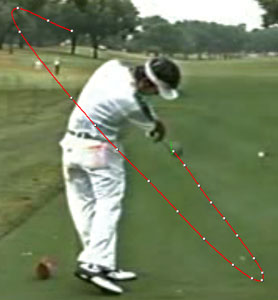 One can see that his splined clubhead path demonstrates that he is swinging his clubshaft on the inclined plane and that he is tracing the base of the plane line post-impact. At the same time, his clubface has rotated counterclockwise while the clubshaft is travelling on the inclined plane - and this represents his horizontal hinging action. HK states that it occurs due to rotary forces operating at left shoulder level, and one can imagine that there is a hinge joint horizontally oriented at the level of the left shoulder - as demonstrated in this TGM photo. 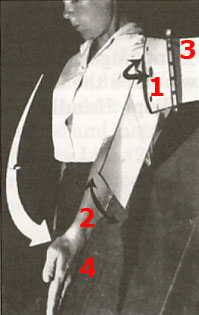 The effect of this hinge action is that the back of the left hand supinates slightly while it is moving up the inclined plane. Supination is a rotary motion, which means that the left hand is rotating during this horizontal hinge action phenomenon. Tiger Woods describes this "feeling" as the feeling of turning the knuckles of the left hand towards the ground after impact. He is therefore aware of a rotation of the left hand. That left hand rotation (supination) is no different to the more complete rotation (supination) that occurs fractionally later in time (during the finish swivel) as the left hand supinates more fully so that the back of the left hand lies against the inclined plane. The only difference is that the first left hand rotation (during the followthrough) primarily occurs due a rotation of the left shoulder socket left-backwards (as part of the torso pivoting action) + rotation of the left arm/forearm unit at the left shoulder socket level, while the second left hand rotation (during the finish swivel) primarily occurs due to left elbow folding and left forearm fanning combined with an active pronation of the right forearm. Although the biomechanical driving mechanisms are different, surely the left hand is rotating (supinating) throughout the followthrough and finish phases of the swing, and it is really a continuous rotary movement. Jeff. |
Quote:
Like many things TGM, you may be making the application of hinging more complex than it really is. But keep working on the biomechanic aspects because there are opportunities for further learning there. Homer differentiated Hinge Action from Swivel and even though they are tightly related, you can't describe swivel as a hinge action because they can be separate as well. For instance, you can have the appearance of a horizontal hinge swivel while executing angled hinging. Rhythm is intregral to the hinge action motion. Also keep in mind that clubface motion differs for each hinge action. Horizontal is closing only, angled is simultaneous closing and layback, and vertical is layback only. There will be a video up tonight of Jeff Hull demonstrating how he applies hinge action. The video was shot a few days ago at the ATT Classic while Jeff was on the practice range. It should help many peel a few layers off the onion. |
Bagger - I realize that one can choose not to have roll action (horizontal hinging) during the followthrough phase of the swing and that one can instead choose a non-roll action (angled hinging) or reverse-roll action (vertical hinging). However, I am interested in the biomechanics of left hand "roll" in the horizontal hinging action and in learning whether the left hand "roll" of horizontal hinging is any different to the left hand "roll" that occurs moments later during the finish swivel action, or whether they are a seamless left hand rolling action (occurring due to different biomechanical actions at different anatomical/biomechnanical levels).
I look forward to learning more from your "new" Jeff Hull swing video - when it becomes available. Jeff. |
Watch Antony Kim
http://www.youtube.com/watch?v=_jNRNRmS1pQ A foot before contact watch the club head go form open to close after contact. That is the Horizontal hinge. Just like a door opeing and closing. The left arm has not swiveled. As both arms go to straight the left arm swivels the the club face back on the inclined plane. Pretty amazing that Homer Kelley. |
Jeff, I have always seen the hinge action as a form of external rotation of the upper arm without independent action of the radius and ulna...
and swivel is primarily a radius and ulna action with minimal further external rotation at the left shoulder.... I think that you are saying something similar? |
mb606
Surely you are wrong to label the change in the clubface angle from open-to-close that occurs one foot prior to impact a horizontal hinging action. That surely is the release swivel action as it occurs pre-impact. Horizontal hinging occurs post-impact and one can see horizontal hinging occurring in Anthony Kim's post-impact swing (during the followthrough phase). What interests me about the left hand movement that occurs in the horizontal hinging action is that the left hand not only moves up the inclined plane - it also seems to supinate slightly while moving up the inclined plane, thereby causing the knuckles of the left hand to face slightly more groundwards during the followthrough phase of the swing. During the finish swivel, the left hand supinates much more (due to a different set of biomechanical actions). However, my interest in the left hand motion during horizontal hinging relates to whether the left hand supination (roll) phenomenon that occurs during horizontal hinging blends seamlessly with the left hand supination (roll) phenomenon that occurs during the finish swivel action. Golfbulldog I agree with your understanding of the different biomechanical mechanisms underlying the supination (roll) of the left hand during both horizontal hinging and the finish swivel. My main interest lies in the supination-roll "feel" that occurs during horizontal hinging and whether it blends seamlessly with the supination (roll) of the left hand that occurs during the finish swivel action. I also would like to know whether Nick Bradley's description of the puck release in his book "The Seven laws of Golf" is a description of the supination (roll) action that occurs during the horizontal hinging period and finish swivel period. Here is the photo showing his puck release swivel action. 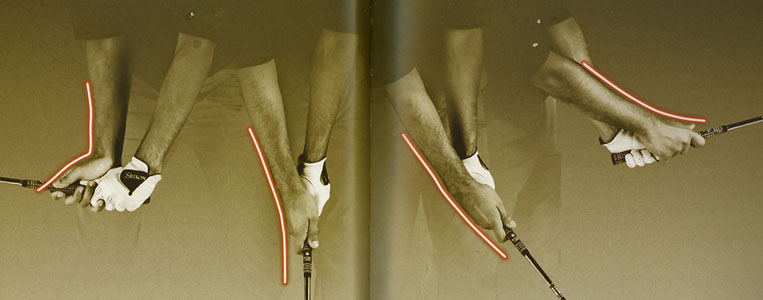 Jeff. |
Quote:
Hinging is simply holding your left wrist vertical to one of the basic planes (Vertical Horizontal and Angled). But your hinging is going to APPEAR different for each plane angle and the amoumt of #3 Angle you set (angle between left arm and shaft). So it's really difficult to pin point hinging without considering the plane angle and #3 angle which are related. So Horizontal Hinging is going to look MUCH DIFFERENT on the Elbow Plane than the Turned Shoulder Plane. Why? Because the more #3 angle you set the more clubhead TRAVEL you get and the less face rotation for a given amount of roll. That being said . . . if you are swinging down on the elbow plane and then disrupt #3 (on purpose or not) you have essential SHIFTED PLANES . . . which in turn is going to impact the rate of face closure . . . Homer said that "Plane shifts are hazardous." I would venture to say that the closer to the ball you get the MORE HAZARDOUS they become. So some people may intentionally disrupt #3 by swinging "out to right field". Others may disrupt #3 for a variety of reasons unintentionally . . . standing up or Bobbing for example. So if you don't have a centered pivot and you RAISE UP (early extension as some say) . . . Bob . . . then you will disrupt #3 and the face may not perform as predictably as you intended. Here's two examples . . . Furyk has major whacky shifting going on EARLY but once he gets to release point his #3 angle DOES NOT CHANGE. Els on the other hand raises the hands up through the ball and the face closes much faster. Both play GREAT golf . . . but there are obvious differences in the hand paths through the ball. Furyk . . . http://www.youtube.com/watch?v=DFDRebJy8ac Els . . . http://www.youtube.com/watch?v=b-1y8lEJUqo I would say there is a difference in the Delivery Lines here . . . One is using Arc of Approach . . . the other maybe Swinging on the Angle of Approach. |
12 piece bucket
What you have stated makes a lot of sense - the amount of roll a golfer gets (during the horizontal hinging action) depends on the angle between the clubshaft and left arm (as seen from a DTL view). Although HK states that the left hand is responsible for controlling the clubface during the hinging action, doesn't the degree of straightening/pronation of the right hand during the followthrough have a major effect on the hinging action. Consider capture images from the Anthony Kim video. 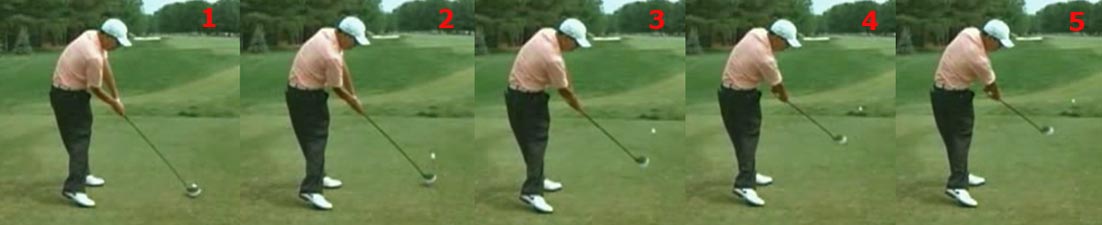 I get the impression that his right hand is straightening and pronating during the followthrough. Doesn't that right hand action induce horizontal hinging by promoting a roll action during the followthrough period? Isn't that right hand action what Nick Bradley describes as a puck release - see the next photo? Jeff. |
Hinging
Quote:
DTL is the right view to examine #3. Face on would be better to see if his right wrist unbends as you describe. I would think that if Kim were doing so, we would see the shaft bending up around the wrist and up some plane rather than appearing to point to the plane line, still in rhythym with the left arm. |
Hennybogan - I thought that flat, level, vertical only applied to the left wrist at impact, and not to the followthrough phase of the swing. During the followthrough phase, the left hand will be vertical to its base plane (eg. ground in horizontal hinging, which means that it is supinated relative to the inclined plane). The puck release doesn't cause the left wrist to bend as the right hand pronates. However, the right wrist pronation does cause the left hand to supinate. While the right hand pronates, it also causes the degree of right wrist bend (that is present at impact) to diminish.
Jeff. |
On Plane . . . Not Under Plane
Quote:
No. There is such a huge difference here. PLEASE tell me you can see it! :eusa pray: |
Yoda - please enlighten me.
Jeff. |
Plane and Power Stuff
Quote:
|
I have never quite understood Nick Bradley's description of his "puck release" concept in his book, and he likens it to the motion that a hockey player would make when flicking a puck on the ice. What worries me about his mental analogy/photo-illustration is that the right wrist seems to straighten immediately post-impact while the left wrist seems to bend. It is my impression (when reading TGM) that HK wants the right wrist to remain bent in the immediate post-impact period, thereby maintaining a FLW, while the right elbow is straightening. I sense that Anthony Kim is fully straightening his right elbow post-impact while keeping a slightly bent right wrist/FLW.
Anybody - Am I wrong, and missing a major factor? Jeff. |
left forearm flying wedge
Jeff,
First, Bradley has some interesting things in his book. This puck release business might be how a hockey player flicks the puck over the goalie's shoulder, but I don't think it's how he would whistle one from the blue line. I nearly bought the book until I read about his release motion. Second, the left forearm flying wedge (search if you need to) should remain intact throughout the motion. One thing that can get very confusing is that the look of maintaing the wedge, ie, left wrist cock in the plane of the left arm (see rhythym) varies greatly with grip type. The easiest way to understand it (and probably to do it) is with a 10-2-B grip, but the wedge can be maintained with a variety of grips. To further the confusion, you may see varying rates of re-cocking from very fast to none at all. And different amounts of #3 accum based on how diagonal one fits his level wrist to the grip. Oh, and plane shifts, etc. The only way I can see that you can unbend the right wrist fully without bending the left wrist is to have the right wrist bend in the plane of the left wrist cock. Or like VJ, Couples, and sometimes Philly Mic, you could let the right hand detach from the club though impact. You will need Talent with a capital T for that move. I strongly recommend watching the Yoda videos on the hammering motion (velocity power) of the left wrist. It is pretty simple in that context. Then, examine how that motion can be made with a variety of grip types (not recommending not using 10-2-B) and how the look changes but the motion of the club does not. Good luck. |
Quote:
|
Quote:
|
The puck release photos look like throw away. right wrist flatten to early. I think it is helpful to differntiate between pronation and supination of forearm(radius & ulna) and pronation and supination of entire arm. Laying club off is a forearm rotation problem. The answers to your questions are important to the understanding of the proper motion. Hopefully Yoda will give us a final understanding. I understand hinging as an entire arm concept and swivel as a forearm concept. Swivel appears to be tied into forearm bending and straigtening and uncocking left wrist. Swivel puts the hands into a vertical position for impact. I guess vertical to all planes and hinging then refers to motion after impact vertical to the selected plane. Help !
|
Hennybogan
You state that the left arm/forearm flying wedge should remain intact through this horizontal hinging motion. I agree. However, isn't the entire left arm flying wedge supinating slightly during horizontal hinging - if the back of the left hand is perpendicular to the ground, and not the inclined plane? If the left arm/forearm flying wedge is supinating slightly, then the right hand must be pronating slightly at the same time. It is my impression that the degree of right wrist bend decreases during the followthrough - because it is pronating. I suspect that this phenomenon is happening in this sequence of Tiger Woods swing. He states that he "feels" that the knuckles of his left hand start to face groundwards after impact - which is the process of supination. 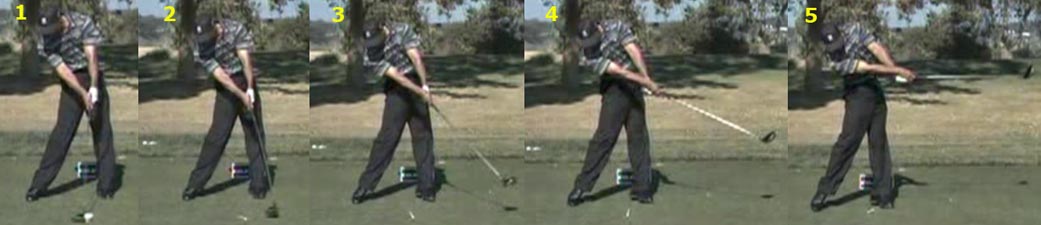 Note in image 3 that Tiger's right wrist is less bent. However, that doesn't necessarily mean that the left wrist is bending. It could be that the decrease in bend of the right wrist is due to pronation and the left wrist is supinating while remaining a FLW. Jeff. |
Understanding Impact Alignments
Quote:
|
Horizontal hinging occurs pre and post impact. The finish swivel is "the gateway"from the both arms straight position of follow through, to the re- cocking of the left wrist to the finish.
|
Neil
I cannot understand what you mean when you state that horizontal hinging occurs pre-impact. Where in TGM does HK state that it occurs pre-impact? I understand that the finish swivel starts when the followthrough is complete - when both arms are fully straight. Look at this series of capture images of Tiger Woods swing. Do you agree that horizontal hinging occurs in images 1,2, 3 and that followthrough is complete in image 3? Do you agree that the finish swivel is occurring in images 4 and 5? Now, what interests me is that Tiger Woods degree of right wrist bend in image 3 is less in image 3 than image 1. Why? I suspect that it is due to pronation of the right hand and supination of the left hand, which is occurring during the horizontal hinging action phase of the golf swing. The question is whether I am accurate in my visual assessment of Tiger Woods swing, and whether this rotation of the left/right hands is part-and-parcel of the horizontal hinging action. Jeff. |
No Rotation During Hinge Action
Quote:
There is no true rotation of the Left Wrist during the Horizontal Hinge Action. Though it appears to Roll, it is merely maintaining its 'vertical to the ground' alignment. There is a true rotation -- supination -- of the Left Wrist into Impact (Release Swivel) and out of the Follow-Through (Finish Swivel). But . . . This is Swivel Action, not Hinge Action. :) |
Quote:
Jeff, Notice how far back Tiger's head is. It has a direct influence on the rate of closure of the clubface. Tiger appears to maintain his left arm flying wedge, but the rate it rotates post impact is related to his head position. He used to (might still) get callouses (sp?) on his wrists from rubbing them together in his finish. |
Quote:
|
Hi Lynn,
Uhm I also notice Anthony kim using strong double action ... while Nick use nuetral single action.. Anthony Kim is doing something compatible while Nick is not really compatible.. because NICK is flipping while anthony kim is not flipping ( bend and arch of the left wrist) and using a Geometric equivalent of the bent left wrist. close enough? |
| All times are GMT -4. The time now is 11:33 AM. |