
|
Right Arm Swing and 4 Barrel Swing
Tomasello Australia "Chapter Series" videos - 4 Barrel Swing per 10-20-D and 7-3, 6-B-2-0 (both forearms start down)
Tomasello Myrtle Beach studio "Letter Series" videos - Right Arm Swing per 10-20-B and 7-3. Tomasello July 1991 Golf Illustrated interview - Right Arm Swing per 10-20-B and 7-3. Both swinging procedures utilize a throw from the top with the Right Forearm utilizing longitudinal acceleration (Lengthwise) per 10-19-C and 7-1. When I studied with Tommy in October of 1993 at his Deer Track Resort studio and out on the driving range, he taught me a Right Arm Swing. Then Tommy handed me the Australia video series tape as I left his studio at the completion of my three-day school. The sequence of events now makes sense!!! Learn the letter series video first, then move onto the chapter series. I hope you make the connection. :salut: :golf: DG |
DG
Could you please expand on the Tomasello right arm 4-B swing? I can understand a swinger using a three barrel swing, but I cannot clearly understand how the Tomasello 4-B right arm swing works. Where exactly is the right arm and right forearm active in a right arm 4-B downswing, and is that activity isometric and/or isotonic? Jeff. |
DG
I have viewed the chapter series and the letter. Tom doesn't explain the biomechanics of the right arm throw action or formulate a causal relationship between the right forearm throw and the downswing pivot action. How does a right forearm throw work in terms of which muscle is active, and whether it is isometetrically or isotonically active, and when exactly it's active? I also cannot understand an automatic causal connection between a right arm throw and lower body activity. Peter Croker also proposes such a causal connection in his hand swing theory - see http://www.petercroker.com/englisch/...olferapril.htm However, both Peter Croker and Tom Tomasello are both presuming that the lower body will respond appropriately. However, "appropriate" with respect to the downswing pivot action could be considered to be a learned behaviour and not necessarily an automatic action. Finally, how does a right arm throw improve on the alternative of starting a downswing pivot action with a right shoulder throw (as per 10-20-C)? Jeff. |
Bio-Mechanics
Quote:
Where does Homer write about Bio-mechanics in TGM? The pivot does respond to the right forearm.....Tommy talks about the response of the pivot to the right forearm in both video series. The trigger types are options... one needs to experiment with all of them to decide what works best for you...not sure what the correct sampling process you would need to determine what trigger type is the most effective (get all 5000 LBG members using a different trigger type....then you have to deal skill level, body type, practice time, etc....LOL). Homer has laid out the components according to their difficulty in execution. I guess the relationship between the components could be thought of in a risk/reward relationship. I tend not to be risk adverse. I enjoy the thrill/risk of cracking a 300 yard drive with hitting the ball a little off-line and I do mean a little!!! :) DG |
Erie Els an Arm Swinger
Quote:
Page 126 I start with my feet firmly planted and as I draw my arm back (per TGM Right Forearm Takeaway and cocking the right elbow per The Magic of the Right Forearm 7-3), my weight transfers back over on to my right side in harmony with the movement of my arm. Then as I bring my arm forward to release the ball, my weight simultaneously shifts over on to my front foot. If I didn't do that, the ball wouldn't go far. Yet this happens naturally on to my front foot without me even having to think about it. ....If you're copying me now you'll realise that in all of these actions, you don't really have to think about the role of your body. It behaves quite instinctively as your arm moves back and forth (Magic of the Right Forearm again). The golf swing isn't such an instinctive, natural movement, but the theories are exactly the same. You can't generate power unless your weight is in harmony with the swining movement of your arms and the club. That's what is meant by good weight transfer. No wonder so many golfers are befiddled by the smooth swing of Erie....he doesn't swing the club by starting with the lower body... |
DG
Let's see if we can agree on certain fundamentals. I believe that one needs to keep the power package assembly intact in the early downswing, which means that one must maintain the right flying wedge intact, while the lower body undergoes a pelvis shift rotation movement - irrespective of the downswing trigger. Do you agree? Here is posed photo of Hogan's swing demonstrating what I mean. 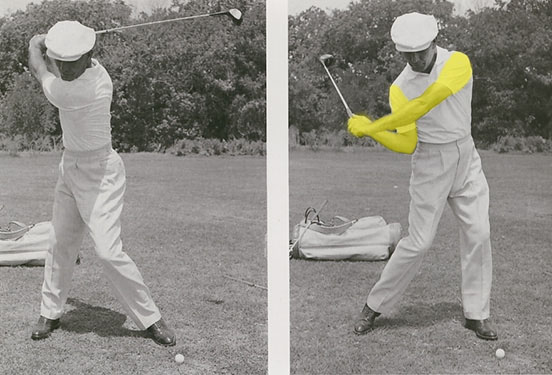 The yellow colored area represents the power package assembly and I think that it should be intact at this point in the downswing - intact despite the fact that the hips have rotated about 45 degrees to a hip squaring position, and despite the fact that the entire pelvis has shifted a little left-laterally as one puts weight on the left foot. Now, has does a golfer get to this position? Ben Hogan states that he thinks of starting the downswing with a lower body move - a pelvis shift-rotation move (hip squaring action) that pulls the power package assembly downwards . I used to start my downswing this way, but it was problematic for me because I tended to suffer from one-or more of these problems - i) too much left-lateral hip slide; ii) a tendency to move my hips too fast and out-of-synch with my upper torso, iii) a tendency to spin my pelvis and roundhouse my upper body. I now initiate my downswing with a right shoulder throw action downplane - and this works better for me because the right shoulder throw downplane causes my pelvis to move the correct amount as a result of a transmitted force going down the spine (right shoulder moves downplane => causes the spine to develop secondary axis tilt and simultaneously produces a transmitted force that passes down the rightwards tilted spine to the pelvis => pelvis shift-rotates to a hip squaring orientation). In other words, I still end up looking like Hogan at this point in the downswing - with a squared pelvis and the power package intact and the right elbow approximated to the right hip. My power package remains intact because during the right shoulder throw action, I also isometrically contract my right arm/forearm muscles in order to maintain the right arm flying wedge angles intact. Now, if a golfer states that he trigger-starts the downswing with a right forearm throw, I can imagine that golfer end-up looking like Hogan if the right forearm throw is i) a throw of the entire power package assembly (as an intact unit) down towards the right hip area and ii) the right forearm is in a state of isometric contraction (and not isotonic contraction, which would straighten the right elbow and prematurely release power accumulator #1). Is my description of the right forearm throw action (that initiates the downswing) representative of Tom Tomasello's approach, or is it totally different? Jeff. |
Quote:
Jeff . . . not to be nitpicky (which I reckon means I'm gonna be nitpicky) . . . but the shoulders are PART OF THE POWER PACKAGE . . . Your pattern is valid BUT you are not benefiting from the entire radius via Swinging from the Feet if you aren't starting the swing from the ground up. The radius ends at the first nonlagging component closest to the ground. |
When Harry Met Sally
Quote:
:wall: :laughing9 |
High Speed Cameras...
Quote:
Jeff, My recommendation is to not only watch the Tomasello videos but you MUST watch them multiple times (so many don not do this). From your comments, I know you haven't done that...first checkout, Tommy's number 2 Letter series video. If you would have studied that video you would not have put up the pictures of Hogan!!! and made the comments regarding keeping the flying wedges intact. For some reason, golfers make the mis-interpretation that if you throw the right forearm from top that you lose the flying wedges....not so. Watch the video (again). Reference the comment around the 14 to 15 minute mark about high speed cameras. It's a shame you want to disprove what Tommy taught. Jeff....btw, Tommy taught both Jodie Mudd and Sally Little the 10-20-C trigger. I'm glad you're experiencing success with that component. It sounds like you have found your swing. However, I have teaching professionals contacting me who say they're having success starting the club down with both forearms per 10-20-D. And they have tried the other trigger types. The beauty of the Golfing Machine it's an individual Journey!!! With Lynn's site, it can finally be a group Journey!!! For so many years, it was an individual Journey, it's a shame we don't have Homer and Tommy here to share in the group journey. DG |
Quote:
Jeff, Watch video 5 from the Chapter series on Power....I no problem in generating superior distance with throwing the right forearm from the top. I'm surprise by how much the pivot contributes in a Right Forearm generated swing. Send me your regular email address and I will send you a copy of Tommy's 1991 GI interview. Where Tommy talks about the right arm and pivot. DG |
DG - you wrote-: "It's a shame you want to disprove what Tommy taught."
You are totally wrong in your assumption. I am actually trying to understand what Tom taught. Don't mistake my assertive questioning with the idea that I am out to disprove things. People frequently make that assumption because of the tenacity of my questions, but I actually want to understand different viewpoints, so that I can increase my breadth of golf mechanics/physics/geometry knowledge. My e-mail is jmannemg@earthlink.net Jeff. |
Quote:
He shouts that at everyone and anyone that asks a question. Just read TT's magazine article and become an expert in all things tgm and TT. I really like TT videos but when a question is asked- DG throws the Delaware Golf-Tomasello Patriot Act at ya. Kelley loved questions, as does Lynn- I wonder why? :) btw- ignore button is great but I do get his musings in replies. |
Quote:
Blah, Blah, Blah.........just like a broken record!!! In my case, I'm just helping golfers find the truth!!! Yeeeeeeee Hawwwwwww............ DG |
From my observations:
Hogan: The Magic of the Right Forearm HK: The Magic of the Right Forearm TT: The Magic of the Right Forearm Blake: The Magic of the Right Forearm Els: The Magic of the Right Forearm Longitudinal or Radial acceleration it's All About the Right Forearm. Are they all using the Right Forearm in the same way? I don't think so. What about hips? The hips might be the single most important component of the golf swing and not all golfers automatically "use" them in the best way by using the Right Forearm to trigger the downswing as TT often says happens automatically I don't think it applies to all. just my thoughts Birdie Chance |
Downstroke Basics
Quote:
The Straightening Right Elbow Delivers the Left Arm and Club into Impact and Follow-Through (Both Arms Straight position). All while the Flat Left Wrist controls the Clubface. |
Quote:
Now you can learn the pivot motion which will enable the right forearm to do its job ...or you can learn the right forearm motion and secondarily discover what your pivot then needs to do to accomodate this motion. Either way there is a degree of learning/training. I think that the right forearm motion described by DG, TT and EE can become the centre of focus for a player if their right forearm has learnt to move within a "machine" which has certain constraints (constraints on movement)...or "essentials"...or "imperatives" which must always be in place for the right forearm to dictate to the pivot... The right forearm does not dictate or directly force pivot to respond in a sequential manner...the pivot makes preparatory moves to allow the right forearm to move in its desired manner , beyond impact to both arms straight. It does this unconsciously to allow the constraints on machine to be maintained.... Those constraints are that lag pressure is maintained, straight plane line, steady head, balance etc...you have seen most of these somewhere before ;) SO... you need 3 essentals, 3 imperatives and straight plane line (most notably through impact)....if your pivot has been programmed to achieve these...then and only then will the right forearm...or hand for that matter...appear to cause movement of the pivot. PLEASE NOTE...that appearance of right forearm causing pivot movement occurs to the player him/herself alone!!!....why to them alone because that is where their conscious brain is focussed. To the video camera it will still appear that the hips are moving first...and they are.... but they have learnt that they have to do that if the right forearm is going to take its intended path beyond impact and all other contraints are in place and maintained. If you had an automaton which could automatically maintain balance and steady head etc....then all you would have to do is program in the right forearm flight plan and the automaton wold make sure everything else moved in an appropriate way.... but the human needs some learning...and you can train from the outside - in (move the hands as directed and let the pivot work out what it has to do) or learn from the inside out ( train that pivot so that , as long as the hands do nothing, the hands end up right) Most people choose the latter, TT and HK were suggesting the former...although Homer would probably have started with zone 1 (pivot essentially) if it were particularly unruly. Here endeth the lesson...;) |
Golfbulldog
Excellent post - and very well expressed. I agree with you 100%. I, for example, am an imperfect golfer due to a host of physical disabilities eg. a severe lack of hula-hula flexibility. I therefore have a compensated downswing pivot action. After studying TGM, I got the idea from TGM to start the downswing pivot action with a right shoulder thrust action rather than a pelvic shift-rotation movement. The final "effect" is the same - the downswing pivot action starts from the ground-up. I am also aware of the magic of the right forearm - although my conscious mind is focused on the right shoulder thrust action, I am very cognizant of the fact that the downswing pivot action is subservient to the greater goal of moving the right forearm in a certain way down towards the impact zone that allows me to trace a SPL and that also allows the right forearm to end up behind the shaft at impact so as to support the shaft through impact. At times, when my downswing pivot action is unusually fluid, I switch my conscious mind to my right forearm action and I often "feel" that I am throwing the right forearm from the top of the backstroke position. I am still hoping to discover from DG whether that "right forearm throw" feeling is the same right forearm throw action that Tom talks about in his swing videos. Jeff. |
Yoda and Bulldog's posts
um amazing!
LBG is Awesome!!! |
Bridging the Gap
Quote:
:salut: |
DG - I have watched the lesson number 2 video and the chapter 5 video a few times.
I will now recount what I think that Tom Tomasello was saying, and you can correct me if I am wrong. Tom was saying that one should throw the right arm at the ball, and that the body should simply get out of the way. He also talked about a push action with reference to the right upper limb, rather than a pull action. He also emphasized the point that when throwing the right arm/forearm at the ball that the right wrist will not become unhinged (neutral or palmar flexed) at impact, and that the right wrist will therefore still be bent (dorsiflexed) at impact. OK. So, how does he power the swing in his "right arm throw action"? If the pivoting body is not pulling the right arm flying wedge unit (ala Hogan's swing style) and the body is simply getting out of the way during the right "arm throw" action, then the right arm/forearm is pushing forward while the body is getting out of the way. What muscles can "push" the right arm/forearm forward while the body is clearing out of the way? Surely, it must be the shoulder girdle muscles that adduct the right upper arm. While this is happening, the right elbow remains bent, which means that there is isometric tone in the right upper arm muscles that maintain the bent right elbow in the early/mid downswing. At a certain point, the right elbow must straighten. Now, Tom did not specify whether the right elbow straightens due to active muscle contraction of the right triceps muscle (as would occur in a hitter) or whether it is due to a passive pull from a clubshaft that is releasing. I will presume that it is the former - right triceps muscle contraction that actively straightens the right elbow (active release of power accumulator #1). He was not apparently describing a hitting action (thrust in a radial direction as in an axe handle action). I therefore presume that the active release of power accumulator #1 causes right palm pressure against preesure point #1, and that it pushes the left hand, and therefore left arm, forward (as a right arm swinger's action). To summarise my understanding of Tom's "right arm throw" swing, the power release sequence is 4,1, 2, 3 where power accumulator #4 is powered by the right arm/forearm pushing action (performed by a pulling/shortening of the shoulder girdle muscles that adduct the right arm plus an isometric-pushing action of the right arm/forearm muscles) rather than a downswing pivot action, and where power accumulator #1 release is active (rather than passive). Is my description accurate, or inaccurate? Feel free to "correct" me as necessary. Jeff. |
Quote:
His break-through was identifying the role of the pp3 and/or forearm in controlling the overall motion and the constraints that are required to allow that to occur. To me, TGM is focusing on these elements...the physics is taken for granted. |
Golf For the Course, Not the Lab
Quote:
:salut: |
Yoda - you wrote-: "The Pivot Delivers the Bent Right Elbow into Release.---
The Straightening Right Elbow Delivers the Left Arm and Club into Impact and Follow-Through (Both Arms Straight position)." You don't state whether the right elbow straightening is an active or a passive phenomenon. It is my understanding, from reading the TGM book, that in a swinger's action, the pivot delivers the entire power package assembly intact to the delivery position, and that release of the power package then happens due to the following phenomenon. When the downswing pivot action subsides in the mid downswing, the left arm is catapulted off the chest (via the pivot-activated release of power accumulator #4) and therefore the left arm is moving towards the target with enough momentum to reach, and pass, the impact position. The right elbow then straightens passively in this scenario, with no need for any isotonic right triceps muscle action. The right triceps only has to have enough isometric tone to allow the right forearm to be driven forward so that it keeps up with the left arm, and simultaneously maintains extensor action throughout the entire downswing. Does my description represent your understanding of a swinger's action? In the Tom Tomasello video tapes, he talks of the two forearms pulling the entire power package down to waist level while the body clears out of the way. He then states that the "right arm hits the ball", which seemingly implies that the right elbow straightening action is an active action. Therefore, Tom Tomasello is apparently describing a 4-barrel swing action activated by the right arm throw action - in the following sequence 4, 1,2,3. Power accumulator #4 is released by the "two forearms" pulling the entire power package downwards and thereby simultaneously propelling the left arm forward (while the pivot action simply allows the body to get out of the way), and then the right elbow straightens actively releasing power accumulator #1. Is that how you understand the TT right arm swing action that DG recommends? Why would DG believe that TT's right arm swing action is preferable to the standard pivot-driven triple barrel swing action (4,2,3)? Jeff. |
Quote:
Is it superior? Well Ben Hogan did it so there is the answer right there. Now i can understand why TT was considered controversial but really the genius is there for all to see:salut: |
The Semi-Passive Right Arm
Quote:
:salut: Quote:
:) Quote:
:???: Quote:
He will respond. Promise! :laughing9 |
Yoda - I don't understand this statement.
"Once the Right Shoulder has Delivered the Power Package to Release, the Right Elbow must straighten, and the Left Arm and Club is driven by that action. Otherwise, nothing moves!" You seem to be implying that the straightening right arm actively drives the left arm and club in a swinger's action. I thought that the downswing pivot action catapults the left arm away from the torso when the downswing pivot action subsides and that the left arm continues to move targetwards because of the momentum gained from this catapulting force. I therefore presume that the right arm straightens passively because the right hand is conjoined to the left hand at the grip end of the club, and the right hand must move as fast as the left hand. In other words, I do not perceive that the straightening right arm is actively driving the left arm and club in a swinger's action, but merely "keeping pace" (= having enough active muscle contractile force to move the right hand at the same speed as the left hand). Am I wrong? You are right! A lot of my understanding of HK's writing comes from other sources - primarily from your archived posts. You have a great explicatory gift when it comes to making HK's obtuse prose more readily understandable. Jeff. |
Pistol
I have viewed TT describing the right hand karate chop motion in that video. Do you interpret his description of that action differently to the description that I have already proffered with respect to my personal interpretation of TT's right arm throw action swing? Are you implying that Ben Hogan used an active right arm throw action and/or an active right elbow straightening action in his full swing? If "yes" - could you please provide the "evidence" so that I can better understand why you believe those facts. Jeff. |
To throw a ball
Quote:
http://www.youtube.com/watch?v=ywrD8LjIE4k It is all about the pivot…(or the dress code):laughing9 |
Quote:
Evidence lets see what did Hogan say "i wish i had 3 right hands" and any video or photo will never tell you what really happens |
New Perspectives
Quote:
"Once the Right Shoulder has Delivered the Power Package to Release, the Right Elbow must straighten. That motion permits the [Swinger's] Left Arm and Club to continue its centrifugally-driven journey into Impact. Otherwise, nothing moves!" I like this second versio0n better because it differentiates action (actively doing work) from motion (passively permitting other things to occur). For further clarification of Right Elbow participation Through the Ball (7-24), study 6-A-1 (the straightening Right Arm changing the shape of the Power Package Triangle); 7-20 (the lengthening Right Arm Triggering the Release); and 6-B-3-0 (Hand Motion "'Roll Power Control'" of the Right Elbow and "true Clubhead Overtaking Control"). :) |
Yoda
Thank you for the clarification. It is now much more precisely expressed, and it is now 100% concordant with many statements that you have previously made in your archived posts. I was worried that I may have misunderstood your previous archived posts when I first saw the phrase "driven by that action". Your now preferred use of the term "motion" promotes a very different understanding of the biomechanics of the right elbow's motion. Pistol You state that TT is implying a right hand/wrist throw. That "belief" really confuses me because I have understood TT to believe in HK's teaching that the right wrist should remain bent throughout the downswing and early (+/- late) followthrough. If the right wrist remains bent, then it is not released, so in what sense is the right wrist/hand thrown (in a way that doesn't involve the elbow joint)? You also quote as "evidence" for your belief that Hogan used an active right hand/wrist throw the following Hogan statement -: "I wish I had three right hands." You obviously have a very different understanding of what the word "evidence" means with respect to understanding the biomechanics of a particular golfer's swing. Jeff. |
Quote:
All i can say is watch the TT video again and he clearly demostrates a right hand karate chop ( down and out motion ) . I can clearly see you cannot grasp the simple concept that this can be done without the right wrist unbending in the initial stages of the downswing so try this. Put your right arm in front of you and fold your elbow then bend your right wrist away from you so your hand / fingers go down to the ground and the palm of your hand is facing away from you. Right now just move your hand only in a karate chop motion and you will see that the elbow hardly moves and the bend in the right wrist is still there.Now add right shoulder motion to it.To easy isn't it As far as me not understanding boimechanics well that is your opinion and frankly you have no evidence to the contrary as you simply can not explain why Hogan wanted 3 right hands and FURTHER you could not explain WHY his right hand comes out in follow through in an UNCOCKED postion but I CAN Simple the Right hand karate chop motion outlined for you above is the CULPRIT:salut: |
Quote:
Jeff, In the Tomasello video I have ( it's in the Gallery, Tomasello chapter 3), Tom talks about the attempt to release the right side wrist angle. He says to try to "undo the bend", and that as long as the left hip keeps moving, you won't be able to actually "undo the bend". Inertia will prevent the release of the angles from actually happening. It's the difference between actual and intent. Peter Croker (who had worked with Tomasello, I think) is a big proponent of this. I think that Martin Green supports this as well. My personal belief is that this kind of swing thought is only effective if there's an effective pivot to go along with it. Otherwise, you will flip it; there will be throwaway. |
Pistol - I think that I may possibly understand your right hand karate chop action better.
You are seemingly describing a right wrist uncocking motion whereby the right wrist (while still bent) moves from a level position to an unccocked position (ulnar-deviated position). If my understanding is correct, then I agree that the right wrist uncocks in Hogan's swing. However, I believe that i) the right wrist always uncocks in all good golfers' swings during the release of power accumulator #3 and that ii) the right wrist uncocking phenomenon is primarily a passive phenomenon. It is my understanding that during release of power accumulator #3, the wrists have to roll as the clubshaft comes into a straight-in-line alignment with the left arm, and that the primary power source for this phenomenon is the club's inherent momentum acquired during the release of power accumulator #2. I therefore think of the release of power accumulator #3 as being a "transfer power" phenomenon, rather than being primarily due to an active right hand uncocking action. I would be interested in learning of Yoda's opinion regarding this matter, and also whether he thinks that it relates to Hogan's statement that he wished he had "three right hands". Bigwill - I can understand the idea of an "intent" to release the right wrist bend without actually releasing it. However, I think that the right wrist is actually released during the release of power accumulator #3, but that it is not released due to a right wrist palmar flexion action, but rather due to a right wrist ulnar-deviation action. Here is a photo of Trevor Immleman during the followthrough phase of the swing.  One gains the "impression" that right hand is rolling under, and I think that it's merely due to fact that the right wrist passively deviates ulnarly during the final stage of the club's release action. Jeff. |
Quote:
I agree that it is released post impact. I don't get the impression of the right wrist rolling under, though. I do see that is flattened, even slightly flexed, in addition to being in a position of ulnar deviation. Is it possible that the ulnar deviation is simply an effect, rather than a cause (club pulling the right wrist into ul. dev.)? I would think that with the momentum of the club moving at decent speed, it would be pretty difficult to prevent ul. dev. of the right wrist post impact. |
Bigwill
You write-: "Is it possible that the ulnar deviation is simply an effect, rather than a cause (club pulling the right wrist into ul. dev.)? I would think that with the momentum of the club moving at decent speed, it would be pretty difficult to prevent ul. dev. of the right wrist post impact." That's how I think of the situation. I think of the right wrist's ulnar deviation action as being passive (reactive to other forces) rather than being active (due to active muscle contractile forces within the right upper limb). Jeff. |
Quote:
|
Pistol - you wrote-: "---but i suspect some amount of active right hand participation don't you wonder why hogan had a tonne of it".
I am amazed that you can infer the presence of active right hand muscle action simply by looking at that photo of Trevor Immelman, and I am equally amazed that you can conclude that Hogan had a tonne of active right hand action in his swing - simply by observing a swing video of his swing. In terms of what represents active right hand action in Hogan's swing, you now seem to be referring to an active right wrist ulnar deviation uncocking action. Even if I were to accept your argument that active right forearm muscle were involved in Hogan's swing, the muscles that produce that particular right wrist 'karate-chop' action must be the forearm muscles that ulnarly deviate the wrist. Here is a photo showing the forearm muscles that produce ulnar deviation of the wrist. 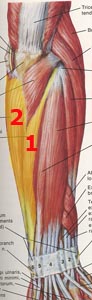 The muscles colored in yellow represent the two forearm muscles that produce ulnar deviation of the wrist (1 = extensor carpi ulnaris; 2 = flexor carpi ulnaris). In terms of the volume of forearm muscle bulk, they represent only a small fraction of total forearm muscle bulk. I, therefore, cannot imagine how they can contribute much to swing power through the impact zone - even if they are actively contracting to their maximum degree. Whatever Hogan meant by "three right hands", I would be amazed to learn that he was referring to 3 x the forearm muscle power contributed by those two forearm muscles. Jeff. |
Caught In a Whirlwind . . . Floating Up
Quote:
-- Dorothy:) And Homer Kelley would be the first to approve (1-H): "Because of questions of all kinds, reams of additional detail must be made available -- but separately. And probably endlessly.""Keep askin', Jeff. We love ya, man! :happy3: |
Hogan Sequences
23 Attachment(s)
I am not sure but it looks like 3 right forearms/wrists at impact :)
|
| All times are GMT -4. The time now is 06:40 PM. |