
|
Arrow Out of Quiver
10-19-C ...Start the Club down as though it were being drawn from a quiver like an arrow-feathered end first. Maintain this motion until the Release switches ends. This is possible only if, and for as long as, Inertia can hold the clubhead inside the arc of the Hands or hold to a Line Delivery Path (2-L). Centrifugal Force will set in when the Clubhead crosses to the outside and it will begin to pull into its own incidental orbit per 2-P and 2-K#5. Then further acceleration can be applied only at Pressure Point #1 to support the Pull on the Clubshaft-especially for Short Shot Power.
I can understand now how "an arrow out of is drawn out of a quiver" with the swing of early Hogan I made. Please share what Homer meant by the words in bold. http://www.youtube.com/watch?v=Gj_GVe61LZo |
Does that mean on plane uncocking?
thanks |
Quote:
I will venture a guess at what Homer meant. Knowledgeable TGMers can correct me if I am wrong. Homer talks of the release switching ends. That presumably happens after the delivery position when the release phenomenon happens. Prior to that point in the downswing, the clubhead is in inside the arc of the hands, but after release (at approximately the delivery position) the clubhead is outside the hands - as demonstrated in this photo of Badds. 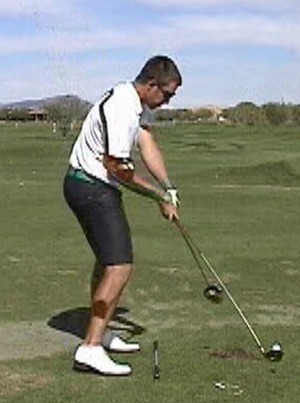 This image shows the clubhead being inside the hand arc (when the clubshaft is in line with the right forearm), and then moving outside the hand arc due to the release phenomenon. After release (due to release of power accumulator #2) the clubshaft is accelerating due to centrifugal action, and a swinger can no longer get the clubshaft to travel faster due to muscle power "pushing" the clubshaft forward at the grip end. A swinger can only use right arm/forearm muscle power to apply "push" pressure at the grip end of the clubshaft (specifically at PP#1) to support the "pull" action already in play due to the release of power accumulator #4. Interestingly, Homer used the word "acceleration" in that last sentence, and it is not clear to me whether he is referring to acceleration of the clubhead or acceleration of the hands. If he is referring to acceleration of the clubhead, then I do not understand how this is possible, because according to Homer's endless belt analogy, maximum clubhead speed is attained at the start of the release and not necessarily at impact. I, therefore, presume that he is referring to acceleration of the hands. However, even this point is interestingly mootable, because this graph shows that the arms decelerate prior to impact. 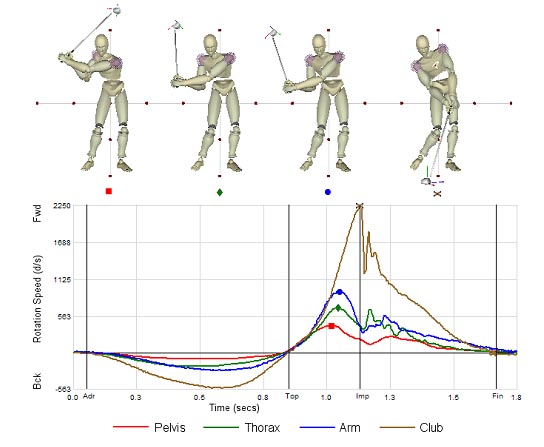 Interestingly, according to nmgolfer's mathematical explanation of the release phenomenon, the clubshaft can constantly accelerate all the way to impact, even if hand speed remains constant or decreases - as long as the club can acquire further angular acceleration due to the hand "pull" force being at an angle to the COG of the club. Jeff. |
KOC Utube Hogan
KOC, I sure enjoyed the Utube video that you linked to.
If someone could put up the still frames on this post, I know that everybody would enjoy the frames. I would do it but don't know how. Thanks again, Donn |
Awesome vid, KOC. You have a great gift in preparing all those vids, and I mean it.
The question is - is the arrow being drawn from a quiver by his right arm or left one ? or maybe both ? As my opinion goes - it's definitely a right arm motion, the same one Pistol was talking about in his posts. Cheers |
Dariusz
According to TGM teaching it cannot possibly be the right arm. Pulling an arrow out of a quiver is a mental concept for swingers, and a swinger pulls the grip end of the club along its longitudinal axis with his left hand. The right arm/forearm can only apply pressure to the left thumb at PP#1, and cannot directly pull on the club. The right hand can sense clubhead lag pressure at PP#3, but it doesn't apply any active force at PP#3. Jeff. |
Quote:
Jeff, what arm does a right-handed archer use while pulling an arrow out of a quiver ? ;) Cheers |
Dariusz,
You are welcome! World is big, but golfers who love Ben Hogan and Golfing Machine are all around. Good question to Jeff here…. Left or Right? My GSEM friend in Hong Kong also asked me your same question when he saw the clip. First of all, let me state that I am not a science student during my schooling and actual don’t know much theory of physics; biomechanics; kinetics. But I seriously to find the answer out of the mat... When I try to hit a ball only with the right arm in pretty slow motion, in such a case I bring the club back to the top and stop, sensing the weight of the club at the first knuckle of the forefinger. From there, I can really swing my right arm to hit the ball with good contact…but the sensing the club weight got lost very soon… Or at the top, my educated hand, in this case only my right hand, with the ultimate mission of sensing the clubhead lags pressure, my body NEEDS to do something to accomplish the mission. So from the ground up, my hip slides, right shoulder move down plane with 2nd axis tilt…and all of a sudden, the clubhead contacts the ball crisply. I try consciously doing nothing with my right arm and hand but something did change…I notice the straightening of right arm and a bit flattening of the right wrist at release point. The above seems like to me what Hogan said about the free ride and then the later stage of 3 right hands How about the left arm? I believe it is definite not an independent pull as the left arm is to be swung, inert, to have master accumulator lag. When left and right all together, now my 3 iron went over 200y and my Driver went over 270 for an inch shorter than the Man. Homer made a statement: The "mystery" of the Mechanics of Golf fades away when Right Arm participation is understood. Does this “mystery” really fade away for so many years in golfdom? There are Gary E. takes Hogan as right-sided model, and of course others as left-sided model…will this story end? Of course, I just share some videos and what I did in the past 6 months. I can be totally wrong but I really feel great with my ball stroking and scores lately.:golfcart: |
Quote:
This debate will probably be endless and i am apt to post as once again Jeff has stated that you can't do it according to interpretation of the book. From my point of view i don't see this concept as anything to do with pulling the club along the longitudenal axis i see it as a concept to fold the right elbow and put it in a deep pitch position plus feeling the weight of the clubhead.In regard to this video of an early Hogan his left arm is much much higher and one could conceivably imagine he is reaching back with his left hand to remove the arrow but later his left arm was much lower and not close to his shoulder at all so the different position would seem difficult to imagine his left hand removing the arrow |
Great posts, KOC and Pistol, and a great food for further thoughts about Hogan's swing principles.
Cheers |
KOC - you wrote-: "How about the left arm? I believe it is definite not an independent pull as the left arm is to be swung, inert, to have master accumulator lag."
I have the Tom Tomasello 5-day TGM school videos and he clearly demonstrates that it is the left hand that pulls the arrow out of the quiver. The left hand holds the club's grip and pulls longitudinally on the grip as the left hand pulls the "arrow out of the quiver". What causes the left arm to move forward so that it causes the left hand to pull the arrow out of the quiver? In body-swingers, it is the downswing pivot action that pulls the left arm forward (via power accumulator #4). In arm swingers, who use a right arm action (ala Tom Tomasello), it is a right arm throw action that pushes on the PP#1 point and thereby causes the left arm to move forward => left hand pulls on the grip => arrow is pulled out of the quiver by the left hand. Jeff. |
Quote:
|
Quote:
For example lets say we we're to do a typical PGA pro pattern starting on the hands only plane... it is very possible that by holding the power package as a construction during the initial startup and the movement of the power package is created via a rotated shoulder turn with the right and left shoulder moving with a parallel to the original inclined plane that the club would move onplane. This would still be a right forearm takeaway because the right forearm is moving in 3 dimensions with relation to the inclined plane. This has a certain feeling of starting up with an almost 'heave' like action. The aiming point concept and the left arm dragging the club longitudinally are not contradictory. Pp3 is always passive - it passively directs only. The swinger uses the pivot to pull the primary lever assembly longitudinally and ideally for the swinger he will increase his wristcock as this occurs which increases the lag pressure you will feel on the rotated pp3 - that clubhead must be felt and is your ultimate guide for impact. The swinger can increase the wristcock by the exact thought of pulling the club longitudinally - or as Homer Kelley says 'like an arrow from a quiver'. |
Quote:
Matthew I have to disagree and Lynn should concur since I have LB on the MMOC video explaining it. The right forearm pickup (LB's term) is simply the right arm picking up the club. No need for any help or intervention from the left arm. You can easily pick the club up with the right forearm and put it perfectly on the turned shoulder plane (or any other plane). You can use the left arm, shoulder or both hands to get to the turned shoulder plane by why complicate it? |
Quote:
If that is what Lynn teaches or your interpretation of what lynn teaches would not change my thoughts on this. An appeal to popular thinking doesn't make something correct. However from what I know of Lynn's teachings, I don't think there is a conflict anyhow - best to let lynn answer that for himself. The alternative to the right forearm takeaway is what Homer Kelley said is a 'shoulder turn takeaway' whereby the shoulder motion displaces the power package with an offplane rotation without the right forearm moving independantly in 3D. The offplane rotation then induces and the clubhead on an orbit inside of the plane line. Any 3 dimensional startup made on onplane is done by the right forearm moving also in 3 dimensions - thats why it is manditory because without it - the precision is lost. For example - If you were doing the 'PGA tour style' putting stroke - thats still a right forearm takeaway even if the displacement of the power package is being done with the dual agent (shoulder motion). The right forearm always traces the plane line with pp3 regardless if it is itself onplane or offplane whether it is 'held' in with relation to the power package like the example above, or is actively or passively used. However any correct startup requires the right forearm to move with a relationship to the inclined plane... that is the right forearm takeaway of the golfing machine. |
I think that Mathew is 100% correct. The right forearm takeaway doesn't necessarily imply any active movement of the right forearm is terms of pulling power. It is primarily a monitoring activity that keeps the clubshaft "on plane".
Whatever, it is still only the left hand that grips the club, and can pull the "arrow out of the quiver" at the end of the backstroke. The right hand has two primary roles - applying extensor action at PP#1 and a SPL/clubhead lag monitoring functions at PP#3. Jeff. |
Quote:
As a newbie here, in case the left arm (as you said) is the correct answer anyhow (which I doubt sincerely), why the names of TGM golf swing thoughts as e.g. "pulling the arrow out of quiver" are misleading and unreal then ? BTW, it's the first time I hear that the left hand grips the club and the right one does not. I do not possess the Yellow Book but the info I am gathering there from you (and I know how serious and accurate student you usually are) does not make me closer to have it... Cheers |
Quote:
Anybody who has enjoyed Yoda's posts will enjoy them 10 times more if you have tried to read the book. Our generationhave th ebest opportunity to learn TGM through the book, internet and a generation of teachers (like Lynn) who had FIRST hand experience of HK himself. Chances like that should not be underestimated! Hit amazon.com... |
the quiver
I may be wrong, but either arm can pull the arrow from the quiver. Just avoid the right arm paddlewheel action and monitor the pull.
|
Where To Buy -- and Not Buy -- 'The Book'
Quote:
For some reason, the publisher doesn't offer the book through Amazon itself. Consequently, the only editions available are from linked re-sellers who price them richly (currently from $56.99 to 99.95). These merchants take great pride in their inventory: The $99.95 'bargain' came with this compelling comment: "NOT 1971 OR EARLIER EDITION. THIS IS THE LATEST EDITION!!!!!!!!!!!!!". Only the uninformed will take this bait. The good news is that the 'latest edition' is in print and readily available from the publisher. I suggest you order directly -- and pay from $22 to $65 less -- at http://www.thegolfingmachine.com/theBook/buyBook.php. Tell'em "Lynn sent me!" :) |
Time is of the Essence
Quote:
|
Quote:
If I'm not mistaken, I don't think he meant that literally, as in an actual archer in the act of drawing and firing an arrow. He was just referring to the fact that, according to TGM, the "arrow from the quiver" motion can be performed with either the left or the right hand, while only the right hand is ever capable of driving (for a right handed golfer). |
Its not left arm power but moved by a force placed apon it created by the pivot.
The left arm is always swinging. The arrow from the quiver is just an analogy for the longitudinal acceleration of the secondary lever assembly. |
| All times are GMT -4. The time now is 02:11 AM. |