
|
10-20 Downstroke Triggers
Who believes the components in section 10-20 are down stroke triggers...or what starts the downstroke. That starting the downstroke with the lower body is not correct?
10-20-A Hands Trigger 10-20-B Right Arm Trigger (right forearm) 10-20-C Right Shoulder Trigger 10-20-D Muscles of both forearms trigger 10-20-E Left Wrist Trigger DG |
or none of above?
|
DG
I am not sure why you started this thread, and I am curious as to whether you think that one can start the downswing with a lower body move and not one of those triggers. Ben Hogan seems to imply that the downswing starts with a lower body move in this video lesson, and he doesn't imply that he needs a trigger from either the right upper limb or right shoulder. http://www.youtube.com/watch?v=QL_6M_xZvq0 Now, although Ben Hogan doesn't apparently need an upper body/limb trigger, I can understand how one can use i) a right shoulder thrust downplane or a ii) right arm throw action to reactively trigger the lower body shift-rotation movement. What I would like to know is whether there is scientific/biomechanical evidence to indicate whether one trigger method is better than another method. Jeff. |
Component #20 -- Release Trigger
Quote:
For the record, the 10-20-D Variation is the Delivery Path Trigger, not "Muscles of both forearms" Trigger. The latter designation does not exist in The Golfing Machine. Per 6-B-2-0, the "muscles of both forearms" are available to actuate the Release of the #2 Accumulator (Left Wrist), but this would apply to the Wrist Throw (10-20-E) and not the Delivery Path Throw (10-20-D). :) |
Differentiating Components
Quote:
Study 7-15; 7-20; 7-23; 7-24; 6-0; 6-A-1; and 6-K-0. :salut: |
Yoda - you wrote-: "In Pivot Strokes, the Lower Body -- specifically, the Hip Action / Component #15 -- pulls the Loaded Power Package to the Release Point with no independent Motion of the Arms. Only then -- after Delivery / Component #23 -- does a pre-selected procedure Trigger / Component #20 the Release /Component #24, i.e., the lengthening of the Third Side (Bent Right Arm) of the Triangle Assembly."
I agree that you are correct with respect to pivot strokes (ala Ben Hogan's swing). However, I presume that DG is asking the question whether those triggers can trigger the downstroke while the hip action is reactive to the trigger action. This is apparently the position taken by Peter Croker in his swing style. Here are two links to his swing ideology. http://www.petercroker.com/englisch/...olferapril.htm http://www.petercroker.com/golfdigestarticle1.htm I think that there is a similarity between Peter Croker's push action from the top and Tom Tomasello's right arm throw action. Do you think that the PC/TT swing methodology is not a viable method of executing a golf swing? I have certain sympathy for the PC/TT ideology and it comes from my experience in executing a stone skipping action. I think that there is a great deal of similarity in the right arm movement in a stone skipping action and a full golf swing. I can perform a stone skipping action two ways and they both work. i) I can start the right arm throw from the top and have the pelvis near-instantaneously react to the right arm throw or ii) I can start the stone skipping action with an initiating pelvic shift-rotation movement that is near-instantaneously followed by a right arm throw action. The difference is very small, but I find that my stone skipping action action is slightly smoother when I perform the stone skipping action using technique number i). Couldn't that analogy also apply to a full golf swing? Could some golfers execute a full golf swing better by triggering the downstroke with a right arm throw action (throwing the entire right arm flying wedge intact) while having the pelvis react to the throw action? Jeff. |
Do whatever works for you, but I am pretty sure this is a case of "not actually doing what you think you are doing".
when i skip the stone I think about getting my stone parallel to the water -via feedback from my hands. What I DON'T think about is my weight transfer to my front foot-my pivot ,but I still do it . I don't wait for my hand to get to "somewhere" and then turn on the hip power -I'd be playing catch up.Catch up doesn't work for me -once I have loaded the power package I want to store it for delivery, not lose half my load and fire whats left . Otherwise I could have saved some effort and made a smaller swing-and still started my downswing with my hips:) |
Neil - I agree that one transfers weight to the lead foot as soon as one starts a stone skipping action. In other words, the mere intent to throw the stone causes the lower body to react near-instantaneously so that the movement of the right upper body throwing unit (right arm flying wedge) occurs synchronously with the shift-rotation of the pelvis. That's the perspective of Peter Croker in his swing ideology. One focuses one's mind consciously on throwing the club from the top, but the "true" reality is that a number of body actions occur simultaneously at the very start of the downswing - the right shoulder moves downplane + right elbow moves towards the right hip + right arm flying wedge remains intact/unchanged (thereby keeping the distance between the hands and the right shoulder unchanged in the early downswing) + pelvis shift-rotates to the left. All these body actions occur simultaneously/synchronously.
Jeff. |
Quote:
|
Quote:
|
DG Means What He Says . . . And Vice Versa!
Quote:
With all due respect to Shakespeare: "Methinks thou dost presume too much." Your position is that, reactive or otherwise, the Hips move first. Take it from me, DG has other ideas. As you no doubt will soon find out! :laughing9 |
Left Arm
I have a student, who's buddies tell him to pull from the
top with the left arm. I tell him that this is incorrect, that the left arm is inert with not much power. I recommend that he start the downswing with shift/pivot/hip rotation. The student says that he can't move the downswing with the shift/hip turn, says it hurts his right hip. He insists that the pull with the left arm makes him pivot. How do I explain to the student that pulling with the left arm does not make the pivot happen? |
Mike
I agree - the mere intent to throw a stone doesn't guarantee that one will transfer weight to the left foot and perform an appropriate hip shift-rotation move. I believe that one has to engrain this pattern if one wants to use an arm-throw swing style. If the pelvis doesn't shift-rotate first, then I cannot understand how the stone skipping action (or golf swing) can occur in the correct manner as a underhand/side-throw action. When I practice a stone skipping action, my right arm immediately goes too far outwards (in an OTT manner) if I do not shift-rotate the pelvis near-instantaneously with the right arm throw action. Yoda If DG believes that the right arm throw action must occur without the pelvis moving first, then I would like to review his reasoning. In particular, I would like to learn how one can get the right elbow into the right side using a pitch elbow position, which I presume is necessary for a pitcher's (or swinger's) action. I presume that if the elbow is allowed to jut away from the body during a stone skipping action (because the pelvis doesn't shift-rotate) that it will cause the hand path to be out-to-in (rather than in-to-out) when it passes across the front of the body (passes through the impact zone). Feel free to correct me if my assumptions are incorrect. Jeff. |
Quote:
The thing is that, for him, that thought may work perfectly. You have to remember that what the student is feeling, or whatever his trigger is, may not be what is ultimately happening. You also have to take into account his physical problem; if focusing on the hips hurts, then he probably shouldn't use that thought, at least until that problem can be addressed. Otherwise, his body will compensate. In his case, the THOUGHT of pulling with the left arm may be the thought he needs in order to get his pivot to pull the left arm properly. I've seen video of myself when my only thought was to pull with the left arm, and the actual first move was of the shift and turn of the hips. The point is that, for some people, the pivot does respond to the intent to make a motion (don't make the mistake of thinking that "respond" in this instance means "to trail" or "come after"). For others, if they don't consciously engage the pivot first, then they'll have problems. You have to separate intent from what actually happens. If someone hits the ball well, with the proper sequencing of feet, knees, hips, trunk, shoulders, arms, hands, and club, then whatever they are focusing on (be it hips or arms/hands/club), is right for them. Whatever the mental key, whether or not the swing is hand controlled or pivot controlled, a good and powerful swing is generally going to actually start from the ground up. For this student, make sure that this thought is actually hurting his swing, before changing it. Whatever trigger he uses, whatever feel he cultivates, is correct if it results in the correct action. Let mechanics produce feel, and let feel reproduce, you know? |
Pulling with left arm
Bigwill, Thank you very much for your well thought out
responce to may question about my student. You spent a lot of time with a solution for me. My thinking has been mostly along the lines that you mentioned. Most of the problems, the student has had with pulling with left arm has been over-the-top moves and/or not getting off the right side. He watched Yodas swing and felt that Yoda stayed mostly on the left side on the backswing and therefor figures that by trying to immulate Yoda that he does not need to make a shift to the left on the downswing. I try to explain that Yoda does favor the left side on the backswing but that does not mean that Yoda does not move left on the downswing with a hip turn. You are certainly correct in that a students preception is a big key. Thanks again, Donn |
Quote:
No problem. I'm usually asking for advice/clarification on these boards. It's cool that I could contribute something helpful for once :laughing9 |
No expert but,
@dkerby - I think the best way to teach the pivot's role in swinging the left arm is to swing the club left arm only.
Keeping the head stationary, start by slowly swinging the club a few feet back and forth. Gradually lengthen until you are making repeated full rhythmical swings. Now try to make the club go faster through impact. It will immediately become evident how to use the pivot to accelerate the club. You simply cannot do it without harnessing the pivot and the left side to power the flail - loading and unloading the "gyroscope". After getting used to that, have him hit shots left arm only with a sand wedge. That will teach him how to add the all important "downward" element of impact. As far as the pain in the right hip goes, it might be swing related. I had pain in my right hip because I tried to immobilize it to combat a slide. When my pivot improved (and I allowed my right hip to clear) I had no more pain, and no more "over the top". Anyways, these are my personal experiences, not tried and true teaching techniques as I'm simply an amateur. Hope it helps anyways! :) |
Quote:
|
Bump
Ultimately . . . gotta go left with the hips. Maybe stick a shaft/dowel in the ground at an angle a few inches out side his left foot and say "Try to make your hips go to this dowel."
...without moving your Head. |
Quote:
|
Rhight shoulder down
Thanks a lot Bigwill, AndyR, Bucket, drewitgolf.
Been working on your suggestions with my student. Now the student says that he wants to stay on the left side on the backswing, then drop the right shoulder and hands, and then pull with the left arm to get his pivot. I mention to him that a shift/turn to start the downswing lowers the right shoulder. He says that he blocks the shot to the right when he does it that way. I think that he looks a results rather than causes. He says that he stays on the left side and does not have to make the shift. I loaned him my alignments DVD and asked that he look at yoda leaving the hands at the top while making a shift. In prior posts, Lagster and bucket observed that trigger delay can be greater if the right shoulder stays higher longer, Ala Hogan, Garcia, Clampet etc. So my student wants to start the downswing with the shoulders and hands. I must admit that if he does not do this he tends to come over the top. My way of thinking is that you do not set the accumulators by starting with a shoulder drop before a shift/pivot. What a battle. What do you suggest? |
What is his pivot doing when he drops the shoulder?
|
Closing Doors
Assuming other Alignments and ball position are OK, teach your student to Hinge properly to get rid of the blocks...Hands, Hands, Hands.
|
Pivot and Hinge
Bigwill, The pivot comes after the shoulder drop when the
pulling of the left arm starts. I guess that, as Homer Kelley says, the left arm is actually substituting for the pivot to introduce the circular motion required to produce Centrifugal Force. The student does not want to start the downswing with a pivot, to set #4. How forcefull should the instruction be to insist on the pivot or should I just try to help the guy with a less effective stroke? drewitgolf, am rechecking Alignments, ball position and hinge to get rid of blocks. |
DK it would appear to me that your student conceptualizes the swing according to Leslie King's swing methodology
See - http://www.golftoday.co.uk/proshop/tuition/index.html I think that an understanding of TGM's power accumulators allows one to understand the difference between the LK arm swing style and the body-pivot swing style. A swinger uses a particular sequence of PA release - 4:1:2:3. PA#4 is the master power accumulator and it is the angle between the left arm and chest wall between the shoulder sockets. 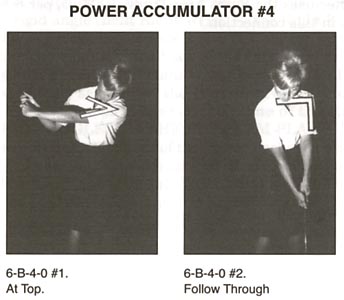 During the backswing one gets the left arm across the chest wall (loading of PA#4) and during the downswing this angle is released. In the Leslie King swing methodology the left arm is actively swung away from the chest wall by active contraction of muscles around the left shoulder girdle (colored in red in the next photo). 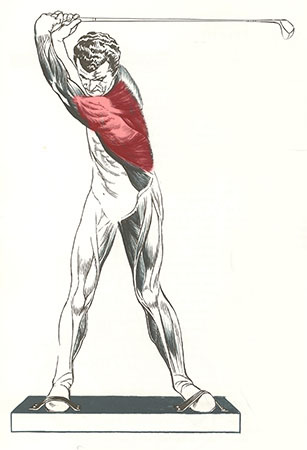 By contrast, the pivot-driven swing has a kinetic sequence where the hips/shoulders/arms rotate in a particular sequence and decelerate in a sequence. 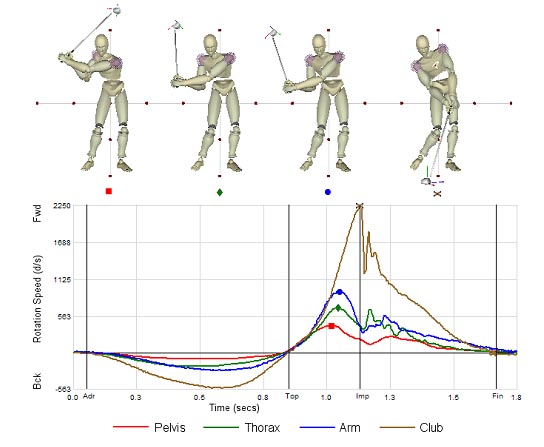 The arms rotate at the same speed as the hips/shoulders in the early/mid downswing and only accelerate more dramatically (release of PA#4) when the torso pivot decelerates. The arms are essentially catapulted passively off the chest wall, rather than being pulled actively off the chest wall by the left shoulder girdle muscles (as occurs in the LK swing style). If your student understands the differences, then he may decide to use the standard pivot-driven swing method of releasing PA#4. Jeff. |
jeff
The hips,shoulders and arms don't moving at the same speed at the beginning of the down swing 6-M-1 say hips,shoulders arms,
hips accelerate first and moving the fastest in the initial start of the downswing, then the shoulders are moving faster, thens arms followed by the club head, then the hips decelerate first,then shoulders then arms then club head. you compare a cheap $40,000 dollar 6 dof electronmagnetic sensor graph, I thinks it funnys you trying to compare a t.pi. graph to a kinetic link which uses a vicon d of system well 0ver $150,00. good to see you have throughly done your research before presenting pathetic kinnematic chains which is missing a world on information, |
Trigger Difficulty
Quote:
DG |
Order of Merit
Quote:
Homer did talk of listing the Variations from "simplest to most sophisticated" or from "least restrictive to zero". These progressive listings are so defined in Chapter 1-H. Of the Release Triggers (Component #20), the final listed Variation (Left Wrist Throw / 10-20-E) is the most sophisticated. :) |
Order of Merit vs. Order of Difficulty
Quote:
Oh, BTW, a 3/4/5 day Masterclass is not the end all in education. I find those educational experiences as a starting point not a complete treatment on any subject. DG |
End Of the Line
Quote:
:) |
You Mean There's More?
Quote:
:laughing9 |
| All times are GMT -4. The time now is 09:25 PM. |