
|
4 Barrel Pattern
Could someone tell me if there is a, 4 barrel swing pattern and a 4 barrel hit pattern? If there is two different patterns what are the differences. If there is only one pattern how would it be described, a hit or a swing or switting?
Please explain. |
Quote:
2) The difference is that one pulls and the other pushes 3) The sameness is that they both are using all four accumulators 4) Players choice - you could use a 4 barrel swinging pattern for putting if you wanted to |
Mike
I don't understand how it is possible to have a four barrel swinging action. I thought that the maximum was triple barrel (4:2:3) and that adding PA#1 would be switting. Jeff. |
Maybe it has something to do with how it is loaded rather than the release of accumulators.
If you drive load 4 accumulators - 4 barrel hit If you drag load 4 accumulators - 4 barrel swing ?? Maybe ?? |
Golfbulldog
I can imagine PA#1 release contributing to drag loading the clubshaft if the actively straightening right arm contributed to the release of either PA#4 or #2 in a coordinated/complementary manner. However, how would that be possible? How can active PA#1 release at a certain point in the downswing produce a better left arm movement than the standard method of releasing PA#4 in a pivot-driven swing? Also, how can contributory active PA#1 release improve on the centrifugal release action of PA#2? I not only cannot understand how a four barrel swing action can be better than a triple barrel swing action (4:2:3) -I also cannot understand how it can be even be equal (because active release of PA#1 can cause considerable interference/harm in a swinger's action). Jeff. |
Over a Barrel
Quote:
I'll take sound Three Barrel (4-2-3) over a Four Barrel any day, regardless of how wide the fairway is. Plus, you get better gas mileage :) . |
Hmm just wondering. Tiger's driver is great on the range but not so on the course......could it be the addition of #1 to his 3 barrel swinging motion when he steps through the ropes?
O.B. |
Find it in the 3rd Edition
Quote:
There is a 4-Barrel Swinging pattern in the 3rd Edition. Tomasello Chapter video series contains a 4 barrel swinging pattern. DG |
DG
I have viewed the TT swing videos (including his "Letter to Lee Dietrick" videos) many times, and I have attempted to use the "right arm" in a variety of ways to supply a "hitting action" while swinging. I still cannot understand why it will not adversely interact with a centrifugal-induced PA#2 release phenomenon (passive release of PA#2). Can you explain in words how one can usefully supply a "right arm hit force" when using a swinger's 4:2:3 release action (that is critically dependent on the passive release of PA#2)? Here is a hand-drawn graph showing the kinetic sequence in a good golfer who uses a swinger's action. 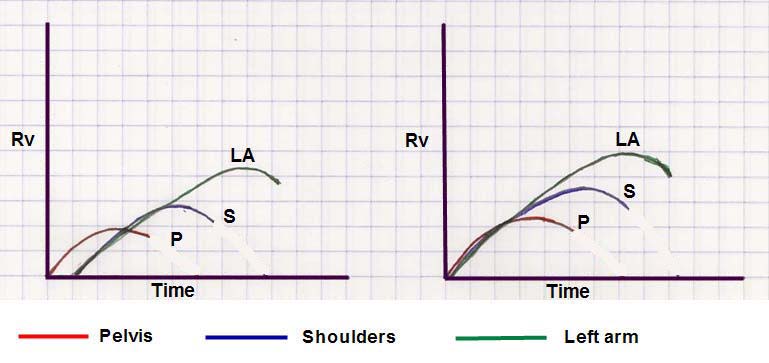 Diagram 1 represents an optimal kinetic sequence where the pelvis rotates before the shoulders ala Hogan (creating increased torso-pelvic separation in the early downswing) while diagram 2 shows a golfer who rotates the pelvis/shoulders equally fast at the start of the downswing (ala Hardy OPS). Either way, both golfers can optimally release PA#4 in such manner that left arm speed is maximal in the mid-downswing. Now look at Sergio's downswing hand arc. 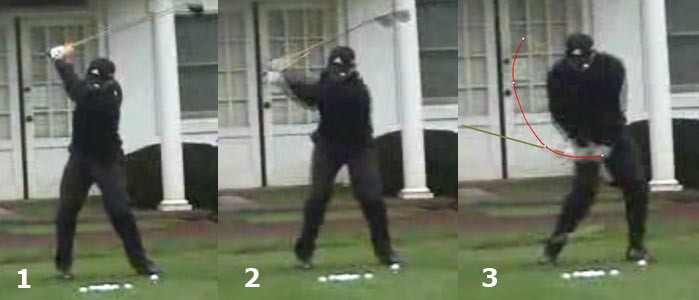 His U-shaped hand arc has its tightest turn (smallest radius) at the exact moment when his left arm, and therefore left hand/wrist, is traveling at its maximum speed (because his kinetic sequence is similar to diagram 1 above). That means that the force inducing a centrifugal release of PA#2 is maximal at that late release time point. He simply has to allow PA#2 to release passively (according to the laws of physics) to acquire maximal clubhead speed into impact. How could a "right arm hit action" at some time-point in his downswing improve on his swinger's action? Jeff. |
Roll out the Barrel, we'll have a Barrel of fun.
Quote:
It theoretically meets maximum Power demands. It is the most complicated "orthodox" uncompensated procedure. It also has the greatest margin of error in execution. It requires the most practice, fortitude and dedication. It is for the gifted competitor. Except for the driver, why not just switch to a longer club and avoid the risk? |
Quote:
LIke DG and others have said....seems surplus to requirements... I wonder if many use their PA1 later...almost overlapping 2 and 3??...but then how does that differ from 4 barrel hit?? When you watch Lynn and Ben doing their pitches on one of 6Bs videos on youtube.... http://uk.youtube.com/watch?v=a3x_AzWlG-A there is discussion about adding some active PA1 on the swinging pitch (Lynn says that early on) ....and I am not sure that that discussion has been fully dissected. There is a definite difference in what happens to the impact bag when Ben hits it and when Lynn hits it.... maybe because Lynn hits it harder but Ben's club has no recoil at all.... Ask Ben Doyle about 4 barrel swing - it seems to be the pattern he aims for by all accounts. 3rd edition patterns may have been Homer giving in to his and other pros' demands for a powerful pattern to teach....??? maybe I am more than happy to take Homer's advice and not try and do it...yet at the same time it would be menatlly satisfying to at least know what he is telling us to avoid. |
Quote:
Secondly, the Right arm can help the pull of the clubshaft (maybe passively versus "actively") (maybe directly or maybe indirectly) or as Homer Kelley stated at least "aid in the support of the left arm pull" 10-24-F 6th edition. So using accumulator #1 does not always mean that you are pushing the entire left arm and clubshaft as a unit (Primary Lever Assembly). For example, can you grab a club with your right hand only and pull it by straighteing your right arm? Can you pull an arrow out of a quiver along the shaft of the arrow with your right hand by straightening the right arm? Or as noted in 10-24-F - you can have the right arm push the left arm and as a result create more pull on the clubshaft. While initially it is important to understand the difference between hitting and swinging: In hitting you are pushing with the right arm and actively using accumulator #1. At some point you also need to learn that because you may be using accumulator #1 - it doesn't mean that you are hitting, pushing the clubshaft. GolfBulldog certainly is on track in that the loading procedure has a big play in this- if the shaft is loaded and "swinging" (as opposed to the hitter's ENTIRE primary lever system (left arm and clubshaft) working as one unit with no "separate" momentum of the clubshaft) then you are swinging and if accumulator #1 and it's corresponding pressure point(s) have some lag and acceleration/power requirements then you're using it. Just understand that we're using this for the course, for real life and if you understand the essential characteristics you'll be able to help your swing- we don't need to measure your right tricep, and pressure points in a lab and determine that it did contribute .0000000001% to the movement and therefore we categorize you as a 4 barrel swinger. It is important to understand the principles. So on the big picture- you can do about anything- you just have to understand what you're doing so that things work together and that you can repeat it and you can fix it if it goes off course. |
Here is my dumbed way way down take on this. Analogies are kind of irritating I know, my apologies.
At first glance it would seem logical that pushing and pulling would provide maximum power. In fact it does. But first appearances in golf are often way off the mark. Take the square to square club face for instance. Imagine a car stuck in the snow. One man pushing , one man pulling is obviously better than only one of em for sure. But the car has structure that these two hard to coordinate forces can not break. Now imagine the car as being made out of balsa wood or spun sugar or whatever. This car had best be pulled or pushed but not both for fear of mis coordinated forces destroying its structure, its raison d'ete. Im thinking for most all golfers the flat left wrist is the spun sugar car stuck in the snow. Push and pull if you want but for crying out loud dont break it. Now if you're left wrist is made of steel go for it. Me, Ill take the one guy pulling golf wise. |
Livin' on the Edge
Quote:
|
Mike - you wrote-: "Secondly, the Right arm can help the pull of the clubshaft (maybe passively versus "actively") (maybe directly or maybe indirectly) or as Homer Kelley stated at least "aid in the support of the left arm pull" 10-24-F 6th edition. So using accumulator #1 does not always mean that you are pushing the entire left arm and clubshaft as a unit (Primary Lever Assembly). For example, can you grab a club with your right hand only and pull it by straighteing your right arm? Can you pull an arrow out of a quiver along the shaft of the arrow with your right hand by straightening the right arm? Or as noted in 10-24-F - you can have the right arm push the left arm and as a result create more pull on the clubshaft."
I have great difficulty understanding your position. I thought that the definition of PA#1 release is that it must be ACTIVE and not passive. If there is a small amount of triceps action in the downswing that ensures that there is active extensor action (via PP#1) and a maintained sense of clubhead lag (via PP#3) then it doesn't imply that PP#1 is being actively released. I also don't know what you are implying when you state that one can grab an arrow out of a quiver with the right hand and pull it down to the ball. That's obviously possible if one grabs the arrow with the right hand (palm and/or fingers). However, in a golf swing the right hand doesn't grip the clubshaft and pull - it can only PUSH at PP#1 and/or PP#3. I don't have the 6th edition of TGM. If HK states that the right hand can push on PP#1 while the left hand pulls on the grip, I can easily understand that this is theoretically possible - but that doesn't mean that it is advantageous. If you look at the hand-drawn diagrams I posted, it can be seen that an optimised downswing pivot-action should optimally release PA#4 and maximise left arm speed at some point in the mid-downswing. Why would one need to add any active release of PA#1 to supplement an optimally fast left arm speed? Why add a push element to a pull element and complicate the swing by introducing a major timing problem - that any push by PA#1 must be perfect in both timing and degree of push force to complement the already optimised release of PA#4 and #2? Golfbulldog - you wrote-: "I agree - tricky stuff. it would have to be 4, 1 , 2 , 3.... which would mean pivot throwing left arm off chest (right shoulder fly wheel)...then a bit of PA1 (using right shoulder as backstop brace off which to push) .. then 2 and then 3...." That four barrel combination is theoretically possible, but it would only make sense from a practical standpoint if the downswing pivot action did not adequately release PA#4 and additional push force was needed from PA#1 to fully release PP#4. However, surely it is easy to get a full release of PP#4 from the downswing pivot action alone? Why would one want to add an additional factor and complicate the downswing by introducing a major timing element? Jeff. |
Quote:
|
Yoda
I would be interested in your opinion as to whether a four barrel swing pattern is truly possible or desirable. DG stated the following - "Tomasello Chapter video series contains a 4 barrel swinging pattern." I don't see any description of a four barrel swing pattern in the TT series. TT describes the role of the arms in chapter 2. In that chapter he states that the right arm hits and that the right arm must be driven to a full straight arm position post-impact. However, in that chapter he doesn't state whether that advice applies to a hitting or swinging action. The only time that TT addresses this specific issue is in chapter 9 on hitting versus swinging. At the start of that video lesson TT demonstrates a classic triple barrel swing action - 4:2:3. He states that the right arm should end up straight in the followthrough, but he specifically states at 2:23 minutes into the lesson that the right arm is not driving to a straight right arm position and that it is responding to the centrifugal release of PA#2. From my perspective, this doesn't represent an active release of PA#1 (an active push action) - because it is not being driven to a straight line alignment by an active triceps muscle contraction action. If PA#1 is not actively releasing, then how can DG imply that TT is recommending a 4:1:2:3 swing pattern? Here is swing video of Anthony Kim' swing. http://www.youtube.com/watch?v=oqmejmw-lu4&NR=1 One can see that his right arm goes to full extension after impact, but I don't see any evidence that he is driving the right arm to full extension via any active release of PA#1. I think that he has a triple barrel swinger's action - 4:2:3. Do you agree? I have viewed the gallery video of you hitting a driver in cold weather. You stated that you were hitting, but at one point in the video you stated that you would swing. You then stated that you had to recalibrate your mind for a swinging action, and you then performed a swinging action. Was your swinging action a triple barrel swing action? Did you have any sense of actively releasing PA#1 in your downswing? Jeff. |
I can imagine the right arm powering the swingers flail, that said, I can image a shooting around 90 or so too. :laughing9
|
What a Pair of Knockers
Quote:
|
more Homer
Quote:
"...no point in 4 Barrel Swinging." "...no real advantage..." "If you try to exceed Momentum Transfer, it will resist." |
Quote:
DG |
Right Arm it or Right Arm and Left Arm it....
Quote:
DG |
shooting the messenger?
Quote:
I've shown great restraint in making "comments", since the "libraries" comment. |
Advantage with the Right Arm...
Quote:
DG |
Re-Vist the Homer Notes
Quote:
Left Arm or Right Arm - If the Right Arm Drive propels the Left Arm Lever Assemblies, it is still a Left Arm Stroke because the center of the Clubhead Arc is the Left Shoulder. It is merely Right Arm Powered. But - if the center of the Clubhead Arc is at the Right Elbow, then it is a true Right Arm Stroke, the Bat. Right Arm thrust can add considerable yardage for an out and out Swinger, provided its tendency toward Angled Hinging is recognized. Pivot Thrust can add about half as much increase in yardage for an out and out Hitter provided its tendency toward Horizontal Hinging is recognize. DG |
DG - you wrote-: "Left Arm or Right Arm - If the Right Arm Drive propels the Left Arm Lever Assemblies, it is still a Left Arm Stroke because the center of the Clubhead Arc is the Left Shoulder."
Under what conditions does the right arm propel the left arm lever assemblies? Are you describing a swing variant where the right arm releases PA#4 - as an alternative to a pivot-driven release of PA#4 (in HK's words "the left arm is blasted off the chest wall when the pivot subsides")? Or, are you describing a swing action where the pivot-drive releases PA#4 but the right arm supplies supplementary power to the swing by an active release of PA#1 at a certain time point during the downswing? Jeff. |
Quote:
Those comments are coming from HK...not me. I would suggest you watch Tomasello's "Letter series #2 video" and Tommy will give a visual demonstration of the release. DG |
Quote:
|
The swinging left arm, right arm role/relationship is the most confusing aspect of TGM IMO. We need a way of explaining these relationships in easy to understand terms so that any idiot can understand it (ahem, that includes me :laughing1 ) . The more clearly we state it, the less uncertainty, the less uncertainty the less room for criticism of TGM as our audience expands.
|
DG
I have watched hat TT letter video. It seems clear to me that he is using a triple barel swinging action - 1:2:3. He states that he throws the right arm from the top in a push action stroke. That represents an active release of PA#1. He states that the body must be reactive to the right arm throw action and follow the throw action (and not lead the throw action) - see comments at 8:00 minutes, 9:07 minutes and 11;20 minutes. That means that he does not use a pivot-diven stroke action to induce release of PA#4. The left arm is propelled forward by the right arm throw action and its push force at pressure point #1. Note that he uses a start up swivel action of the left hand, which is only compatible with swinging (and not hitting where the clubface continuously faces the ball druing the takeaway). Then his right arm throw action induces a passive release of PA#2 via centrifugal action (rather than an axehandle technique of radial force being applied against pressure point #3). Do you agree with my description - which is a triple barrel right arm swinging action and not a four barrel swinging action? mb6606 I thought that the "magic of the right forearm" refers to its directional qualities of getting the clubshaft to remain on-plane, which can occur in a triple barrel 4:2:3 swinging action (which doesn't involve active right elbow straightening). Where does it state in TGM that it only applies to an active push release of PA#1? |
Ouch, my brain hurts. I've been trying to figure 4-Barrel out since I got into the book and don't know. One summer I hit the ball 50 yards farther than ever (300-325 yard carries), I don't know how, but my forearms would hit each other due to a lot of #3. Haven't been able to find that since, maybe just maybe, I had the elusive 4-barrel.
|
Quote:
Bucket and I are down here at the Tavern drinking- feel free to join us.:occasion: Bucket's reading the book looking for 4 barrel information :book: I'm just drinking and getting ready to hang bucket! Come down and watch - should be fun! |
Release Triggers Versus Power Accumulators
Quote:
The Hitting Stroke involves Muscular Acceleration through Impact whereby the Lever Assemblies are Pushed via Right Triceps / Elbow Thrust (6-C-0 #1). In contrast, the Swinging Stroke involves Centrifugal Acceleration whereby the Clubhead is Pulled toward its In-Line condition by Centrifugal Force (6-C-0 #4). All Stroke Patterns – both Hitting and Swinging – require both a Power Accumulator Combination (Component #4) and a Release Trigger (Component #20). By definition, the #1 Power Accumulator (Right Arm Thrust) is restricted to a Hitting Stroke (6-B-1-0). Therefore, the 1-2-3 Triple Barrel Accumulator Combination is limited to Hitters. Similarly, the 2-3-4 Variation is limited to Swingers. The Hitter’s Basic Pattern (Drive Loading / 12-1-0) lists the Right Arm Throw (10-20-B) as the Release Trigger Variation. The Swinger’s Basic Pattern (Drag Loading / 12-2-0) lists the Left Wrist Throw (10-20-E). Normally, these Variations are restricted to their respective Patterns because each is the natural byproduct of the Thrust produced by the Stroke itself. However, neither option defines its Pattern nor is its use mandatory. Therefore, in a Swinging Motion (Right Arm or Left), the Centrifugal Throwout Release of the Left Wrist may be Triggered by the Right Arm. Nevertheless, as a Power Source, again by definition, the #1 Power Accumulator is passive. Summarizing, Right Arm Throw (Release Trigger) and Right Arm Power (Stroke Variation) are not the same thing. :salut: |
Quote:
|
bursting bubbles
Quote:
Must you always swat flies with wrecking balls? Party pooper....:crybaby: &C :notworthy |
Quote:
|
Yoda - interesting points.
In particular, you stated: Quote:
Jeff. |
True To the Discipline
Quote:
To your immediate question . . . "Yes." :) Now to my own . . . Did Tommy refer to his heretofore described Right Forearm Action as the Right Arm Throw? It's been a while since I've viewed his many videos on site, and without a return visit, I don't know. But again, per my previous post . . . I don't care. I care only about consistency. Consistency of description within the constraints of: The Terminology;Of The Golfing Machine as set down by Homer Kelley and illuminated in thousands of posts by myself and many others on this site. Including yours, Jeff. IMHO, as aggravating as you can be at times -- :) -- you're terrific! And I am delighted and privileged to have you posting on my site. Thanks. :salut: |
Yoda, Yodasluke, Jeff, and everyone else watching this thread,
I'm going to jump in and point out the obvious here which you guys already know. Any Drive Loading Action or Active Right Arm Power is Hitting. It can be maximum trigger delay or not but if you feel the right side you are hitting. Sometimes the only way the teacher knows is by asking the the player.... Do you feel more of a push through impact or a pull through impact???? Jeff, what you describe above immediately became hitting when the right arm got involved. Hope this helps the thread. Still Sorting Through the Instructor's Textbook. B-Ray |
hhhmmm....if someone feels the right side you are hitting? si swingers should not feel anything in the right side? is that correct? when im at top, i feel a shitload of pressure on my right hand and right shoulder, so am i a hitter?
|
| All times are GMT -4. The time now is 02:12 AM. |