
|
Pivot center
In another thread, Yoda stated that a golfer needs a i) pivot center and that the pivot center needs to be centralised between the feet.
Of all HKs' ideas I have never understood why there needs to be a pivot center for the swinging arms/clubshaft. I can understand a grandfather clock having a pivot center located at the fulcrum of the pendulum because i) the length/radius of the pendulum arm is constant and ii) the low point of the pendular arc is constant. However, golfers don't have a consistent ball position and/or a consistent low point - relative to the center of their stance. Also, the length (radius) of the left arm/clubshaft swinging structure varies continuously during the downswing. Also, the fulcrum (left shoulder socket) of the left arm/clubshaft structure moves in space continuously and has a variable distance from the required low point (a set number of inches ahead of the ball). Also, although the low point of the swing is roughly opposite the left shoulder socket area, the left arm/clubshaft length/radius is not necessarily at its greatest value at that time point. The left arm/clubshaft's length/radius is at its greatest value when the left arm is maximally straight and the clubshaft is maximally straight-in-line with the left arm, and that occurs at the end of the followthrough. Maybe that is why HK didn't state that a stationary head is an imperative, but more imprecisely classified it as an essential requirement. Rhythm and balance are also imprecise concepts that are classified as essential requirements. To make any further discussion interesting/informative, I am including a series of photos showing the pivot center of different golfers. I drew red lines through the pivot center (defined as a point midway between the shoulders) at address. I then left the red line constant, and captured two additional images - at the end-backswing and at impact. From this swing video - http://www.youtube.com/watch?v=StKkT9sTTtQ Gary Player 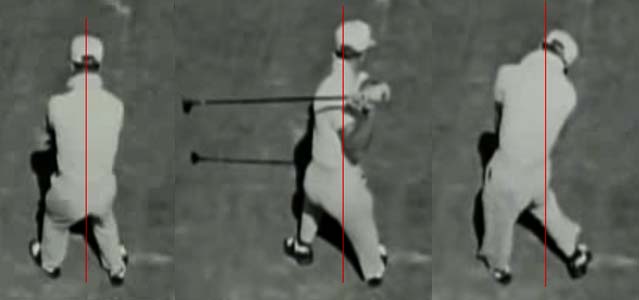 Arnold Palmer 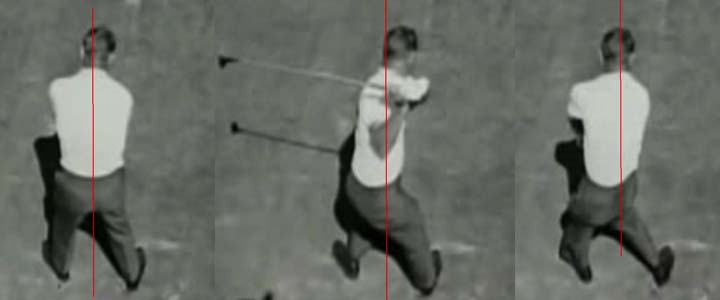 Jack Nicklaus 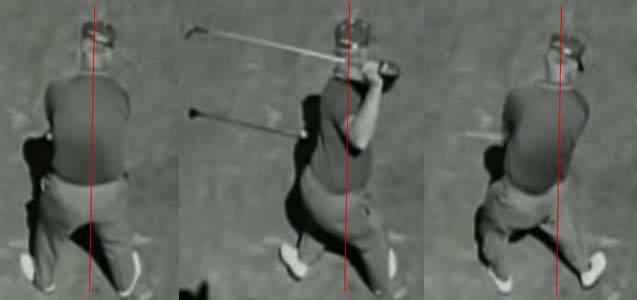 Mike Souchak 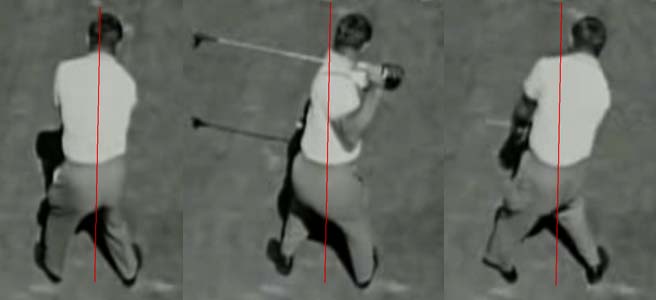 Here is another swing video that is pertinent to this discussion From this Natalie Gulbis/Paula Creamer swing video - http://www.youtube.com/watch?v=jviToMF5kYk Natalie Gulbis 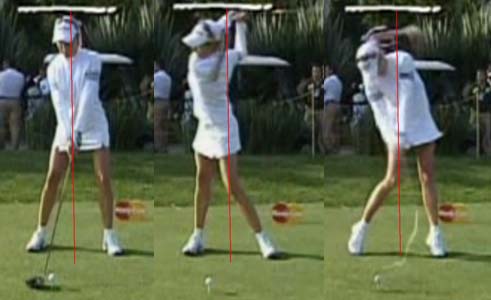 Paula Creamer 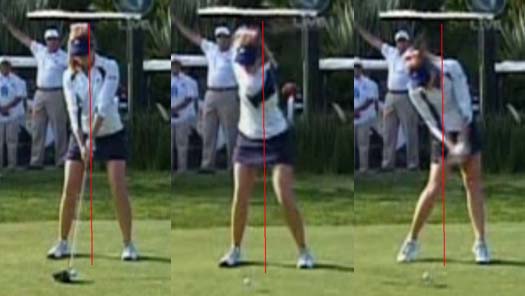 If I were considering essential requirements (and not imperatives) for a golf swing, I would consider removing "stationary head" and inserting "set distance of the left shoulder socket from the ball at impact". Jeff. |
angle of pics
I think (unless both girls play with the ball way back in the stance) that because of the angle from which the photos are taken, the pics of Creamer and Gulbis aren't very useful.
|
Even though the camera angle was not square, one can certainly see that both of the young ladies do not keep their head, or upper swing center, stationary. Check the swing video for a DTL view to see how much their heads drop. It's a staggering amount. They do not have any pivot center to their swings.
Jeff. |
???
Hmmmm...... I'll take the "Big 3" over Souchak/Gulbis/Creamer any day.
On second thought..... you know that move by Gulbis does look quite "golf-like".... I wonder if I shouldn't work on that. Jeff - can you please tell me how to go about it? Looks like it might be the way to go. |
Cometgolfer
I think that you are missing the point. I am not recommending that anybody emulate the Gulbis/Creamer approach. I only posted their swings as extreme examples of golfers who don't have a stationary head and who don't have anything resembling a pivot center in their swing, and yet they can consistently hit the ball well enough to play at a professional level. The question that it raises is what is the primary function of a i) stationary head; ii) a pivot center; and does the pivot center have to centralised between the feet throughout the swing. You are free to express your opinions on this issue. Jeff. |
Quote:
|
Seeing that nobody has posted deep thoughts on the idea of a pivot center and/or stationary head, I will post my personal opinions. Feel free to criticise them. I have been wrong many times in the past and I am willing to modify my opinions in the face of constructive criticism.
I think that the pivot plays a number of roles in a golf swing. It powers the swing via the loading and release of PA#4. It transports the intact power package assembly downplane at the start of he downswing. Finally, it forms a stable supporting structure during the release of the PA#4/2 so that a golfer can generate an on-plane clusbhaft movement (that traces the SPL) and that results in a consistent low point position. In other words, for a golfer to consistently swing and have the low point at exactly the same spot (for a particular club) requires a stable supporting pivot structure. Consider this swing video lesson by Shawn Clements. http://www.youtube.com/watch?v=tstAAWUGN6c Note how he can swing back-and-forth consistently because he has a stable pivoting structure - which he likens to a construction crane. I think that's a good analogy. A construction crane cannot be unstable/wobbly if it wants to perform its role correctly/optimally. What part of the pivoting structure plays the key role in this stable supporting structure during the downswing. I think that its the skeletal structure that runs from the C7 vertebra down the spine to the pelvis passing through the pelvis to the left foot via the braced left leg - as seen in this next photo. 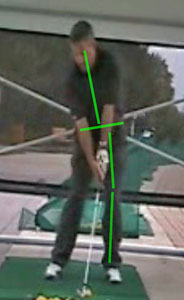 I have placed green lines to identify the key skeletal structures that allows a golfer to pivot in a stable manner. The left lower limb needs to be braced and the secondary spinal axis tilt must also be braced to keep the entire pivoting structure stable during the downswing. The head sits atop this structure and is a marker for the stability of that pivoting skeletal structure. Actually, it is acceptable for the head to drop downwards-backwards if a golfer has a large degree of secondary axis tilt as long as the base of the neck (C7 vertebra) doesn't move. That's why I can understand Homer Kelley stating that the base of the neck is equivalent to the stationary head as a marker of a stable pivot. Does the head (or C7 vertebra) have to be situated in the center of the stance for a golfer to have a stable pivoting structure. I don't think that it's a necessary requirement. Consider Shawn Clement in his one-leg drill. http://www.youtube.com/watch?v=T2FnfZlRwak He has no pivot center or any possibility of a centralised stance. However, he can swing very consistently to a consistent low point in his downswing. This composite photo shows the change in his degree of secondary axis tilt during the downswing. 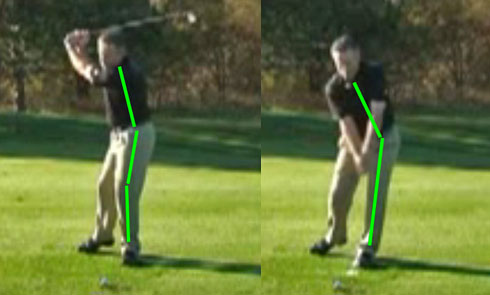 Obviously his head has to move during the downswing. However, he is still creating a stable pivoting structure that is consistently stable swing-after-swing. Also, note that his stance (with his right hip cleared way back) forces him to have a large degree of secondary axis tilt at address. However, that doesn't mean that one cannot have a stable pivot in the downswing. In other words, I think that variable degrees of rightwards tilt at address (and during the downswing) is still compatible with the concept of a stable pivoting skeletal structure. I think that the position of the base of the neck (C7 vertebra) relative to the center of the stance depends on the swing style and not the stability of the pivot. Consider Mike Bennett's swing - he is the originator of the S&T swing. http://www.youtube.com/watch?v=XgbubywoLCw His head (and C7 vertebra) remain centralised between his feet because he loads over the left leg in the backswing, and he therefore does not have any rightwards pivot shift. The same type of centralised pivot is seen in Sam Snead's swing. http://www.youtube.com/watch?v=U6Gu7n7Vnm0 Sam Snead has very a centralised swing. By contrast, Anthony Kim's head is well behind the center of his stance. http://www.youtube.com/watch?v=oqmejmw-lu4&NR=1 Note how stable/stationary his head remains during the entire downswing - despite the fact that his head is well behind the center of his stance. In other words, his head is far back because he develops more secondary axis tilt than Mike Bennett or Sam Snead. However, that doesn't mean that he is a less superb ball striker. I think that he is a superb ball-striker, who has a very stable pivoting skeletal structure. In other words, I don't think that the head (or base of the neck) has to be in the center of the stance to fulfill Homer Kelley's definitional requirement of a "stationary head" being a necessary requirement as part of the triad of essential requirements (the other two being balance and rhythm). Jeff. |
Would you want your dentist to be moving his head all around while he drilled your teeth? How about the surgeon in the operating room?
Homer was about repetitive precision - The Machine. |
mb6606
That's what I implied in the post above your post. Anthony Kim's swing is all about repetitive precision! Jeff. |
Pivot Center Q&A
Quote:
Quote:
Quote:
Quote:
Quote:
Quote:
Quote:
Quote:
Quote:
:golfcart2: |
Quote:
"The Lever Assembly is seldom more then an inch from Full Extension at Impact". |
Yoda
This is one heck of a post. Jeff your persistence does bring out the best from the best. But what is the nature of this mission that you are on? O.B. |
When Does Full Lever Extension Occur?
Quote:
Agreed, Mike: There is a difference between my conclusion (point of Full Extension past Impact) and the "exact [Kelley] quote" (degree of Extension at Impact). For practical purposes, I believe that my conclusion is valid. Remember, the Left Wrist doesn't go from Cocked to Level -- then hang around a while -- and later proceed to its Uncocked condition. No sir, the Left Wrist is rapidly Uncocking -- perpendicular Wrist MOTION (4-0 / 4-B) -- and it is Releasing in one unbroken thrust. Even with the Swinger's Sequenced Release (4-D-0), there is an overlapping of the #3 Accumulator Wrist Roll and completion of the #2 Accumulator Wrist Uncocking. In any event, the Left Wrist ideally is Level at Impact and then immediately proceeds down approximately one inch to fully-Uncocked through the Impact interval. No way does this complete Uncocking take until the end of the Follow-Through (which was Jeff's point). Mike . . . I don't want to get too far from the subject of this thread, but since you've raised the question . . . If at Impact, the Primary Lever has only one inch to go until it reaches Full Extension, and if the Left Wrist is Releasing freely, then what is your best guess as to when Full Extension occurs, i.e., how far past Impact? :salut: |
Yoda - you wrote-: "To maintain the Point of Compression (2-C-0) through Impact and for consistent Directional Control (2-D-0), there must be a Centered Arc. Or, a "compensating manipulation". In turn, a Centered Arc requires that both the Pivot and the Arm/Clubshaft Swing be Centered. In other words, the Pivot has its Center, and the Primary Lever Assembly (Left Arm and Club) has its Center. They are not the same."
I can understand that there are two centers of rotation - one for the pivot's center and one for the arm/clubshaft's center, but you have not explained why they both have to centered between the feet to create a centered clubhead arc. First of all, the left arm/clubshaft has a fulcrum point at the left shoulder socket joint. However, the clubhead does not circumscribe a perfect circle around the left shoulder socket (because the clubshaft has an angle relative to the left arm that varies from 90 degrees at the start of the downswing to 0 degrees at the low point). Secondly, the left shoulder socket has a variable relationship to the pivot center (base of the neck) during the downswing. It's like there are two intersecting circles of rotation - left shoulder socket relative to the pivot center (where the radius is likely to be constant) and left shoulder socket to the clubhead (where the radius is constantly changing). These two circles are moving at different speeds in the downswing, and hopefully, the clubhead arc will end up being relatively circular (actually more likely to be slightly elliptical) with its low point ending up a desired distance ahead of the ball position. So, for example, if the ball is placed 4" inside the left foot, then the low point needs to be "x" inches ahead of the ball position. However, in this model - there is no necessary requirement regarding the two circles of rotation (that are both in constant motion) that the pivot center must be perfectly centralized in the stance. Here is the downswing clubhead arc of Aaron Baddeley's swing. 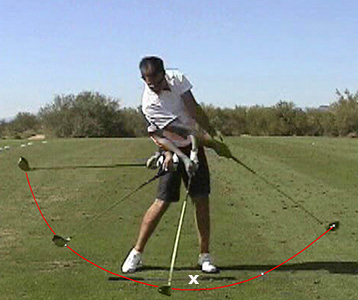 Point "X" is the low point of the clubhead arc. Note that the pivot center (base of the neck) is not centralised in the stance. Here is the downswing clubhead arc of Tiger Woods swing. 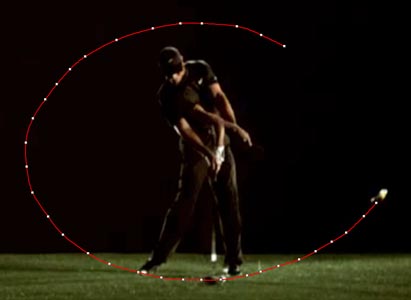 Note that the clubhead arc is elliptical. Note that the low point is at the ball position. Note that Tiger's pivot center (base of neck) is not centralized between his feet. Jeff. |
Quote:
|
Not So New News
Quote:
"This book presents the 'uncompensated' Stroke as a goal, guide and progress report, not as a minimum entrance test. Compensation for physical limitation, personal preference or special purpose are actually specialized techniques."His recommendation was to set the Head in an Impact Fix (Section TWO) of the Stroke and then leave it there at least until the end of the Follow-Through (Section ELEVEN). Most golfers ignore this instruction, of course, and take their Adjusted Address (Station THREE) with their Heads set 'any old where'. Then, they have to Bob (Third Snare / 3-F-7-C) -- often significantly (check out Gulbis and Creamer) -- in order to achieve their desired Impact location during the Stroke itself. I well remember standing directly in front of him in his study in January 1982 as he demonstrated this point. As he moved from a conventional 'head high' address, his bald head dropped at least a couple of inches as he moved into an Impact Fix. It was dramatic difference, so much so that I even snapped a photo. If he were posting in this thread, I'm sure he would say "Put your head anywhere you want at Fix. Then, leave it there! The important thing is that your pivot has a center and that it moves as little as possible." Just like he told the five of us privileged to be in his Masters Class that day. This is not news. I have written on the subject many times in the past few years. Search my archives. |
Nicklaus or Gulbis
2 Attachment(s)
Quote:
|
Coon Hunt / A "Sportin' Chance" Gone Wrong
Quote:
"WhhhoooooWWAAAHH!!! Have mercy! This thang's killin' me!" http://www.youtube.com/watch?v=-AX9QoFhEhI :salut: |
In 2-H Mr. Kelley wrote, ‘Though the “Head” Pivot Center is recommended, it is not at all mandatory. The important thing is that the true Swing Center for ALL COMPONENTS is around a Hinge Pin with one end at the top of the Stationary Head and the other in the ground, precisely between the feet, with no regard for Body Location or Position at any time.’
You can move your head if you choose to but what advantage is it? Why not keep it stationary? It is too bad that Gulbis, Creamer, Woods, Baddeley and others do not set their head at impact fix. |
Quote:
|
Quote:
Since Jeff will give you some story about searching out the truth et.c etc. :sleepy: Let me answer this for you - his mission is to drive people insane- Bucket and I have him on a retainer fee for this exact purpose. |
Quote:
|
Quote:
|
Quote:
|
Are We There Yet?
Quote:
In Homer-speak, that would be zero. :salut: |
The Dark Side
I've decided on my final 18 posts to move on over to the dark side with Jeff and just ask questions!
Does "precisely between the feet" mean precisely somewhere between the feet or precisely in the middle of the feet? If it was in the middle of the feet- then would that nullify "with no regard for Body Location or Position, at any time."? |
Quote:
|
18 Posts And Counting . . .
Quote:
What if you had the club down well in the fingers, you know, at or below the proximal phalanges http://en.wikipedia.org/wiki/Proximal_phalanges? Would this be a maximum #3? If so, what does this imply? And what if you were older and couldn't zero it because of an arthritic condition? Would this eliminate the #2 accumulator? How about #3? I see no reason for that because clearly Moe Norman never did either. For example, consider http://perfectgolfswingreview.net/swingplane.htm. It doesn't come close to the breadth of my argument, but you get the idea. Plus, if you'll draw the lines -- I see no need to go to that extreme here since it is obvious and everybody can see it -- you'll see that his head moved at least .0001 of an inch (in front of the ball . . . but that is in a different place than Ben Hogan's or Jack Nicklaus's ball). BTW, is that right? You know, should it be Nicklaus's or should it be just Nicklaus'? Finally, would any of this affect my ability to pivot Saturday night at Hernando's Hideaway? Please don't delay your post . . . "I gotsta know." http://www.youtube.com/watch?v=1-0BVT4cqGY :laughing9 P.S. Jeff, please don't take offense, you know "I luv ya, man!" And sincerely appreciate all you are doing here. It's just that sometimes . . . it can get to be a bit much. But that's you, and I'm growing fond of your deep-digging. Keep it coming, my friend; just know that there are time constraints on my ability to read your insightful posts, let alone comprehend and respond. :salut: |
Here is a simple thought experiment as to whether Tiger's driver clubhead arc should be elliptical or perfectly circular in shape, and whether two consecutive driver swings would have clubhead arcs of exactly the same elliptical shape.
To make the experiment simple, consider that the pivot center (base of the neck at C7) remains fixed in space during the downswing between swing A and swing B. Also accept that the clubhead is in exactly the same identical 3-D position at the start of the downswing in those two swings. Now consider what factors will affect the position of the clubhead in space at different time points during the downswing. Imagine a very accurate timer that can measure the downswing action in millionths of a second, and let's determine where the clubhead will likely be located after xx/100th of a second into the downswing. There are six interacting variables that will influence the clubhead position after xx/100th of a second. 1) The speed of rotation of the left shoulder socket around the "fixed" pivot center. 2) The exact angle of rotation of the left shoulder socket around the "fixed" pivot center. For example, in swing A the left shoulder may rotate around the pivot center at a 90 degree angle while in swing B it could be at an 85 degree angle. 3) The speed/timing of left arm rotational movement around its left shoulder socket fulcrum point which depends on the PA#4 release pattern. 4) The angle of the left arm's rotational circle relative to the left shoulder socket - relative to the inclined plane. 5) The precise timing of release of the clubshaft (uncocking of the left wrist) and therefore the precise timing of the lengthening of the left arm-clubshaft radius. 6) The angle of the clubshaft release relative to the back of the left hand. Hopefully, the left wrist will uncock perfectly in plane with the left arm so that the clubshaft will release in the same planar arc of the flat left hand, but there could be a variation of a few degrees from swing-to-swing. One doesn't have to be a rocket scientist to realize i) that the 3-D clubhead position at xx/100th of a second will not likely be in the same precise 3-D location in swing A compared to swing B; ii) that the total clubhead arc shape will more likely be elliptical in shape rather than perfectly circular in shape; iii) that there is no fixed center of an elliptical arc; iv) that there is no necessary causal reason why the pivot center (base of the neck) should be at the "center" of that elliptical-shaped clubhead arc. It also doesn't require a rocket scientist to realize that the i) low point of that elliptical clubhead arc may be just inside the left foot, or somewhere else - dependent on the "fixed" position of the pivot center; and that if the low point is just inside the left foot that it doesn't necessarily imply from a causal perspective that the pivot center must be in the center of the stance. Jeff. |
This Just In . . .
Quote:
Jeff,:laughing9 |
Leaping Lizards, Batman!
Quote:
:scratch: |
Quote:
|
Howard Carter and King Tut's Tomb -- "I Found It!"
Quote:
"The point may be made that it is impossible to inscribe perfect circles while the center -- that is the turning shoulder -- is in motion. The straight line requirements of the Compression Point are satisfied as long as the Lever Assembly Center [Yoda note: Left Shoulder] is moving in a circle during Impact . . ." (2-H) Quote:
:shock: BTW, as long as we're 'noting', let's note that Tiger's 2007 Ball Position is well ahead of its position in the January 2001 Golf Digest "Head 'Oh So Far' Behind the Ball" sequence posted in another thread). See my responsive post: Tiger's Journey. Remember? If not, see #8 here: http://lynnblakegolf.com/forum/showt...8805#post58805. In contrast, while you're at it, compare my view to Jim Flick's congratulatory comments http://www.book4golf.com/lessons/. C'mon, Jeff. Give us something new. Not just your incomplete conclusions as to 'what is' framed by "I found it"! :salut: |
Navel Contemplation
Quote:
:shock: Et cetera . . .It goes nowhere from here, Mike. Let's just let it go! :laughing9 |
ok..... I certainly can't attempt to respond to the original concepts put forth in this thread more appropriately than Lynn et al, so I'm going on a tangent here with my "opinions":
1) I for one "do not" appreciate Jeff's meandering posts and for the life of me I can't understand the objective of most of them. I get an immediate case of "tired-head" when I get past the 1st paragraph in most cases. 2) I made an attempt to read Jeff's "white paper", but when I pulled up the video segment on "hitting" and saw his demonstration replete with a flattening right wrist into impact then "all bets were off" so to speak. 3) I do not know what Jeff's "mission" is either (as OB Left asked), but I think I read something to the effect of it being a "precision" description of the golf swing for deep analytical scientific thinkers (I'm paraphrasing). Well..... I think I played behind your 4-some today and we waited on every shot. 4) It sickens me to see Jeff throw around TGM terms as if he's an AI. It's one thing to have learned forum members use HK's "language" to help others with their questions. It's another (in my opinion) to use them in print and on video as if one is an expert in their meaning. This stuff has been simmering with me for a bit and when I saw the swing sequence of a HYPER-FLEXIBLE Gulbis who has a bad back as an example of "see..... HK is wrong again" I had to speak up. TGM is difficult enough to understand and Lynn has done a lot to make more comprehendable for the masses. When I read Jeff's posts it seems like the attempt is to perpetuate the TGM stigma. CG |
Dross And Gold
Quote:
"Reading makes the learned man.:salut: |
Under 2-H, HK wrote-: "The straight line requirements of the Compression Point are satisfied as long as the Lever Assembly Center is moving in a circle during Impact and Both the Vertical and Horizontal Centers move precisely in unison.
What is the Vertical Center? What is the Horizontal Center? HK also wrote-:"The important thing is that true Swing Center for ALL COMPONENTS is around a hinge pin with one end at the top of the Stationary head and the other in the ground, precisely between the Feet, with no regards for Body Location or Position at any time. So, in this photo of Tiger Woods, does the yellow line represent the hinge pin around which the true Swing Center exists/rotates?  Jeff. |
CometGolfer
You wrote-: "I made an attempt to read Jeff's "white paper", but when I pulled up the video segment on "hitting" and saw his demonstration replete with a flattening right wrist into impact then "all bets were off" so to speak." My U-tube name = Imperfect Golfer. That means that my visual demonstrations are imperfect. However, that doesn't mean that my understanding, or written descriptions, are imperfect. I wrote regarding this next video-: "Note that Scott has maintained a bent right wrist (which is called a frozen right wrist) throughout his entire swing - backswing, downswing, followthrough and finish - and that he doesn't change the degree of right wrist bend at any time point throughout the swing." http://www.youtube.com/watch?v=08k4R6SlbZI Jeff. p.s. If you don't like a person, who is not an AI, writing review papers for his personal website, then don't read my forthcoming review papers. |
Discerning Centers
Quote:
I will answer, but only in a dedicated thread, and that only because nobody I've read -- no matter how famous their MORAD or S&T instruction -- has gotten it right. However, I must warn you . . . 1. It will be without illustration (which I am not now prepared to supply), and thus, the answer will be somewhat obtuse.It's late, and I'm done for today, Jeff. Let it be for awhile, okay? |
Quote:
Jeff, I assure you I have seen all that I want to of your "website" and the papers included therein. Your sidekick may have come close, but I pity the poor guy that stumbles across some of your Utube stuff and tries to execute a golf-like motion. At least update YOUR hitting motion and get a flat left wrist in there. It's the LEAST you can do as a TGM "expert"! Or does HK have that wrong too? Please make sure you get the Gulbis sequence on there as well to support your theories. CG |
| All times are GMT -4. The time now is 11:24 AM. |