
|
Clubhead speed at separation
How do you interpret the following statement at the end of the second paragraph under 6-B-0?
"So, the Clubhead (or primary Lever Assembly) whose Swing Radius extends to the feet is much harder to decelerate during Impact, which means better Clubhead Speed at Separation." Jeff. |
Quote:
|
Let me rephrase the question.
Imagine three golfers who each generate a clubhead speed at the time of first ball contact of 100mph. They each swing an identical driver that has the same clubhead mass. 1) Golfer A is a swinger and he simply uses a 4:2:3 PA release action. His clubhead reaches impact due to the passive release of PA#2. His clubhead obviously decelerates during impact. 2) Golfer B is also a swinger and he also uses a 4:2:3 PA release action. However, in his "mind" he envisages that the swing radius of his clubhead arc extends to his feet (whatever that mental concept entails). His clubhead obviously decelerates during impact. 3) Golfer C is a hitter and he powers his swing via the release of PAs 1,2,3. His clubhead obviously decelerates during impact. Do you think that there is any difference in the magnitude of clubhead speed at the time of ball-clubface separation between the three golfers, and do you think that there is any difference in ball velocity between the three golfers? Please support your opinion with a sufficiently detailed explanation. Jeff. |
zip
Practically No difference....
Its been gone over a million times but in essence Mike down under is right.... Even if the shaft weren't relatively speaking "a noodle" making it virtually impossible to transfer any appreciable force to the club head during impact, the time duration is so small that the force has practically NO EFFECT V = velocity = integral of Acceleration (this is basic calculus) V = A dt .... where A is acceleration (force divided by ball mass) where dt is the time the force is in effect (i.e. during clubface contact which is .0005 seconds max) This is why I asked soulmanz what kind of force he thought he was capable of generating. It figures he being a know-nothing poser would not answer. But lets say for argument sake the shaft is infinitely stiff (doesn't deflect under applied loads) and lets say and the golfer (your "hitter") could put 10 lbf into effort on during impact (totally unrealistic situation but just for the sake of argument of it lets assume its possible) Then how much additional velocity would a hitter's effort give the ball? .0005 sec * 10 slug ft/sec^2 / (.101 lbm /32.2 lbm/slug) = 1.6 fps = 1.09 mph He-man hitter picks up maybe 1.09 mph which ain't squat. Better to focus on proper technique then to subscribe to a debunked theory of the "heavy hit". |
I interpret nmgolfer's post as indicating that golfer C would not generate a significantly greater ball velocity than golfer A, and that golfer C's clubhead will not slow significantly less than golfer A's clubhead as a result of ball collision.
What about golfer B compared to golfer A? What does HK mean when he envisages a swing radius extending from the feet to the clubhead, and what effect does this "mental construct" have on ball velocity and clubhead slowing as a result of ball collision? Jeff. |
Quote:
Swinging from the feet and pivot lag is what he's talking about there. 6-M-1 DOWNSTROKE SEQUENCE The Downstroke sequence of the Stroke Components is dictated essentially by Centrifugal Force; acceleration of a lagging Componet will cease at the instant it achieves an “In-Line” position with its immediately preceding Component. Centers and Accumulators can be sequenced, overlapped, omitted, emphasized, triggered, and timed as the players understanding and skill permit. But the Club’s Swing Radius (6-B-0) ends at the “non-lagging” Component nearest to the Clubhead. The “Centers” of the Stroke start with the Feet or the employeed Component nearest to the feet in the following order: Knees, Hips, Shoulders, arms, Right Elbow, Left Wristcock and/or Left Hand Rotation. For maximum Power, the position of must be taken with that will allow Delay of the Release until all Components, except the Right Foot and Right Shoulder, have reached, or passed the Line-of-Site-to-the-Ball per 6-B-1-C. Then the Accumulators must move very rapidly toward their “In-Line” Position. But none should actually arrive (lose all their Lag and Drag until well after Impact. Also see 6-H-0. |
12PB
I can readily accept the idea that there must be lag in the entire system and that an inline condition (where lag is lost) should only occur post-impact. That applies to golfer A as it applies to golfer B. Therefore, I cannot understand any claim that "the clubhead is harder to decelerate during impact" only applies to golfer B (and not golfer A) considering the fact that under standard conditions there is always a flat left wrist and clubhead lag at impact. Also, how does clubhead lag at impact make the clubhead harder to decelerate during impact if clubhead speed is 100mph at the exact moment of first ball contact? Jeff. |
Quote:
Dude, you're so deep that sometimes when I read your posts .........I see them in like different colours............weird. But wonderful. |
Quote:
I thought we'd eventually debate the flat left wrist and now here we are, at the beginning. Jeff this process could take a while. It took Homer 40 years to write the book and we're moving even slower. |
Quote:
|
12PB
I am very much in favor of the idea of lag existing throughout the swing system - for a pivot-driven swing. I am only questioning the belief that the presence of lag will decrease clubhead deceleration during impact. It is my belief that the clubhead will decelerate to the same degree as a result of ball collision - whether there is lag at impact, or not (presuming the same clubhead speed at impact and the same ball-clubface contact conditions). I also believe that lag mainly applies to the relationship between the clubshaft and the left arm, which means that the swing radius ends at the left shoulder socket. The concept of "lag" extending to the feet may be a useful idea in a pivot-driven swing, but doesn't apply to a left arm swinger. Jeff. |
Quote:
What is a left arm swinger? In the book Swinging is based on the massive rotor of the pivot . . . . sounds like a "left arm swinger" is non-pivot delivery . . . . good for short shots. Hitting or swinging . . . . you need lag in the pivot . . . . . again look at the extension in the longest hitters. |
Which one shoots farther?
Quote:
|
12PB - Left arm swinging is a non-pivot-driven swing where the left arm is pulled away from the chest wall, and not blasted off the chest wall - as taught by proponents like Leslie King.
See - http://www.golftoday.co.uk/proshop/tuition/lesson1.html I don't personally favor left arm swinging, but it exists as a viable method of swinging a golf club. Jeff. |
if you got lag, then you have maybe still a chance to have a "loaded" shaft helping in resisting the additionnal deceleration caused by impact of ball. Wouldnt the delofting caused by lag cause a more massive punch through the ball as more of the face is contacting the ball rather then hitting and skidding off the upper face of the club without lag?
just off the top of my head here with my comments so be gentle...lol |
Quote:
What does "blast off" mean to you? I think this can be a major misconception . . . . |
Powerdraw
You wrote-: "a "loaded" shaft helping in resisting the additionnal deceleration caused by impact of ball." It is my opinion that a "loaded shaft" has no effect on the magnitude of clubhead deceleration due to ball collision. See nm golfers' post. I agree that forward shaft lean at impact delofts the club. However, in my question - I stated that one should presume that clubhead speed, clubhead mass, and clubface conditions at impact should be the same for the three golfers. That would allow one to determine whether "clubhead lag" alone would affect the clubhead's magnitude of deceleration due to ball collision. I know of no reason why it should have any effect - compared to a clubhead that impacts the ball without lag. Jeff. |
12PB
I think that "blast off" is Homer Kelley's wording. I simply think of the left arm moving away from the chest wall when the upper torso rotation slows in the mid-downswing. The rate of angular acceleration of the free-wheeling left arm remains the same, but its angular speed increases as it freewheels towards impact - because there is no impedance to the release of PA#4 and the freewheeling forward movement of the left arm. This graph shows that the slope of the left arm graph doesn't increase when the shoulder rotation slows. However, angular speed increases. 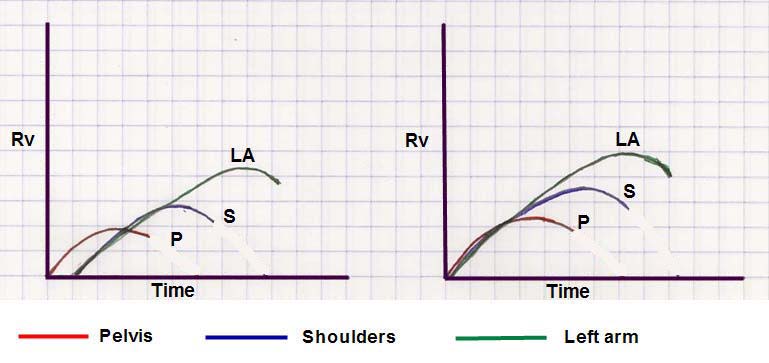 Jeff. |
Quote:
|
Powerdraw
That's a good question. I cannot think of how that would be possible seeing that every club has an inbuilt clubface configuration that requires it to be oriented in a certain way at address/impact. I was merely trying to eliminate confounding variables so that one could clearly establish a clear-cut causal relationship between a cause (swing radius extending to the feet) and an effect (less clubhead deceleration as a result of ball collision) presuming a "fixed" clubhead speed of 100mph at first ball contact. Jeff. |
| All times are GMT -4. The time now is 04:47 AM. |