
|
Keeping the right forearm on-plane
Seeing that Yoda has banned me from participating in other forums on this website, I couldn't comment on this statement by Kevin Carter in another thread.
He stated with regards to Brian Gay's swing-: "I have never seen a player keep his right forearm in such a solid on plane condition for the entire motion as Brian does. It looks so freaking simple!" First of all, what does he mean when he states that the right forearm is on-plane during the entire motion? Secondly, what are the major factors that affect the orientation of the right forearm to the inclined plane during the downswing? Jeff. |
Quote:
Please keep in mind that I am a complete TGM beginner. I have been around the game and teaching for 30 years, but I am beginning a new journey that I am very excited about. I LOVE TGM, but ANYTHING I say has to be taken as a statement from a beginner. I am here to learn. What I meant was that Mr. Gay starts with his right elbow exactly in line with the shaft at address. Something he and YODA are (were) working very hard on. This is discussed in the premium video on this site that I am currently enjoying very much. "On plane during the entire motion" may have been a mis-statement, I'm not sure. Hope I didn't lead anyone the wrong direction! Kevin |
When you state that Brian Gay's right forearm is on-plane at address, I think that you are only looking at a golfer who uses little plane shift and who swings along a plane that is just below the turned shoulder plane. That will mean that his right forearm will lie along that plane angle if he keeps his arms "straightish" at address.
However, that doesn't mean that swinging like Brian Gay is desirable or better than alternative choices. For example, here is a swing video of Stuart Appleby. http://www.youtube.com/watch?v=_jqJ9R2LypY&NR=1 He has a double plane shift swing - from the elbow plane to the turned shoulder plane in the backswing and vica versa in the downswing. You will notice that his right elbow stays close to the elbow plane line during his entire backswing, but the right forearm moves off it during the later backswing. I think that the right forearm must always move off-plane during the backswing so that the right forearm flying wedge can end up being at a near-right angle to the left arm flying wedge at the end-backswing - like a strut supporting an airplane wing. Jeff. |
Quote:
Thank you, I appreciate you trying to help. Of course there is more than one way, that is the entire premise of The Golfing Machine. However... Yoda has shown me through this video of Brian Gay a very valid way to set up and swing. He has documented areas in the yellow book to back it up. He has real world experience from thousands of lessons, displays it in action, and you can watch it in action at the highest level on TV. It is one thing to show fancy graphs and 3D images, and use words that only biomechanics understand, it is another to see it work in the real world. I believe in The Golfing Machine, I want to be what some doubters on other forums would call a "book literalist." My goal is to someday attend AI classes and attempt to pass the tests. The way Brian Gay is setting up with his right forearm is going to be an option in what I teach, as will a double plane shift as Applebees swing is a wonderful model as well. I also like S&T, there are many valid options available that Homer Kelley would approve of. I have chosen my course and that's where I am going to continue heading. Thanks again, Kevin |
Kevin
I think that you may have misunderstood the primary intent behind my statement when I stated-: "However, that doesn't mean that swinging like Brian Gay is desirable or better than alternative choices." You highlighted in bold the first section of that sentence regarding "desirability". It was my mistake to phrase the statement in that manner because it gives readers the incorrect impression that I do not think it is desirable - which wasn't my intention. I mainly wanted to state that it is not necessarily more-or-less desirable than swings that have slightly more plane shift - like Stuart Appleby's swing. Brian Gay has a wonderful swing that is very TGM-sound, as is Stuart Appleby's swing. I think that the question as to whether an individual golfer should chose the Brian Gay model or the Stuart Appleby model is significantly dependent on body physique and biomechanical predispositions (strengths and weaknesses). Jeff. |
Quote:
Thank you very much for clearing that up for me! I did take your statement the wrong way. Jeff Evans, another TGM teacher who I respect immensely, is trying to teach me how to set up with my right forearm positioned like Mr. Gay. My old fat body won't quite allow it. Maybe when I lose 100 pounds! :) I agree 100%, a valid option, but just that, an option. I like the way YODA says it in the video, you can certainly set up without your right forearm on plane, but why would you want to? :) Thanks man, Kevin |
Quote:
truly on plane and not shift planes. You would have to match Dianne in the picture 10-6-B #1. Most setup closer to the elbow plane 10-6-A #1 and shift to the TSP. |
Quote:
Thanks, Kevin |
mb6606
Have you ever considered why golfers do not setup like Diane in 10-6-B? Note that her right upper arm is along/parallel to the TSP. I think that it is biomechanically very difficult to fold the right elbow to achieve the desired right forearm flying wedge position with the hands behind the right shoulder at the end of the backswing - when starting with the right upper arm in that position. It is much easier when the right upper arm hangs down vertically - as in 10-6-A. You used the word "desirable" with respect to the TSP. In what sense is the TSP desirable? Is it from the backswing and/or downswing perspective? Is it from a end-backswing or impact perspective? Jeff. |
Quote:
Desirable = 12-1-0 and 12-2-0. |
mb6606
I do not disagree that setting up as 10-6-B #1 is comfortable. However, I cannot perform the correct right elbow folding action in a comfortable biomechanical manner that allows me to get my right forearm flying wedge to its desired location relative to my right shoulder - when I start from that address position. I am curious - why do you believe that zero plane shift on the turned shoulder plane is desirable? Also, could you please supply me with a list of about five PGA tour players who follow your recommended zero plane shift TSP pattern? Thanks, Jeff. |
Quote:
I do not know of a single player on the PGA tour that does not plane shift. Where did I recommend it? |
mb6606
When I wrote that you recommended a zero plane shift, I inferred it from your previous statement that 12-1-0 and 12-2-0 is desirable, and I presumed that if it is desirable then it must be recommendable. I personally can understand why a zero plane shift could be perceived to be desirable from a mechanical/geometrical perspective, but I believe that it is very undesirable from a biomechanical perspective, which is presumbaly the reason PGA tour players do not use it. Most PGA tour players use a double plane shift swing - hand plane (or elbow plane) to the turned shoulder plane in the backswing, and turned shoulder plane to the elbow plane in the downswing. I think that the major reason for this choice is biomechanical - it is biomechanically natural and therefore it is easier to develop a repeatable swing. The other point that I cannot understand about 12-1/2-0 is the choice of TSP for the downswing plane. Why would it be desirable to come down on the turned shoulder plane? Virtually all PGA tour players are on, or near, the elbow plane at impact. Jeff. |
Quote:
"Virtually all PGA tour players are on, or near, the elbow plane at impact". I suggest you study the Mr. Kelley's plane further 10-6-a,b,c. It is not a question of where the elbow is at impact but rather the plane the club was swung down from the top into impact. |
mb6606
I cannot understand your last post. You wrote-: "It is not a question of where the elbow is at impact but rather the plane the club was swung down from the top into impact." Who was talking about the position of the elbow at impact? I stated that most PGA tour golfers have their clubshaft on the elbow plane at impact. They get it there by having their clubshaft shift planes from the turned shoulder plane to the elbow plane during the downswing. 12-1-0 and 12-2-0 recommends a zero plane shift swing where the golfer remains on the turned shoulder plane. I cannot understand why having the clubshaft on the turned shoulder plane in the late downswing and at impact is deemed to be desirable. Jeff. |
Jeff,
No sense arguing read for yourself 10-6-B! "I stated that most PGA tour golfers have their clubshaft on the elbow plane at impact". I would love to see the stats behind your statement - please list all the players along with the video clips. |
Elbow Planes and Shifts
Jeff,
Please compare Tiger Woods and David Toms 'Elbow Plane' through impact. Especially as it relates to their respective Turned Shoulder Planes. Thanks. :) |
David Toms and Tiger Woods
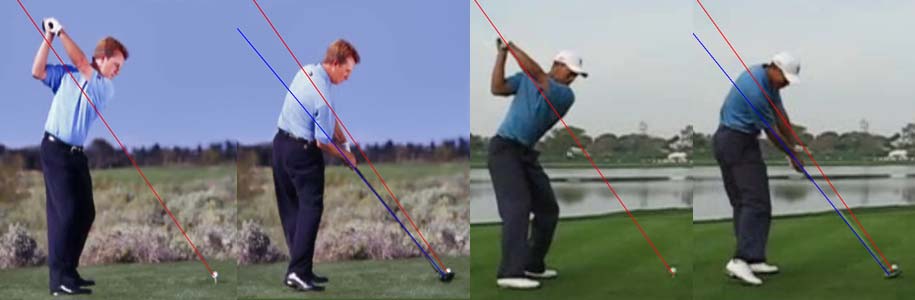 Jeff. |
Customized Plane Angles
Quote:
|
Quote:
|
Excellent post Yoda truly showing the difference between shoulder and elbow planes!!!
|
Yoda
I don't know what point you are trying to make. I only know that there are significant variations in how golfers look in their late downswing. There are golfers like Toms/Furyk/Hogan who have their right elbow tucked well into their side with a significantly bent right elbow at impact. Then, there are golfers like Tiger Woods who lets his right elbow move well away from his right hip pre-impact and that causes his right elbow to be be straighter. TW has less plane shift than DT. In general, I think that most golfers have a shallower clubshaft plane at impact than the angle of the TSP. See the next photo. 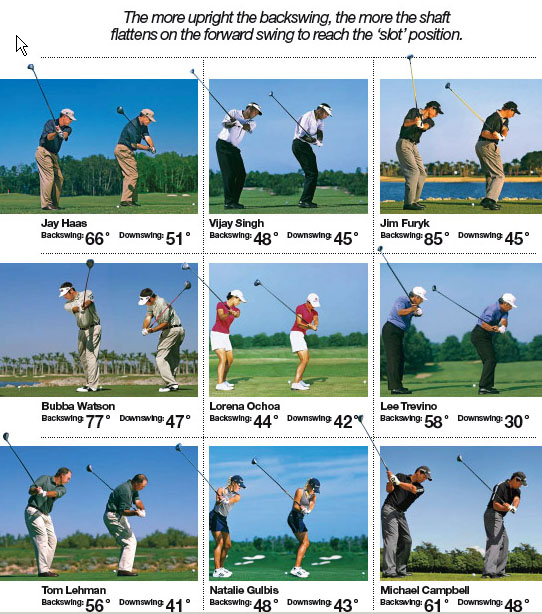 I have noticed that most professional golfers, irrespective of their end-backswing clubshaft position, tend to shallow their clubshaft angle in the downswing so that they reach the delivery position on a shallower plane - roughly 45 degrees (+/- 5 degrees). I generally never see professional golfers coming steeply down the TSP line. Jeff. |
Jeff,
Please read 10-6-A. Tell me which pics are the "flattest normal plane"? |
Quote:
|
mb6606
You wrote-: "Please read 10-6-A. Tell me which pics are the "flattest normal plane"? What are you trying to get at? I have no idea. In a general sense, the flattest normal plane at impact is dictated by the club - it is the plane that allows the lie of the club to be "normal" (sole of the club to be horizontal to the ground) at impact, so that the the heel of the club doesn't hit the ground first. Jeff. |
Plane Shifts of the Best
Quote:
Could you now offer a 'from the Top' photo comparison of Tiger and Sergio? Ideally, the sequence (and the lines you draw) will differentiate Top, Start Down, Downstroke, Release and Impact. Thanks! :salut: |
Garcia versus Woods
Sergio Garcia
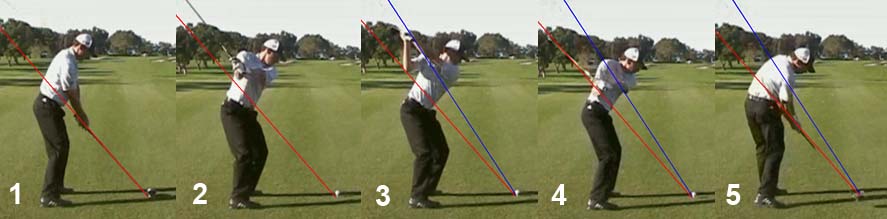 Tiger Woods  Jeff. |
duplicate post
|
Quote:
Best way to truly understand the swing plane is build yourself a swing plane as in the book. Set the plane per the photos in 10-6 and swing away. |
mb6606
You may find it difficult to interpret 2-D DTL images in terms of swingplane, but I don't. I realize that a perfectly accurate assessment cannot be established from a 2-D DTL image that is off-axis, but it can be close enough to justify general conclusions eg. establishing that SG and TW's clubshaft comes down on a shallower plane than the TSP in the mid-late downswing, and that SG drops his hands/clubshaft down to the elbow plane early in his downswing action. Look at SG's third image - when his hands are at belt level, when his clubshaft cuts across his lower biceps and when his clubshaft cuts across his mid-lumbar spine. Adopt that position when facing a side-mirror - it is incontrovertible that your clubshaft will be just above the hand plane, and close to the elbow plane, at that time point. Jeff. |
Quote:
|
mb6606
Could you please describe, or visually demonstrate, your golf swing when you use a quadruple plane shift? Jeff. |
Quote:
address - elbow plane top - TSP end - Turning SP down to impact -TSP |
mb6606
Thanks. Homer described a triple shift in 10-7-D but he didn't include your quadruple shift variation in his book. I would be very interested in seeing a visual demonstration of your quadruple plane shift swing. Jeff. |
You can shift all over the place you might end up looking like Charles Barkley
http://www.youtube.com/watch?v=DFtoe...eature=related |
| All times are GMT -4. The time now is 07:26 PM. |