
|
Left Arm rotation Question
Please bear with me if this question has been dealt with in a previous post,not sure how to word heading in "search" to find out,so I will ask directly.
Where does the L/arm actually "rotate" from?,in my attempts to maintain FLW(R/hander),I have found myself rotating my L/forearm,but get the feeling that it is not correct,should my L/arm be rotating from the shoulder and not the elbow?,both can be done ,butthe resultant finishes are quite different...What is right?....Thanks in advance Where in the book is this covered...thanks |
Great Question.
Do you mean "From what joint does the Left Arm Roll when the #3 Accumulator Rolls in a Sequenced Release? If so, then, "The Hinge". Your Left Shoulder. The Primary Lever Rolls by Rolling the Right Forearm Flying Wedge. The Right Forearm Flying Wedge Rolls when it passes to the Left of the Right Elbow during Release. |
Thanks
Thanks for quick reply Daryl,do you see my reason for my asking this question. For quite some time I have felt that I had to roll L/forearm at the elbow,it seems to create a fault in the follow through which a lot of golfers may not recognise where the fault is actually coming from hence the reason for my query.
The fault could actually begin at the release point,where I felt I was erring,the only way I can describe it,it was short circuiting my finish,it I felt was affecting my pivot "to a point".I hope you can follow my train of thought....cheers |
So,let me see if I get it,at release I swivel to impact,at impact it is hinged to follow through to both arms straight and then to finish swivel,forgive the dumb questions,but you are turning on some light bulbs for me...thanks Daryl
|
Quote:
But Swiveling and Roll Power are not the same. Swiveling Rotates the Clubface by the Left Wrist while Roll Power Rotates the Primary Lever from the Right Elbow. Swingers using Standard Wrist Action may Swivel during Release but it is not required. Swiveling is necessary when you release early (Elbow Plane) because you cannot Uncock and Roll the #3 Accumulator on the same Plane Line. Swiveling Rotates the Clubshaft Counterclockwise. The #3 Accumulator Roll, rotates the Power Package and Clubshaft. Swingers using a Turned Shoulder Plane can Uncock and have the #3 Accumulator Roll on the Same Plane Line. Right Elbow Location determines how much Roll Power can be used. However, a Double Wrist Action Swinger Only Swivels through the Release Interval. With Roll Power you should feel the #3 Pressure Point move to the Fatty part of your Right Index Finger during Impact. With Swiveling, the Pressure will stay on Top of the Clubshaft. Quote:
|
great post
Once again good post. Importance of distinguishing between forearm wrist motion and whole arm motion is rarely pointed out.
|
Quote:
Brownman assuming you are still Hitting, Id say that given Angled Hinge Action and Punch elbow there isnt a feeling of turn or roll, so you dont need to worry about where originates from. The left wrist however will still need to swivel onto plane in the backswing and in release - a left wrist only deal as opposed to the entire left arm deal of Hinge Action. A Hitter bends his right elbow to move the Primary Lever (left arm and club) in startup. No turning left wrist necessary but you do need to monitor your left wrist staying perpendicular to the Angled Plane. Let the right elbow provide its magic and it will get it done and cock the left wrist in the process. Ob |
Thanks for reply OB.
I still "HIT" from time to time,but at present Im learning swing procedure,my bad,sorry. The thing that got me on track today or lit up another light bulb was imagining the is a plane line 2" below the surface,NOW,Im really compressing the ball.More later...cheers |
NO worries mate, I swing and hit too. There is something special about going all the way "down". I think the arms go up and down and the pivot goes back and around, the clubhead orbit netting out on plane. As such the arms and the hands if focused upon must be very "down" oriented. The pivot will supply the "out". Normally it is the "down" that is missing in 3D impact.
|
Thanks OB,I totally agree with your 3D concept,I played today and generally compressed the ball well,for the most part.
I have to "fess-up",I hit 2 of those shots we dont speak of,s....s,but at least I understand what took place,simply did not full uncocking left hand,I feel I actually let my fingers on my R/hand come into play...flipped...I think it is down to discipline...cheers |
Hammer time.
Perhaps researching the "Throws" will help the Throwaway problem. Similarly named things but actually very different and delightfully mutually exclusive to some extent.
10-20-E The Swingers left wrist Throw. By actively throwing down plane any horizontal hand motion or "throwaway" is highly unlikely. Also 10-20-B Hitters Right arm throw. Let the right shoulder take the power package down plane as per usual in Startdown ensuring that you dont run out of right arm and then trigger the power packages release of its accumulated power with a Throw of some sort. Early or later throw (trigger) for various shots, trajectories, power etc. No Throwaway as its hard to "hammer" and flip at the same time. It seems like a throw would encourage an early release but on film you'd be surprised by how late it can be despite the way it feels. Oh and man do you go down, way on down to where the music plays as Elvis would say. This component may be the main difference between Hitting and Swinging for me anyways. |
The Wrist Throw automatically Triggers the Release of the #3 Accumulator. If the Right Palm faces the Plane at Release and the Right Wrist is Bent and Level, then Straightening the Right Elbow will Force the Left Arm to Roll. Centrifugal Force Uncocks the Left Wrist and Straightens the Right Elbow. So, it's Automatic if one can achieve the Geometry of the Right Palm Facing the Plane at Release. Definite Pitched Elbow.
Quote:
Note: Without using a Wrist Throw Procedure, all Swingers must use a Non-Automatic Roll. That means they must deliberately bump the Left Wrist before reaching the End of the Delivery Line. |
Quote:
As for the left arm rotation,I am still having a battle finding a "feel"that reminds my body to rotate my upper arm from shoulder-NOT elbow as this is a point that is breaking my swing down from time to time. It doesnt matter whether or not my R/ forearm pushes to both arms straight,that can be done with L/forearm roll or upper arm roll (sorry roll should read rotate)but one or the other is causing a faulty stroke. I hope you can follow my description.....cheers |
Quote:
Quote:
Your Right Elbow needs to get closer to your Belt Buckel while your right palm is still facing up and you begin to Uncock as your Right Palm is Facing Up. This Alignment will Snap Roll the #3 Accumulator as the Right Elbow Straightens. It has no choice. You will feel an underhand Pitch motion. Quote:
Hinging occurs when the Left Wrist is Flat before, during and After Impact. You're Aligned to produce an Angled Hinge. You want to Align Components in such a way to produce a Horizontal Hinge (Full Roll - See Above) |
Thanks
Thanks for help Daryl,I will take time to read through the yellow bible armed with your advice....I will let you know how its progressing...thanks again
|
Daryl,and OBleft.
Good news on my journey to swingland,I feel so much more at home with the wrist throw.Now Im getting R/elbow into "pitch " position with R/palm up.But Im now understanding more about my alignments and how it all unfolds down into the the back of the ball,all still on plane. Once it all started to come together it feels so "natural" for my R/elbow to get nearer to belt buckle and the resulting shots are begining to look,feel and sound like a golf shot Today,I found myself being able to practice 3 forms,1...swinging.2...hitting.3...single plane the latter just for fun.As for the the distance difference between hit and swing,very minimal,what I did find was mainly a difference in height between H & Swinging. I might have been slow learning the swingers pattern but along the way I have learned a lot more about lever alighnments...Cheers BM |
Its all about the right elbow's position, to my mind. That is why Homer used it, the right elbow, to define the various strokes. PItch , Punch, Push etc. The elbows position promotes the corresponding hand, wrist alignments. Pitch elbow begets a early left wrist cocking via the bent right elbow and a delayed release for instance.
Want to Float Load? Get a Pitch elbow in transition. By the way, since you are an old hitter type, Pitch ish elbow does not mean that you cant use a right arm throw. |
wrist throw
Daryl, I believe you have mentioned this before, but the left wrist is slightly bent at release to allow for the uncock and roll of the wrist throw, correct? It appears to be the case, but as you know, there is no 'seems as if' in the golf swing, just checking. Thanks
|
Quote:
The amount of Bend in the Left Wrist (10-2-B Grip) depends and coordinates with Right elbow Location. Flatter Swing Planes have the Right Elbow Closer to and in front of the Right Hip and need Wrist Bend. Right Elbows on a Turned Shoulder Plane are Located Slightly away from the Body and Closer to the Belt Buckle and need a Flat Left Wrist. With a Level and Bent Right Wrist, relocating the Right Elbow left vs. Right and Closer vs. away from the Body, which is simply relocating the Right Elbow to Flatter and Steeper Planes will show that the Left Wrist Bend Changes without changing the Bend in the Right Wrist. Clubhead Vs. Clubface: Changing the Left Wrist from Bent to Flat demonstrates that the motion spins the Clubshaft and Changes the Clubface. This is a Clubface Motion. I think that this is Zero #3 Accumulator. Two Barrel. The #3 Accumulator is a Clubhead Motion (Flat Left Wrist). It is a Flying Wedge Roll that Changes the Location of the Clubhead. This is why Horizontal Hinging has greater Clubhead Travel than Angled Hinging and why Vertical Hinging has very little Travel. This is #3 Accumulator Power that will be added to the Residual #2 Velocity Power. Three Barrel. |
Quote:
What I think you mean, the left wrist being 'flat' visually at release is not actually flat, but slightly arched. There is no need for 'bend' at release if the proper definition of 'flat' is understood. bent = left arm flying wedge out of alignment flat = left arm flying wedge in alignment. Take your left hand and grab a bottle/glass or water and lift it up to drink. That is a flat left wrist. |
Quote:
He's talking about a Double Left Wrist Bend and how to perform a Non-Automatic Release of #3. I agree about the Left Arm Wedge. To me, Flat is Flat. Visually, lay a Level on it Flat. Flat Left Wrist, Bent and Level Right Wrist, Uncock and Roll the Power Package on Plane. Flat. |
Quote:
HH has greater clubhead travel - so would it be moving faster or slower... resistance vs. speed from face rotation. AH/VH has less travel and a slower rotation, so does the face move faster or slower with rotation/closure? we know what it does to curvature. |
Quote:
Accumulators move the Center of Gravity of the Clubhead. Hinging controls the Club Face by rotating the Primary Lever around one of three Hinge Axes; Vertical, Horizontal, or Angled. Release Interval, Stroke Length effect Clubhead Speed. So, though one Hinge may appear to have more Clubhead travel than another because of how the #3 Accumulator is used (Right Elbow Path through the Release Interval), the Sweet-spot has the same Travel. Meaning that from start-up to Finish, the Clubhead Travels the same distance regardless of Hinge Action. 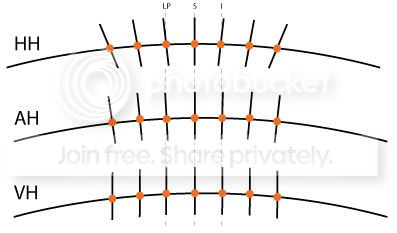 |
Nice drawings.
But I dont get the sweet spot not traveling with the clubheads travel. Travel is dependent on Hinge Type but only via the #3 Accumulator angle, the angle at the left arm and club when seen from DTL. The more angle the more travel. You can zero out #3 by going in line like we do when putting say with less send resulting. In this case the travel associated with all Hinge Actions would be the same. But, Im thinking that if the clubhead travels so does the sweet spot, no? Although sometimes I do feel like Ive left my sweet spot behind, some place. |
Quote:
Pressure Points sense the CG of the Clubhead. Accumulators Speed up the CG of the Clubhead. Accumulator Pressure adds Mass to the Clubhead. Hinging controls the Clubface Rotation. Slicer Mcgolf was asking if the greater club head travel distance with a Horizontal Hinge created a faster moving Clubhead than an Angled Hinge with its comparatively shorter Clubhead travel distance. A Hinge isn't an Accumulator. Hinging is Clubface motion. In an Automatic Release: No, but the Clubhead moves faster because it uses an additional Accumulator (#3 in a sequenced Release). Not because of Face Rotation. Quote:
In a Non-Automatic Release: No, because Accumulators #2-3 are Simultaneous. The Clubface Rotates around the Center of Gravity of the Clubhead, not "A Hinge Pin" perpendicular to the Horizontal Plane. The #3 Accumulator is negated. |
| All times are GMT -4. The time now is 04:37 PM. |