
|
Hip rotation
In one of the Alignment golf drill's DVD ( think it ie "highschool Hips") VJ puts a dowel in his front pant loops and says not to hit the dowel. Yoda also seems to have a "less violent" hip rotation. BUT Hogan would hit the dowel every time. I hit the dowel. I do not know why this is wrong. why is it wrong and how do I make a change like that without stopping or slowing my pivot?
The Bear |
Very good question!
Patrick |
Hint: Hula :)
|
It's been a long time. Work has kept me busy 24/7.
 Above is a pre-impact photo of Jim Furyk. It serves to illustrate that one can build a respectable game and include almost any oddity one can imagine. JF drops his hands straight-down-vertically to the ground before finding the Elbow Plane. That’s not “Tracing the Plane Line” and it’s not clearing the Hips in the traditional sense. His Power Package looks ok, but his Hips are doing what? Is his Pivot supporting Delivery Alignments? Is his Pivot helping the #3 Pressure Point Trace the Plane Line? Power comes from the Accumulators and not from flinging the Hips forward and toward the target like Elvis Presley in Jail House Rock. If a student starts acting like Elvis, then V.J. gives them the dowel drill to thwart other bad habits before they start creeping into the swing. Consider what happens when planting the left heel initiates the downswing. The Hips move slightly toward the target, the left hip moves away from the plane line, the right hip doesn’t move much toward the plane line, the shoulders instantly begin their rotation as the right shoulder and Power Package are “driven” toward the plane line which helps/allows the #3 Pressure Point Trace the Plane Line . The Right Elbow will “clear” the Right Hip and the dowel drill will have served its purpose. The Purpose is to teach that the Pivot moves to support all of the delivery Alignments while the Accumulators create Power. Thousands of ways to swing a club. |
It may have been a long time coming but that is a great welcome back post :)
|
Hi Daryl,
I am new here. May I ask what the "dowel drill" is? I have been a long time hip thruster and this sounds like it may be helpful to me. Thank you in advance. |
Hips
Thanks all.
If I may ask by describing my feel'(s) Let’s start with a description of intentions and feel. I am likely wrong (obviously ) . 1. I turn back and arrive at top with the following feel. BOTH feet are flat , left knee in and forward a bit (points to about where right foot point on plane line), right knee slight flex, weight on inside of foot , tension on inside of leg all the way up. My right foot feels screwed into the ground and wants to rotate clockwise but can’t. 2. My shoulders arrive almost level , facing away from target, hips have rotated back about 30 degrees. 3. I stop my arms at the point either shoulder would start to move independently, so both shoulders feel forward and the right hand is “kind of” stretching the left. (I do this a little different – EXTENSOR ACTION) 4. I can stop here and contemplate my shot- It can get tiresome but I can hold the position. 5. Hula- Hula, I slide my hips parallel to the plane line, no rotation, spine is now tilted, shoulders-arms- hands-head-feet,all stay still. King of making my body a flying wedge pointing to the target NO rotation, hips slide in direction of left rear pocket- repeat- NO rotation only slide twords target, just middle of body. creating spine tilt only 6. NOW time to commit. I can either swing or hit from this position. No need to go through all the zone #2 alignments I am preparing for but they happen now. 7. Coming down , prior to release is much the same for either. I aim my right shoulder at the plane line and I START TO UNWIND. LEFT hip turning , torso under tension, EITHER- left arm PULLING #4 or RIGHT HAND DRIVING #1 Elbow leads more for swing and pitch less for punch and hit. 8. MY RIGHT HIP , TURNING WISE, REMAINS WAY AHEAD OF MY SHOULDERS, MY ARMS DON’T PASS THE BODY UNTIL DURING THE RELEASE INTERVAL and just get in front at follow through (both arms straight) I can do the motions in slow motion and the result is still: I can not avoid hitting the dowel?? Let me add- I am doing some things wrong because I am not getting the results expected. I try t get the alignments available in TGM. And I can get -what I call- a little "Loosy-Goosy" ( a rubber man)and I am sure that does not help but power comes up through the hips and I need to keep the power and loose the motion- make sense?? How do I do that?? The Bear |
V.J's dowel drill is good for pointing out the extent of the problem but there may be a better drill to give you a solution.
Ben Doyle's drill: Cut a length of dowel so it can be used as a stick seat. Put the dowel in place and learn to swing the club and Pivot so that the dowel doesn't fall away from your butt until follow-through. Don't put a lot of weight on the dowel because it'll defeat the purpose. You won't hit the dowel in V.J.'s drill if you learn to pivot using Ben Doyles Drill. Bucket uses a drill involving a car battery and jumper cables but it's been banned in most States and Canada. |
Quote:
The first things that came to mind were: Snipe hunt and Something about my goat. I will shorten my Hip shift first- I may even prefer the battery experiment to sitting on Ben's short dowel. I do ralize this may be an honest drill and I am sorry for seeing any humor in an honest attempt to help. The Bear |
Quote:
|
It's good to have you back Daryl,
We have been missing you. Quote:
Turning the hips here as Jim Furyk is doing helps to preserve pp#4 pressure and save a lot of Accumulator #4 power to impact. It also provides a post from where it is possible to keep turning hard thorough the ball. And thrusting. And pulling. From a pivot with all the right tensions in place. I know because I've been doing it for years. I have now experimented with a more typical TGM impact alignment for half a year. Swing speed is basically the same but I get a lot more lag pressure through impact when I do something similar to Furyk. I get more from all accumulators through the ball this way. The strong hip turn is also a good throwaway & flipping insurance. All golfers are stronger before the hands pass their right hip than after - if they have the footwork to make it happen. The later it happens the longer they can use their strength. |
Welcome back Daryl!!!!!!!!!!!!
Go Chi Hawks! |
Quote:
|
Quote:
You're good on my drill North of the Mason Dixon . . . never been to the state of Canada before . . . so probably OK there too . . . . |
I was actually born in Dixie, in the province of Virginia. Dad was working down there for a bit. I told Lynn that once and he was like "Virginia? Thats just about as north as you can get and still be in Dixie".
Elvis' American Trilogy gets me all teary eye'd to this day. Seriously. This might be a good time to discuss Homer's impact being "comparatively squared away". Surely he saw Hogan's two cheeks in photographs. Phil Mick and Greg Norman dont two cheek it. It can be a sign of Thrusting for some folks or a rate of overtaking thing for a swinger Id imagine. I think you should spin the Hips and then let em coast. So they do some initial work some pulling and then they subside into mere motion prior to the Shoulders overtaking them. Consider for a moment the 6-m-1 "Downstroke Sequence". There is no mention of degree of leading , Hips vs Shoulders. Only that they lead. It wouldnt be labelled a "Sequence" if the Hips were meant to keep working, pulling forever Im thinking. Homer talked about the Swinger "spinning the fly wheel". Having spun a fly wheel recently , its a spin it and let er go thing, not a continuous spinning. How 'bout Hogans' "quick initial hip acceleration"? Homer said it took his Hands from End to Top. Note he said "initial" as opposed to constant or continuous or something. Some folks advocate a second firing of the Hips. Kinda weird and not flywheel like. Some advocate Pivot braking , less weird to my mind, but not a flywheel thing either. How do baseball pitchers turn? Do they plant their lead foot , and then turn their whole body or do they spin their hips? Why did Homer say "comparatively squared away"? Not that I dont like it or anything, being comparatively squared away at impact, myself |
O.B,
Great Post. I love the Term “Comparatively Squared Away”. 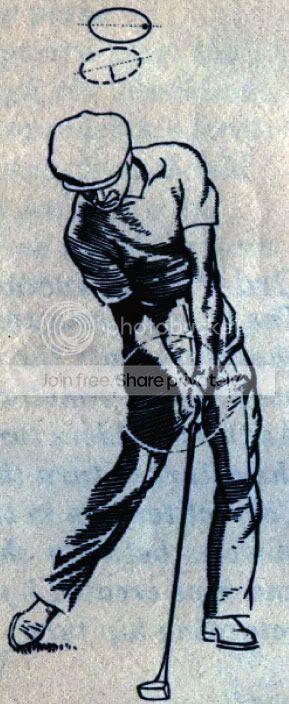 From the Top of the Backstroke to Impact, Hogans shoulders Rotated 90 degrees while his Hips Rotated 75 degrees. Did his Hip Turn slow down allowing his shoulders to catch up? or Did His Right Shoulder accelerate, thus gaining on his Hips? The following Vapid Post tries to answer this question: The Farther the Right Shoulder is Driven Down-plane before Release (the left Shoulder moves correspondingly Up-Plane), the greater the Right Elbow Bend at Release. The Greater the Right Elbow Bend at Release, the Farther Forward the Hands can be at Impact and reach the Line-of-sight to the ball without the risk of Running-Out-Of-Right-Arm at Impact. If the Left Shoulder leaves the Plane while the Right Shoulder is moving Down-plane, then the “off the Plane” rotation will cause the Player to Bend the Plane-Line. Notice in the BH illustration that while both the Right and Left shoulders rotate On-Plane, there is 0 degree horizontal rotation. The Shoulders have rotated open 45 degrees to the Target, while the Hips are open 30 Horizontal degrees to the Target. I think the Hips still lead and drive the Right Shoulder through the Impact Interval. BH's hips are turned 45 degrees at the Top of his Backstroke while his shoulders are turned 90 degrees. So, one Question is: Did his Hips slow, allowing his right shoulder to catch-up? Or, did Hogans Right Shoulder Accelerate Down-plane? If his Right Should accelerated, then the thrust applied to them from the Top of the swing remained constant during the Downstroke sequence. In other words, his rate of Hip turn wouldn't slow down, but rather speed up. This is possible because the Hips Slide (Slower rate of rotation), then Turn (sharper rate of rotation). If the Right Shoulder is Driven Down-Plane by Hip Action, then slowing or stopping Hip Action prevents Right Shoulder acceleration. Holding a Ball in your hand out the window of a car traveling 50 MPH, then slamming on the brakes, and then throwing the ball, isn't "Launching Pad" or "Flywheel Spinning". Even Thrust is needed for the Right shoulder to accelerate into the Release Interval, which requires the Hip Turn to increase speed. Hip speed is increased by changing its rate of Turn, not by using muscular effort to fling the Hips toward the Target. __________________________________________________ __________________________________________________ O.B. Ya know, if you were born in the US, then you may qualify for our new National Health Care system. That's the Ultimate Choice. You can choose to wait in line in Canada or wait in line in the USA. |
In the Shells WWOG lesson, Hogan demonstrates what we'd term a Startdown Waggle and talks about how its the "movement of the lower body", the "knees and hips", "not the shoulders". And goes on to take the club all the way down to Release with an apparent Turning motion.
In his slow motion drills, The Coleman tape for instance he shows a similar lower body turn with no shoulder action or independent movement even in Startdown and Downswing and does it in such a manner that the clubshaft gets really stuck behind him and off plane. Im wondering if this is a slight exaggeration, a feel maybe but not a real? What do you guys think? Although he did get the club laid off a tad in transition sometimes when actually swinging, Im thinking that he got the sequence , the next component above the Hips the Shoulders going earlier than Release, Actively (Shoulder Throw) or otherwise. This would be consistent with his chain action theory wouldnt it? Homer made a serious study of this motion. He thought Hogan was the "Ideal" in terms of Pivot and CF. He thought Hogan spun the fly wheel and then having set the whole thing in motion had no choice but to just let er go...........that he could fall asleep and still end up hitting the ball. An early , over the top firing of the Shoulders is a 6-M-1 wrecker for sure............but what about an effort to turn the Hips to pull the Shoulders deep into the swing? Is that a Sequence wrecker too? Dont the Hips have to give way to the next component, the Shoulders if your using 6-M-1? After the quick initial acceleration is it even possible to maintain the Hips rate of turning, acceleration? If no then the Shoulders are coming on stream whether your spinning the Hips hard or not. The force, in its ground up 6-M-1 Downswing Sequence pathway has passed from Hips to Shoulder to Arms to Hands to clubhead already by impact .............so what is the continued effort to make the Hips pull the Shoulders accomplishing? And even if you could maintain the Hips rate of turning to pull the Shoulders all the way down to Impact would that not mean that you have yet to Release? Where is the clubface then? You'd making contact with all the Power Accumulators fully loaded. What if they are the same at Separation? The Hips for some guys may be very open at impact but this doesnt mean they are still pulling the Shoulders to my mind. Its a residual. They did have a running start after all being less turned at Top than the Shoulders. Heck you could turn the Hips and Shoulders together as a unit from Top and arrive at Impact with the Hips relatively open and having had zero hip pull. Its a co ordinated sequence. Like whip cracking or towel snapping or whatever. You have to let the force pass on to the next component. The Hips go and then slow, they work and then coast. We dont consciously slow them they just do it on their own. They cant maintain the pull, so the Shoulders go no matter what. No second firing , no constant spinning required , no braking. Although a firm left side and balance are alway welcome. After the Shoulders go the Left Arm separates, #4 fires. Whether your Shoulders are still moving forward or not. Same deal. Its a multi levered sequence. Making "High School hip action" an exaggerated , sequence and balance damaging .....affectation. Unless of course the co-eds like it which would be another consideration all together. I have super 8 film of my swing when i was about 15 or so back in the seventies ........showed it to TEd recently ............man its funny. Ted wondered how I was able to see the ball through all that hair. My back aches just looking at that reverse C swing today. |
O.B.
Very Convincing. Quote:
    |
Two cheeks for sure and interesting given that Toms and Trevino are generally considered to be Thrusters.
But what do you see D? I see all these guys releasing into the ball. Do you see the Hips still pulling the shoulders here? They're open for sure, they havent been overtaken by the Shoulders yet. But Id say their Sequence has long since passed the Hip firing , active turning, hip work period. If Hip work is critical to power then how do we explain guys that can hit it 280 off their knees? Take away their Arms in some way and youd have placed a serious restriction on their power though I bet. Who would hit it further a guy off his knees or a guy on his feet but with his arms strapped to his body? Homer had Zone 2 as Power right? What are we supposed to be talking about again? Oh yah, how far ahead do the Hips need to be? Must they be? Why? What do those things do anyways? Im thinking that they provide the initial spin to the flywheel. Me personally Ive got a lazy set of Hips. Lynn thinks its residual from my hockey slap shot, which makes a ton of sense to me. He kind of blew me away with that insight actually. You cant spin the hips when taking a slap shot , your loaded edges wont allow it, its all shoulders and arms , hitting across your body. And interestingly often accompanied with a Greg Norman like backward right foot drag. |
I completely agree again. Look at the Right Shoulders in the Pics above. They are all On-plane at Impact. I doubt that you'll find a Professional Golfer that doesn't have an On-Plane Right Shoulder at Impact.
The Pivot moves to keep the Right Shoulder and #3 PP On-plane. Accumulators generate Power. Hip Action driving the Right Shoulder Downplane is a Power Package Alignment issue. At Impact, it would be easier if the Right Shoulder, Right Elbow and #3 Pressure Point were all On-Plane. When Hip Action Stops, the Right Shoulder moves off plane; Horizontal, above Plane. Hip Motion allows the Shoulders to turn. Hip Action directs them by Driving the Right Shoulder On-Plane, Down-Plane. 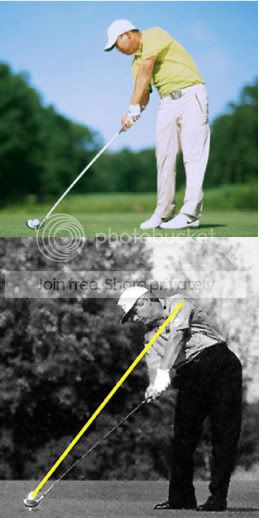 |
Cough, cough..
Cough, Cough.....
If I may rudely interrupt.. Way back at post #1 in this thread I was trying to riddle the use of VJ's dowel drill which he calls "high School Hips".. "we" may have concluded that failure of his test ain't always and for everyone BAD. But I do fail the test and I do think it is a "MESS-UP" that I should try and change. BUT, I do fear it may be a pyrrhic victory. The Bear again. |
Welcome back D!
Would the elbow plan swinger need greater hip rotation through impact than the TSP??? |
Quote:
I think the Drill will bring instant improvement. It forces you to keep the Hips from sliding too far left and especially forward. The Pivot should maintain its posture. Losing waist/hip bend (Standing up) during the down-stroke forces the right shoulder to flatten and go off plane. You want Hula-Hula flexibility, not hula hoop Hips. I think the Ben Doyle Drill teaches all of it. Hi MB66. The amount of Hip Slide needed to keep the Right Shoulder On plane differs. I don't know about the Turn part of it. Great question. |
Quote:
Not D but I play him on TV. Im thinking an Elbow Plane guy probably has a really strong sense of turning, Pivoting through the shot, a strong sense for the #4 pp , he's Arc of Approach, Wheel Rim, maybe has a feel for some rolling of #3 angle too. So yeah, Hip turn and feel for sure Id say. One Hip turn though, not two firings or whatever. I know there's a really popular teacher who advocates swinging left on the Elbow Plane, a refiring of the hips and using the Angle of Approach but .....arent those kinda mutually exclusive? How do you get your clubhead to go out to right field and swing left at the same time? How do you see a wheel track on the elbow plane unless your eyeballs are in your elbow? How do you re fire the Hips? Even if you could re fire them , could they get in front of the Shoulders and start to pull them again? Sorry for the digression .......Daryl brings back a lot of misty water color memories. |
Porch Light's On
Quote:
The thickest skin . . . And, the most sensitive . . . I have ever known. :salut: |
Rhythm!!!
An opportunity for BD "short dowel" drill just passed. Bear |
Quote:
Im guilty of that too. Maybe all us Homerites are to varying degrees? It aint easy. Such is the price of genius, Daryl. Galileo was tried and found guilty of heresy for things we now consider common knowledge as well. Just like you buddy. I see no difference , he was a Sox fan too. Which in retrospect is maybe why they fried him. A huge Hawks fan, he is said to have worn a Makita jersey to his inquisition. Gotta love the guy for that. |
If Stan and Galileo could do it once again..
Tell me, OB, would they, could they? Or, has time re-written every line? You know, it don't come easy. But you've got to pay your dues if you want to sing the blues.
Babs, was a great singer despite her politics, IMHO. :) Ringo was more my speed. Pat Quote:
|
Quote:
I know, I know. I'm thin skinned. :) Not always, but much of the time. And I'll tell ya, it's as hard for me as it is for everyone else. :laughing9 I stand out because, comparatively, this web-site has mostly steady, even-tempered and friendly personalities. It's something I promise to work on. :) |
Quote:
|
Quote:
The board is simple. A 4x8 sheet 1/2" covered foam insulation. Cut a 30" radius center-edge. Adjust with 2 48" driveway markers for angle desired. < $7 cost. Rail is 2 10' lengths 2" pvc (grey) electrical conduit, 2ea. 2" PVC (white) DWV (pluming-drain) "T's" and 90*'s . cut one 10' into stand pieces and cut molded coupling off one 10' to fit fittings. No glue, friction fit, assemble when using. $10-$12 cost. Good and Bad points. Good- gives a clearand different view of swing Bad- Both promote a tendency to try for a sweep release so the shaft rides on the plane. You have to overcome this tendency or U are doing nothing. ALSO- ( I do things on the EDGE so these are my "damages") I have nicked the plane board low/right between release and impact- only during swinging [only use Irons]. I think this is hossel hitting board at swivel because sweet spot trys to stay on plane so hossel goes underplane. I quickly smashed the rail and had to replace because after a few swings I tried a metal wood. The good thing was I hit the bar less than a club length behind the ball . SO remember a metal wood has a big protrusion below plane before swivel. Irons don't do this so not an off plane movement. The Bear |
I bought a simple lazer devise that attaches to the shaft of the club. With one laser pointing each way.
It told me a lot about my swing plane. Eventually I concluded that keeping the shaft on plane was not for me. I'm a natural born plane-shifter. |
Quote:
I have one of those laser gizmos too and like it as well. Mine actually points a laser out of the #3pp at the sweetspot which I like. Dont know if I should mention the make, but lets say its offered by a guy that used to coach Tiger Woods. Im thinking the genius of its alignment is probably mere happenstance. No offence to Dutch Barmon , I just dont think he had Homers geometry in mind, thats all. Remember it is really the Sweet Spot plane that travels the Inclined Plane , the shaft and butt end are only handy, close approximates. The #3pp is the lowest point on the grip that attaches to the shaft, making it the top of the Sweespot Plane, the Longitudinal Center of Gravity. Take a plum bob line and attach it to the top of the grip, where it intersects the face is the commonly termed Sweetspot , but the entire line is the LCOG. Now move the top of the plumb bob down to a lower point on the grip, where the #3 pp would be approximately. Notice how the place where the line crosses the clubface has moved!!!!!!! The sweetspot on the face has moved! Gripping down on a club moves the sweetspot. Lag Pressure is the feeling of the Sweetspot, so direct that pressure at the ball. The shaft rotates around the LCOG, not vice versa. " The Sweetspot is a point without dimension", said Homer. Like a balance point. So running the shaft down a plane or rail is good for training but not exactly what is going on when swinging. The shaft will be under the plane at impact. Which is why Homer preferred a flash light held at the #3pp for plane tracing exercises. The high jumpers COG never gets over the bar but his arched body does (and he rotates his feet around it). |
Quote:
It is the Hands that we Swing and the #3pp that we direct, Trace with. Swinging the Clubhead will always promote a Sweep Release. A throwing of the clubhead at the ball. Swing the Hands, let the Club go where ever it wants to go in the hands. The Hands are just clamps. Release is when the Palm of the Left Hand comes off the Inclined Plane. Put your brain in your Hands, in your Pressure Points. Play by feel. What was it Homer said? "If you're not getting all you should out of your shots , despite your knowledge of alignments. STOP MONITORING THE CLUBHEAD AND MONITOR THE HANDS!" Something like that. |
Quote:
I think you missed my point. I was talking about using a plane board or a rail. With either a "proper" swing the hands are so far down plane that the shaft does not reach the board or the rail until almost release for a plane board and after release for the rail but to SEE-LOOK, LOOK, Look- the shaft ON the plain BOARD or RAIL requires an early sweeping motion. While here- Sweet Spot- Where it is and how and why it gets on the ball begs some theoretical discussion. Try this- In the dark, have someone hand you clubs with a non indexed grip and without plum bobing them find the sweet spot face orientation 100% of the time. You may be surprised. Watch the trick shot artist, always has an "address routine" for locating...?? The Bear |
Think I found the answer
Thanks all for helping me think this out.
I think the problem/solution is: I "was" not only sliding and rotating my hips but also turning them on a sweeping plane. very close to what may be called a hip plane. this down and around I do not find in any competent swing I have looked at.:naughty: The best swings show a very level hip turn.:study: I got out a couple of my shop adjustable roller stands. One stand just under my butt. As i go to top my right cheek kind of sits on the roller, I slide along roller only 2-3 inches then as i rotate left I feel my left cheek sit on the roller and if I am swinging:golf: my butt kind of rolls around end of roller and If I am hitting:boxing: it kind of stays on roller. This is far from automatic yet and the feel is very different but I have looked and looked in a mirror and I think I am on the right track.:question: I use a second roller in front of right thigh an I try not to bump it . How does my analysis and remedy sound? The Bear |
Quote:
Quote:
Go-ahead and test your results with the V.J. Trolio Dowel Drill. Let us know the results. Pass or Fail? |
Go-ahead and test your results with the V.J. Trolio Dowel Drill. Let us know the results. Pass or Fail?[/quote]
Thanks; It enables me to pass the dowel drill. BECAUSE- (now I have not tested long enough to see all the results). I FEEL that my pelvis rotates MUCH quicker but also slows quickly and sooner. I have a better pivot separation between pelvis and shoulders. maybe I shouldnt mention the words but _KINEMATIC SEQUENCE- with distinct hip and shoulder separation. The rollers do not help with balance because I will just roll off or push them away if I put much pressure against them. I just feel position. The Bear |
Quote:
Please don't use "Kinematic Sequence". Please use "Pivot Lag". |
More testing
Thanks all.
I am still testing and looking. I am at the point where a "no slide" feel is what I need to work on. Even with a no slide feel I have a slide. I have look closely in the mirror and even with short strokes and trying not to I have a slide. I have traced to find a necessary clearance for the right elbow and it takes very little to assure clearance. short clubs with closer hands have elbow contact for rffw than longer clubs with proper rffw. This surprised me. Much of this may be because I "was" an old C guy- ?? Old Habit that still stuck? I am going to work on this feel. I see plenty of slide and hip clearance with a no slide feel. Comments? Suggestions? Thanks The Bear |
| All times are GMT -4. The time now is 04:49 AM. |