
|
Draw with angle hinge?
All things being equal in "standard "golf swing,if one chooses angle hinging can the resulting ball travel be draw or fade.
I suppose the real question is ,can you draw the ball with angle hinging.......thanks in advance |
Easily, regardless of Hinge Action.
|
Thanks Daryl,
Im gunna have to have a BETTER listen to TT,I was under impression that angle hinge produces fade,talk about getting confused
|
Thats it????????
Quote:
|
 |
D, I love your drawings but I dont think that is quite right. Like all things Homer its a confusing bit of business .......so it could very well be that Im in the wrong.
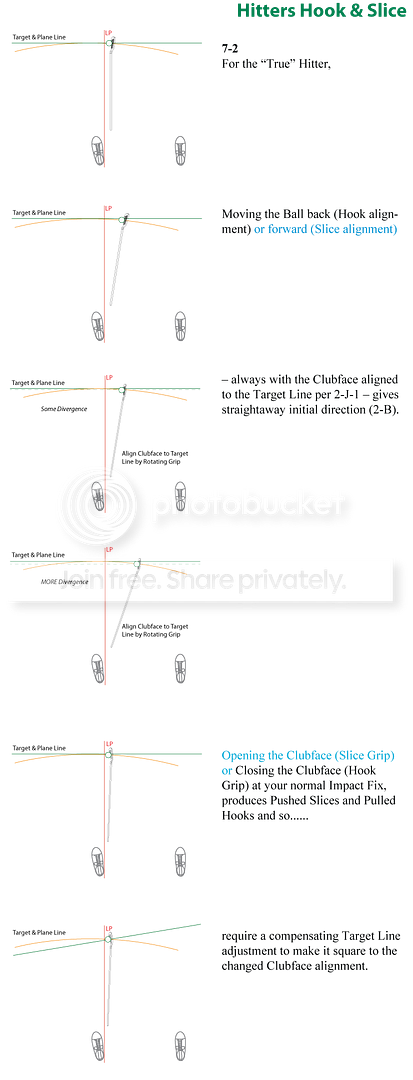
To decipher 7-2 I believe one needs to understand Homers definition of a True Swinger. Tell me how I'm doing here: CF alone aligns the clubface which to Homer meant (amongst other things) that as the ball is moved back in the stance the grip is not "Rotated". See 6-H-0 IMPERATIVES E and F points #3. E Being Hitting and F ( True) Swinging. What does this mean to impact geometry? Given that the True Swinger doesnt Rotate hIs grip as he moves the ball back in his stance his clubhead moves back and the face opens accordingly. To compensate for this open face he Rotates his Plane Line to the left to square the face to the target but in so doing creates a divergence in Path and Face which if given enough speed, not too much loft etc will tend to produce a fade. The Manipulated Hands Swinger or the Hitter on the other hand will (amongst other things, Hinge Action for instance) Rotate the Grip for balls played back so as to square the face to the target. As the ball moves back along the inside/out Arc of Approach there is also divergence this time tending towards a draw. It had me stumped for a while but I think got this one particular riddle figured out......maybe. You know Homer had it all figured out but the way he explained things was not his strongest suit it would seem. But, that said, if you ever try to rework his writings .......you fall flat on your face. It aint nearly as easy at it seems. I wish he'd done more drawings, like yours for instance, D. When BerntR and Bear finish with their time machine (they're getting really close they tell me) we'll have to send you back to Homers lab so you can help him out with some drawings for his book. Man he'd loved that opportunity I bet. |
O.B.,
Your interpretation-explanation, and my drawings - match. If you don't think so, then please explain. Is this drawing easier to understand?  |
Quote:
I am having difficulty relating the bottom picture (above) to step 3 picture in your previous post. In the bottom picture above, the clubshaft and face are in line. Whereas, in the step 3 picture, there is a distinct angle between the clubshaft (green line) and the clubface (black line). The distinct angle appears to me to be the result of rotating the grip. Sounds similar to what OB was commenting on. Did I mis-interpret your original drawings? |
Quote:
|
Whats interesting to me is how many golfers maintain a swing which keeps the baseline the same as the ball target line? I don't think many do, I think it moves around based on other components of the swing. Now it may be very consistent from swing to swing thus they can predict the ball flight, but to think they can line up and swing it on a plane line square to the stance line....not so sure.
Yoda said he witnessed Hogan with a closed stance line but traced a baseline left of the ball target line and hit a fade, time after time. I wonder how good he would have been trying to hit a square square shot? Maybe not good at all? |
The Club is on an Inclined Angle and moves on that flat Angle (end over end - Gyroscope). The Plane. Can you Align the Plane? Yes. Trace the Baseline.
 A simple drill to show how the Right Shoulder can move On-Plane and Downplane and support the #3 PP. Address the ball. Add more Knee Bend. Move your Left Foot 6" away from the Plane Line. Start with short Strokes. You'll need to move closer to the Ball, but that shows how far away golfers normally stand, and always reaching for the ball with the right arm and shoulder. An On-Plane Right Forearm Wedge at Impact Fix will show you the same Ball Location as this drill. |
My questions involves the location of the hands in those pics and what club is illustrated, a driver or a mid or short iron. When I play a driver forward I set the club with the face square and even if I move it back to just off my forward heel I still set the driver face square. Of course I never use adjusted address, I always have the club shaft and left arm aligned. Over the many years adjusted address always scrambled my brain so I gave up on it and start at "almost fix". I rarely ever fade the ball and often have a soft draw. At any rate I am glad you haven't brought up D plane. I just laugh at those discussions. I have worked with setting up, ball position, address location for years and somehow have been able to hit the ball mostly with a slight draw to where I want it without trackman knowledge. Understanding impact location, low point and plane lines haves been sufficient. So I guess Mike Hebron would saw I have "learned by playing" and others would say I have just "dug it out of the dirt". I will admit my alignments have often been corrected by golfgnome! So realizing I am left handed perhaps Daryl could create some of his wonderful drawings for a left hander illustrating starting from fix or adjusted address. Just kidding Daryl, I always look at your drawings with a mirror. Years ago I used to set up my video camera and record golf videos playing on the TV in a mirror and then play them back so they would be left handed.
|
This is history you're drawing here Daryl.
Quote:
I believe this is keerect. (Assuming you rotated the whole machine in that last drawing, what Homer refers to as a "Rotated Plane Line "....it certainly appears that way to me as I look that third drawing. Not to be confused with a mere change in foot line or some such thing.) This is an illustration of how a True Swinger would need to Rotate his Plane Line to square his Clubface for balls positioned forward of Low Point given that he hasnt Rotated his Grip. A Draw resulting as True Swinging assumes no compensational Hand Manipulation to offset the draw alignments, Divergence in Path and Face during the swing. CF alone will square the face during the swing (CF naturally creates Horizontal Hinging without any manipulation by the hands). These are the "passive hands" of golf literature taken to their logical extreme.....with some accompanying passive arms too I believe although Im still thinking the True Swinger could employ Extensor Action it being a non accelerating thrust of the right arm. Not sure .. life line .....anybody? D, would you care to try the manipulated hands Swinger / Hitter version......which I believe Doctor Sandridge is perhaps referring to? The Rotated Grip version in other words .....where the face is squared to the target via "manipulation" as opposed to CF alone. (As I interpret Homer anyways). How bout an iron played back in the stance with and without Grip Rotation. As a side note the thing that really troubled me when I first read 7-2 was that there seemed to be two sets of physics, impact geometry laws .........one for true swinger , one for hitter. But I read it wrong of course. There is but one sets of laws, natural and universal and as I believe Ben Doyle says "either you're lawful or you're awful". (Was I correct in thinking that's Ben Doyle's line David? I figure you'll know having had lessons with Misters Doyle , Sloan , Tomassello , McHatton, Blake etc.......thats the entire group from the "pioneer" first GSEM class with Homer and a couple of bright lights from Lynn's GSEM class...... as some of you guys who keep track of such things will notice). |
Daryl, how 'bout a ball played back in the stance with a mid iron , Grip Rotation and Angled Hinge? Gonna have to draw the face staying square to the Arc or Inclined Plane.......
Im seeing a brave new world of TGM drawings. Where once there were just words, beautiful words but poorly suited for illustrating geometry.......we shall see illustrations and boldly go where no man ....... http://www.youtube.com/watch?v=hdjL8WXjlGI |
 |
Thanks D.
In your third drawing......Ball positioned back of low point, grip rotation (and given True Hitting we assume Angled Hinging) resulting in a Draw given enough Divergence. This is where I go a little foggy ..........the implications of Angled Hinging to the ball response. Gotta think a bit on that one, do some research..... Re your second drawing and the accompanying quote from 7-2. "Moving the ball back (hook alignment) ...." I believe that should be accompanied by a drawing showing Grip Rotation with the ball fore and aft of low point. Your drawing shows a "Slice Grip" with a probable Push ball response which could be compensated for with an adjustment to the Target Line , Plane Line rotation in other words. Which would give you a straight at the hole shot but higher and softer given the increased loft on the club and slightly steeper Angle of Attack maybe. Not sure , maybe in the future they'll invent a machine that can measure all these dynamics.... Somewhere in the book Homer mentions the influence of an increase in the Angle of Attack on ball flight....it goes higher. Cant find it right now.....again its kinda hidden in there somewhere. But suffice it to say that moving the ball back and rotating the grip has implications. We're talking Machine Adjustments. The tools of the trade for the shot maker. Like Jacks towering long irons.......or Tigers low spinning wedge 1/2 wedge ....or Trevino or Bobby Lockes putting or or or. This is the dna of their business. |
Quote:
|
Found it finally. The influence of an increase in the Angle of Attack on the ball flight.
From 2-N-0 "When the Ball is positioned at the Low Point, the two Plane Lines combine as one, but as the Ball is moved toward the Right Foot, these lines appear farther apart and the Angle of Approach becomes wider. Then, the steeper the Plane Angle (10-6), the steeper the Angle of Attack (2-N-1), the higher the trajectory and the deeper the Divot (7-6)." |
Quote:
Just saying the series of drawings doesnt line up with the words. But I could be wrong again......happens all the time. Oh man you're close to crackin 7-2 wide open Dude. But this thread was really about Angled and a Draw or something.......cant remember. So Im gonna shut up before I get called a thread jacker by Mike O or somebody equally ironic. Mike O being the Grand Masta Thread Jacka of all time....although Vegas has seen a lot money coming in on Inner City lately. Daryl, this should be continued in its own thread maybe? Something like "whats up with 7-2 anyways?" Or "whats the deal with True Swinging? or Grip Rotation, Plane Line Rotation , what the.....? |
draw with angle hinge
A very simple answer would be the go here,you guys have got yourselves all tied up in a "Drawing contest" and we have here "SENIOR MEMBERS" having a peeing contest as to knows more than the other and can draw better
Does anybody understand what is being said here "I doubt it". I would say if someone saw the answers here,would they be able to determine what the opening question was without seeing the opening question first.........I DONT THINK SO....your "in depth" answers answer zilch.........I have written this reply without animosty...thank you:laughing9 |
Quote:
You're welcome to join the discussion and contribute by pointing out our shortcomings or by offering another interpretation or simply by recommending what colors to use for the Drawing. |
Hey O.B., Graphically, Hitting looks like a much simpler procedure.
|
Quote:
drive my hands somewhere versus swing them somewhere......I think one is much more precise, and IMO you can be a little less athletic to make it happen. |
Quote:
By the way , who in the history of golf is a True Swinger? I honestly dont know. I can imagine a few, Bobby Jones maybe, but under my interpretation of Homer anyways , vis a vis grip rotation ...........maybe not. And for the record , I have no interest in a peeing contest with Daryl. My only interest is in the uncovering of Homers meaning or the truth about golf. Be they one and same or otherwise. So far , Homer's doing pretty good to my mind. But it doesnt really matter to me if he's wrong about something, or Daryl is for that matter , or me........so what? Its a journey of discovery, something we have embarked on together , a quest we share. Lets make a million mistakes and find the answer in the process. It will require dialogue. If what we're talking about amounts to "ziltch" then we have failed. But only for now. |
The latest Drawing of Hitters "Hook" Setup. What should I change to make the drawing more accurate or more understandable?
|
This angled hinge draw is likely to produce a low ball flight, yes?
I guess you can still draw with angled hinge with the ball forward and a slightly stronger than usual grip if you want the high draw, no? |
D to answer your question and at the risk of being slightly off topic. I'd say, respectfully :
Lose the line and title defining the foot or stance line as it has no bearing on plane line considerations. Identify your Low Point line. Move the ball back progressively to highlight the associated progressive increase in Divergence. I'd also remove your title "the hook" it's really not a how to hit a hook thing but rather the inherent draw tendency associated with moving the ball back given grip rotation. 7-2 GRIP TYPES. Not shot shaping. There are plane line implications to Grip Rotation.. You've drawn the angle of approach this being a hitter question but Hitters do commonly use the Arc of Appraoch as well ..... So maybe for clarity sake you could draw and identify the Arc of approach and leave that 2-j-3 can of worms for another day. It got a whole different set of geometric considerations that is best left alone for these purposes. Including a cross line plane line. But that said the ground work you are doing here would describe it as well ........ Man imagine 7-2 and 2-J-3 explained with diagrams......that would some serious fog abatement. |
Quote:
|
Quote:
While Angled does tend towards a push or a fade if not compensated for with a clubface adjustment at fix, you can still hit draws and hooks easily by rotating your plane line to the right to create more divergence between face angle and clubhead path. The more divergence the more tilted the backspin the more curve. This for what you call a standard swing or geometrically correct swing. Now if you're really talking about hitting draws and hooks despite the fact you think you're Angled Hinging along a Square Plane Line, then that's a different matter all together. But in Homers world all roads do lead back to impact geometry and so the answer to that one lies there as well. |
Quote:
|
Quote:
Stance line closed makes tracing a plane line left easier. Ball should be played at low point as well because as the plane moves left the ball moves further back. I am not sure what procedure I use, it cant be cross line because my aiming point is low and left, but its certainly not an arc either. |
 |
These drawings are really great. Are you drawing set up or impact. I really am inquiring about the location of the hands. If they are set up the hands are not mid body but close to fix. They are closer to fix therefore impact location. Sorry I might have had a few two many libations as we are snowed in here in south carolina. Very unusual for us. Hard to be stuck inside and reading about golf. I will review all of this in AM with COFFEE and perhaps my old brain will get it. At any rate I am saving it all to my file "Best of Lynn Blake". Looking foward to putting it all on the new Ipad I will get with the gift cards my kids gave me for Christmas. Then I can take it to the range and go over to the shade and look at it. You see for an old guy it is hard to remember to stuff between the house and the range !!
|
Yoda Phone Home
Quote:
These are important drawings. But some work remains. Thank you for all you do. Magnificent. I'll call tomorrow. :salut: |
Just noticed how the third and the fourth diagrams have an Impact Plane Line and a Low Point Plane line.........thats one heck of a great addition D.
The further back the ball goes the wider the gap between the two plane lines gets, the more Divergence, the more tilted backspin and the more curvature. Or something like that anyways. |
Quote:
And who knows back in the hickory age. I guess those shafts didn't respond very well to brute force drive loading. |
This discussion touches upon a very fascinating topic: What you need to do to work the ball as a hitter is in many ways the opposite of what a swinger need to do. And if yo drag & drive you better know what you're asking for. Cause you will get it :laughing9
Quote:
|
Quote:
But I could be wrong about Grip Rotation too. |
Quote:
|
Quote:
BerntR you say "Swinger" but you're really referring to the True Swinger I think. You're garden variety Swinger, the so called Manipulated Hands Swinger, Rotates the Grip and employs a Hinge Action (another form of manipulation) leaving him or her with the same set of geometry as the Hitter. The True Swinger is a rare bird and leaves everything to CF, no manipulation of any kind , no grip rotation no manipulation of a Hinge Action , Auto Release I think too. Just CF producing its natural Horizontal Hinging ...... passive hands in other words. CF alone squares the clubface. But I could be wrong, waiting for Yoda to weigh in here about grip rotation...... |
| All times are GMT -4. The time now is 04:06 AM. |
