
|
Hinging actions and the inclined plane
I am new to TGM (I started reading the book last month) and I have a question about hinging actions.
During the hinging action, the back of the left hand is apparently vertical/perpendicular to its basic plane (inclined plane in angled hinging, ground in horizontal hinging, the vertical in vertical hinging) while the left arm/clubshaft is traveling along/parallel to the the inclined plane. Is that correct? The reason why I ask is this demonstration of hinging action by Tom Tomasello (from the videos available in the gallery). Here is a composite photo of Tom Tomasello demonstrating the three hinging actions. 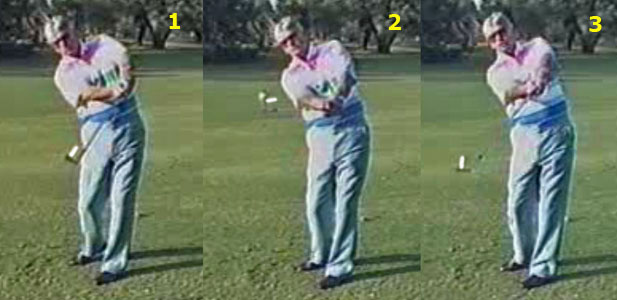 Tom Tomasello states that vertical hinging (seen in image 3) is useful for hitting out of bunkers or hitting flop shots. During that vertical hinging action - when hitting out of bunkers or hitting high soft-landing shots - must the left arm/clubshaft still be travelling parallel to the inclined plane during the followthrough phase, or can one allow the left arm to angle closer to the ball-target line (be more directed towards the target and therefore off-plane)? Jeff. |
Sounds like you got it right.
Producing different hinge actions shouldn't stop you from tracing a straight plane line, so letting the left arm and clubshaft wonder to the right would not be optimal. |
Parallel Motion
Quote:
However, TGM students know that, normally, only the orbiting Sweetspot defines the Plane (2-F). Since the Clubshaft is set an inch or so inward of the Sweetspot, the visible Clubshaft cannot not define this invisible Sweetspot Plane. Hence, in the Backstroke, the Clubshaft must rotate from its own Plane to that of the Sweetspot. Then, in the Downstroke (specifically, in Release), it rotates back to its own Plane. Finally, at the end of the Follow-Through and into the Finish, it rotates again to the Sweetspot Plane. The Left Arm, except with Zero #3 Accumulator Angle, is never On Plane. Nevertheless, as with the Turning Shoulder Plane (10-6-D), the Left Arm can move parallel to the Plane Line. |
Yoda - thanks for replying.
I can understand the concept of a sweetspot inclined plane being different to the clubshaft hosel inclined plane, and how the angular difference is at its maximum near the low point of the swing, and at its minimum at the end-backswing and finish positions. However, the angular difference is very small in practical terms, and presumably it is sufficiently accurate to roughly trace the SPL with the right forearm/PP3. Prior to reading the TGM book, I used to use lay-back when hitting out of bunkers or hitting flop shots. However, I simultaneously allowed my arms to steer towards the target while using a vertical hinging action, and my left arm could be closer to the ball-target line than the inclined plane. My question is whether it is very important that I should deliberately learn to ensure that I trace a SPL in the followthrough phase of the swing while using vertical hinging? Jeff. |
Not sure if this is right but I think that you are asking about the difference between dual vertical hinge ( which keeps the shaft/sweetspot on plane) or the vertical hinge which doesn't...
You are describing a controlled steering procedure i think... for non-full power shots it probably has little bad effect...as long as you know what you are really doing and not what you think you are doing... then you can repeat it and modify it according to need. |
| All times are GMT -4. The time now is 01:43 AM. |