LynnBlakeGolf Forums

LynnBlakeGolf Forums (http://www.lynnblakegolf.com/forum/index.php)
-   The Golfing Machine - Basic (http://www.lynnblakegolf.com/forum/forumdisplay.php?f=16)
-   -   impact on TSP (http://www.lynnblakegolf.com/forum/showthread.php?t=6963)

slicer mcgolf 10-13-2009 10:53 PM

impact on TSP
 
I'm wondering about some pros and cons to the downswing being on the TSP.. including impact. Are there any specific components or accumulator sequences that would be necessary?

not sure where this can go but a little discussion on it might trigger a few questions. thanks

KevCarter 10-13-2009 11:27 PM

Quote:

Originally Posted by slicer mcgolf (Post 68139)
I'm wondering about some pros and cons to the downswing being on the TSP.. including impact. Are there any specific components or accumulator sequences that would be necessary?

not sure where this can go but a little discussion on it might trigger a few questions. thanks

To start, the simplest procedure would be the standard shoulder turn (10-13-A) which is really a combination of B-Flat backstroke and D-On Plane downstroke.

Not mandatory, but recommended.

Quote:

7-13 SHOULDER TURN
...
When the Shoulder moves on the same Downstroke Plane as the Hands it provides the greatest support and its best guidance to the Stroke.
...

10-13-A STANDARD
This is dual application of the Flat (-B below) Backstroke and On Plane (-D below) Down-stroke Shoulder Turn.

10-13-B FLAT
This is a relatively flat Backstroke Shoulder Turn which places the Shoulder “On Plane” for any Plane Angle with a flatter angle than the Rotated Shoulder Angle. A Flat Down-stroke Shoulder Turn can serve only to impact a circular motion to the Stroke, but almost irresistibly “Off Plane.”

10-13-D ON PLANE
After a 13-B or 13-C Backstroke Shoulder Turn, the Right Shoulder moves toward Impact precisely on the preselected Down-stroke Clubshaft Plane, establishing and supporting the Power Package Delivery alignments. When the Shoulder can’t quite reach the Plane, it is better to use a steeper Plane.
Kevin

12 piece bucket 10-13-2009 11:45 PM

Quote:

Originally Posted by slicer mcgolf (Post 68139)
I'm wondering about some pros and cons to the downswing being on the TSP.. including impact. Are there any specific components or accumulator sequences that would be necessary?

not sure where this can go but a little discussion on it might trigger a few questions. thanks

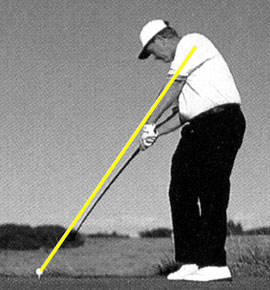
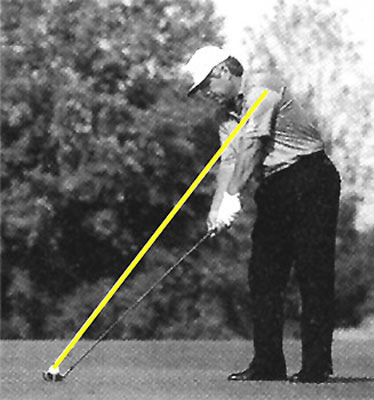
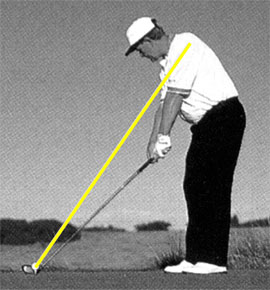
Got any pictures?

Interesting that Mr. Kelley seemed to be more of an Elbow Plane guy in the earlier editions than the later ones.

Pretty significant differences in the release motions of #2 and #3 for the different plane angles . . . in addition you can't discount "dynamic" plane angle shifting thru the ball.

slicer mcgolf 10-13-2009 11:48 PM

Quote:

Originally Posted by KevCarter (Post 68141)
To start, the simplest procedure would be the standard shoulder turn (10-13-A) which is really a combination of B-Flat backstroke and D-On Plane downstroke.

Not mandatory, but recommended.


Kevin

Thanks Kev, great answer.

If I understand this correctly, the shoulder turn is a flatter one in which the right shoulder traces the tsp into impact.

I'm confused on what is bold.


10-13-B FLAT
This is a relatively flat Backstroke Shoulder Turn which places the Shoulder “On Plane” for any Plane Angle with a flatter angle than the Rotated Shoulder Angle. A Flat Down-stroke Shoulder Turn can serve only to impact a circular motion to the Stroke, but almost irresistibly “Off Plane.”

10-13-D ON PLANE
After a 13-B or 13-C Backstroke Shoulder Turn, the Right Shoulder moves toward Impact precisely on the preselected Down-stroke Clubshaft Plane, establishing and supporting the Power Package Delivery alignments. When the Shoulder can’t quite reach the Plane, it is better to use a steeper Plane.

slicer mcgolf 10-13-2009 11:52 PM


slicer mcgolf 10-13-2009 11:56 PM

Quote:

Originally Posted by 12 piece bucket (Post 68143)
Got any pictures?

Interesting that Mr. Kelley seemed to be more of an Elbow Plane guy in the earlier editions than the later ones.

Pretty significant differences in the release motions of #2 and #3 for the different plane angles . . . in addition you can't discount "dynamic" plane angle shifting thru the ball.

Thanks Bucket,

I'm assuming that with the shaft on the tsp at impact, #3 will be fairly active. how does #2 become more or less involved?

What do you mean by dynamic plane angle shifting?

12 piece bucket 10-14-2009 12:10 AM

Quote:

Originally Posted by slicer mcgolf (Post 68146)
Thanks Bucket,

I'm assuming that with the shaft on the tsp at impact, #3 will be fairly active. how does #2 become more or less involved?

What do you mean by dynamic plane angle shifting?


Actually I'd say the opposite of above . . . TSP (steeper plane) much more #2 dependent . . . where as the flatter planes are more #3 dependent . . .


KevCarter 10-14-2009 08:44 AM

Quote:

Originally Posted by slicer mcgolf (Post 68144)
Thanks Kev, great answer.

If I understand this correctly, the shoulder turn is a flatter one in which the right shoulder traces the tsp into impact.

I'm confused on what is bold.


10-13-B FLAT
This is a relatively flat Backstroke Shoulder Turn which places the Shoulder “On Plane” for any Plane Angle with a flatter angle than the Rotated Shoulder Angle. A Flat Down-stroke Shoulder Turn can serve only to impact a circular motion to the Stroke, but almost irresistibly “Off Plane.”

10-13-D ON PLANE
After a 13-B or 13-C Backstroke Shoulder Turn, the Right Shoulder moves toward Impact precisely on the preselected Down-stroke Clubshaft Plane, establishing and supporting the Power Package Delivery alignments. When the Shoulder can’t quite reach the Plane, it is better to use a steeper Plane.

I think that is an endorsment by Mr. Kelley for using the TSP. I believe what he meant is that he feels a straight line delivery to the aiming point is the simplest procedure, and you can't do it from the elbow plane. Hence, better to use the steeper TSP where the right shoulder can travel down the plane line.

I think Bucket is correct, as always, the elbow plane procedure includes a lot more #3, possibly why folks like Mr. Gay aren't super long, but perhaps also why Brian is so solid and consistent.

My opinion is the TSP with straight line delivery in a hitting procedure is incredibly easy to master.

I could be completely wrong...

There are lots of great ways to get 'er done, but TSP is what I am loving right now. No disrespect to Mr. Bucket. :notworthy

Kevin

slicer mcgolf 10-14-2009 11:14 AM

Thanks again Kev,

Why do you think that using more #3 doesn't result in distance? I know what #2 and #3 are but I think I'm confused as to their usage with a tsp straight line delivery.

KevCarter 10-14-2009 11:34 AM

Quote:

Originally Posted by slicer mcgolf (Post 68152)
Thanks again Kev,

Why do you think that using more #3 doesn't result in distance? I know what #2 and #3 are but I think I'm confused as to their usage with a tsp straight line delivery.

I think the opposite mcgolf, I just didn't state it very well. While some pics show Brian getting close to the elbow plane at impact, I think he is closer to the TSP than most, resulting in a little less #3 than those with lower hands at impact... Make a little more sense? OB has posted some great pics of Brian's plane, but they are on my home computer...

Kevin


All times are GMT -4. The time now is 09:44 AM.