YPE HTML PUBLIC "-/ Endless belt and release physics - Page 2 - LynnBlakeGolf Forums

Endless belt and release physics

The Golfing Machine - Advanced

Reply
 
Thread Tools Display Modes
  #1  
Old 06-12-2008, 12:25 AM
Mike O's Avatar
Mike O Mike O is offline
Senior Member
 
Join Date: Jan 2005
Location: Oceanside CA
Posts: 1,398
Originally Posted by Jeff View Post
Mike

When you refer to an "imaginary point" located "somewhere" between the left shoulder and upper spine as being the "center" of an "imaginary circle" circumscribed by the hands, then I can basically understand your conceptual idea in a certain way. What you are apparently doing is simply taking the hand arc movement => then you are perceiving it as being a circular arc (even though the arc doesn't have a perfectly circular shape) => then you are trying to locate its "central locus point" with respect to the golfer's body ("central locus point" being "equivalent" to the central axis point of the circle that represents the hand circle).

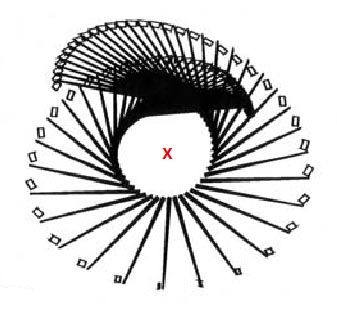
So, for example, here is a diagram showing the movements of the hands, and clubshaft, and clubhead in a low handicap golfer.


Point X is the center of the circle for both the hand arc and the clubhead arc, and one can conceptually think of the angular acceleration of the hands and/or clubhead with reference to that central "X" point (which is conceptually located "somewhere" in the golfer's body).

However, that doesn't help us understand the release phenomenon, because the clubshaft is released (and not the clubhead) with respect to the hands and the clubshaft in that diagram is not rotating in a circular fashion around point X. Therefore, one cannot conceive of the clubshaft having angular acceleration with respect to point "X".

nmgolfer gets around this problem by using the double pendulum swing model.


The double pendulum swing model involves a central arm ( represented by the golfer's conjoined two arms) and a peripheral arm (clubshaft) connected together at a peripheral hinge point. nm golfer's mathematical explanation attempts to explain the release phenomenon occurring at the peripheral hinge point using the following assumptions - i) that the hinge joint is passive and therefore the forces causing the clubshaft's release is passive (not directly related to any active hand unhinging action); ii) and that the clubshaft's movement in space can only be affected by movement of the peripheral hinge point (hands) in space - without having to be concerned about the underlying body forces that cause the hands to move (body forces that torque the central arm). Regarding nm golfer's explanation, the clubshaft can be angularly accelerated at the peripheral hinge point, which serves as the "center" for the angular rotation of the clubshaft around the peripheral hinge point (hands). In other words, the clubshaft rotates around a central point (hands) and therefore the grip end of the club must (by definition) angularly-rotate at the same rpm speed as the clubhead end of the club because the clubshaft is a rigid structure rotating around a central hinge point (although the clubhead end obviously has a faster curvilinear speed than the grip end). In nm golfer's explanation, what's the source of power that allows the clubshaft to develop angular acceleration? It is derived from the fact that the peripheral hinge point (hands) constantly move about in space, and the hand movement has both a directional quality and a velocity quality. The movement of the hands (peripheral hinge point) causes the club to develop angular acceleration, because the movement of the hands is at an angle to the COG of the clubshaft. The clubshaft therefore rotates in a circle relative to the hands, and the angular rpm acceleration of every part of the clubshaft (grip end and clubhead end) must be the same. nm golfer's explanation explains how the club develops angular acceleration with respect to the hands, and how the club releases with respect to the hands. nm golfer's explanation doesn't have to concern itself with "imaginary" locus points - point X in the first diagram.

Jeff.
Jeff,
In the first part of your post above, you accurately describe my previous post i.e. my viewpoint.

However, I still need to get my mind around your viewpoint and also go back and see the purpose of the thread and what we are analyzing here. But in the meantime, I'll make a quick comment regarding your quote below in case you can help me understand where you're coming from.

"However, that doesn't help us understand the release phenomenon, because the clubshaft is released (and not the clubhead) with respect to the hands and the clubshaft in that diagram is not rotating in a circular fashion around point X. Therefore, one cannot conceive of the clubshaft having angular acceleration with respect to point "X". "

I can understand your concept of isolating the clubshaft in relation to the hands and saying that the entire clubshaft has the same angular acceleration- so conceptually I see what you are saying. But I would think that if there was anything that you would say that the clubshaft is release with respect to - it would be the ball- in regards to what forces will be created and not the hands (if that gets the discussion off base in regards to the context that you are discussing - just ignore it for now). Secondly, When you say that the clubshaft in that diagram is not rotating in a circular fashion around point X- therefore....... - you lost me there - looks to me like it is moving in a circular motion around X to me- generally speaking - so IF you wanted to I could see one conceiving of angular acceleration with respect to point X. Enlighten me.
__________________
Life Goal- Developing a new theory of movement based on Brain Science
Interests - Dabbling with insanity
Hobbies- Creating Quality
Reply With Quote
  #2  
Old 06-11-2008, 05:45 PM
BerntR's Avatar
BerntR BerntR is offline
Senior Member
 
Join Date: Feb 2005
Posts: 981
Hello Jeff,

Originally Posted by Jeff View Post
Bernt

I, unfortunately, cannot understand your physics explanation or its applicability to the release phenomenon.
Jeff.
Unfortunately the wireless connection let me down at the wrong time, so in this second try I will be short.

I had a look at the nm golfer link. It wasn't very detailed at that specific page, but the point of departure seemed to be Newtonian enough for me

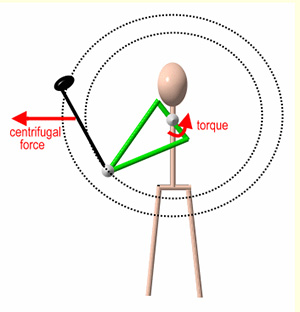
And, I suspect that the not-inline condition that you are referring to is a very close cousin to the momentum that I drew around the golfer's neck, and also the tangential force that appears by the clubface in my sketch. I didn't read any more than was on the very page you referred to - you must have read more somewhere.

But nevertheless, I think that focussing on angular acceleration does cloud the issue somehow. If for no other reason, angular acceleration can be had without increasing the speed of the golf club. And angular deceleration can be combined with increased clubhead speed.

As far as my own, very simplistic and very mechanical and geometrically oriented approach goes, I think it is a big issue in understanding the golf swing that only tangential force can generate clubhead speed.

Anyway, thanks for the opening statement and the follow-ups. It has been very stimulating, and such threads have been a rare thing to me at LBG lately. I cannot say how much I appreciate that you ask questions that goes to the fundament of TGM. TGM is by far the best golf book I've ever read, but even masterpieces has limits. If Homer Kelly found all the answers it would be the first time in the history of knowledge creation. And even if that should happen to be the case during the course of time, we will become wiser if we dare think a little bit outside the yellow box from time to time. I have noted a few negative reactions to some of your posts, but I enjoy them because they trigger the incubator.

__________________
Best regards,

Bernt
Reply With Quote
Reply


Thread Tools
Display Modes

Posting Rules
You may not post new threads
You may not post replies
You may not post attachments
You may not edit your posts

vB code is On
Smilies are On
[IMG] code is On
HTML code is Off
Forum Jump


All times are GMT -4. The time now is 04:40 PM.


Design by Vjacheslav Trushkin, color scheme by ColorizeIt!.
PUBLIC "-//W3C//DTD HTML 4.01 Transitional//EN" "http://www.w3.org/TR/html4/loose.dtd"> ERROR: The request could not be satisfied

504 Gateway Timeout ERROR

The request could not be satisfied.


We can't connect to the server for this app or website at this time. There might be too much traffic or a configuration error. Try again later, or contact the app or website owner.
If you provide content to customers through CloudFront, you can find steps to troubleshoot and help prevent this error by reviewing the CloudFront documentation.

Generated by cloudfront (CloudFront) HTTP3 Server
Request ID: Frtvlb6WorYNO019S8T7jgbOlDJkLm-QLH0aJgv2fqMUEYq1Tzw14Q==