Rsheehy & packard are the only two worth reading...
While edification is generally speaking elusive golf forums provide endless amusement....
Here we have Jeff, who is completely clueless about simple physics terms and absolutely refuses to admit it (and he refuses to read links), spinning aimlessly. And then there is you BrentR whom I strongly suspect is just yet another poser.
You see scientists and engineers know the word is PHYSICS not fysics... they would NEVER make that blatant mistake or many of the others that scream out in your posts. Scientists and engineers generally make sense when they write and you don't.
Nevertheless BerntR I suspect you do know a tiny little bit about transducers (got a job as an aid in a lab did you?) ... I suspect you may even know a tiny little bit about vibration measurment or perhaps acoustics and you are trying to transfer that modicum of superficial extremely cursory knowledge to "your" analysis of the golf swing. This is why we see you tossing out of big sounding totally irrelevant, totally inappropriate terms like "harmonic" or "q factor". See when all you have is a hammer everything looks like a nail... when you are a surgeon the only solution is to operate.
Well guess what.... the golf swing is a gestalt... an event... it is not an oscillating system with or with out damping. Try again BrentR...YOUR MODEL DOESN'T FIT! No energy is stored in the golf swing anytime anywhere.
Oh BTW merry Christmas!
Originally Posted by BerntR
Oh really ......
Energy storage is a very essential topic in a lot of mechanical engineering subjects like noise control and vibration damping. Transducer technology is a subject I know pretty well where energy storage is an essensial challenge. In many cases the efforts are about minimizing energy storage. In other cases it's about tuning. Typical efforts to reduce energy storage in mechanical systems is to reduce mass and add mechanical resistance.
Energy storage is often described with a Q-factor that deals with the ratio of reactive (energy-storing) components to resistive (energy-dissipating) components. http://en.wikipedia.org/wiki/Quality_factor
The down swing converts potential energy (related to g) to kinetic energy, that's true. In addition it stores the kinetic energy that is added by the player working the club. Moving mass is one of the essential ingredients. Most of the mass in the clubhead is there to help the player accumulate energy until impact.
Last edited by no_mind_golfer : 12-25-2008 at 06:02 PM.
Instead of calling me clueless, why don't you use your superior knowledge to point out the errors in my understanding of the term "centripetal force". There are many other forum members who could benefit if you share your knowledge in a constructive fashion - by demonstrating my faulty reasoning.
Consider my understanding of the term "centripetal force".
In a previous post (#264) I wrote the following-: "Imagine that there a million points on that hypothetical circle's circumference, and imagine that an orbiting object (traveling at a constant finite speed) has to move from from one point on the circumference to the next point on the circumference to the next point on the circumference -- and that it has to complete this process one million times to complete one orbit. In each of those movements (from one point to the next point), the orbiting object needs a tangential force to move it at its constant "finite" speed and a centripetal force to keep it moving on the circular path."
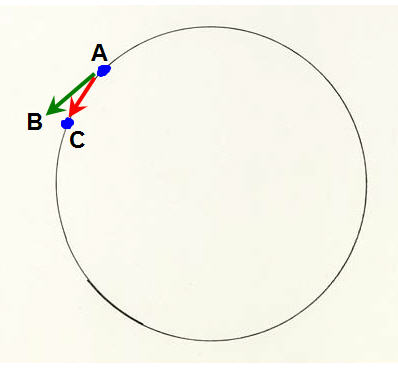
Now, consider the following diagram.
I mentioned that one could mentally picture that there a million time-points that the orbiting object will pass through on its circular orbit around one circumference of the circle in one second.
Now, imagine that the orbiting object is at point A. Then, one millionth of a second later the object is at point C.
What forces are in play to move the orbiting object from point A to point C, and do those forces involve the use of energy?
I believe that two forces are in play. The first force is a tangential force that moves the object in a straight line direction with enough energy to keep the object traveling at the same speed. In one millionth of a second, if that tangential force was operant, and no centripetal force was present, then the object should end up at point B (having traveled in a straight line at a 90 degree angle to the circumference of the circle).
If the orbiting object ends up at point C, then we can reasonably conclude that a centripetal force is present. What did that centripetal force actually do? I think that the centripetal force applied centripetal acceleration that moved the orbiting object more inwards (towards the center of the circle) so that it ends up at point C instead of point B. The centripetal force, in theory, should direct the orbiting object to the center of the circle. However, the amount of energy that the centripetal force has is only sufficient to bend the path of straight line movement of the orbiting object enough to get it to point C in one millionth of a second - in other words, the centripetal force has enough energy to keep the orbiting object traveling on a constant circular path. The centripetal force when operant is manifesting its force (energy) and it is therefore doing work to get the orbiting object to end up at point C instead of point B.
I found your response rude and insulting. It's certainly not something I am used to from people with scientific pretensions.
The Q-factor I linked to is more relevant to the the discussion than you seem to have comprehended:
Physically speaking, Q is 2π times the ratio of the total energy stored divided by the energy lost in a single cycle or equivalently the ratio of the stored energy to the energy dissipated per one radian of the oscillation.[1]
If we can exclude all the working forces and just "hold on to the rope" prior to impact we can actually measure the q-factor of the swing. It would be a function of swing speed reduction per degree of rotation. But of course, the experiment must be led by someone who knows how to measure the stored, kinetic energy.
Here's another example of an energy storage device based on rotating mass. I've never heard of it before. I simply googled for something more similar to the golf swing:
The flywheel energy storage accumulates energy by rotating mass up to speed. Kinetic energy in the form of 1/2mv2. If you don't see that the same thing happens in the golf stroke then your understanding of physics and mechanics has serious flaws.
Consider my understanding of the term "centripetal force".
In a previous post (#264) I wrote the following-: "Imagine that there a million points on that hypothetical circle's circumference, and imagine that an orbiting object (traveling at a constant finite speed) has to move from from one point on the circumference to the next point on the circumference to the next point on the circumference -- and that it has to complete this process one million times to complete one orbit. In each of those movements (from one point to the next point), the orbiting object needs a tangential force to move it at its constant "finite" speed and a centripetal force to keep it moving on the circular path."
Now, consider the following diagram.
I mentioned that one could mentally picture that there a million time-points that the orbiting object will pass through on its circular orbit around one circumference of the circle in one second.
Now, imagine that the orbiting object is at point A. Then, one millionth of a second later the object is at point C.
What forces are in play to move the orbiting object from point A to point C, and do those forces involve the use of energy?
I believe that two forces are in play. The first force is a tangential force that moves the object in a straight line direction with enough energy to keep the object traveling at the same speed. In one millionth of a second, if that tangential force was operant, and no centripetal force was present, then the object should end up at point B (having traveled in a straight line at a 90 degree angle to the circumference of the circle).
If the orbiting object ends up at point C, then we can reasonably conclude that a centripetal force is present. What did that centripetal force actually do? I think that the centripetal force applied centripetal acceleration that moved the orbiting object more inwards (towards the center of the circle) so that it ends up at point C instead of point B. The centripetal force, in theory, should direct the orbiting to the center of the circle. However, the amount of energy that the centripetal force has is only sufficient to bend the path of straight line movement of the orbiting object enough to get it to point C in one millionth of a second - in other words, the centripetal force has enough energy to keep the orbiting object traveling on a constant circular path. The centripetal force when operant is manifesting its force (energy) and it is therefore doing work to get the orbiting object to end up at point C instead of point B.
Please explain the errors in my reasoning?
Jeff,
In your opinion -- just asking -- does your explanation above differ from the basic laws Sir Isaac Newton expressed in his Philosophiæ Naturalis Principia Mathematica (1687)?
hehehehe..... hope I don't offend anyone who has posted within the last 28 pages, but do any of you guys physically go to a golf course, walk up to the counter, pay a green fee and tee it up? If you do can you keep in double-digits?
I get plenty of flak from my buddies who think I'm too analytical/mechanical in regards to the swing. If they only knew what else is out there!!
Thanks again to Yoda for building a "quarantine wing" of the forum!!
I get plenty of flak from my buddies who think I'm too analytical/mechanical in regards to the swing. If they only knew what else is out there!!
Thanks again to Yoda for building a "quarantine wing" of the forum!!
Agreed, CG.
I was reading the most recent exchanges on Christmas Eve and thought to myself . . .
In the history of CyberGolf, is there any precedent for this?
Probably . . .
But I haven't read it!
P.S. There definitely is new ground being plowed here. No doubt, a large portion of the text is dross. At the same time, what remains may be gold. The problem is, first, discerning between the two and, second, applying it to the Golf Stroke. Meanwhile, my hat is off to all those who participate.
Yoda - you asked-: "In your opinion -- just asking -- does your explanation above differ from the basic laws Sir Isaac Newton expressed in his Philosophiæ Naturalis Principia Mathematica (1687)?: "
I have not read Newton's work so I do not know whether my explanation differs from the basic laws expressed by Newton in his work "Philosophiæ Naturalis Principia Mathematica (1687)".
However, I do not think that my explanation differs from the explanations offered in these links that nmgolfer recommended - relating to the topic of Newtonian laws regarding forces and motion.
Yoda - you asked-: "In your opinion -- just asking -- does your explanation above differ from the basic laws Sir Isaac Newton expressed in his Philosophiæ Naturalis Principia Mathematica (1687)?: "
I have not read Newton's work so I do not know . . . ".
Thanks, Jeff. I appreciate your response.
Question: Do you feel your answer differs from a conventional understanding of Sir Isaac's work (as explained in your posted links or otherwise)? From your post, apparently not.
This is not a trick question. I only want to know if you feel you are illustrating his principles with your models (and explaining them in your own words) -- nothing wrong with that and a lot to be commended -- or if you are 'plowing new ground'.




 Linear Mode


