A question for you. Do you believe in 10-23 different hand path?
__________________
If you cannot take the shoulder down the clubshaft plane, you must take along some other path and add compensations - now, instead of one motion to remember, you wind up with at least two!
KOC - I don't really believe that the hands ever move in a straight line in a full golf swing. The hands obviously move in an U-shaped arc and during the "straight section" of the U-shape, the radius of the hand arc's circular motion is so large that it appears "straight".
What advantage do you consider you have over left gonad centered swingers/hitters and do you feel this is why female golfers hit the ball nowhere?
__________________ The student senses his teacher’s steadfast belief and quiet resolve: “This is doable. It is doable by you. The pathway is there. All you need is determination and time.” And together, they make it happen.
Clarifying statements regarding the string-ball example.
When I state that an additional force can throw the ball off its orbit, the force doesn't come from the string. The force can occur when the hands do not constantly move along a circular path at a smooth rate of speed - which provides the centripetal force. So, the following factors can disrupt the ball in its orbit.
1) Sudden hand over-acceleration movement (equivalent to Hk's over-acceleration idea).
2) Sudden hand deceleration movement (equivalent to quitting on the shot).
3) Hand motion becomes non-circular (equivalent to HK's steering idea).
4) Sudden change in the radius of the hands' circular motion (which causes a sudden non-circular motion as the hands move to an orbit of different radius).
Also, when I state the clubshaft's flexibility causes the clubhead to move off its orbit, I mean that it allows it. The fundamental cause is the slowing of the hands pre-impact, and the shaft flexibility allows the clubhead to move out of its perfect circular path.
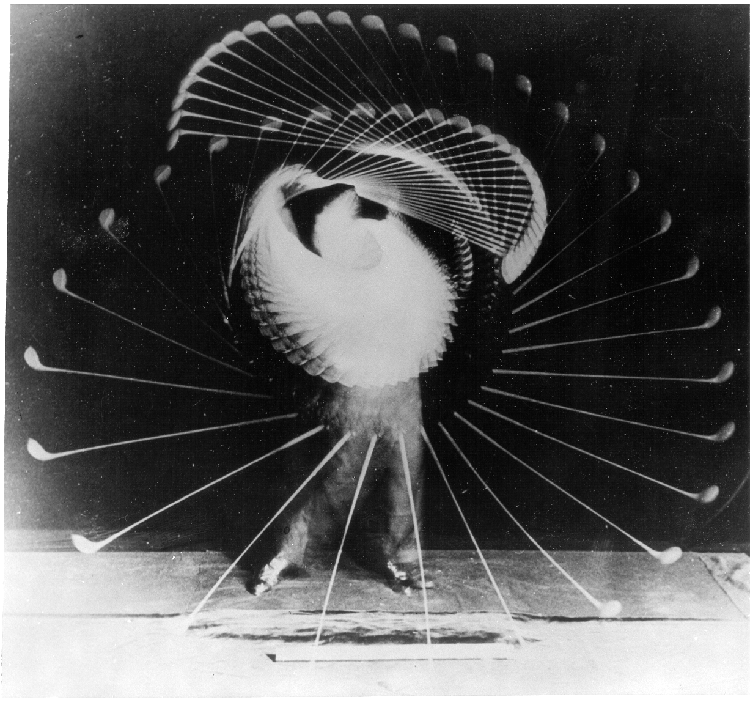
Here is a strobe photo of Bobby Jones swing.
What causes the clubhead arc to be circular? The answer - the circular motion of the hands. Anything that disrupts the smooth circular motion of the hands (over-acceleration, quitting, steering) will disrupt the clubhead's circular motion. An overly flexible clubshaft only makes these problems more apparent.
Jeff.
If you want the hands to move in a constant consistent arc . . . then why would you want to move off the ball???? That's the WHOLE POINT OF THE CENTERED PIVOT . . .
What advantage do you consider you have over left gonad centered swingers/hitters and do you feel this is why female golfers hit the ball nowhere?
Styles
Being from a windy area ..my left side is very dominant so its just a feel thing ..the right gonad evens me out so the actual pivot center is between..perineum lol
Do women play golf?
You wrote-: "If you want the hands to move in a constant consistent arc . . . then why would you want to move off the ball???? That's the WHOLE POINT OF THE CENTERED PIVOT . . ."
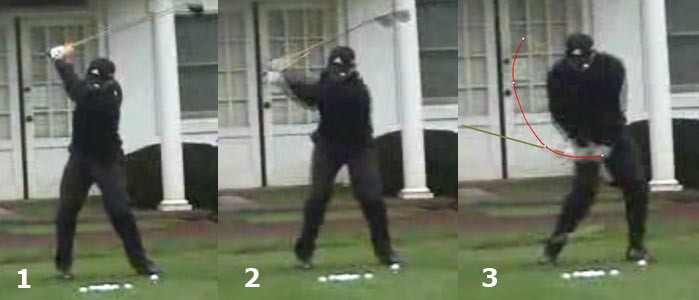
When I stated a "constant consistent arc", I only meant a hand arc that is smooth without any sharp, abrupt (V-shaped) curves. I didn't mean a very rounded hand arc. The hand arc actually shouldn't be too rounded because that predisposes to a sweep release. To get a late release, like Sergio Garcia in the next photo, the hand arc must be distinctly U-shaped with a tight curve at the lower end of the U-shape (equivalent to going around a small pulley at the end of the endless belt).
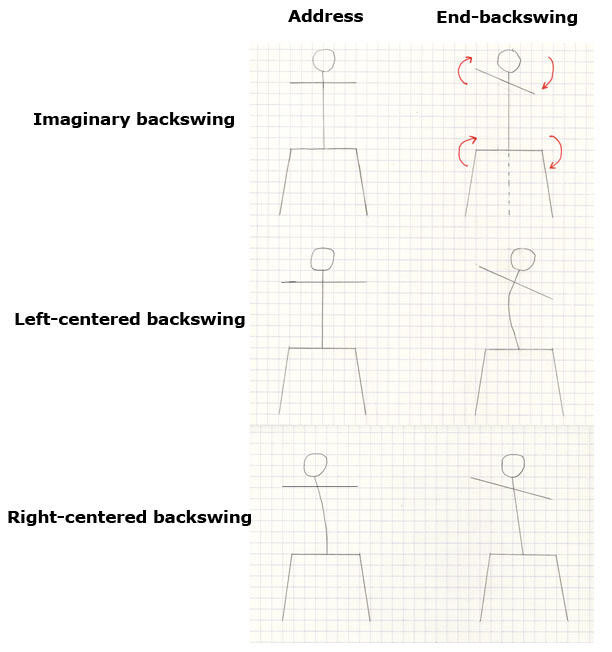
I also have never recommended a non-centered pivot. I wrote a review paper on weight shift in the golf swing and I used the following diagram in that paper.
Image 1 shows a "hypothetical" perfectly centered pivot where the golfer rotates around an imaginary central axis (dotted line). The head is central, the spine is vertical and the golfer simply pivots around the central axis. However, that would only be possible if human beings had only one leg which was in the center of the pelvis and perfectly in line with the spine.
The reality is that human beings have two legs and a golfer has to pivot over the right leg in the backswing and over the left leg in the downswing, which means that there are really two pivot axes for the pelvis in a golf swing. There are biomechnaical consequences to this biomechanical fact.
One can choose to keep one's head centralised (in a tripod fashion) and then pivot centrally => that prediposes to a left-centered pivot action where the spine will tend to lean leftwards at the end-backswing (slight reverse pivot).
Alternatively, one can adopt a small amount of rightwards spinal tilt at address and allow the head to move slightly to the right-of-center of the stance. That allows a golfer to acquire secondary axis tilt naturally during the backswing pelvic action (which moves the lumbar spine left-laterally and aligns the lumbar and thoracic spine into a "straightish" spine that is tilted to the right at the end-backswing.
By my arbitrary personal definition, both a leftwards-centered pivot action and a rightwards-centered pivot action are centralised swing actions - because the head remains within the inner boundaries of the feet and there is no unnecessary lower/upper torso swaying movements off the ball.
You wrote-: "If you want the hands to move in a constant consistent arc . . . then why would you want to move off the ball???? That's the WHOLE POINT OF THE CENTERED PIVOT . . ."
When I stated a "constant consistent arc", I only meant a hand arc that is smooth without any sharp, abrupt (V-shaped) curves. I didn't mean a very rounded hand arc. The hand arc actually shouldn't be too rounded because that predisposes to a sweep release. To get a late release, like Sergio Garcia in the next photo, the hand arc must be distinctly U-shaped with a tight curve at the lower end of the U-shape (equivalent to going around a small pulley at the end of the endless belt).
I also have never recommended a non-centered pivot. I wrote a review paper on weight shift in the golf swing and I used the following diagram in that paper.
Image 1 shows a "hypothetical" perfectly centered pivot where the golfer rotates around an imaginary central axis (dotted line). The head is central, the spine is vertical and the golfer simply pivots around the central axis. However, that would only be possible if human beings had only one leg which was in the center of the pelvis and perfectly in line with the spine.
The reality is that human beings have two legs and a golfer has to pivot over the right leg in the backswing and over the left leg in the downswing, which means that there are really two pivot axes for the pelvis in a golf swing. There are biomechnaical consequences to this biomechanical fact.
One can choose to keep one's head centralised (in a tripod fashion) and then pivot centrally => that prediposes to a left-centered pivot action where the spine will tend to lean leftwards at the end-backswing (slight reverse pivot).
Alternatively, one can adopt a small amount of rightwards spinal tilt at address and allow the head to move slightly to the right-of-center of the stance. That allows a golfer to acquire secondary axis tilt naturally during the backswing pelvic action (which moves the lumbar spine left-laterally and aligns the lumbar and thoracic spine into a "straightish" spine that is tilted to the right at the end-backswing.
By my arbitrary personal definition, both a leftwards-centered pivot action and a rightwards-centered pivot action are centralised swing actions - because the head remains within the inner boundaries of the feet and there is no unnecessary lower/upper torso swaying movements off the ball.
Jeff.
Sergio is RIGHT ON TOP OF THE BALL . . . actually looks like your hypothetical left pivot . . . exactly my point . . . thanks for putting that up. I don't see no reverse k in that pivot either . . . perfect. Probably known as the best ball striker on tour . . . pivot is a big reason.
__________________
Aloha Mr. Hand
Behold my hands; reach hither thy hand
Last edited by 12 piece bucket : 12-19-2008 at 02:51 PM.
I agree that SG is a great ball striker. However, I would not automatically conclude that it is primarily due to his having a leftwards-centered backswing action. He has many other great golf swing skiils.
I also don't mind if you prefer a leftwards centered backswing action. Sam Snead and Mike Bennett and Aaron Baddeley (new swing) use that type of backswing action to great effect.
However, other great golfers - Tiger Woods, Ben Hogan, Anthony Kim - use a rightwards-centered backswing action with great results.
Yoda - you wrote-: "Try swinging the Clubhead without the "connecting" Clubshaft. Let's see what kind of orbit you can create."
I could retort - try swinging the clubshaft without the hands moving along a circular path and see what kind of clubhead orbit one can create.
Jeff,
Assume a tethered ball in orbit around an axis. Does the tether (and its tension) serve as the centripetal force of that action? If not, what does? If so, how does that differ from the concept of the clubhead tethered to its center (left shoulder) by the left arm and clubshaft?




 Linear Mode


