Bernt
I, unfortunately, cannot understand your physics explanation or its applicability to the release phenomenon.
To start with my understanding-problem.
Issue 1:
Consider your diagram, which could be thought of as a shaft that is hinge-centered in the center of the circle, and rotating in a circular motion.
You talk of a tangential acceleration and a radial acceleration. You state that tangential acceleration applies to the direction that the clubhead (which is merely the peripheral end of that centrally-hinged shaft) is moving at any moment in time. I can understand that point and the "correct" applicability of your directional-arrow labelled aT (which is at a 90 degree tangent to the radius of the circle). I cannot understand your term "radial acceleration" as you have drawn the
first arrow AR as being directed towards the center of the circle (along the longitudinal axis of the shaft). I can think of that "centrally-directed" force" as being a centripetal force, but not a radially-accelerated force. I can also think of the term "radial acceleration" as being representative of the angular acceleration of the shaft as its rotates around its central hinge-axis point. I particularly cannot understand your use of the two aR arrows drawn at a tangent to the circle at the 9 o'clock and 3 o'clock position - what do those aR arrows (drawn at a 90 degree tangent-angle to the circle) represent?
Issue 2:
I still cannot understand your concept of a swing center. Are you referring to the upper swing center of the body?
Here is an image showing the movement of Tiger Woods left shoulder socket and upper swing center during his downswing.
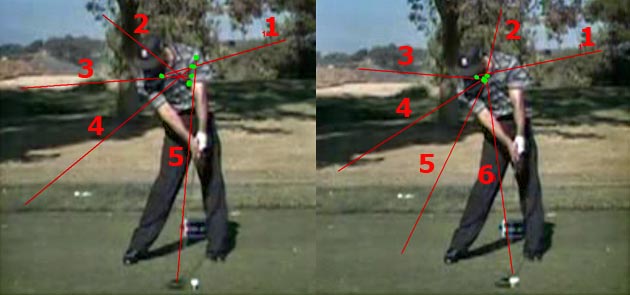
In image 1, the green dot shows the position of the left shoulder socket at different time-points during the downswing, while the red line is a straight line drawn from the left shoulder socket to the clubhead. One can see how the left shoulder socket moves in space during the evolution of the downswing.
In image 2, the green dot is drawn at the upper swing center (midway point between the two shoulder sockets as seen in a frontal-view). The red line is a straight line drawn between the clubhead and the upper swing center. One can see that the upper swing center stays very centralised during the downswing.
So, in conclusion (using my concept of an upper swing center), the left shoulder socket's sequential movement in space during the downswing has no relationship to the stable movement of the upper swing center (which remains very centralised during the downswing).
Issue 3:
You state that tangential acceleration and radial acceleration forces are applied to the clubhead via the hands. I don't understand this point at all. I can understand the concept of the terms "tangential/radial" as being applicable to the circular motion of the left arm around a "fixed" point (left shoulder socket). However, in a "real life" golf swing, the left shoulder socket is constantly moving in space during the downswing, and therefore the final speed/direction of movement of the hands during the downswing is the end-product of two interlinked movements - i) the speed of rotation of the left arm at the shoulder socket, and ii) the rate/direction of curvilinear movement of the left shoulder socket in space. The beauty of nm golfer's "release phenomenon" explanation is that he doesn't need to know what moves the hands. He simply states that movement of the hands has two components - i) a constantly-variable direction of movement; and ii) a constantly-variable speed of movement; and that these two variables produce angular acceleration of the clubshaft because the COG of the clubshaft is not in-line with the constantly-varibale directional movement of the hands. nm golfer doesn't have to use the terms "tangential" or "radial" in his explanation of the "release phenomenon", and his explanation makes sense whether the hands travel in a circular, or elliptical, or C-shaped/J-shaped curvilinear manner.
Jeff.