Mike
When you refer to an "imaginary point" located "somewhere" between the left shoulder and upper spine as being the "center" of an "imaginary circle" circumscribed by the hands, then I can basically understand your conceptual idea in a certain way. What you are apparently doing is simply taking the hand arc movement => then you are perceiving it as being a circular arc (even though the arc doesn't have a perfectly circular shape) => then you are trying to locate its "central locus point" with respect to the golfer's body ("central locus point" being "equivalent" to the central axis point of the circle that represents the hand circle).
So, for example, here is a diagram showing the movements of the hands, and clubshaft, and clubhead in a low handicap golfer.
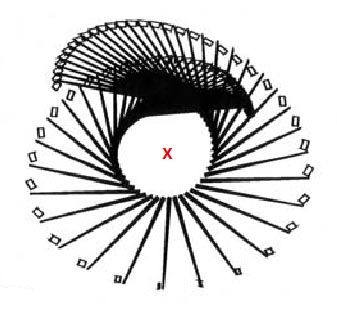
Point X is the center of the circle for both the hand arc and the clubhead arc, and one can conceptually think of the angular acceleration of the hands and/or clubhead with reference to that central "X" point (which is conceptually located "somewhere" in the golfer's body).
However, that doesn't help us understand the release phenomenon, because the
clubshaft is released (and not the clubhead) with respect to the hands and the clubshaft in that diagram is
not rotating in a circular fashion around point X. Therefore, one cannot conceive of the
clubshaft having angular acceleration with respect to point "X".
nmgolfer gets around this problem by using the double pendulum swing model.
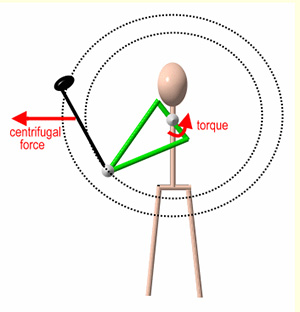
The double pendulum swing model involves a central arm ( represented by the golfer's conjoined two arms) and a peripheral arm (clubshaft) connected together at a peripheral hinge point. nm golfer's mathematical explanation attempts to explain the
release phenomenon occurring at the peripheral hinge point using the following assumptions - i) that the hinge joint is passive and therefore the forces causing the clubshaft's release is passive (not directly related to any
active hand unhinging action); ii) and that the clubshaft's movement in space can only be affected by movement of the peripheral hinge point (hands) in space - without having to be concerned about the underlying body forces that cause the hands to move (body forces that torque the central arm). Regarding nm golfer's explanation, the clubshaft can be angularly accelerated at the peripheral hinge point, which serves as the "center" for the angular rotation of the clubshaft around the peripheral hinge point (hands). In other words, the
clubshaft rotates around a central point (hands) and therefore the grip end of the club must (by definition) angularly-rotate at the
same rpm speed as the clubhead end of the club because the clubshaft is a rigid structure rotating around a central hinge point (although the clubhead end obviously has a faster curvilinear speed than the grip end). In nm golfer's explanation, what's the source of power that allows the clubshaft to develop angular acceleration? It is derived from the fact that the peripheral hinge point (hands) constantly move about in space, and the hand movement has both a directional quality and a velocity quality. The movement of the hands (peripheral hinge point) causes the club to develop angular acceleration, because the movement of the hands is at an angle to the COG of the clubshaft. The clubshaft therefore rotates in a circle
relative to the hands, and the angular rpm acceleration of every part of the clubshaft (grip end and clubhead end) must be the same. nm golfer's explanation explains how the club develops angular acceleration with respect to the hands, and how the club releases with respect to the hands. nm golfer's explanation doesn't have to concern itself with "imaginary" locus points - point X in the first diagram.
Jeff.