Yoda - you asked-: "Why not position the ball further forward and thus eliminate the need for a "greater amount of secondary axis tilt" and the "stationary head further back"?"
The answer is related to the structure/biomechanics of the human golfer and the constraints of golf. If TW/MA/JS need a "fixed" amount of secondary axis tilt to keep in balance when swinging their arms that fast across the body, they cannot place the ball more forward than a point opposite their left foot because one cannot complete an arm arc that will cause the clubhead to be square at impact if the ball is positioned well ahead of the left foot.
Reagrding the question of how much secondary axis tilt is appropriate at impact. The answer depends on a golfer's pivot action style.
Look at this video.
There are 4 demonstrated pivot actions. Let's ignore pivot action number 2 as being a non-viable method because the golfer is swaying and we both agree that swaying is bad.
Consider pelvic action number 3 - the S&T swing. It is a viable way of playing golf, but there are biomechanical aspects that I don't like about that pelvic action style. Note that the spine has to be leftwards tilted at the end-backswing, and then has to become rightwards tilted by impact. I don't think that it is biomechanically efficient to reverse-shift the spine tilt during the downswing and I don't think that it is good for the back over a lifetime of playing golf. We will see in 20 years whether S&T golfers have more back problems than conventional golfers. I also don't like the fact that the outer border of the left pelvis has to move outside the outer border of the left foot in the downswing - in order to shuttle the pelvis leftwards under a reverse-tilting spine. I think that many golfers cannot shuttle the pelvis left-laterally in a smooth manner and they develop a jerky swing.
So, let's consider the difference between pelvic actions #1 (conventional swing) and #4 (Trolio swing). Note that they both involve the same amount of rightwards spinal tilt (secondary axis tilt). The difference lies in their head position. In the Trolio swing, the head is centralised in the stance because the golfer pivots more over the left leg in the backswing. However, in a conventional swing, a golfer pivots more over the right leg, which means that the head cannot be centralised. The head must be slightly right-of-center for a "given" amount of rightwards spinal tilt.
Now, which is better - the Trolio pivot action or the conventional pivot action?
You may argue that the Trolio pivot action is better because the head is centralised in the stance. However, is it biomechanically easy to pivot like Trolio. I think that it takes a special level of pelvic/hip/thigh flexibility to pivot in that manner, and many golfers do not have the biomechanical ability to pivot easily/efficiently in that manner. Have you tried that pivot style? Looking at your pivot action in your posted swing videos, I actually think that your pivot action is more conventional. In your Alignment Golf DVD you demonstrate a drill of using the right hand to pull the left hand across in a simulated backswing action - where you apply extensor action and where you pull the left shoulder behind the ball (feeling a tightening of the left shoulder girdle muscles). In that action, you seem to have a conventional pivot action movement of the lower torso and your weight is more over the right leg than the left leg at the end-backswing. Also, your head is slightly right-of-center.
It is my belief that a golfer should chose a particular pivot action style that works well for him from a biomechanical perspective - based on his physical/biomechanical abilities and limitations. For many golfers, the conventional pivot action style works best - even though it means that the head is slightly right-of-center, and even though it means that the golfer will have to utilize more left-lateral pelvic shift in his downswing action.
As this next photo series demonstrates, Ben Hogan used this conventional pivot action style for most of his career.
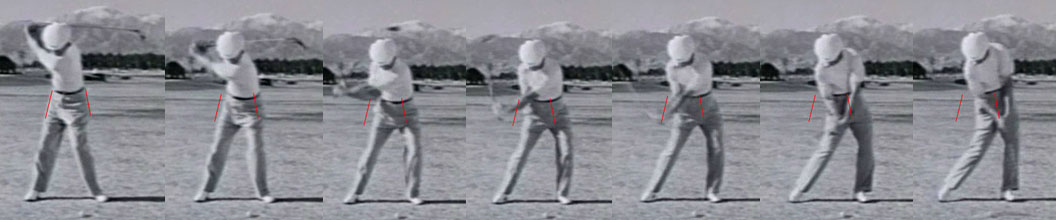
Whats wrong with Hogan's pivot action? His head is right-of-center and he needs a lot of left-lateral pelvic movement in the downswing to get from the right side to the left side. However, as we all know, a golfer can play superb golf using that type of pivot action. Even Tiger Woods knows that!
Jeff.