I do not recall VJ referring to the head as the pivot center. In one drawing, his pivot axis goes up the left leg and then through the cylinder to exit centrally at the top of the cylinder (equivalent to a torso with an exit point at the level of the base of the neck). On another page, he draws the pivot axis through the left side of the torso - well left of the spine and head.
I personally do not think that the head acts as a counterbalancing force, and/or that it will necessarily create wobble of the torso if slightly offset.
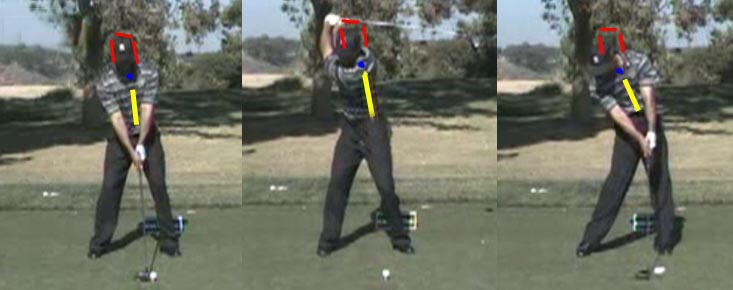
Here is a capture image from a Tiger Woods swing video - his head falls back-and-downwards during the downswing. However, I don't think that it affects his swing.
Whether one describes the base of the neck or the head as the pivot center, I can accept the implications of your posted HK-definition of a pivot center - "SOME POINT on the body kept stationary throughout the Stroke, to stabilize the motion."
However, I cannot understand the concept of a centralised pivot center (being centrally located in the body or centrally located in the stance) with a vertical pivot axis going through that pivot center point.
Jeff.
Tiger's head moving back and down does not affect his swing? Or do mean you can't tell from the ball flight, as in, he hits it good even though he makes this move? Surely, it has a effect, for which he must account.
Instead of centralized pivot center, what if we thought of it as point that the power package moves around? If we don't bob or sway the point between the shoulders, we don't have to compensate for that movement.




 Threaded Mode
