
|
Hogan - closing clubface
Pistol wrote in another thread-: "And while you are digging there can you go in to great detail for me as to how Hogan squared the clubface to the arc relatively early in his downswing and believe me there is some great photos out there that will prove this. Since he got the club "laid off" and open relative to the plane at the top if he just Pulled the club what would happen??"
This is my personal interpretation of what happened to Hogan's clubface at the end-backswing and early downswing. I believe that Hogan's clubface was frequently slightly open at the end-backswing position, and I think that the main cause was his tendency to cup his left wrist at the end-backswing, which caused the clubshaft to slightly cross the line ( and point right-of-parallel), and also caused the clubface to open. Here is a photo-example. 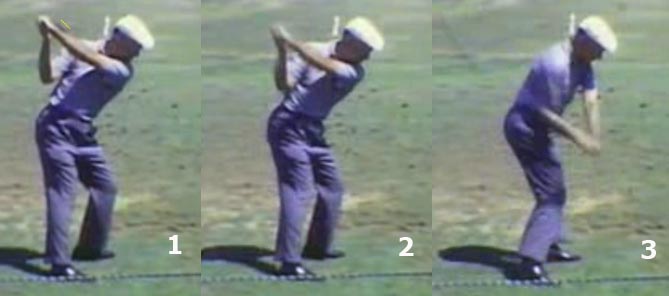 Image 1 shows that Hogan's club is slightly beyond parallel at the end-backswing, and pointing slightly to the right of target. I believe that he often ended up in that position because he had ultra-flexible wrists, that allowed his left wrist to upcock (radially deviate) >90 degrees at the end-backswing position. That large degree of radial deviation of his left wrist also caused some dorsiflexion of his left wrist so that his left wrist was slightly cupped at the end-backswing position, which caused his clubface to become slightly open. At the same time, his bent right wrist developed a small degree of radial deviation (upcocking). I believed that Hogan closed his clubface at the very start of the downswing, so that it became neutral to the clubhead swingarc, by starting his downswing with a very assertive hip shift-rotation movement. That lower body movement caused his clubshaft to fall back/shallow-out, thereby flattening his left wrist - see image 2. When his left wrist became flat, then his clubface became neutral to the swingarc. Interestingly, Jim Hardy claims that Hogan closed his clubface in the early downswing by means of a counterclockwise rotation of his left arm, that caused his right forearm to "twist and throw" the clubface into a closed position, and that also caused his right elbow to end up behind the right hip, instead of in-front of the right hip, in the mid-downwsing. However, I can see no evidence of any left arm counterclockwise rotation in image 2 or image 3, and no evidence to support Jim Hardy's belief that Hogan used an active right forearm "twist-and-throw" maneuver in his early downswing. Here is another image demonstrating how Hogan shallowed his clubshaft at the start of the downswing and flattened his left wrist. 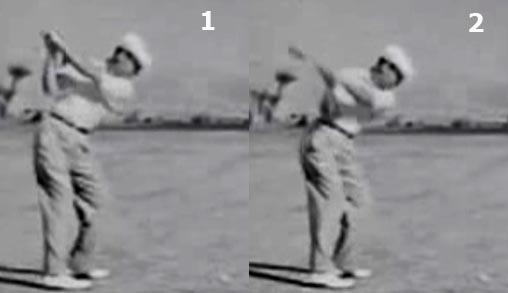 Image 1 show Hogan at the end-backswing and he has a slightly cupped left wrist. At the start of the downswing, he starts the downswing with a lower body pelvic shift-rotation movement (hip squaring action) that shallows his clubshaft and causes the clubhead to move backwards (away from the ball-target line) and that also flattens his left wrist. When his left wrist flattens, it automatically closes the clubface to the swingarc. Here is a third image which clearly shows Hogan's clubface closing slightly at the very start of the downswing. 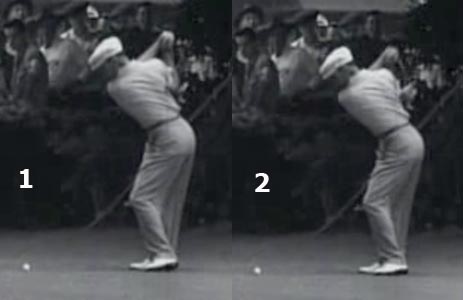 Image 1 shows that Hogan had a slightly cupped left wrist and a clubshaft that was slightly right-of-parallel at the end-backswing. That predisposes to a slightly open clubface. Image 2 shows Hogan at the very start of the downswing, and one can see his flat left wrist and see that his clubface is now parallel to the back of his flat left wrist, which means that it is neutral to the swingarc. Jim McLean in his DVD series on Hogan's swing claims that Hogan kept his left wrist cupped in the downswing and he supplies visual evidence. 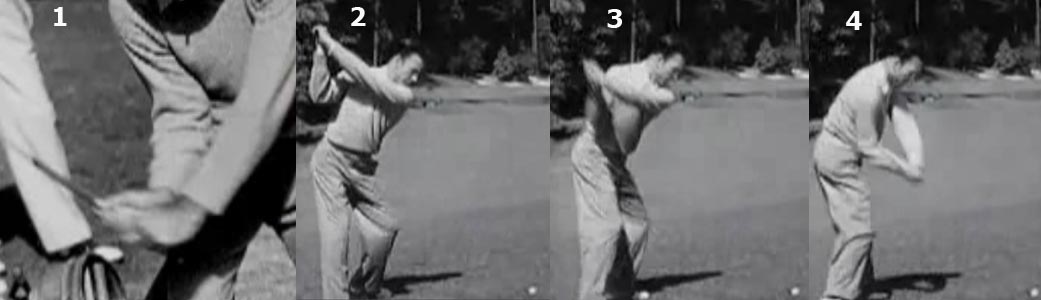 Image 1 is a close-up of Hogan's cupped left wrist when he is in a mid-downswing position. Image 2,3, 4 shows an early-Hogan sequence demonstrating the same phenomenon - maintaining a cupped left wrist in the downswing and an open clubface. I don't know whether this phenomenon was a feature of Hogan's early swingstyle or whether Hogan selectively kept his left wrist cupped during the downswing at certain times for a particular purpose. I am interested in informed opinions regarding this issue. My opinions are always open to modification if forum members can provide alternative opinions supported by solid "evidence". Jeff. |
Short reply and thinking of: Henry Picard to rotate Hogan left hand grip a tad to the left.
 His right hand looks like rolled to the left in many pictures...Denis Pugh called that a butterfly grip. So, the combination of 10-2-G and 10-18-B? |
Quote:
So you are stating JIM HARDY's theory is wrong but at least he came up with some photos of the elbow marginally behind the hip. But i will go along with you that Hardy's theory is wrong BUT yours is way WORSE pleassse the left hip can turn as hard as it wants and the "CUP" on the left wrist can actually increase. I can only imagine a very lifeless left arm not involved in the Pulling motion and the weight of the clubhead causing the left wrist to lose the cup TT and the right hand karate chop down and out would seem a much more valid idea as it would flatten the left wrist and square the clubface to the arc AS it would geometrically fit and take care of the 3 right hands mystery |
Pistol
It is my biased opinion that you may have problems with respect to understanding cause-and-effect relationships in human biomechanics. You seem to have difficulty understanding how a fast hip turn at the start of the downswing can cause the clubshaft to shallow-out/flatten. You also seem to have difficulty understanding how a flattening clubshaft at the top of the swing can produce forces that promote left wrist flattening. You state that a fast hip turn can increase cupping. It can if the clubshaft is kept across-the-line. However, Hogan's clubhead moved backwards (away from the ball-target line) so that his clubshaft became laid off at the start of the downswing, and that clubshaft movement makes it much more difficult to maintain a cupped left wrist. In fact, that clubshaft movement promotes the passive acquisition of a flat left wrist. Also, whether a golfer decides to allow the left wrist to be flattened in response to forces that shallow/flatten the clubshaft is still under control by the golfer. It is obviously possible for a golfer to deliberately resist those forces and intentionally maintain a cupped wrist. There is a second biomechanical phenomenon that promotes a flattening of the left wrist when the downswing starts with a fast hip shift-rotation movement. That fast lower body movement also causes the right elbow to be pulled rapidly down towards the right hip area, and because the right arm flying wedge remains intact, that right elbow movement causes the right forearm and right hand to be pulled down under the flattening clubshaft, which in turn promotes further flattening of the clubshaft - as can be seen in this photo. Whether you find my biomechanical explanation credible, or not, the photos demonstrate the "reality" that Hogan's left wrist flattened at the start of the downswing, and this biomechanical event would cause the clubface to close slightly if the left wrist was previously cupped. Jeff. |
Quote:
You state that i have difficulty understanding cause and effect which is ludicrous Jeff because i CAN DO and you can't and you are NOT a biomechanist. Your explanation on Hogan is probably the weakest arguement i have ever seen stated It is obvious that the wrist flattens but you cannot even offer a credible arguement that a turning hip will cause this except to say the flattening shaft creates forces on the wrist Here is something for you to look into so you can be better educated. There is footage there Face On of Hogan post accident 1960's where its clearly evident that his hands have already moved longitudinally away when his left hip has not even started to clear in fact he is still finishing his lateral shift with the right buttock/leg so that clearly shows that the turning left hip has nothing to do with the wrist change Now TT method of delivering the right hand and releasing against a firm left hand would make a lot more sense rather than the fiction you have stated How many years you work on a golf swing JEff? Why do you seem to think that the TT concept is not correct after all he was at it for what 60+ years? ITs obvious that it would fit the criteria for the clubface being squared to the arc and the 3 right hands comment by the man himself.Why is your arguement based on the 2 reasons above that are so flawed? http://www.youtube.com/watch?v=inC8g...eature=related Watch this and you will see the left hip has not begun to clear at all |
Jeff,
Let me express my voice as a huge Hogan fan that analyzes his swing motion almost everyday. Look at those two photos in your above post. Compare how many degrees Hogan's hips turned left (the belt buckle is still visible on the second photo) with the right elbow movement. Sorry to say, but when looking at the photos I find it simply not natural that the sharp hip turn caused Hogan's elbow to move that far down. Granted, the hip turn will flatten the arc a bit but, IMHO, it's not possible to say that it causes everything (i.e. flattening the plane, bringing right elbow to the right hip and flattening the left wrist). Do an experiment yourself - go to the top with a cupped left wrist and just turn your hips as quick as possible without trying to go low with the clubhead to the ground in urge to hit the ball - jus hold the club and turn your hips - you'll observe that your cupped left wrist remains cupped despite the turn. It implies that except the obvious froces as hips leading the downswing (after the CoG shift) and pulling with the left side of the body there must be a force generated by the right side (hand, forearm, elbow, shoulder, etc.) in a due time in synch with the pivot. Pistol's theory based on Tom Tomasello's findings is very interesting. Many people tried to explain Hogan's swing with ONLY left side and left arm turning and pulling towards the target, yet, noone is still able to duplicate his swing motion decently in every aspect of the swing. I watched Tomasello's vids and what he says is very convincing. The "right hand karate chop down and out" he is talking about really flattens left wrist, lets right wrist remain in dorsiflexed, and ensure that the clubface becomes square to the arc almost automatically, provided the body work is proper. It's much better than Hardy's "twist" part of the "twist&throw" concept that cannot be observed in Mr.Hogan's motion. Despite the lack of it, he delivered the clubface square to the arc before entering impact zone. IMHO, not all puzzles of "Hogan's secret" are discovered and put in a proper place so far. Cheers |
Printing
Jeff, do me a favour. If you would, please shorthen the lines of
the text. I like to print the posts so that I can take them to the range. When I tried to print this post, the end of the lines are cut off. In the "printable version" the words are so small that I can not read them. Thanks, Donn |
not sure i am absolutely right on this..
but what i have notice is.. Hogan have a pretty upright posture and a very "lowish" arm at the top of the swing, and a mid hand setup. with that kind of combination he need to rotate his arm to get connected , be on plane and "one plane " position at the top. very similar to what this guy http://www.youtube.com/watch?v=dk6M67EBSyc teach.or sergio. very similar way. more "flattish " shoulder turn.. but in order to stay in sync or connected. he need to turn his arms back and through swing like hogan did... ie a flatter rotated shoulder turn. but rotate arm to stay on plane. huge amount of lag using this way... due to the increased flexibility.. arm not flexed around the Rotor wrist joint.. at the top. .. Say if we dont rotate our arms. and a flat shoulder turn. I think we will end up a little like David toms .. Arm have to move higher to stay on plane. ie flat shoulder turn.. and if we dont rotate the arms again , and stay "arm same line as shoulder on the top. while staying connected. we have to Pivot a little like sam snead , Jim hardy OPS or Stack and tilt swing..steeper rotated shoulder turn. Many ways to skin the cat .. I say its choose your poison. I think type of shoulder turn vs steepness shoulder turn vs arm rotation vs arm height.. need to be compatible . so that the motion create an on plane swing Just my 2 cents observations. |
Pistol - you wrote-: "Now TT method of delivering the right hand and releasing against a firm left hand would make a lot more sense rather than the fiction you have stated. How many years you work on a golf swing JEff? Why do you seem to think that the TT concept is not correct after all he was at it for what 60+ years? ITs obvious that it would fit the criteria for the clubface being squared to the arc and the 3 right hands comment by the man himself."
You are free to find TT's idea of the right hand karate-chop throw action interesting and attractive. However, it's astonishing that you are willing to state that it fits in with Hogan's swing. You have provided no "evidence" to support that belief other than Hogan's statement that he wishes he had "three right hands". The reason why I find it astonishing is that you are ignoring Hogan's own statements regarding his swing. You are implying that Hogan utilised an active right arm karate-chop action from the very start of the downswing, thereby implying that the right arm is active when it is well above waist level. That factually-unsupported belief contradicts Hogan's own comments in his "Five Lessons" book. On page 93 of his book, Hogan wrote-: "What do the hands do? The answer is they do nothing active until after the arms have moved on the downswing to a position just above the level of the hips. The arms don't propel this motion themselves. They are carried down by the movement of the hips". He then goes in the rest of that paragraph to describe how the hands and arms get this "free ride". He also demonstrates this "free ride" phenomenon in his swing video lesson. http://www.youtube.com/watch?v=QL_6M_xZvq0 In this lesson, Hogan demonstrates unequivocally how the arms/hands are brought passively down to hip level and how the right elbow is brought rapidly down to the right hip area solely as a result of his lower body move. He states unequivocally that this lower body action "brings one in a position to hit". This "hit position" occurs when Hogan's hands are well below waist level. Whatever Hogan meant by "three right hands", it must occur when his hands were in a "position to hit" and not at the start of the downswing - ala Tom Tomasello's description. This is my last post that will be addressed to you. We live in parallel mental universes and we apparently cannot fruitfully interchange ideas. I am also tired of being subjected to your constant baiting and insults. This forum allows free discourse, and you are free to make insulting ad hominem comments, but I don't have to perpetuate your behaviour by personally responding to your posts. Jeff. |
Dariusz
I am aware that you a serious student of Hogan's swing. I therefore find it very surprising to read what you wrote- : "Sorry to say, but when looking at the photos I find it simply not natural that the sharp hip turn caused Hogan's elbow to move that far down." Look at Hogan's swing video lesson, which you must have looked at many, many times. Are you really not convinced that Hogan's entire power package assembly was brought down to waist level as a result of his rapid lower body action. He demonstrates this "lower body move" repeatedly in this video lesson, and it is so easy to see his entire power package assembly moving as a single unit down to hip level, concurrently with his lower body action. In his "Five lessons" book he makes the same point of how the arms/hands get a "free ride" down to waist level. He is very definite about the upper limbs (arms/hands) being passive in the early downswing. You also wrote-:"Do an experiment yourself - go to the top with a cupped left wrist and just turn your hips as quick as possible without trying to go low with the clubhead to the ground in urge to hit the ball - just hold the club and turn your hips - you'll observe that your cupped left wrist remains cupped despite the turn." Of course my left wrist will remain cupped if I deliberately maintain a cupped left wrist. However, my left wrist flattens immmediately if I relax my left wrist and allow the left wrist to passively respond to forces that have a left wrist flattening effect. The key "feeling" is the "feeling" of leaving the club behind while the downswing is initiated. Hogan had ultra-flexible wrists and you can actually see his degree of left wrist lag increasing at the start of the downswing. I believe that the cause of that phenomenon is due to the combination of i) a sudden pull-down of the left arm (secondary to the lower body pivot action that initiates Hogan's downswing) and ii) very relaxed wrists. The likelihood of that "increased lag" phenomenon happening at the start of the downswing would be much more unlikely if Hogan was actively propelling the club downwards by means of a right arm throw action. Finally, Hogan was a swinger, and HK stated that a swinger's power accumulator release sequence must be 4,2,3. HK never stated that the right arm should be actively throwing/thrusting in a swinger's action, and certainly not before the release of power accumulator #4. Jeff. |
Quote:
This forum does not allow free discourse regarding direct personal insults. Passions can and do run high sometimes, but we have forum rules which must be followed. Typically we try to address these issues privately via PM, but if they persist I've had to ban more than a handful of people here. Its the most unpleasant part of running a forum, but unfortunately it must be done at times for the health of the site. We'll be following the discussions more closely, and if we miss anything please bring it to our attention via PM. Thanks, |
This is my last post that will be addressed to you. We live in parallel mental universes and we apparently cannot fruitfully interchange ideas. I am also tired of being subjected to your constant baiting and insults. This forum allows free discourse, and you are free to make insulting ad hominem comments, but I don't have to perpetuate your behaviour by personally responding to your posts.
Jeff.[/quote] Jeff Its IRONIC that you state in your opinion that i have no understanding of human biomechanics cause and effect etc What's more interesting is that in your original analogy you had no understanding and in my first post on this subject i actually leave you an answer for your own theory i.e lifeless left arm with hip turn doing the pulling. Later posts you use this to explain your own theory which seems a little to coincidental to me. I for one learned from watching TT and the application works and a snap release still occurs in fact its a highest quality snap and the true magic of the right forearm:salut: |
Quote:
|
Quote:
I'd be interested if someone could clearly clarify for me what is meant by open and closed in relation to the swing arc. If at impact the left wrist is cupped then the face closes. If at impact the left wrist is arched the face is open. So how does the left wrist moving from cupped to flat at the top of the swing- create a closing motion of th clubface? Never understood this and I have never heard a reasonable explanation- look forward to understanding your perspective. |
Quote:
Now, depending on the release type, some golfers brings the clubface square earlier and some later just before impact. The same may happen after impact - some golfers maintain the clubface square after impact (those who swing left with a late swivel) and some close it rapidly just after impact together with a crossover of their forearms (early swivel). Hogan delivered his clubface square already before entering the impact zone and maintained it square long after impact what is one of very suspected "culprits" of his overhuman accuracy and repeatability. Cheers |
Quote:
The more I look into Hogan's swing motion the more I believe in his "three right hands" comment; I think he was "above" those swingers/hitters criteria and sincerely am of the opinion that his downswing was a mixture of a dominant left side of the body (pulling) turboed by right arm/forearm/elbow/hand action. Now, Tomasello theory that Pistol brought into life in this thread is simply a possible great explanation that I take into accout since there is no many concept how to combine left and right side action during the swing. Many can say that it is not even possible, but it is not true. You can easily combine and synchronize a pulling motion of the main body and correlated pushing motion of a distal part of the same body and it is a very natural thing. Discus throwers or rotational-style ball throwers in lightathletics are a great example of this kind of correlation. Cheers |
Dariusz
You wrote-: "I am more than sure that his right arm/forearm was intentionally involved in his motion." How can you be sure? What are you actually seeing in his swing, and at what point of the downswing are you seeing "it" so that you can definitively conclude that Hogan is actively using his right arm/forearm? You wrote-: "The more I look into Hogan's swing motion the more I believe in his "three right hands" comment; I think he was "above" those swingers/hitters criteria and sincerely am of the opinion that his downswing was a mixture of a dominant left side of the body (pulling) turboed by right arm/forearm/elbow/hand action." I do not doubt your sincerity as a serious student of Hogan's swing. I just would like to know precisely what you mean when you state that you can see Hogan "using his right arm/forearm/elbow/hand to turbo his downswing." At what point in his downswing do you see this happening, and how can you incontrovertibly conclude that it is an active versus passive phenomenon. When I look at Hogan's swing (as in his swing video lesson) I see an incredibly fast downswing pivot action that throws the left arm off the chest wall with immense force/speed (release of power accumulator #4) in the mid-downswing. I then see his other power accumulators (#2 and #1) release ultra-fast in the late downswing. According to HK, the release of power accumulator #1 is passive in a swinger's action because the clubshaft is traveling so fast after the release of power accumulator #2 that the straightening right elbow simply allows the right forearm to keep up with the released clubshaft. HK seemingly implied that any "push" action by an active release of power accumulator #1 in the late downswing would not be advantageous because the clubshaft is already travelling at optimum speed due to a super-efficient sequential release of power accumulators #4 and then #2. How would an active push action release of power accumulator #1 be advantageous in a swinger who has an optimised swing? Yoda has stated that he can understand the "three right hand" concept as being an optimal isometric contraction of the right forearm muscles and right triceps muscle so that the right forearm can provide optimal support behind the clubshaft in the late downswing and at impact, and in that sense I can understand the "three right hands" concept (as a non-push, "keep-up", support action). However, you are seemingly implying that the right arm/forearm/hand can provide extra push power. The onus is on you to i) demonstrate how that is theoretically possible in a super-efficient swinger's swing (like Hogan's swing which I think can be accurately described as a triple barrel 4:2:3 swing) and ii) how you know with 100% certainty that Hogan is performing that active right hand action. Jeff. |
Quote:
Jeff, when i said "I am more than sure" I tried to say that it is my own belief - with due proportions of course, as was Mr.Kelley's belief that one must be either swinger or hitter and that Hogan was a pure swinger; please, do not go into semantics :) I have utmost respect to Homer Kelley's work, but he did not eat all brains and was not all-knowing person, since he was only a human afterall... Let me ask one question - have you ever tried to throw a discus ? If not, try it and it shows you more than I can say here in my broken English. Also, observe what happens when a tennis player uses one-handed backhand and compare to a double-handed one. Pay attention to two things when looking at swing of Hogan: 1) during the second phase of downswing, he squares the clubface while still maintaining huge lag and his right hand goes into sort of palm-down position; I call it the conversion of a left wrist cock lag into a right wrist hinge lag; how do you explain this phenomenon without an active right arm ? not possible to do it, IMHO, by only pulling with the lead arm since it would bring inevitably his right arm away from his body at impact. 2) what I already said - compare his right elbow move in relation to his pivot - you will observe that his right elbow moves independently (i.e. more than his pivot would suggest); it's easily visible on each post-secret DTL Hogan's swing motion. Cheers |
Dariusz
First off it is nice to see you have a great grasp on reality versus illusion and some interesting ideas on the right elbow position. This is my opinion on the deal regarding Jim Hardy and how i see the right elbow position. Hogan 1946 to accident had the right elbow well in front of his hip and maintained the left wrist cup and predominantly faded the ball with the odd hook thrown in according to Dr Cary Middlecoff . Post accident and later footage 1960's in particular Hogan clearly changed his pivot and his hands move longitudinally out and down while his lateral shift is just finishing and in my opinion his knee action is part of the deal. Now the right elbow moves into a deep pitch position early in the transition as a result of the knee action and the right hand /wrist/forearm throw that TT describes and this is why the right elbow "freezes" on the hip and some footage marginally behind while the pivot continues and Hogan gets that long right arm after impact. Release and hold i describe this motion as the right hand releases down and out while the left hand holds. This is my opinion why Hardy was fooled by the right elbow as it is still in a pitch and not punch position as it will " freeze" when this motion of the right hand/forearm karate chop is done correctly. In Summary Hogan 1946 to accident very evident cup on left wrist with standard pivot and left arm dominant and not the master of his swing Hogan later years less evident cup on left wrist, different pivot/knee action and right arm dominant and master of his swing |
Dariusz
You wrote-: "during the second phase of downswing, he squares the clubface while still maintaining huge lag and his right hand goes into sort of palm-down position; I call it the conversion of a left wrist cock lag into a right wrist hinge lag How do you explain this phenomenon without an active right arm ? not possible to do it, IMHO, by only pulling with the lead arm since it would bring inevitably his right arm away from his body at impact." I am willing to take time to understand your viewpoint because I know that you are a serious student of Hogan's swing. However, I can only understand your viewpoint if you express it in sufficient detail that I can grasp what you are implying. What do you mean by "squaring the clubface in the late downswing"? What do you mean by the "right palm-down" position? What do you mean by "conversion of a left wrist cock lag into a right wrist hinge lag"? What do you mean when you state that the "right elbow moves independently more than the pivot suggests"? When does this happen? Are you implying that the right elbow moves independently, and out of synchrony, with its right arm flying wedge relationships? It is interesting that you made this statement -:"not possible to do it by only pulling with the left arm"? I wonder whether we have the same conception of HK"s description of a swinger's swing. It is my understanding that HK stated that a swinger uses a triple barrel swing - 4:2:3 - and that the release of power accumulator #1 is not active. From my perspective, that only means that power accumulator #1 doesn't apply additional "push" power over-and-beyond that required to supply continuous extensor action via PP#1 and more than is necessary for the right elbow to straighten at a rate that is synchronous with the left arm pulling away as a result of release of power accumulator #4. Yoda can correct me if I am wrong. However, this is my perception of a swinger's downswing action - like Hogan's downswing action. A swinger (who is not an arm swinger, but a body swinger) initiates the downswing with a downswing pivot action starting with the lower body and then involving the upper body. During the early/mid downswing, the torso moves as fast as the arms, so that the entire power package remains intact until the hands reach waist level. Then, the downswing pivot action subsides and that causes the left arm to be catapulted off the left shoulder area thus widening the angle between the left arm and upper chest wall between the shoulder sockets. From this time-point onwards the arms are moving faster than the torso, and this represents the "effect" of the release of power accumulator #4. When the left arm is moving faster than the torso, it is indeed pulling the grip end of the club in a longitudinal direction. However, that doesn't mean that the right arm/forearm is passive. During the mid downswing, when the distance between the left hand and the right shoulder is increasing as a result of the release of power accumulator #4, the power package structure remains intact and the right elbow is still bent at a right angle. I think that it is only possible to maintain these power package relationships if the right arm/forearm muscles are isometrically active. In other words, I believe that the right arm/forearm is very active in an isometric sense during the downswing, and it is only correct to state that the right arm/forearm is passive from an isotonic perspective (which means that the right triceps doesn't shorten and actively straighten the right elbow, and the right forearm flexor muscles do not shorten and palmar flex the right wrist). However, the right arm/forearm muscles must be very active from an isometric perspective for a golfer to maintain the right arm flying wedge relationships and to also maintain constant extensor action throughout the downwswing. I also believe that the isometric contraction of the right arm/forearm muscles allow a golfer to "direct" the right forearm to remain "on plane" and avoid a situation where the left arm flies away from the body during the mid-late downswing (as you implied). It is the right arm/forearm that keeps the clubshaft "on plane" during the downswing and that would not be possible if the right arm/forearm muscles are not actively contracting. However, that doesn't mean that the right arm/forearm muscles are supplying "push" power in the sense of actively releasing power accumulator #1. HK suggested in his TGM book that one shouldn't "pull" and "push" at the same time, which is why he stated that a standard swinger's action (non-right arm swinger's action) can only be a 3-barrel action (4:2;3) and not a 4-barrel action (4:1:2:3). Jeff. |
Thankfully Hogan changed from a 3 barrel to a 4 barrel or else nobody would even discuss him.
APPLICATION is the order of the day not reciting a textbook with no true understanding of motions. Dariusz i saw your latest swings and that motion is a vast improvement so keep up the application and good things will happen:golf: |
Dariusz
Here is another comment to supplement my previous post. This graph shows the kinetic sequence in an excellent swinger's swing. 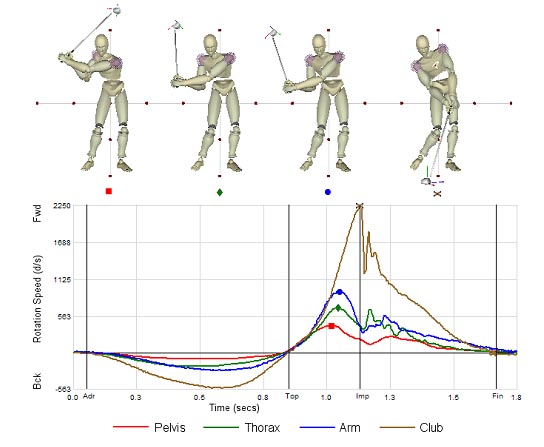 The graph is from Philip Cheetham of TPI. Note how the angular speed of rotation of the hips/shoulders/arms is the same in the early downswing. Then note that the pelvis slows down slightly before the shoulders, and that the shoulders slow down a little later, just before the arms reach peak velocity. Note that the arms reach peak velocity when the hands are at waist level - in the mid-dowswing. Note that the arms are moving at a slower speed in the late downswing, but that the clubhead is rapidly accelerating in the late downswing to reach maximum velocity at impact. The reason why the club is moving so fast in the late downswing is due to the release phenomenon (release of power accumulator #2). Considering how fast the club is moving in the late downswing due to the sequential release of power accumulators #4 and then #2, how could an active release of power accumulator #1 at this same time-point in the late downswing increase clubhead speed? Remember that the the right elbow is straightening in the late downswing at the same time as the clubhead is traveling at an ultra-fast speed. How can any active isotonic contraction of the right triceps muscle at this same time-point in the swing get the club to move faster than is demonstrated in this diagram. Maybe that is why Hogan "wished he had three right hands". He wished that he could get the club to move faster in the late downswing, but practical common-sense probably made him realize that his swing was already optimized for maximum clubhead speed generation., and that any attempt to add extra swing power in the late downswing was not practically possible for a swinger who had a perfected triple barrel 4:2;3 swing. Jeff. |
Understanding the Swinger's Right Arm Participation -- Real Vs. Feel
Quote:
:salut: Jeff, I understand and agree with your premise regarding the Swinger's passive Right Arm participation. But for me, it does not explain Hogan's desire for "three right hands". In fact, the whole notion of 'passive right arm' conflicts with it. Here's my view: As do all good players, Hogan sensed tremendous Clubhead Lag Pressure Point Pressure from Release to the end of the Follow-Through ('Through the Ball' per 7-24). He felt this Lag Pressure (Acceleration Rate / 2-M-2 #1) in his #3 Pressure Point (first joint of the Right Hand forefinger) and wanted more. Alas, since Clubhead Inertia can withstand all the Lag Pressure anyone can generate (7-19), there was no 'more' to get. Thus, with only one right hand, Hogan felt deficient. Further, though Clubhead Lag Pressure only indirectly drives (7-11) the Club through Impact, it is nonetheless a dominant Feel. In fact, creating and maintaining this Lag Pressure (1-L #7) is no less than The Secret of Golf (6-C-2-0 / - A). And this indirect drive at Pressure Point #3 -- Right Hand -- is transmitted via the passive Power Accumulator #1 -- Right Elbow (6-C-2-C / 10-11-0-3). All of which explains the Swinger's Feel ("describable sensation" per 1-J and 3-B) of the "stiff-wristed Right Forearm Slap" (Major Basic Stroke / 10-3-B) and the mantra of The Golfing Machine: Sustain the Lag! [3-F-7-B] :golfcart2: |
Yoda
I find your explanation very credible. It makes much more sense than the idea proposed by the proponents of a "right arm throw action" who claim that Hogan actively used his right arm in a karate-chop action, which started at the very beginning of the downswing. In fact, I would imagine that an active right arm throw action, which occurs out-of-sequence at the very start of the downswing, could predispose to clubhead throwaway and a premature loss of that "feeling" of lag pressure at the PP#3 point. I presume that when you state "stiff-wristed right forearm slap" that you are not implying an active release of power accumulator #1 (due to an isotonic contraction of the right triceps muscle), but rather a well-sequenced release of power accumulator #4, and then PA #2, synchronously combined with the optimum amount of isometric contraction of the right arm/forearm muscles that allows a golfer to sustain the lag. Jeff. |
Quote:
Tom Tomassello's concept + VJ Trolio's findings = possible greatest description of Hogan's swing so far...:salut: Cheers Cheers |
Quote:
Jeff, my answers, for what they are worth, in bold blue above. |
Quote:
Yoda, I'd love to understand your version, but I am too dumb to grasp it. Too bad, since I believe it may be another top post about Hogan...:) I agree 200% to the first sentence of yours directed to Jeff. |
Sustaining Versus Creating Lag
Quote:
Moreover, I am referring to the Swinger's Feel -- monitored in the Right Forearm and Pressure Point #3 -- of sustaining (not creating) Lag Pressure 'Through the Ball'. This Lag Pressure is the indirect drive of the Clubhead (7-11), and its associated Accumulator #3 Action (Clubhead Overtaking) is the product of the passive Accumulator #1, i.e., the straightening Right Elbow per 7-3, 7-20, 6-B-3-0 and 10-11-0-3. In my own case, my Right Forearm through Impact feels as if I am pressing the palm of my right hand on the inside of a doorway (with the Pivot and its Right Shoulder leading the action), but the doorway won't move. Presumably, this is the "optimum amount of isometric contraction" to which you refer. |
Caveat Emptor For Swingers
I strongly suggest that Swingers attempting to monitor the Right Forearm Slap of the Major Basic Stroke (7-3; 10-3-B) first firmly secure the last three fingers of the Left Hand (Pressure Point #2) when taking the Grip. Then, maintain that Pressure throughout the Stroke, especially at the Top during the Left Wrist Loading (accomplished by the Pivot per 7-12, 7-19, 7-20 and 10-19-C).
Otherwise, it is all to easy for any 'Right-Sided' Action to degenerate into Throwaway (6-D-0/1/2/3) with its disastrous consequences. For a 'through Impact' drill, do the 'doorway' drill mentioned above, only use the back of the Left Hand (and the Flat Left Wrist) against the door jamb's resistance. Feel the Pivot pulling the Left Arm. Of course, the same thing is happening with the Right Arm: It is being Pulled by the Body, its rotation and the ultimating Centrifugal Force. But, it is easy for the player's Right Hand to mistake this Pull - against the Lag Pressure it generates -- as a Push. |
Post Translation Coming
Quote:
I know it was a tough read, especially for those not well down the road that is TGM. Now that the nuts and bolts are up for the 'deep drillers' -- :book: -- I'll put up a capsule summary ASAP that might actually mean something to the other 98 percent of the readers on this site. Meanwhile, though, it's Father's Day, and I'm out for a family celebration! :salut: |
Yoda
I look forward to your capsule summary. I hope that you will address the following issue in particular. You stated-: "Of course, the same thing is happening with the Right Arm: It is being Pulled by the Body, its rotation and the ultimating Centrifugal Force. But, it is easy for the player's Right Hand to mistake this Pull - against the Lag Pressure it generates -- as a Push." If I understand you correctly, Hogan had a body-generated swinger's action, whereby the downswing pivot action essentially provides the swing power. I envisage the downswing pivot action pulling the entire power package assembly (left and right arm flying wedges) at the start of the downswing, so that the right arm/forearm merely has to supply sufficient isometric muscle force to maintain the right arm flying wedge intact during the early/mid downswing. Then, when power accumulator #4 and then #2 release, the right arm/forearm needs to supply enough muscle force to maintain the constantly bent right wrist/right hand firmly against the grip/left thumb so that the golfer can provide constant extensor action throughout the downswing and also constantly sustain clubhead lag and prevent club throwaway. I would also be interested in your opinion as to whether a Tom Tomasello-style "right arm throw" action is suitable for right arm-swingers, who do not use the downswing pivot action to release power accumulator #4. Tom Tomasello stated that in an "arm swinger's" action, the body simply gets out of the way so that the arms can swing freely across the front of the body. In that scenario, I can envisage the the right arm/forearm being actively responsible for the release of power accumulator #4 - by the right palm pressing against the left thumb at PP#1 and pushing the entire left arm forward. In that sense, I can envisage the "right arm throw" action causing the release of power accumulator #4 via an active "push"' action, and the release of power accumulator #2 via a secondary "pull" action on the clubshaft (the right forearm/arm pushes the left arm forward at PP#1 => the left hand pulls the grip => the club passively releases via a centrifugal action). The question then becomes - does the right arm/forearm also cause an active release of power accumulator #1 in a right arm swinger's action, or is the right arm swinger's action still a triple barrel (4:2:3) swing action? Jeff. |
Dariusz
You wrote-: "What I see, Hogan squared his clubface just before entering the impact zone when his right hand seem to turn into a palm down position. It can be seen when his shaft is, more or less, in parallel to the ground position." When you state that the clubshaft is parallel to the ground, then you must surely be referring to the delivery position. You then imply that Hogan's clubface is square at this position with the right palm facing the ground. I do not see that phenomenon in Hogan's swing. Do you have a single photo showing that Hogan's clubface is square to the swingarc when his clubshaft is in the delivery position? From my perspective, Hogan would have wanted to avoid that scenario because he had a hooking problem and he apparently wanted his clubface to be slightly open throughout the early/mid downswing. Jim McLean makes this point in his DVD series analysing Hogan's swing. Here is a photo of Jim McLean mimicking Hogan's swing action when his clubshaft is at the delivery position.  The dotted yellow line shows that the clubface of Jim McLean's club is slightly open at this time-point. Jim Mclean stated that Hogan deliberately maintained a slight cupping of the left wrist throughout his downswing so that he could keep the clubface slightly open to the clubhead swingarc. If the clubface was square at this time-point in the downswing, then the back of Hogan's left hand (which is parallel to the clubface) must be facing slightly groundwards. I have never seen a photo of Hogan at this time-point in his downswing with the back of his left hand facing groundwards. If anything, it always seems to face slightly skywards. You also wrote-: "The hip turn that starts the downswing (i.e. left side of the body action - remember Hogan's image of elastic tape glued to his left hip ?) is a pulling motion that can create by itself the left wrist cock. Supposing that Hogan used his right arm/elbow/forearm/hand to support the hit, he had to convert the left wrist cock lag into a right wrist hinge lag." I don't think that you understand Hogan's swing action from a TGM perspective. Power accumulator #2 is loaded during the backswing and that establishes the left wrist cocking angle of =>90 degrees. When the left wrist cocks up during the left arm's lifting/counterclokcwise rotation movement, the right elbow folds and the right wrist hinges back into a bent right wrist position. Therefore, the bent right wrist situation is established during the backswing. Once established, the bent right wrist is never released during the downswing, even when the right elbow straightens in the late downswing, and even when the left wrist uncocks as power accumulator #2 is released. Jeff. |
No Mas Tomasello
Quote:
In any event, this is not the appropriate thread for such discussions. For those interested, Bagger Lance has established a Right Arm Swing thread precisely for that purpose. http://www.lynnblakegolf.com/forum/s...ead.php?t=5617 And a few clicks will lead others to numerous 'Tomasello' threads. Thank you in advance for understanding. :salut: P.S. Quote:
:) |
I believe Hogan qualified his “three right hands” statement with the following paragraph.
“On a full shot you want to hit the ball as hard as you can with your right hand. But this is only half the story. HIT THE BALL AS HARD AS YOU CAN WITH BOTH HANDS. The left is a power hand, too. If you hit hard with only the right and let the left go to sleep, you will not only lose much valuable power, you also will run into all the errors that result when the right hand overpowers the left. YOU MUST HIT AS HARD WITH THE LEFT AS WITH THE RIGHT. “ (Lesson 4 page 99) In the paragraph above he appears more concerned with the left not doing its job (going to sleep) and being overpowered by the right rather than being worried about a deficient right hand. He also wanted the “…right hand in a position to perform its share of the work but no more than its equal share”. (Lesson 1 p24). Here again he appears more concerned about the right hand dominating rather than it being deficient. Given equal strength in both hands, if he desired the power of three right hands he must have also desired the power of three left hands (“the left is a power hand, too.”) so that the right hand did not dominate and in order to achieve his objective, which was to “HIT THE BALL AS HARD AS YOU CAN WITH BOTH HANDS.” |
Quote:
|
http://www.julesalexander.com/hogan.html
Jeff, I am not sure how to upload photos on this Forum. Call me a PC laic and you won't be far from the truth :eyes: if I knew how to do it from my PC collection I'd give the evidence of my way of thinking for you. There is a ton of photos of post-accident Hogan that support what I've written (such as e.g. the photo from Jules Alexander site to which I included the link above with). Jim McLean's version from the BH Collection is not even close to the original. Please look even at the photo you put in your post - pay special attention to where the V on the right hand grip is pointing - there is a huge difference still visible (although the Hogan's photo is of bad quality). Before-secret Hogan wanted to deliver the clubface as open as possible since he believed it could tame his hooks. It did not work, as we all know. Post-secret, and specially post-accident Hogan appeared to do a completely reverse thing (which seemed to be totally counterintuitive) - to square the clubface earlier and maintain it square as long as possible (delayed post-impact swivel and swinging left with an angled hinge); the whole question is if you are able to do it with only left arm pulling...I do not believe it is so easy and so efficient comparing to the right forearm support while swinging the club around... Cheers |
Quote:
Great pictures and insight and just a reminder that I am sure HK states somewhere in the book That a player on Elbow Plane and a lot of no3 angle would need an earlier release point which is a possibity that Hogan figured out and those pics hint at this. Maybe Jeff will find that passage in the book and post it |
Dariusz
It is very easy to link to photos so that they appear in your text message. There should be a series of formattiing choices at the top of this window, and the one choice is a mountain with a yellow colored sky. If you hover your mouse arrow above that "picture" it should state "insert image". You simply have to click on that "insert image" link and insert your url link. If you cannot find the "extra" formatting options, got to UserCP => click on "edit options" => got to miscellaneous options at the bottom, and then choose "standard editor". Regarding that Jules Alexander photo, it doesn't show the clubshaft at the delivery position. The clubshaft is already well into that part of the downswing called the "release swivel" phase and during this phase of the downswing, the left hand and clubface will undergo a 90 degree rotation into impact. During that 90 degree rotation phase, the back of the left hand will swivel so that it faces the target and it will also face groundwards if the golfer is hitting down on the ball. It is perfectly normal for the clubface, and back of the left hand, to be facing slightly groundwards during the release swivel phase of the downswing - and this applies to all good golfers, and not only Hogan. I think that you would benefit greatly if you did what I did 2 months ago - become an avid student of TGM. It has changed my understanding of the golf swing in many ways, even though I still have a lot to learn. Then, you wouldn't write-: "to square the clubface earlier and maintain it square as long as possible (delayed post-impact swivel and swinging left with an angled hinge); the whole question is if you are able to do it with only left arm pulling...I do not believe it is so easy and so efficient comparing to the right forearm support while swinging the club around..." I think that you have an incomplete/ wrong conception of the golf swing. A swinger may "pull" the club longitudinally with the left arm, but the right forearm and PP#3 control the clubshaft to ensure that it is on plane during the downswing, while the left hand controls the clubface through impact. I don't believe that a golfer should ever "hold" the clubface square as long as possible. In HK's terms, that represents "steering", which is a significant mistake. The clubface should always come into impact with a slightly open clubface, and a good golfer controls its rate of closure through impact/followthrough via a hinging action, which is under the control of the back of the left hand, but biomechanically operant at the level of the left shoulder socket. Any post-impact swiveling action occurs after the followthrough phase of the swing. Here is a post-accident photo of Hogan posing - to demonstrate how he wanted the clubface to be slightly open when it reached the delivery position. 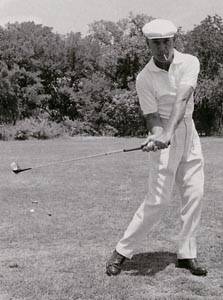 If you have "evidence" that Hogan changed his approach to deal with his lifelong hooking problem very late in his career, then could you please i) quote Hogan stating that he deliberately chose to close the clubface earlier in his downswing; and ii) explain how an earlier clubface closure action would be a good anti-hooking strategy. Jeff. |
Dariusz
Here is link to a slo-mo swing video of Tiger Woods's swing, and you will be able to study the movement of the back of his left hand and clubface during the release swivel action. http://www.youtube.com/watch?v=yqsf4bEBF-Q This photo comparison shows that both Tiger and Ben had the back of their left hand facing slightly groundwards at this stage of the release swivel action (when viewed from a similar off-center camera angle) and that the clubface is not square yet to the swingarc. 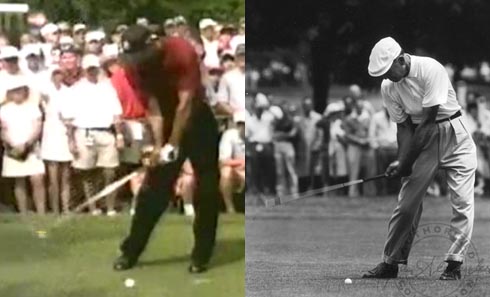 I believe that the clubface must always approach the ball slightly open at the time of first ball impact in standard shots. Jeff. |
Quote:
I am not going to debate with you or any of the Forum members in a TGM language since my knowledge is very limited so far. Neverteless, I can easily answer your 2 questions using ordinary terms: i) quote Hogan stating that he deliberately chose to close the clubface earlier in his downswing I cannot do it since I believe it is one of the important puzzles of Hogan's secret that he did not want to reveal to anyone. ii) explain how an earlier clubface closure action would be a good anti-hooking strategy It's very easy. In case of pivot guided swings the most efficient motion is to subdue the clubface movement to the body turn; when your clubface is already square to the arc before entering the impact zone no further action is taken in order to close the clubface, because your brain already knows it is square; you, as a Doc, should know much better than me that everything happens in our brain - if your brain "sees" the clubface as closed and, simultaneously, your brain "wants" to hit the ball straight, it won't allow your hands to close the clubface and will force them to be completely passive during the impact zone. Do an experiment yourself - address the ball with a severely closed clubface with an attempt to hit the ball straight forward - you will see how hard (or even impossible) is to hook the ball in such a scenario. What will happen is that you subconsciousnessly hit the ball with a more open clubface that it was at address and most likely (depending on your swing characteristic) you'll obtain a fade pattern. No CP, CF or other forces will be ever able to overcome your subconsciousness. I think that Hogan discovered this phenomenon and he gave us some clues while saying: "if you think that a given thing in your swing will help you - do exactly opposite thing and you'll obtain what you want Cheers P.S. the comparison between Hogan and Woods on those 2 pics of yours is wrong - first, the angles are different, second, they are not in the same moment of the swing. Lastly, look carefully at Hogan's clubface - it is square to the arc already (the whole face of the club is visible). |
| All times are GMT -4. The time now is 04:37 PM. |