Pistol wrote in another thread-: "And while you are digging there can you go in to great detail for me as to how Hogan squared the clubface to the arc relatively early in his downswing and believe me there is some great photos out there that will prove this. Since he got the club "laid off" and open relative to the plane at the top if he just Pulled the club what would happen??"
This is my personal interpretation of what happened to Hogan's clubface at the end-backswing and early downswing.
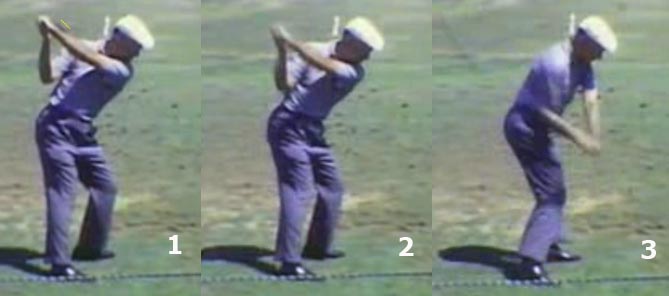
I believe that Hogan's clubface was frequently slightly open at the end-backswing position, and I think that the main cause was his tendency to cup his left wrist at the end-backswing, which caused the clubshaft to slightly cross the line ( and point right-of-parallel), and also caused the clubface to open.
Here is a photo-example.
Image 1 shows that Hogan's club is slightly beyond parallel at the end-backswing, and pointing slightly to the right of target. I believe that he often ended up in that position because he had ultra-flexible wrists, that allowed his left wrist to upcock (radially deviate) >90 degrees at the end-backswing position. That large degree of radial deviation of his left wrist also caused some dorsiflexion of his left wrist so that his left wrist was slightly cupped at the end-backswing position, which caused his clubface to become slightly open. At the same time, his bent right wrist developed a small degree of radial deviation (upcocking).
I believed that Hogan closed his clubface at the very start of the downswing, so that it became neutral to the clubhead swingarc, by starting his downswing with a very assertive hip shift-rotation movement. That lower body movement caused his clubshaft to fall back/shallow-out, thereby flattening his left wrist - see image 2. When his left wrist became flat, then his clubface became neutral to the swingarc.
Interestingly, Jim Hardy claims that Hogan closed his clubface in the early downswing by means of a counterclockwise rotation of his left arm, that caused his right forearm to "twist and throw" the clubface into a closed position, and that also caused his right elbow to end up behind the right hip, instead of in-front of the right hip, in the mid-downwsing. However, I can see no evidence of any left arm counterclockwise rotation in image 2 or image 3, and no evidence to support Jim Hardy's belief that Hogan used an active right forearm "twist-and-throw" maneuver in his early downswing.
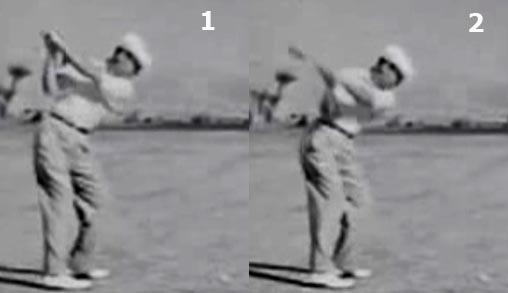
Here is another image demonstrating how Hogan shallowed his clubshaft at the start of the downswing and flattened his left wrist.
Image 1 show Hogan at the end-backswing and he has a slightly cupped left wrist. At the start of the downswing, he starts the downswing with a lower body pelvic shift-rotation movement (hip squaring action) that shallows his clubshaft and causes the clubhead to move backwards (away from the ball-target line) and that also flattens his left wrist. When his left wrist flattens, it automatically closes the clubface to the swingarc.
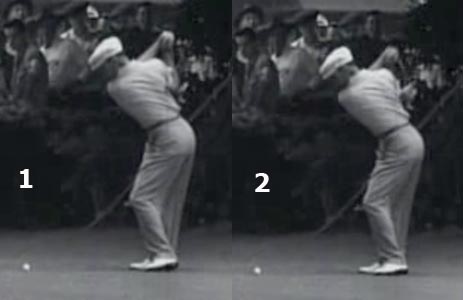
Here is a third image which clearly shows Hogan's clubface closing slightly at the very start of the downswing.
Image 1 shows that Hogan had a slightly cupped left wrist and a clubshaft that was slightly right-of-parallel at the end-backswing. That predisposes to a slightly open clubface. Image 2 shows Hogan at the very start of the downswing, and one can see his flat left wrist and see that his clubface is now parallel to the back of his flat left wrist, which means that it is neutral to the swingarc.
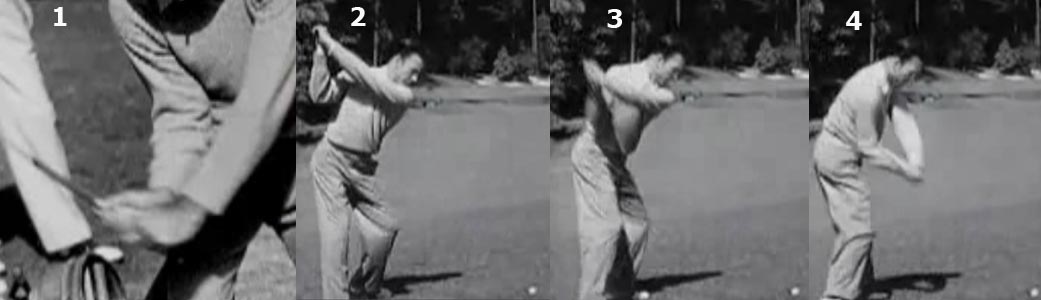
Jim McLean in his DVD series on Hogan's swing claims that Hogan kept his left wrist cupped in the downswing and he supplies visual evidence.
Image 1 is a close-up of Hogan's cupped left wrist when he is in a mid-downswing position. Image 2,3, 4 shows an early-Hogan sequence demonstrating the same phenomenon - maintaining a cupped left wrist in the downswing and an open clubface. I don't know whether this phenomenon was a feature of Hogan's early swingstyle or whether Hogan selectively kept his left wrist cupped during the downswing at certain times for a particular purpose. I am interested in informed opinions regarding this issue.
My opinions are always open to modification if forum members can provide alternative opinions supported by solid "evidence".
Short reply and thinking of: Henry Picard to rotate Hogan left hand grip a tad to the left.
His right hand looks like rolled to the left in many pictures...Denis Pugh called that a butterfly grip.
So, the combination of 10-2-G and 10-18-B?
__________________
If you cannot take the shoulder down the clubshaft plane, you must take along some other path and add compensations - now, instead of one motion to remember, you wind up with at least two!
Pistol wrote in another thread-: "And while you are digging there can you go in to great detail for me as to how Hogan squared the clubface to the arc relatively early in his downswing and believe me there is some great photos out there that will prove this. Since he got the club "laid off" and open relative to the plane at the top if he just Pulled the club what would happen??"
This is my personal interpretation of what happened to Hogan's clubface at the end-backswing and early downswing.
I believe that Hogan's clubface was frequently slightly open at the end-backswing position, and I think that the main cause was his tendency to cup his left wrist at the end-backswing, which caused the clubshaft to slightly cross the line ( and point right-of-parallel), and also caused the clubface to open.
Here is a photo-example.
Image 1 shows that Hogan's club is slightly beyond parallel at the end-backswing, and pointing slightly to the right of target. I believe that he often ended up in that position because he had ultra-flexible wrists, that allowed his left wrist to upcock (radially deviate) >90 degrees at the end-backswing position. That large degree of radial deviation of his left wrist also caused some dorsiflexion of his left wrist so that his left wrist was slightly cupped at the end-backswing position, which caused his clubface to become slightly open. At the same time, his bent right wrist developed a small degree of radial deviation (upcocking).
I believed that Hogan closed his clubface at the very start of the downswing, so that it became neutral to the clubhead swingarc, by starting his downswing with a very assertive hip shift-rotation movement. That lower body movement caused his clubshaft to fall back/shallow-out, thereby flattening his left wrist - see image 2. When his left wrist became flat, then his clubface became neutral to the swingarc.
Interestingly, Jim Hardy claims that Hogan closed his clubface in the early downswing by means of a counterclockwise rotation of his left arm, that caused his right forearm to "twist and throw" the clubface into a closed position, and that also caused his right elbow to end up behind the right hip, instead of in-front of the right hip, in the mid-downwsing. However, I can see no evidence of any left arm counterclockwise rotation in image 2 or image 3, and no evidence to support Jim Hardy's belief that Hogan used an active right forearm "twist-and-throw" maneuver in his early downswing.
Here is another image demonstrating how Hogan shallowed his clubshaft at the start of the downswing and flattened his left wrist.
Image 1 show Hogan at the end-backswing and he has a slightly cupped left wrist. At the start of the downswing, he starts the downswing with a lower body pelvic shift-rotation movement (hip squaring action) that shallows his clubshaft and causes the clubhead to move backwards (away from the ball-target line) and that also flattens his left wrist. When his left wrist flattens, it automatically closes the clubface to the swingarc.
Here is a third image which clearly shows Hogan's clubface closing slightly at the very start of the downswing.
Image 1 shows that Hogan had a slightly cupped left wrist and a clubshaft that was slightly right-of-parallel at the end-backswing. That predisposes to a slightly open clubface. Image 2 shows Hogan at the very start of the downswing, and one can see his flat left wrist and see that his clubface is now parallel to the back of his flat left wrist, which means that it is neutral to the swingarc.
Jim McLean in his DVD series on Hogan's swing claims that Hogan kept his left wrist cupped in the downswing and he supplies visual evidence.
Image 1 is a close-up of Hogan's cupped left wrist when he is in a mid-downswing position. Image 2,3, 4 shows an early-Hogan sequence demonstrating the same phenomenon - maintaining a cupped left wrist in the downswing and an open clubface. I don't know whether this phenomenon was a feature of Hogan's early swingstyle or whether Hogan selectively kept his left wrist cupped during the downswing at certain times for a particular purpose. I am interested in informed opinions regarding this issue.
My opinions are always open to modification if forum members can provide alternative opinions supported by solid "evidence".
Jeff.
Great post Jeff so Your Theory is simply the sharp hip turn flattened the left wrist . WHERE is the EVIDENCE and if this was FACT why did Hogan maintain the cup in the left wrist in the 1949 sequence you posted above and his hips are turning sharply then.
So you are stating JIM HARDY's theory is wrong but at least he came up with some photos of the elbow marginally behind the hip.
But i will go along with you that Hardy's theory is wrong BUT yours is way WORSE pleassse the left hip can turn as hard as it wants and the "CUP" on the left wrist can actually increase. I can only imagine a very lifeless left arm not involved in the Pulling motion and the weight of the clubhead causing the left wrist to lose the cup
TT and the right hand karate chop down and out would seem a much more valid idea as it would flatten the left wrist and square the clubface to the arc AS it would geometrically fit and take care of the 3 right hands mystery
It is my biased opinion that you may have problems with respect to understanding cause-and-effect relationships in human biomechanics.
You seem to have difficulty understanding how a fast hip turn at the start of the downswing can cause the clubshaft to shallow-out/flatten. You also seem to have difficulty understanding how a flattening clubshaft at the top of the swing can produce forces that promote left wrist flattening. You state that a fast hip turn can increase cupping. It can if the clubshaft is kept across-the-line. However, Hogan's clubhead moved backwards (away from the ball-target line) so that his clubshaft became laid off at the start of the downswing, and that clubshaft movement makes it much more difficult to maintain a cupped left wrist. In fact, that clubshaft movement promotes the passive acquisition of a flat left wrist.
Also, whether a golfer decides to allow the left wrist to be flattened in response to forces that shallow/flatten the clubshaft is still under control by the golfer. It is obviously possible for a golfer to deliberately resist those forces and intentionally maintain a cupped wrist.
There is a second biomechanical phenomenon that promotes a flattening of the left wrist when the downswing starts with a fast hip shift-rotation movement. That fast lower body movement also causes the right elbow to be pulled rapidly down towards the right hip area, and because the right arm flying wedge remains intact, that right elbow movement causes the right forearm and right hand to be pulled down under the flattening clubshaft, which in turn promotes further flattening of the clubshaft - as can be seen in this photo.
Whether you find my biomechanical explanation credible, or not, the photos demonstrate the "reality" that Hogan's left wrist flattened at the start of the downswing, and this biomechanical event would cause the clubface to close slightly if the left wrist was previously cupped.
It is my biased opinion that you may have problems with respect to understanding cause-and-effect relationships in human biomechanics.
You seem to have difficulty understanding how a fast hip turn at the start of the downswing can cause the clubshaft to shallow-out/flatten. You also seem to have difficulty understanding how a flattening clubshaft at the top of the swing can produce forces that promote left wrist flattening. You state that a fast hip turn can increase cupping. It can if the clubshaft is kept across-the-line. However, Hogan's clubhead moved backwards (away from the ball-target line) so that his clubshaft became laid off at the start of the downswing, and that clubshaft movement makes it much more difficult to maintain a cupped left wrist. In fact, that clubshaft movement promotes the passive acquisition of a flat left wrist.
Also, whether a golfer decides to allow the left wrist to be flattened in response to forces that shallow/flatten the clubshaft is still under control by the golfer. It is obviously possible for a golfer to deliberately resist those forces and intentionally maintain a cupped wrist.
There is a second biomechanical phenomenon that promotes a flattening of the left wrist when the downswing starts with a fast hip shift-rotation movement. That fast lower body movement also causes the right elbow to be pulled rapidly down towards the right hip area, and because the right arm flying wedge remains intact, that right elbow movement causes the right forearm and right hand to be pulled down under the flattening clubshaft, which in turn promotes further flattening of the clubshaft - as can be seen in this photo.
Whether you find my biomechanical explanation credible, or not, the photos demonstrate the "reality" that Hogan's left wrist flattened at the start of the downswing, and this biomechanical event would cause the clubface to close slightly if the left wrist was previously cupped.
Jeff.
Jeff i don't find any of your explanations above to be credible because they all have holes in them as large as the milky way galaxy . Now you state i don't understand that a hip turn may/will flatten out a shaft plane which is a silly statement because i do.The wrists can operate indepentantly of the forces on the shaft and wrist angle can be increased whether laid off or across the line. And a fast lower body with a deep pitch elbow doesn't mean the wrist can't be cupped there just look at the photo you posted yourself.
You state that i have difficulty understanding cause and effect which is ludicrous Jeff because i CAN DO and you can't and you are NOT a biomechanist.
Your explanation on Hogan is probably the weakest arguement i have ever seen stated
It is obvious that the wrist flattens but you cannot even offer a credible arguement that a turning hip will cause this except to say the flattening shaft creates forces on the wrist
Here is something for you to look into so you can be better educated. There is footage there Face On of Hogan post accident 1960's where its clearly evident that his hands have already moved longitudinally away when his left hip has not even started to clear in fact he is still finishing his lateral shift with the right buttock/leg so that clearly shows that the turning left hip has nothing to do with the wrist change
Now TT method of delivering the right hand and releasing against a firm left hand would make a lot more sense rather than the fiction you have stated
How many years you work on a golf swing JEff? Why do you seem to think that the TT concept is not correct after all he was at it for what 60+ years? ITs obvious that it would fit the criteria for the clubface being squared to the arc and the 3 right hands comment by the man himself.Why is your arguement based on the 2 reasons above that are so flawed?
Watch this and you will see the left hip has not begun to clear at all
Let me express my voice as a huge Hogan fan that analyzes his swing motion almost everyday.
Look at those two photos in your above post. Compare how many degrees Hogan's hips turned left (the belt buckle is still visible on the second photo) with the right elbow movement.
Sorry to say, but when looking at the photos I find it simply not natural that the sharp hip turn caused Hogan's elbow to move that far down. Granted, the hip turn will flatten the arc a bit but, IMHO, it's not possible to say that it causes everything (i.e. flattening the plane, bringing right elbow to the right hip and flattening the left wrist).
Do an experiment yourself - go to the top with a cupped left wrist and just turn your hips as quick as possible without trying to go low with the clubhead to the ground in urge to hit the ball - jus hold the club and turn your hips - you'll observe that your cupped left wrist remains cupped despite the turn.
It implies that except the obvious froces as hips leading the downswing (after the CoG shift) and pulling with the left side of the body there must be a force generated by the right side (hand, forearm, elbow, shoulder, etc.) in a due time in synch with the pivot.
Pistol's theory based on Tom Tomasello's findings is very interesting. Many people tried to explain Hogan's swing with ONLY left side and left arm turning and pulling towards the target, yet, noone is still able to duplicate his swing motion decently in every aspect of the swing. I watched Tomasello's vids and what he says is very convincing. The "right hand karate chop down and out" he is talking about really flattens left wrist, lets right wrist remain in dorsiflexed, and ensure that the clubface becomes square to the arc almost automatically, provided the body work is proper.
It's much better than Hardy's "twist" part of the "twist&throw" concept that cannot be observed in Mr.Hogan's motion. Despite the lack of it, he delivered the clubface square to the arc before entering impact zone. IMHO, not all puzzles of "Hogan's secret" are discovered and put in a proper place so far.
Jeff, do me a favour. If you would, please shorthen the lines of
the text. I like to print the posts so that I can take them to
the range. When I tried to print this post, the end of the
lines are cut off. In the "printable version" the words are so
small that I can not read them.
but what i have notice is.. Hogan have a pretty upright posture and a very "lowish" arm at the top of the swing, and a mid hand setup.
with that kind of combination he need to rotate his arm to get connected , be on plane and "one plane " position at the top. very similar to what this guy
teach.or sergio. very similar way. more "flattish " shoulder turn.. but in order to stay in sync or connected. he need to turn his arms back and through swing like hogan did... ie a flatter rotated shoulder turn. but rotate arm to stay on plane.
huge amount of lag using this way... due to the increased flexibility.. arm not flexed around the Rotor wrist joint.. at the top.
..
Say if we dont rotate our arms. and a flat shoulder turn. I think we will end up a little like David toms .. Arm have to move higher to stay on plane. ie flat shoulder turn..
and if we dont rotate the arms again , and stay "arm same line as shoulder on the top. while staying connected. we have to Pivot a little like sam snead , Jim hardy OPS or Stack and tilt swing..steeper rotated shoulder turn.
Many ways to skin the cat .. I say its choose your poison.
I think type of shoulder turn vs steepness shoulder turn vs arm rotation vs arm height.. need to be compatible . so that the motion create an on plane swing
Just my 2 cents observations.
__________________
God :God is love.
Latest incubator: Finally appreciate why Hogan wrote 19 pages on GRIP. I bet he could write another 40 pages.
Pistol - you wrote-: "Now TT method of delivering the right hand and releasing against a firm left hand would make a lot more sense rather than the fiction you have stated. How many years you work on a golf swing JEff? Why do you seem to think that the TT concept is not correct after all he was at it for what 60+ years? ITs obvious that it would fit the criteria for the clubface being squared to the arc and the 3 right hands comment by the man himself."
You are free to find TT's idea of the right hand karate-chop throw action interesting and attractive. However, it's astonishing that you are willing to state that it fits in with Hogan's swing. You have provided no "evidence" to support that belief other than Hogan's statement that he wishes he had "three right hands". The reason why I find it astonishing is that you are ignoring Hogan's own statements regarding his swing. You are implying that Hogan utilised an active right arm karate-chop action from the very start of the downswing, thereby implying that the right arm is active when it is well above waist level. That factually-unsupported belief contradicts Hogan's own comments in his "Five Lessons" book.
On page 93 of his book, Hogan wrote-: "What do the hands do? The answer is they do nothing active until after the arms have moved on the downswing to a position just above the level of the hips. The arms don't propel this motion themselves. They are carried down by the movement of the hips". He then goes in the rest of that paragraph to describe how the hands and arms get this "free ride". He also demonstrates this "free ride" phenomenon in his swing video lesson.
In this lesson, Hogan demonstrates unequivocally how the arms/hands are brought passively down to hip level and how the right elbow is brought rapidly down to the right hip area solely as a result of his lower body move. He states unequivocally that this lower body action "brings one in a position to hit". This "hit position" occurs when Hogan's hands are well below waist level. Whatever Hogan meant by "three right hands", it must occur when his hands were in a "position to hit" and not at the start of the downswing - ala Tom Tomasello's description.
This is my last post that will be addressed to you. We live in parallel mental universes and we apparently cannot fruitfully interchange ideas. I am also tired of being subjected to your constant baiting and insults. This forum allows free discourse, and you are free to make insulting ad hominem comments, but I don't have to perpetuate your behaviour by personally responding to your posts.
I am aware that you a serious student of Hogan's swing.
I therefore find it very surprising to read what you wrote- : "Sorry to say, but when looking at the photos I find it simply not natural that the sharp hip turn caused Hogan's elbow to move that far down."
Look at Hogan's swing video lesson, which you must have looked at many, many times. Are you really not convinced that Hogan's entire power package assembly was brought down to waist level as a result of his rapid lower body action. He demonstrates this "lower body move" repeatedly in this video lesson, and it is so easy to see his entire power package assembly moving as a single unit down to hip level, concurrently with his lower body action. In his "Five lessons" book he makes the same point of how the arms/hands get a "free ride" down to waist level. He is very definite about the upper limbs (arms/hands) being passive in the early downswing.
You also wrote-:"Do an experiment yourself - go to the top with a cupped left wrist and just turn your hips as quick as possible without trying to go low with the clubhead to the ground in urge to hit the ball - just hold the club and turn your hips - you'll observe that your cupped left wrist remains cupped despite the turn."
Of course my left wrist will remain cupped if I deliberately maintain a cupped left wrist. However, my left wrist flattens immmediately if I relax my left wrist and allow the left wrist to passively respond to forces that have a left wrist flattening effect. The key "feeling" is the "feeling" of leaving the club behind while the downswing is initiated. Hogan had ultra-flexible wrists and you can actually see his degree of left wrist lag increasing at the start of the downswing. I believe that the cause of that phenomenon is due to the combination of i) a sudden pull-down of the left arm (secondary to the lower body pivot action that initiates Hogan's downswing) and ii) very relaxed wrists. The likelihood of that "increased lag" phenomenon happening at the start of the downswing would be much more unlikely if Hogan was actively propelling the club downwards by means of a right arm throw action.
Finally, Hogan was a swinger, and HK stated that a swinger's power accumulator release sequence must be 4,2,3. HK never stated that the right arm should be actively throwing/thrusting in a swinger's action, and certainly not before the release of power accumulator #4.




 Linear Mode


