This is my last post that will be addressed to you. We live in parallel mental universes and we apparently cannot fruitfully interchange ideas. I am also tired of being subjected to your constant baiting and insults. This forum allows free discourse, and you are free to make insulting ad hominem comments, but I don't have to perpetuate your behaviour by personally responding to your posts.
Jeff.
Jeff,
This forum does not allow free discourse regarding direct personal insults. Passions can and do run high sometimes, but we have forum rules which must be followed. Typically we try to address these issues privately via PM, but if they persist I've had to ban more than a handful of people here. Its the most unpleasant part of running a forum, but unfortunately it must be done at times for the health of the site.
We'll be following the discussions more closely, and if we miss anything please bring it to our attention via PM.
Thanks,
__________________
Bagger
1-H "Because of questions of all kinds, reams of additional detail must be made available - but separately, and probably endlessly." Homer Kelly
This is my last post that will be addressed to you. We live in parallel mental universes and we apparently cannot fruitfully interchange ideas. I am also tired of being subjected to your constant baiting and insults. This forum allows free discourse, and you are free to make insulting ad hominem comments, but I don't have to perpetuate your behaviour by personally responding to your posts.
Jeff.[/quote]
Jeff
Its IRONIC that you state in your opinion that i have no understanding of human biomechanics cause and effect etc What's more interesting is that in your original analogy you had no understanding and in my first post on this subject i actually leave you an answer for your own theory i.e lifeless left arm with hip turn doing the pulling. Later posts you use this to explain your own theory which seems a little to coincidental to me.
I for one learned from watching TT and the application works and a snap release still occurs in fact its a highest quality snap and the true magic of the right forearm
Last edited by pistol : 06-14-2008 at 01:13 AM.
Reason: bagger advised me to edit
The likelihood of that "increased lag" phenomenon happening at the start of the downswing would be much more unlikely if Hogan was actively propelling the club downwards by means of a right arm throw action.
WRONG
Finally, Hogan was a swinger, and HK stated that a swinger's power accumulator release sequence must be 4,2,3. HK never stated that the right arm should be actively throwing/thrusting in a swinger's action, and certainly not before the release of power accumulator #4.
Jeff.
QUITE a few knowledgeable TGM would disagree that Hogan was a 3 barrel swinger post accident
Pistol wrote in another thread-: "And while you are digging there can you go in to great detail for me as to how Hogan squared the clubface to the arc relatively early in his downswing and believe me there is some great photos out there that will prove this. Since he got the club "laid off" and open relative to the plane at the top if he just Pulled the club what would happen??"
This is my personal interpretation of what happened to Hogan's clubface at the end-backswing and early downswing.
I believe that Hogan's clubface was frequently slightly open at the end-backswing position, and I think that the main cause was his tendency to cup his left wrist at the end-backswing, which caused the clubshaft to slightly cross the line ( and point right-of-parallel), and also caused the clubface to open.
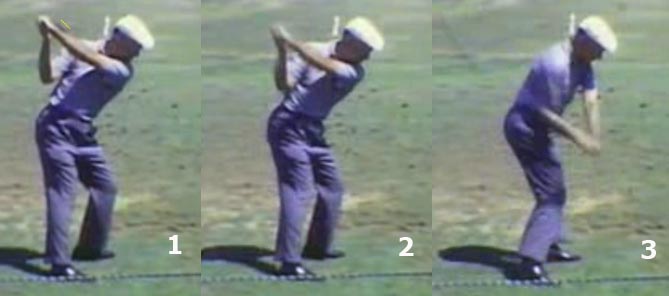
Here is a photo-example.
Image 1 shows that Hogan's club is slightly beyond parallel at the end-backswing, and pointing slightly to the right of target. I believe that he often ended up in that position because he had ultra-flexible wrists, that allowed his left wrist to upcock (radially deviate) >90 degrees at the end-backswing position. That large degree of radial deviation of his left wrist also caused some dorsiflexion of his left wrist so that his left wrist was slightly cupped at the end-backswing position, which caused his clubface to become slightly open. At the same time, his bent right wrist developed a small degree of radial deviation (upcocking).
I believed that Hogan closed his clubface at the very start of the downswing, so that it became neutral to the clubhead swingarc, by starting his downswing with a very assertive hip shift-rotation movement. That lower body movement caused his clubshaft to fall back/shallow-out, thereby flattening his left wrist - see image 2. When his left wrist became flat, then his clubface became neutral to the swingarc.
Interestingly, Jim Hardy claims that Hogan closed his clubface in the early downswing by means of a counterclockwise rotation of his left arm, that caused his right forearm to "twist and throw" the clubface into a closed position, and that also caused his right elbow to end up behind the right hip, instead of in-front of the right hip, in the mid-downwsing. However, I can see no evidence of any left arm counterclockwise rotation in image 2 or image 3, and no evidence to support Jim Hardy's belief that Hogan used an active right forearm "twist-and-throw" maneuver in his early downswing.
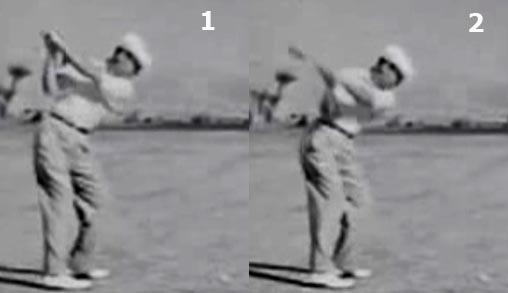
Here is another image demonstrating how Hogan shallowed his clubshaft at the start of the downswing and flattened his left wrist.
Image 1 show Hogan at the end-backswing and he has a slightly cupped left wrist. At the start of the downswing, he starts the downswing with a lower body pelvic shift-rotation movement (hip squaring action) that shallows his clubshaft and causes the clubhead to move backwards (away from the ball-target line) and that also flattens his left wrist. When his left wrist flattens, it automatically closes the clubface to the swingarc.
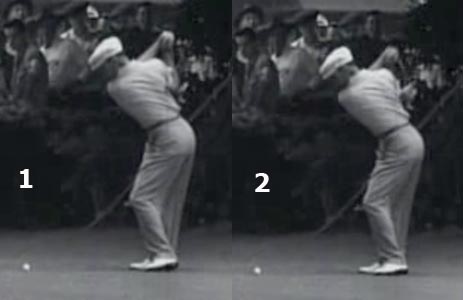
Here is a third image which clearly shows Hogan's clubface closing slightly at the very start of the downswing.
Image 1 shows that Hogan had a slightly cupped left wrist and a clubshaft that was slightly right-of-parallel at the end-backswing. That predisposes to a slightly open clubface. Image 2 shows Hogan at the very start of the downswing, and one can see his flat left wrist and see that his clubface is now parallel to the back of his flat left wrist, which means that it is neutral to the swingarc.
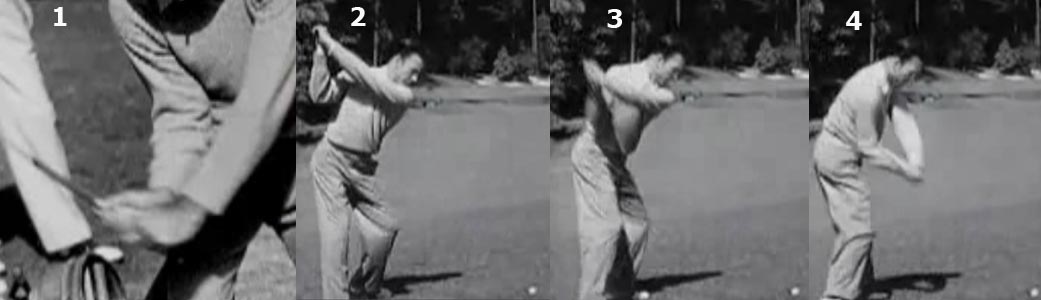
Jim McLean in his DVD series on Hogan's swing claims that Hogan kept his left wrist cupped in the downswing and he supplies visual evidence.
Image 1 is a close-up of Hogan's cupped left wrist when he is in a mid-downswing position. Image 2,3, 4 shows an early-Hogan sequence demonstrating the same phenomenon - maintaining a cupped left wrist in the downswing and an open clubface. I don't know whether this phenomenon was a feature of Hogan's early swingstyle or whether Hogan selectively kept his left wrist cupped during the downswing at certain times for a particular purpose. I am interested in informed opinions regarding this issue.
My opinions are always open to modification if forum members can provide alternative opinions supported by solid "evidence".
Jeff.
Jeff or anyone else,
I'd be interested if someone could clearly clarify for me what is meant by open and closed in relation to the swing arc. If at impact the left wrist is cupped then the face closes. If at impact the left wrist is arched the face is open. So how does the left wrist moving from cupped to flat at the top of the swing- create a closing motion of th clubface? Never understood this and I have never heard a reasonable explanation- look forward to understanding your perspective.
__________________
Life Goal- Developing a new theory of movement based on Brain Science
Interests - Dabbling with insanity
Hobbies- Creating Quality
Jeff or anyone else,
I'd be interested if someone could clearly clarify for me what is meant by open and closed in relation to the swing arc. If at impact the left wrist is cupped then the face closes. If at impact the left wrist is arched the face is open. So how does the left wrist moving from cupped to flat at the top of the swing- create a closing motion of th clubface? Never understood this and I have never heard a reasonable explanation- look forward to understanding your perspective.
Mike, a square-to-the-arc clubhead means that the clubface is perpendicular to the swing arc. The forearm rotation clockwise during backswing opens the clubface in relation to the arc; the same rotation but anti-clockwise brings it to the square position during downswing and closes it in the follow through.
Now, depending on the release type, some golfers brings the clubface square earlier and some later just before impact. The same may happen after impact - some golfers maintain the clubface square after impact (those who swing left with a late swivel) and some close it rapidly just after impact together with a crossover of their forearms (early swivel).
Hogan delivered his clubface square already before entering the impact zone and maintained it square long after impact what is one of very suspected "culprits" of his overhuman accuracy and repeatability.
I am aware that you a serious student of Hogan's swing.
I therefore find it very surprising to read what you wrote- : "Sorry to say, but when looking at the photos I find it simply not natural that the sharp hip turn caused Hogan's elbow to move that far down."
Look at Hogan's swing video lesson, which you must have looked at many, many times. Are you really not convinced that Hogan's entire power package assembly was brought down to waist level as a result of his rapid lower body action. He demonstrates this "lower body move" repeatedly in this video lesson, and it is so easy to see his entire power package assembly moving as a single unit down to hip level, concurrently with his lower body action. In his "Five lessons" book he makes the same point of how the arms/hands get a "free ride" down to waist level. He is very definite about the upper limbs (arms/hands) being passive in the early downswing.
You also wrote-:"Do an experiment yourself - go to the top with a cupped left wrist and just turn your hips as quick as possible without trying to go low with the clubhead to the ground in urge to hit the ball - just hold the club and turn your hips - you'll observe that your cupped left wrist remains cupped despite the turn."
Of course my left wrist will remain cupped if I deliberately maintain a cupped left wrist. However, my left wrist flattens immmediately if I relax my left wrist and allow the left wrist to passively respond to forces that have a left wrist flattening effect. The key "feeling" is the "feeling" of leaving the club behind while the downswing is initiated. Hogan had ultra-flexible wrists and you can actually see his degree of left wrist lag increasing at the start of the downswing. I believe that the cause of that phenomenon is due to the combination of i) a sudden pull-down of the left arm (secondary to the lower body pivot action that initiates Hogan's downswing) and ii) very relaxed wrists. The likelihood of that "increased lag" phenomenon happening at the start of the downswing would be much more unlikely if Hogan was actively propelling the club downwards by means of a right arm throw action.
Finally, Hogan was a swinger, and HK stated that a swinger's power accumulator release sequence must be 4,2,3. HK never stated that the right arm should be actively throwing/thrusting in a swinger's action, and certainly not before the release of power accumulator #4.
Jeff.
Jeff, you presented some valid arguments, no doubt. However, do you really think that Hogan's swing was being powered by lower body action only ? I am more than sure that his right arm/forearm was intentionally involved in his motion. In the same book you quote he wrote "hit the ball with your right hand as strong as possible". Tomasello's theory is very interesting, as I said, because it unifies the right forearm throw with the pivot very soundly.
The more I look into Hogan's swing motion the more I believe in his "three right hands" comment; I think he was "above" those swingers/hitters criteria and sincerely am of the opinion that his downswing was a mixture of a dominant left side of the body (pulling) turboed by right arm/forearm/elbow/hand action.
Now, Tomasello theory that Pistol brought into life in this thread is simply a possible great explanation that I take into accout since there is no many concept how to combine left and right side action during the swing. Many can say that it is not even possible, but it is not true. You can easily combine and synchronize a pulling motion of the main body and correlated pushing motion of a distal part of the same body and it is a very natural thing. Discus throwers or rotational-style ball throwers in lightathletics are a great example of this kind of correlation.
You wrote-: "I am more than sure that his right arm/forearm was intentionally involved in his motion."
How can you be sure? What are you actually seeing in his swing, and at what point of the downswing are you seeing "it" so that you can definitively conclude that Hogan is actively using his right arm/forearm?
You wrote-: "The more I look into Hogan's swing motion the more I believe in his "three right hands" comment; I think he was "above" those swingers/hitters criteria and sincerely am of the opinion that his downswing was a mixture of a dominant left side of the body (pulling) turboed by right arm/forearm/elbow/hand action."
I do not doubt your sincerity as a serious student of Hogan's swing. I just would like to know precisely what you mean when you state that you can see Hogan "using his right arm/forearm/elbow/hand to turbo his downswing." At what point in his downswing do you see this happening, and how can you incontrovertibly conclude that it is an active versus passive phenomenon. When I look at Hogan's swing (as in his swing video lesson) I see an incredibly fast downswing pivot action that throws the left arm off the chest wall with immense force/speed (release of power accumulator #4) in the mid-downswing. I then see his other power accumulators (#2 and #1) release ultra-fast in the late downswing. According to HK, the release of power accumulator #1 is passive in a swinger's action because the clubshaft is traveling so fast after the release of power accumulator #2 that the straightening right elbow simply allows the right forearm to keep up with the released clubshaft. HK seemingly implied that any "push" action by an active release of power accumulator #1 in the late downswing would not be advantageous because the clubshaft is already travelling at optimum speed due to a super-efficient sequential release of power accumulators #4 and then #2. How would an active push action release of power accumulator #1 be advantageous in a swinger who has an optimised swing? Yoda has stated that he can understand the "three right hand" concept as being an optimal isometric contraction of the right forearm muscles and right triceps muscle so that the right forearm can provide optimal support behind the clubshaft in the late downswing and at impact, and in that sense I can understand the "three right hands" concept (as a non-push, "keep-up", support action). However, you are seemingly implying that the right arm/forearm/hand can provide extra push power. The onus is on you to i) demonstrate how that is theoretically possible in a super-efficient swinger's swing (like Hogan's swing which I think can be accurately described as a triple barrel 4:2:3 swing) and ii) how you know with 100% certainty that Hogan is performing that active right hand action.
You wrote-: "I am more than sure that his right arm/forearm was intentionally involved in his motion."
How can you be sure? What are you actually seeing in his swing, and at what point of the downswing are you seeing "it" so that you can definitively conclude that Hogan is actively using his right arm/forearm?
You wrote-: "The more I look into Hogan's swing motion the more I believe in his "three right hands" comment; I think he was "above" those swingers/hitters criteria and sincerely am of the opinion that his downswing was a mixture of a dominant left side of the body (pulling) turboed by right arm/forearm/elbow/hand action."
I do not doubt your sincerity as a serious student of Hogan's swing. I just would like to know precisely what you mean when you state that you can see Hogan "using his right arm/forearm/elbow/hand to turbo his downswing." At what point in his downswing do you see this happening, and how can you incontrovertibly conclude that it is an active versus passive phenomenon. When I look at Hogan's swing (as in his swing video lesson) I see an incredibly fast downswing pivot action that throws the left arm off the chest wall with immense force/speed (release of power accumulator #4) in the mid-downswing. I then see his other power accumulators (#2 and #1) release ultra-fast in the late downswing. According to HK, the release of power accumulator #1 is passive in a swinger's action because the clubshaft is traveling so fast after the release of power accumulator #2 that the straightening right elbow simply allows the right forearm to keep up with the released clubshaft. HK seemingly implied that any "push" action by an active release of power accumulator #1 in the late downswing would not be advantageous because the clubshaft is already travelling at optimum speed due to a super-efficient sequential release of power accumulators #4 and then #2. How would an active push action release of power accumulator #1 be advantageous in a swinger who has an optimised swing? Yoda has stated that he can understand the "three right hand" concept as being an optimal isometric contraction of the right forearm muscles and right triceps muscle so that the right forearm can provide optimal support behind the clubshaft in the late downswing and at impact, and in that sense I can understand the "three right hands" concept (as a non-push, "keep-up", support action). However, you are seemingly implying that the right arm/forearm/hand can provide extra push power. The onus is on you to i) demonstrate how that is theoretically possible in a super-efficient swinger's swing (like Hogan's swing which I think can be accurately described as a triple barrel 4:2:3 swing) and ii) how you know with 100% certainty that Hogan is performing that active right hand action.
Jeff.
Jeff, when i said "I am more than sure" I tried to say that it is my own belief - with due proportions of course, as was Mr.Kelley's belief that one must be either swinger or hitter and that Hogan was a pure swinger; please, do not go into semantics I have utmost respect to Homer Kelley's work, but he did not eat all brains and was not all-knowing person, since he was only a human afterall...
Let me ask one question - have you ever tried to throw a discus ? If not, try it and it shows you more than I can say here in my broken English. Also, observe what happens when a tennis player uses one-handed backhand and compare to a double-handed one.
Pay attention to two things when looking at swing of Hogan:
1) during the second phase of downswing, he squares the clubface while still maintaining huge lag and his right hand goes into sort of palm-down position; I call it the conversion of a left wrist cock lag into a right wrist hinge lag;
how do you explain this phenomenon without an active right arm ? not possible to do it, IMHO, by only pulling with the lead arm since it would bring inevitably his right arm away from his body at impact.
2) what I already said - compare his right elbow move in relation to his pivot - you will observe that his right elbow moves independently (i.e. more than his pivot would suggest); it's easily visible on each post-secret DTL Hogan's swing motion.
Dariusz
First off it is nice to see you have a great grasp on reality versus illusion and some interesting ideas on the right elbow position.
This is my opinion on the deal regarding Jim Hardy and how i see the right elbow position.
Hogan 1946 to accident had the right elbow well in front of his hip and maintained the left wrist cup and predominantly faded the ball with the odd hook thrown in according to Dr Cary Middlecoff .
Post accident and later footage 1960's in particular Hogan clearly changed his pivot and his hands move longitudinally out and down while his lateral shift is just finishing and in my opinion his knee action is part of the deal.
Now the right elbow moves into a deep pitch position early in the transition as a result of the knee action and the right hand /wrist/forearm throw that TT describes and this is why the right elbow "freezes" on the hip and some footage marginally behind while the pivot continues and Hogan gets that long right arm after impact.
Release and hold i describe this motion as the right hand releases down and out while the left hand holds.
This is my opinion why Hardy was fooled by the right elbow as it is still in a pitch and not punch position as it will " freeze" when this motion of the right hand/forearm karate chop is done correctly.
In Summary
Hogan 1946 to accident
very evident cup on left wrist with standard pivot and left arm dominant and not the master of his swing
Hogan later years
less evident cup on left wrist, different pivot/knee action and right arm dominant and master of his swing
You wrote-: "during the second phase of downswing, he squares the clubface while still maintaining huge lag and his right hand goes into sort of palm-down position; I call it the conversion of a left wrist cock lag into a right wrist hinge lag How do you explain this phenomenon without an active right arm ? not possible to do it, IMHO, by only pulling with the lead arm since it would bring inevitably his right arm away from his body at impact."
I am willing to take time to understand your viewpoint because I know that you are a serious student of Hogan's swing. However, I can only understand your viewpoint if you express it in sufficient detail that I can grasp what you are implying.
What do you mean by "squaring the clubface in the late downswing"?
What do you mean by the "right palm-down" position?
What do you mean by "conversion of a left wrist cock lag into a right wrist hinge lag"?
What do you mean when you state that the "right elbow moves independently more than the pivot suggests"? When does this happen? Are you implying that the right elbow moves independently, and out of synchrony, with its right arm flying wedge relationships?
It is interesting that you made this statement -:"not possible to do it by only pulling with the left arm"?
I wonder whether we have the same conception of HK"s description of a swinger's swing. It is my understanding that HK stated that a swinger uses a triple barrel swing - 4:2:3 - and that the release of power accumulator #1 is not active. From my perspective, that only means that power accumulator #1 doesn't apply additional "push" power over-and-beyond that required to supply continuous extensor action via PP#1 and more than is necessary for the right elbow to straighten at a rate that is synchronous with the left arm pulling away as a result of release of power accumulator #4.
Yoda can correct me if I am wrong. However, this is my perception of a swinger's downswing action - like Hogan's downswing action.
A swinger (who is not an arm swinger, but a body swinger) initiates the downswing with a downswing pivot action starting with the lower body and then involving the upper body. During the early/mid downswing, the torso moves as fast as the arms, so that the entire power package remains intact until the hands reach waist level. Then, the downswing pivot action subsides and that causes the left arm to be catapulted off the left shoulder area thus widening the angle between the left arm and upper chest wall between the shoulder sockets. From this time-point onwards the arms are moving faster than the torso, and this represents the "effect" of the release of power accumulator #4. When the left arm is moving faster than the torso, it is indeed pulling the grip end of the club in a longitudinal direction. However, that doesn't mean that the right arm/forearm is passive. During the mid downswing, when the distance between the left hand and the right shoulder is increasing as a result of the release of power accumulator #4, the power package structure remains intact and the right elbow is still bent at a right angle. I think that it is only possible to maintain these power package relationships if the right arm/forearm muscles are isometrically active. In other words, I believe that the right arm/forearm is very active in an isometric sense during the downswing, and it is only correct to state that the right arm/forearm is passive from an isotonic perspective (which means that the right triceps doesn't shorten and actively straighten the right elbow, and the right forearm flexor muscles do not shorten and palmar flex the right wrist). However, the right arm/forearm muscles must be very active from an isometric perspective for a golfer to maintain the right arm flying wedge relationships and to also maintain constant extensor action throughout the downwswing. I also believe that the isometric contraction of the right arm/forearm muscles allow a golfer to "direct" the right forearm to remain "on plane" and avoid a situation where the left arm flies away from the body during the mid-late downswing (as you implied). It is the right arm/forearm that keeps the clubshaft "on plane" during the downswing and that would not be possible if the right arm/forearm muscles are not actively contracting. However, that doesn't mean that the right arm/forearm muscles are supplying "push" power in the sense of actively releasing power accumulator #1. HK suggested in his TGM book that one shouldn't "pull" and "push" at the same time, which is why he stated that a standard swinger's action (non-right arm swinger's action) can only be a 3-barrel action (4:2;3) and not a 4-barrel action (4:1:2:3).



 I have utmost respect to Homer Kelley's work, but he did not eat all brains and was not all-knowing person, since he was only a human afterall...

 Linear Mode


