People say Sergio has lots of Lag. That's Accumulator #2 Lag they are usually referring to. The angle between left arm and clubshaft is what they see.
But TGMers know that Clubhead Lag is the resistance of the Sweetspot to change direction, which is established during Start Down. It is very slight, very ellusive and hard to see.
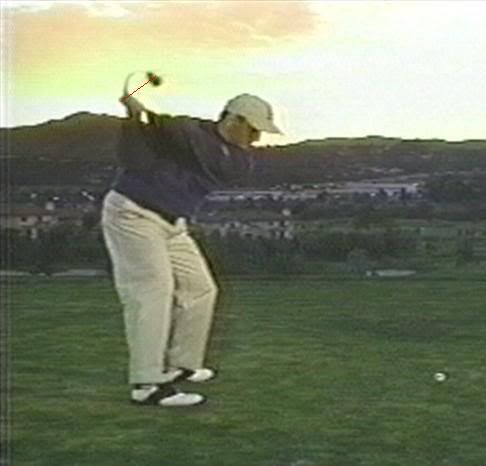
But it's not hard to see in this case!
Now THAT'S Clubhead Lag!
You may say he's using some women's whippy shaft. Uhh....no. It's XXX
__________________
tongzilla
Last edited by tongzilla : 01-12-2006 at 06:09 PM.
People say Sergio has lots of Lag. That's Accumulator #2 Lag they are usually referring to. The angle between left arm and clubshaft is what they see.
But TGMers know that Clubhead Lag is the resistance of the Sweetspot to change direction, which is established during Start Down. It is very slight, very ellusive and hard to see.
But it's not hard to see in this case!
Now THAT'S Clubhead Lag!
You may say he's using some women's whippy shaft. Uhh....no. It's XXX
Nice pic there Tong...Bobby was the one that got me started in TGM - despite those cheesy ads from OHP.
Per 6-C-2-A "The Clubshaft is stressed by the weight of the Clubhead resisting a change in its direction or velocity - which is Acceleration....Change of direction bends it during Longitudinal Acceleration (10-19-C)..."
Per 6-C-2-C "The prestressed Clubshaft will resist the added weight of the ball during Impact..."
1/16 inch of bend adds 1 ounce of mass.
Per 2-M-1 "Power is the total effective force impinged on the ball."
Per 2-C-0 "The Ball leaves the Clubface with force proportional to the compression produced by Impact."
Power is 1/2 x Mass x Velocity squared.
When you load the shaft, mass is added.
When mass is increased, power is increased.
When power is increased, the "total effective force impinged on the ball" increases, the FURTHER the ball flies if all things remain the same.
That dam tape is the same reason i got hooked on TGM also. Some times its a curse but I know its the truth though after hearing Bobby's impact. One day I will have that sound
I can verify that Schaeffer's shafts are xxx in that picture. Bobby can also hit lots of different shots including soft pitches, punches and partial speed shots.
He really should have made the tour. Gregg was just as good as a young man and even now. Lucky for us students that they became teachers.
We'll be in Australia for our golf schools starting this weekend.
So what use is clubshaft lag like this (by the way I think the magnitude of the bend "observed" here is a aperture speed issue) if the shaft is bent toe up? Does anyone think this is useful in transfering power to the ball? If so how?
So what use is clubshaft lag like this (by the way I think the magnitude of the bend "observed" here is a aperture speed issue) if the shaft is bent toe up? Does anyone think this is useful in transfering power to the ball? If so how?
Golfie
Per 2-E "Notice this - the ball acquires only 70% of the Clubhead "approach" speed (so there must be speed) but 100% of the Clubhead "separation" speed (so there must be resistance to deceleration)...Prestress (Acceleration) stiffen the Clubshaft for consistent (minimum to maximum) resistance to Impact Deceleration."
By loading the shaft, you "prestress" it, making it less susceptible to deceleration during impact.
Why is that needful?
Because ball speed is dependent on two factors; Clubhead approach speed and Clubhead separation speed.
The more loaded the shaft, the more it resists deceleration because of a greater Moment of Inertia, hence increasing the second contributing factor to ball speed - separation speed.
With high approach speed and high separation speed, we will get high ball speed ceteris paribus which translates into "big" shots!
So what use is clubshaft lag like this (by the way I think the magnitude of the bend "observed" here is a aperture speed issue) if the shaft is bent toe up? Does anyone think this is useful in transfering power to the ball? If so how?
Golfie
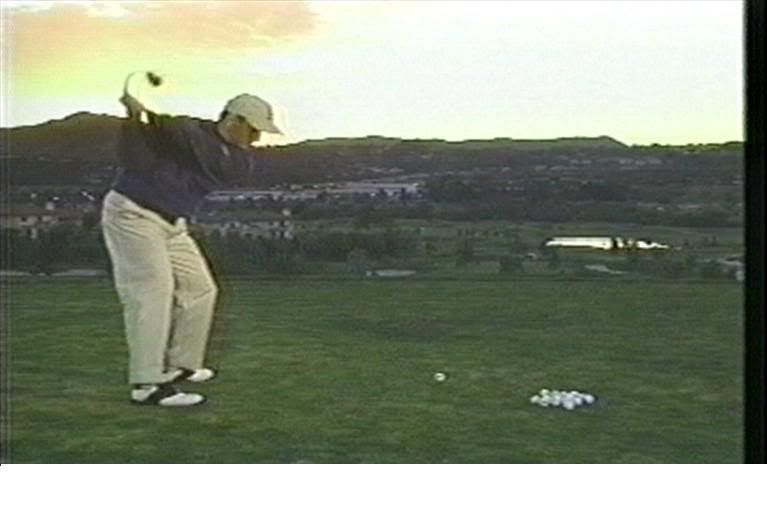
Some differents vues of Bobby's swing . The bent is not an aperture speed issue.
The saft is stressed at the top and the player (not me , alas...) keep this stress till impact
Is it usefull: YES
How: by adding this "stocked energy" during impact. Read Compda...
PM
Please take a harder look at the diection of the supposed bend in this shaft and tell me if you think this will increase clubspeed. The shaft is bent so that it is toe up, is it not?
Some differents vues of Bobby's swing . The bent is not an aperture speed issue.
The saft is stressed at the top and the player (not me , alas...) keep this stress till impact
Is it usefull: YES
How: by adding this "stocked energy" during impact. Read Compda...
PM
Hi phimaynard,
How did you get the frame by frame? Screen shots?
The bend you see here is shutter speed issue. You would not see anywhere near this bend with high speed photography.
Has anyone visited a ShaftLab equipped facility? If so has anyone recorded a driver swing that had a lagging clubshaft prior to impact and a clubhead speed greater than 110 mph? My local guy at the Golftown mega store says he has not seen one. Mind you they've only had the gear for 6 months.
Golfie
__________________
Swinging and loving it
Last edited by Golfie McG : 01-12-2006 at 02:45 PM.






 Linear Mode


