The Real Clubhead Lag! - LynnBlakeGolf Forums

The Real Clubhead Lag!

The Golfing Machine - Basic

Reply
 
Thread Tools Display Modes
  #1  
Old 01-14-2006, 06:48 AM
BerntR's Avatar
BerntR BerntR is offline
Senior Member
 
Join Date: Feb 2005
Posts: 981
Originally Posted by comdpa
Per 2-E "Notice this - the ball acquires only 70% of the Clubhead "approach" speed (so there must be speed) but 100% of the Clubhead "separation" speed (so there must be resistance to deceleration)...Prestress (Acceleration) stiffen the Clubshaft for consistent (minimum to maximum) resistance to Impact Deceleration."
Although Sergio's prestressed shaft looks (and is) impressive and probably helps increase ball speed, it doesn't happen tha way it's indicated in a few of the posts here. The prestress that we see on these pictures is more or less completely unloaded a long time before impact. And it's probably reloaded and unloaded a second time before impact. Shaft loading profile depends on swing technique. See this link. The first graph that appears has to loading bursts and is the most typical loading and unloading pattern:

http://www.truetemper.com/shaftlab/profile.html

Please also note that the shaft is completely unloaded at impact. Only centrifugal acceleration and mass velocity is at work, and the toe of the club is pointing down. Don't underestimate the power of centrifugal force regarding impact deceleration resistance!

The prestressing of course happens because active torq is applied. The torque causes a clubshaft bend that has a similar effect as an increased wrist cock. That in itself will contribute to increased swing speed.

Back to the pictures of Sergio: With the same swing and even stiffer shaft, the torque in the wrist cock would increase because the shaft wouldn't bend as much. That torque increase would in fact lead to reduced swing speed - as in clubhead throw away. As a general rule, big wrist cock (with a help of shaft bend) early in the swing will produce increased swing speed. Torque might increase swing speed if it is applied very late in the swing (as for hitters?)but that has no relation to what we are seing in this pictures.
__________________
Best regards,

Bernt
Reply With Quote
  #2  
Old 01-14-2006, 01:59 PM
tongzilla's Avatar
tongzilla tongzilla is offline
Senior Member
 
Join Date: Apr 2005
Location: London, UK
Posts: 825
Good reply BerntR. So most the prestress is lost at Impact

Would you say Homer was wrong about the idea of a prestressed Clubshaft and how it helps the golfer, or we just don't completely understand what he's trying to say?
__________________
tongzilla
Reply With Quote
  #3  
Old 01-14-2006, 04:25 PM
tongzilla's Avatar
tongzilla tongzilla is offline
Senior Member
 
Join Date: Apr 2005
Location: London, UK
Posts: 825
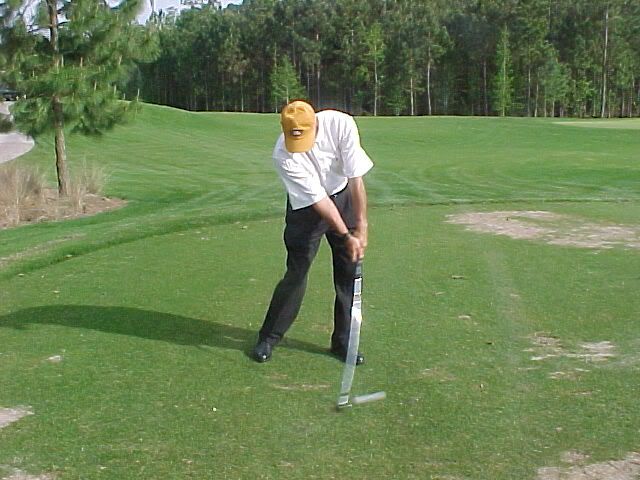
Photo evidence


I think someone said earlier that the clubhead never lags behind during impact.
__________________
tongzilla
Reply With Quote
  #4  
Old 01-14-2006, 08:15 PM
Burner's Avatar
Burner Burner is offline
Senior Member
 
Join Date: Jan 2005
Location: England
Posts: 626
Originally Posted by tongzilla


I think someone said earlier that the clubhead never lags behind during impact.
Provided that the acceleration, or rate of motion, of the shaft is not exceeded by that of the clubhead, then this wonderful impact position will always obtain.
__________________
IB

"My only handicap is me!!!"
Reply With Quote
  #5  
Old 01-15-2006, 12:07 AM
BerntR's Avatar
BerntR BerntR is offline
Senior Member
 
Join Date: Feb 2005
Posts: 981
Originally Posted by tongzilla
I think someone said earlier that the clubhead never lags behind during impact.
How would this post-impact look like if the ball hadn't gotten in the way?
__________________
Best regards,

Bernt
Reply With Quote
  #6  
Old 01-14-2006, 04:27 PM
BerntR's Avatar
BerntR BerntR is offline
Senior Member
 
Join Date: Feb 2005
Posts: 981
Originally Posted by tongzilla
Good reply BerntR. So most the prestress is lost at Impact
Not lost, transformed from potential energy to kinetic energy -clubhead speed

I think I will leave to other to comment on the Homer part of your question.
__________________
Best regards,

Bernt
Reply With Quote
  #7  
Old 01-14-2006, 07:06 PM
tongzilla's Avatar
tongzilla tongzilla is offline
Senior Member
 
Join Date: Apr 2005
Location: London, UK
Posts: 825
Originally Posted by BerntR
I think I will leave to other to comment on the Homer part of your question.
No need to be so conservative
__________________
tongzilla
Reply With Quote
  #8  
Old 01-15-2006, 03:28 AM
BerntR's Avatar
BerntR BerntR is offline
Senior Member
 
Join Date: Feb 2005
Posts: 981
Originally Posted by tongzilla
No need to be so conservative
ALLRIGHTYTHEN

I am puzzled about some of Homer's club shaft ideas.

Any shaft bends and unbends. It stores and releases energy. A very stiff shaft will release the energy sooner, a very weak shaft will release this energy later and slower. Therefore it is easier to maintain a weak shaft prestressed at impact than a stiff one. Homer's preference for stiff shafts is in this regard conflicting with a preference for a prestressed shaft at impact. Did Homer btw write that the shaft ideally was prestressed at impact?

I would think the best way to apply the energy being stored in the shaft is to increase clubhead speed at impact. And that will be max'ed if the clubshaft has recovered to straight at impact.

Or thereabout. Centrifugal force complicates things. What happens between impact and separation could be complicating the mater further.

In addition to the "rebound" effect above, there is an issue of thrust power versus centrifugal power - drive versus drag (of the club). When drive is converted to speed, the clubhead will increase it's rope pulling forces through the shaft. The clubhead's centre of inertia will seek it's inline condition. As an isolated force this will bend the shaft downward and forward. So this rope pulling will work against efforts to keep the shaft prestressed.

Regarding the stroke itself: I do not recall having read anything in the yellow book about impact that didn't make sense to me. From the loading profiles I've seen at TrueTemper and other places it seems obvious that timing is involved though. The last shaft loading sequence in the swing maxes a brief time before impact - not at impact.

I have now idea how much right hand thrust that ideally should be applied through the ball. In my own mediocre golf game it is much more important to feel "rope handled" clubhead lag in the left hand (and sometimes shoulder and maybe even foot) than the sensation of a strong thrust from PP#1 and pp#3 through impact. Judging from the famous image of VJ letting go of his left hand I believe I am in good company.

I am not a golf pro, and my reply may be regarded as (more or less) qualified speculation. It would be very interesting to hear some of the TGM heavyweighters' take on these issues.
__________________
Best regards,

Bernt
Reply With Quote
  #9  
Old 01-15-2006, 07:52 PM
Burner's Avatar
Burner Burner is offline
Senior Member
 
Join Date: Jan 2005
Location: England
Posts: 626
Originally Posted by BerntR
ALLRIGHTYTHEN
I would think the best way to apply the energy being stored in the shaft is to increase clubhead speed at impact. And that will be max'ed if the clubshaft has recovered to straight at impact.
If the the clubshaft has "recovered" at impact, or before, then throwaway is taking place as the hands and shaft are slowing to the point that they are being overtaken by the accelerating clubhead.

The "maxing" of the force generated by the pre-stressed clubshaft should, at least, remain constant and be carried through impact; only kicking in as part of the separation process, if it is to be an additional force.

Quote:
I am not a golf pro, and my reply may be regarded as (more or less) qualified speculation. It would be very interesting to hear some of the TGM heavyweighters' take on these issues.
I too would like the definitive answers because I cannot for the life of me see how, despite the loading profiles given by TrueTemper etc. to the contrary, that the swing maxes a brief time before impact causing the shaft to flex, or bow, forwards. They do, however, also mention that most swings have achieved their maximum velocity some little while before impact. Thus the clubhead inertia (cause of the pre-stressed clubshaft) is being lost and "throwaway" (forward bowing of the shaft) is a consequence.
__________________
IB

"My only handicap is me!!!"
Reply With Quote
  #10  
Old 01-15-2006, 08:39 PM
Yoda's Avatar
Yoda Yoda is offline
Administrator
 
Join Date: Jan 2005
Location: Atlanta, Georgia
Posts: 10,681
What Produces Clubshaft Stress?
Originally Posted by BerntR

Did Homer btw write that the shaft ideally was prestressed at impact?
The Shaft is stressed by the Impact Collision of Club and Ball. In the Start-Down Loading, the Hitter Pre-Stresses the Shaft with Clubhead Lag Pressure Point Pressure via the Right Elbow. The Swinger's Loading allows Centrifugal Force and its efforts to Straighten the Shaft to do that job via the Left Wrist. This is the "flexed, stressed Clubshaft (Hitters) and the wallop of Centrifugal Force (Swingers)" of 6-F-1.
__________________
Yoda
Reply With Quote
Reply


Thread Tools
Display Modes

Posting Rules
You may not post new threads
You may not post replies
You may not post attachments
You may not edit your posts

vB code is On
Smilies are On
[IMG] code is On
HTML code is Off
Forum Jump

Similar Threads
Thread Thread Starter Forum Replies Last Post
Pressure Point #1, Clubhead Lag, and Low Point Yoda Chapter 6 0 04-30-2006 10:08 PM
6-C-2-0 Clubhead Lag Yoda Chapter 6 3 04-30-2006 01:52 PM
2-0 Basic Imperative Number 2 A Clubhead Lag Pressure Point Yoda Chapter 2 3 04-28-2006 09:41 PM
She's Real Yoda Fit For G.O.L.F. With Vickie Lake 0 10-14-2005 10:56 PM
The Real Golfing Machine dkerby Orange County National 1 04-27-2005 01:38 PM


All times are GMT -4. The time now is 08:36 PM.


Design by Vjacheslav Trushkin, color scheme by ColorizeIt!.