I think someone said earlier that the clubhead never lags behind during impact.
Provided that the acceleration, or rate of motion, of the shaft is not exceeded by that of the clubhead, then this wonderful impact position will always obtain.
I am puzzled about some of Homer's club shaft ideas.
Any shaft bends and unbends. It stores and releases energy. A very stiff shaft will release the energy sooner, a very weak shaft will release this energy later and slower. Therefore it is easier to maintain a weak shaft prestressed at impact than a stiff one. Homer's preference for stiff shafts is in this regard conflicting with a preference for a prestressed shaft at impact. Did Homer btw write that the shaft ideally was prestressed at impact?
I would think the best way to apply the energy being stored in the shaft is to increase clubhead speed at impact. And that will be max'ed if the clubshaft has recovered to straight at impact.
Or thereabout. Centrifugal force complicates things. What happens between impact and separation could be complicating the mater further.
In addition to the "rebound" effect above, there is an issue of thrust power versus centrifugal power - drive versus drag (of the club). When drive is converted to speed, the clubhead will increase it's rope pulling forces through the shaft. The clubhead's centre of inertia will seek it's inline condition. As an isolated force this will bend the shaft downward and forward. So this rope pulling will work against efforts to keep the shaft prestressed.
Regarding the stroke itself: I do not recall having read anything in the yellow book about impact that didn't make sense to me. From the loading profiles I've seen at TrueTemper and other places it seems obvious that timing is involved though. The last shaft loading sequence in the swing maxes a brief time before impact - not at impact.
I have now idea how much right hand thrust that ideally should be applied through the ball. In my own mediocre golf game it is much more important to feel "rope handled" clubhead lag in the left hand (and sometimes shoulder and maybe even foot) than the sensation of a strong thrust from PP#1 and pp#3 through impact. Judging from the famous image of VJ letting go of his left hand I believe I am in good company.
I am not a golf pro, and my reply may be regarded as (more or less) qualified speculation. It would be very interesting to hear some of the TGM heavyweighters' take on these issues.
ALLRIGHTYTHEN
I would think the best way to apply the energy being stored in the shaft is to increase clubhead speed at impact. And that will be max'ed if the clubshaft has recovered to straight at impact.
If the the clubshaft has "recovered" at impact, or before, then throwaway is taking place as the hands and shaft are slowing to the point that they are being overtaken by the accelerating clubhead.
The "maxing" of the force generated by the pre-stressed clubshaft should, at least, remain constant and be carried through impact; only kicking in as part of the separation process, if it is to be an additional force.
Quote:
I am not a golf pro, and my reply may be regarded as (more or less) qualified speculation. It would be very interesting to hear some of the TGM heavyweighters' take on these issues.
I too would like the definitive answers because I cannot for the life of me see how, despite the loading profiles given by TrueTemper etc. to the contrary, that the swing maxes a brief time before impact causing the shaft to flex, or bow, forwards. They do, however, also mention that most swings have achieved their maximum velocity some little while before impact. Thus the clubhead inertia (cause of the pre-stressed clubshaft) is being lost and "throwaway" (forward bowing of the shaft) is a consequence.
Did Homer btw write that the shaft ideally was prestressed at impact?
The Shaft is stressed by the Impact Collision of Club and Ball. In the Start-Down Loading, the Hitter Pre-Stresses the Shaft with Clubhead Lag Pressure Point Pressure via the Right Elbow. The Swinger's Loading allows Centrifugal Force and its efforts to Straighten the Shaft to do that job via the Left Wrist. This is the "flexed, stressed Clubshaft (Hitters) and the wallop of Centrifugal Force (Swingers)" of 6-F-1.
The Shaft is stressed by the Impact Collision of Club and Ball. In the Start-Down Loading, the Hitter Pre-Stresses the Shaft with Clubhead Lag Pressure Point Pressure via the Right Elbow. The Swinger's Loading allows Centrifugal Force and its efforts to Straighten the Shaft to do that job via the Left Wrist. This is the "flexed, stressed Clubshaft (Hitters) and the wallop of Centrifugal Force (Swingers)" of 6-F-1.
Agree that the shaft is stressed by the collision with the ball. Another question is the shaft condition at impact.
Inspired by your post, I opened the yellow book. I think 6-F-0 Timing - General sheds some light too:
... "So, the Clubhead is not picking up speed during the Overtaking (release) Interval, either when Hitting or Swinging."
What does this implicate?
A prestressed spring will start bouncing back as soon as the force that stressed the spring is being reduced. Similarly, a prestressed shaft will bounce back as the accelleration drops and swing speed reaches max during the release.
If thrust is maintained (according to Homer it should be) during the Overtaking, the clubhead will be forced to catch up with the hands. If thrust is aborted, the hands will simply wait for the clubhead that and potential speed increase is lost.
Originally Posted by Burner
They (True Temper) do, however, also mention that most swings have achieved their maximum velocity some little while before impact.
This is exactly what Homer says in 6-F. In fact I see no conflict between 6-F and the shaft loading profiles from the True Temper shaft lab. On the contrary, they are complimentary.
If my understanding of Homer and True Temper is correct, the player should do his/her best to maintain a prestressed shaft all the way to impact. But the appropriate shaft should nevertheless straighten out juust in time for max clubhead velocity at impact.
Inspired by your post, I opened the yellow book. I think 6-F-0 Timing - General sheds some light too:
... "So, the Clubhead is not picking up speed during the Overtaking (release) Interval, either when Hitting or Swinging."
Remember, as Mike O pointed out in a post last year, Homer Kelley is not referring here to the Clubhead's Surface Speed (miles per hour). That Speed does indeed increase during Release. However, because of the Flat Left Wrist, Angular Speed, i.e., Hand Speed versus Clubhead Speed as measured in revolutions Per minute around the Left Shoulder Axis, does not increase. A readily understood example of Angular Speed is that exhibited by the various components of a merry-go-round all rotating at the same RPM around a common axis.
For the Swinger, after the initial Acceleration in the Start Down, Angular Speed is constant from Release until Impact. For the Hitter, the deceleration begins immediately at Release. For both Swinger and Hitter, the Impact collision slows Angular Speed and Surface Speed.


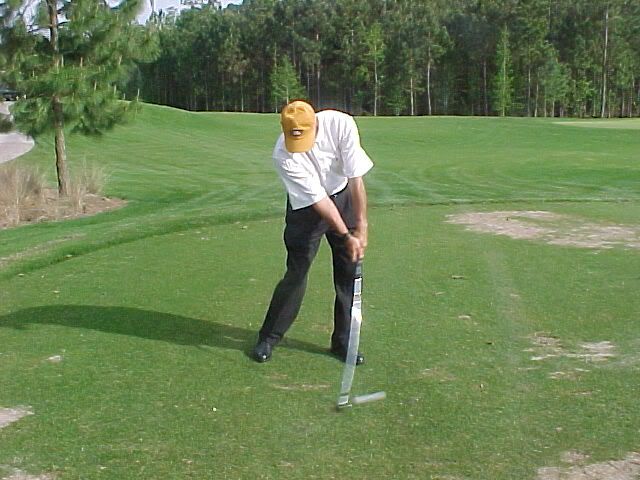


 Linear Mode


