Fun Probability problem
The Clubhouse Lounge
|

02-20-2007, 04:10 AM
|
|
Senior Member
|
|
Join Date: Aug 2005
Posts: 139
|
|
|
I see and understand the logic you are trying to use, but I think it is wrong.
The fact one door was preselected has NO bearing on which door has the car behind it.
If you walk into a room with 3 doors, 1 is open showing a goat, and the other 2 are closed, you then have to pick a door knowing a car is behind 1, what is your chance of picking the car?
I say 50%...
This is exactly the same scenario, the fact that there was a previous action and door reveal does not change the probabilites related the this event...like I said look up Mutually exclusive...
It is like a coin toss, if you toss a coin and get a head 5 times in a row there is still a 50% chance the next will be a head, the previous events don't change the probabilities involved in this event.
|
|
02-20-2007, 05:34 AM
|
 |
Inactive User
|
|
Join Date: Jan 2005
Posts: 833
|
|
Originally Posted by Toolish

|
I see and understand the logic you are trying to use, but I think it is wrong.
The fact one door was preselected has NO bearing on which door has the car behind it.
If you walk into a room with 3 doors, 1 is open showing a goat, and the other 2 are closed, you then have to pick a door knowing a car is behind 1, what is your chance of picking the car?
I say 50%...
This is exactly the same scenario, the fact that there was a previous action and door reveal does not change the probabilites related the this event...like I said look up Mutually exclusive...
It is like a coin toss, if you toss a coin and get a head 5 times in a row there is still a 50% chance the next will be a head, the previous events don't change the probabilities involved in this event.
|
This called the Monty Hall Problem or Dillema. It is an example what is logical is not always instinctive.
Think of it like a process tree
Goat 1 - Goat 2 is shown - switching gets car.
Goat 2 - Goat 1 is shown - switching gets car.
Car - Either goat is shown - switching loses car.
Therefore you get into a situation where you have a choice between the two doors and two times out of three it is the other door than the one you originally picked. Therefore you double your chances by switching.
If you would like to bet $4.50 (you give me when I win) to my $5.50 (I give you when I lose) then I would be willing to accept (repeated 100 times to counteract any variance). If your right and its a cointoss - you will be in positive expectation. If I'm right I will be...lol

|
|
02-20-2007, 12:57 PM
|
|
Lynn Blake Certified Instructor
|
|
Join Date: Jan 2005
Location: West Linn, OR
Posts: 1,645
|
|
|
Mathew, I think you are not seeing the difference between a pattern and an event. The probability of a particular pattern can depend on previous events, the probability of a single event does not.
Any single coin toss is 50/50, all day, every day.
A choice between 2 doors is 50/50, all day, every day.
To answer your initial post - is it in your interest to switch - what are your odds of picking correctly?
50/50.
You assume a pattern (event A may/does alter event B), when in this example, there is no relationship between event A and B that justifies viewing it as such, absent any other data.
The 'feel vs real' of statistics.
__________________
"Support the On Plane Swinging Force in Balance"
"we have no friends, we have no enemies, we have only teachers"
Simplicity buffs, see 5-0, 1-L, 2-0 A and B 10-2-B, 4-D, 6B-1D, 6-B-3-0-1, 6-C-1, 6-E-2
|
|
02-20-2007, 02:15 PM
|
|
Inactive User
|
|
Join Date: Jan 2005
Posts: 833
|
|
|
Originally Posted by EdZ
|
Mathew, I think you are not seeing the difference between a pattern and an event. The probability of a particular pattern can depend on previous events, the probability of a single event does not.
Any single coin toss is 50/50, all day, every day.
A choice between 2 doors is 50/50, all day, every day.
To answer your initial post - is it in your interest to switch - what are your odds of picking correctly?
50/50.
You assume a pattern (event A may/does alter event B), when in this example, there is no relationship between event A and B that justifies viewing it as such, absent any other data.
The 'feel vs real' of statistics.
|
You would be right that you will always end up with two doors - but to say it was 1/2 would be wrong because you fail to look at the process which got you there. One door is really 1/3 chance of being the car and the other door 2/3 chance being the car. Its really that simple....
Just because there is two doors does not mean its 1/2. If I had two boxes and one contained a prize and I put it in one box 1/3 of the time and the other box 2/3 of the time and you knew this, it would no longer be a 1/2 chance.
However you would be correct if lets say after you picked your door and a goat was revealed, you ignored the pass actions and then tossed a coin to determine whether you switched or not. Then it would be a fifty fifty chance.... this would also be true of 100 doors....
Here are some webpages which explain it in further detail.
This is a good page which describes it in detail....
http://en.wikipedia.org/wiki/Monty_Hall_problem
Some stuff on youtube
Here you can try it out yourself
http://math.ucsd.edu/~crypto/cgi-bin/monty2?1+13588
Last edited by Mathew : 02-20-2007 at 02:35 PM.
|
|
02-20-2007, 03:07 PM
|
|
Member
|
|
Join Date: Jan 2005
Location: Pennsylvania
Posts: 56
|
|
What would you think if I stated it like this...
Original Selection: - The player originally picked goat 1.
- The player originally picked goat 2.
- The player originally picked the car.
Chances of originally selecting the car: 1 in 3.
Second Selection: - The player originally picked goat 1. The door with goat 2 is revealed. The remaining door has the car.
- The player originally picked goat 2. The door with goat 1 is revealed. The remaining door has the car.
- The player originally picked the car. The door with goat 1 is revealed. The remaining door has goat 2.
- The player originally picked the car. The door with goat 2 is revealed. The remaining door has goat 1.
Chances of switching and selecting the car: 2 in 4 (1 in 2) |
|
02-20-2007, 03:16 PM
|
|
Inactive User
|
|
Join Date: Jan 2005
Posts: 833
|
|
The statistics ....
From one of the webpages I just listed
http://math.ucsd.edu/~crypto/cgi-bin/monty2?0+4338
Switched - 319 players - 210 Winners - 65.8%
Didn't switch - 201 players - 72 Winners - 35.8% |
|
02-20-2007, 03:29 PM
|
|
Inactive User
|
|
Join Date: Jan 2005
Posts: 833
|
|
|
Originally Posted by armourall
|
What would you think if I stated it like this...
Original Selection:- The player originally picked goat 1.
- The player originally picked goat 2.
- The player originally picked the car.
Chances of originally selecting the car: 1 in 3.
|
Correct...
|
Quote:
|
|
Second Selection:[list=1][*]The player originally picked goat 1. The door with goat 2 is revealed. The remaining door has the car.
|
Correct
|
Quote:
|
|
[*]The player originally picked goat 2. The door with goat 1 is revealed. The remaining door has the car.
|
Correct
|
Quote:
|
- The player originally picked the car. The door with goat 1 is revealed. The remaining door has goat 2.
- The player originally picked the car. The door with goat 2 is revealed. The remaining door has goat 1.
Chances of switching and selecting the car: 2 in 4 (1 in 2)
|
Nope - there is only 1 car behind the doors not two....
Just because there are four permutations of what can occur doesn't mean you have four choices. It really doesn't matter if you eliminate goat 1 or goat 2 when you have picked the car. If you switch, you will lose either way....
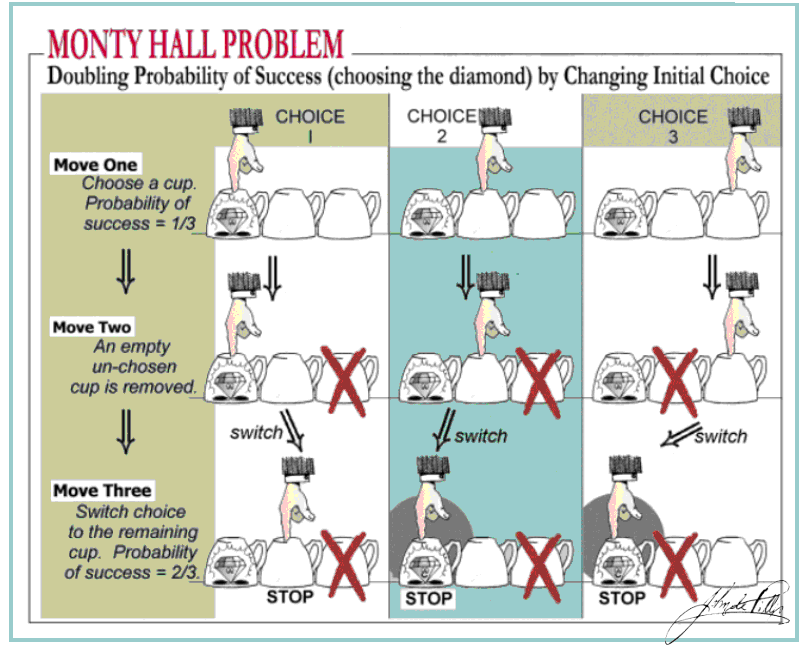
Make this any easier to understand ?
|
|
02-20-2007, 03:34 PM
|
|
Member
|
|
Join Date: Jan 2005
Location: Pennsylvania
Posts: 56
|
|
|
Quote:
|
|
Just because there are four permutations of what can occur doesn't mean you have four choices. It really doesn't matter if you eliminate goat 1 or goat 2 when you have picked the car. If you switch, you will lose either way....
|
Then what are the odds of switching and getting goat 1? |
|
| Thread Tools |
|
|
| Display Modes |
 Hybrid Mode Hybrid Mode
|
 Posting Rules
|
You may not post new threads
You may not post replies
You may not post attachments
You may not edit your posts
HTML code is Off
|
|
|
All times are GMT -4. The time now is 11:02 AM.
|
| |


